
Key Takeaways
You can sue over workplace defamation in Oklahoma only when the evidence satisfies the defamation rules. A false, unprivileged factual statement must be communicated in a legally sufficient way, with the required fault and resulting harm. Internal corporate communications and authorized job references have important protections.
Being called “difficult,” receiving an unfair evaluation, or disagreeing with the reason for termination does not automatically create a defamation claim. Start with the exact words, who said them, who received them, and whether the statement can be proven true or false.
Libel, slander, and the core questions
12 O.S. §§ 1441 and 1442 define libel and slander. Libel generally concerns a fixed representation such as writing or an image. Slander concerns other false and unprivileged publication, including specified statements that directly injure a person in an occupation.
A practical claim review asks:
- What exactly was said? Preserve the actual message, post, letter, recording, or witness account.
- Was it a provably false statement of fact? Truth is a defense. Loose insults, rhetoric, and opinions without a provably false factual implication may not be actionable.
- Was it about the claimant? The recipient must reasonably understand who the statement concerned.
- Was there a legally sufficient publication? The statement must reach someone other than the person allegedly defamed, subject to Oklahoma's rules for intra-corporate communications.
- Was it privileged? A statutory, judicial-proceeding, fair-report, common-interest, or other privilege may apply.
- What fault standard applies? The answer can depend on whether the claimant is a public or private figure and whether the subject is a matter of public concern.
- What harm can be proved? Lost work, a withdrawn offer, clients leaving, or other reputation evidence may matter. Damages cannot simply be assumed in every case.
The Oklahoma intra-corporate publication rule
This is a major obstacle in many workplace cases. In Thornton v. Holdenville General Hospital, 2001 OK CIV APP 133, the Oklahoma Court of Civil Appeals held that communications within a corporation among its officers, employees, and agents are not publication for a defamation action.
The rule makes the capacity and audience important. A supervisor's report to human resources or another corporate decisionmaker can be treated differently from repeating the same accusation to customers, unrelated workers, a prospective employer, or the public. The analysis also requires proof that the people were acting as corporate agents in the communication at issue.
Do not assume a large internal email chain automatically creates publication merely because many coworkers saw it. First address Thornton and the role of each recipient.
Oklahoma's job-reference statute
40 O.S. § 61 allows an employer to disclose information about a current or former employee's job performance to a prospective employer when the prospective employer requests it with the employee's consent, or when the employee requests the disclosure. Authorized employees and agents are covered.
The employer is presumed to act in good faith. Civil immunity applies unless the employee rebuts that presumption by showing the information was false and the employer knew it was false or acted with malice or reckless disregard for the truth.
That is not blanket immunity for every statement to anyone. Check:
- whether the disclosure concerned job performance;
- who requested it;
- whether the employee consented when required;
- whether the speaker was authorized;
- the exact information disclosed; and
- evidence concerning falsity and the speaker's state of mind.
An employer can choose to provide only dates and positions, but Oklahoma law does not require every employer to give a substantive reference.
Performance reviews, investigations, and termination reasons
A negative review often contains both facts and evaluative judgments. “The report was submitted on June 10” is testable. “The work did not meet leadership expectations” may be an opinion unless it implies a specific false fact. Read the full document and supporting records rather than isolating one adjective.
The same applies to “terminated for cause.” The phrase may carry a factual implication in context, especially if the employer identifies theft, dishonesty, violence, or another specific act. Preserve the personnel record, policy, separation notice, unemployment submission, and all versions of the explanation.
Statements in judicial or other authorized proceedings can be privileged under 12 O.S. § 1443.1. A pleading, agency filing, or hearing statement therefore requires a different analysis from an ordinary workplace rumor.
Coworker statements and social media
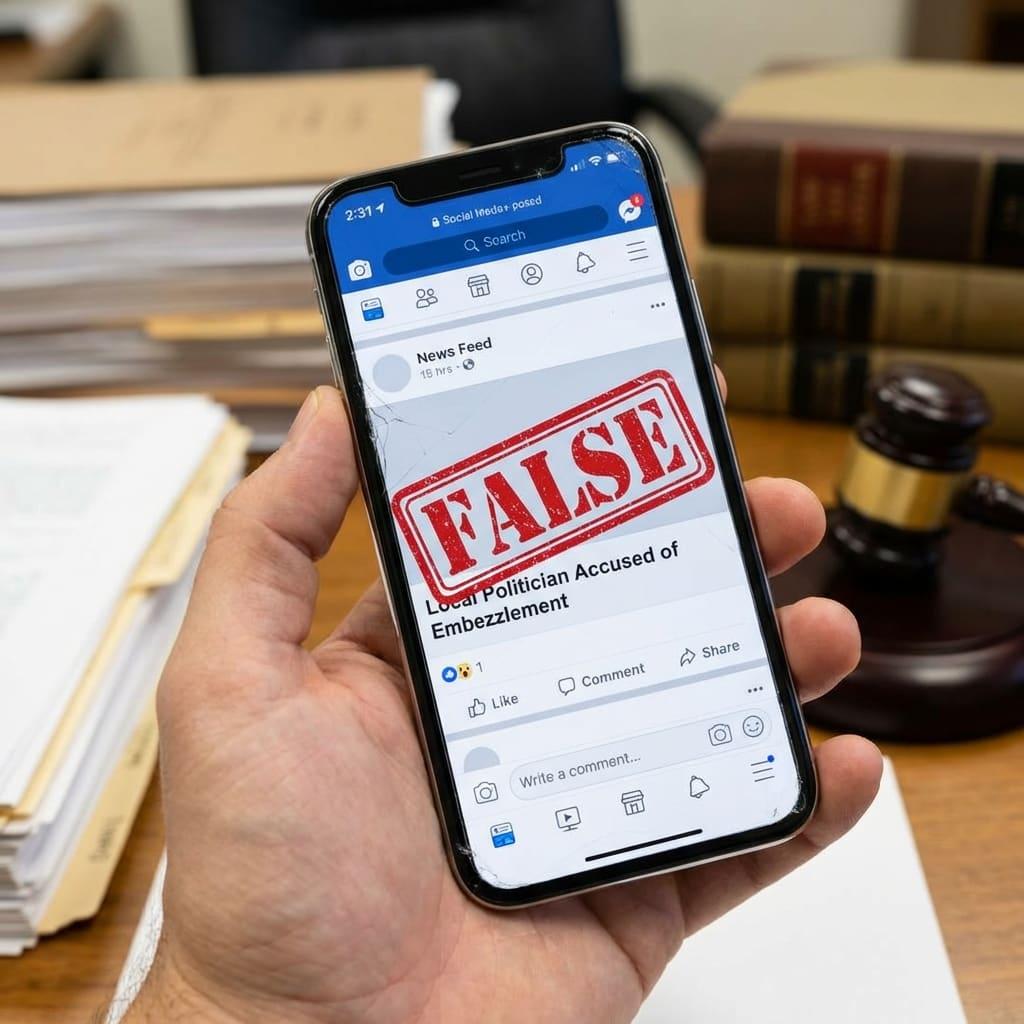
A coworker does not gain automatic immunity merely because the topic concerns work. A knowingly false factual accusation sent to customers, a professional group, or social media can satisfy publication. The employer's liability for a coworker's statement is separate and depends on agency, scope, authorization, ratification, and other facts.
Before responding publicly, preserve the original post, URL, date, audience, comments, shares, account information, and any resulting job or client loss. A public counterattack can enlarge the dispute, create new claims, and make correction harder.
If a supervisor is spreading false statements while also retaliating for a protected complaint, the employment and defamation theories should be evaluated separately. The same chronology may support both, but each has different elements and deadlines.
Oklahoma's one-year deadline
12 O.S. § 95(A)(4) provides a one-year limitations period for libel and slander. Accrual and republication issues can be disputed, so do not assume the clock begins only when the employee eventually discovers the statement.
Preserve the earliest publication date and obtain advice promptly. A human-resources investigation, correction request, or severance negotiation ordinarily does not stop the limitations period by itself.
Correction, retraction, and employment strategy
Litigation is not the only possible response. A focused correction request can identify the exact false statement, provide the record that disproves it, and ask that the correction reach the same recipients. The wording matters: a broad threat may prompt the employer to stop communicating without preserving what was already said, while a precise request can create a useful written response.
Evaluate the reputation issue alongside any workplace-retaliation claim or dispute about the stated reason for termination. A defamation count should not be used as a substitute for the elements of wrongful termination, and an employment claim does not eliminate the separate publication and privilege barriers to defamation.
What evidence makes the claim concrete
- the exact statement in original form;
- the speaker, each recipient, and the date and method of publication;
- records proving falsity;
- evidence showing knowledge, malice, or reckless disregard when required;
- a withdrawn offer, lost client, changed assignment, termination, or other concrete harm;
- the applicable policy and job-reference authorization; and
- a chronology separating internal corporate communications from outside publication.
If a recording is part of the proof, first review Oklahoma's one-party-consent rule. Preserve the complete original rather than a clipped excerpt.
Frequently asked questions
Can I sue over a bad performance review?
Usually not just because it is harsh or unfair. Identify a provably false factual assertion, publication under Oklahoma law, lack of privilege, the required fault, and harm. Thornton may bar the publication element for intra-corporate communications.
Can I sue a former employer for a false reference?
Possibly, but § 61 creates a good-faith presumption and immunity for a qualifying authorized disclosure. The employee must address the statute's request and consent conditions and show falsity plus knowledge, malice, or reckless disregard to overcome the protection.
What if a coworker posts the accusation online?
That is publication outside an ordinary internal corporate channel. Preserve the post and audience. The remaining questions include fact versus opinion, falsity, fault, privilege, identity, damages, and the one-year deadline.
Are damages presumed when the accusation concerns my profession?
Do not build a case on a presumption alone. Oklahoma's slander statute identifies occupational statements, but constitutional fault and damages rules can affect recovery. Document actual reputation, employment, and economic harm whenever possible.
Can I force my employer to provide a positive reference?
Generally no. Section 61 protects certain authorized disclosures; it does not require an employer to give a substantive or favorable reference.
What should I do first?
Preserve the exact statement and recipient evidence, avoid a public argument, request relevant personnel records when appropriate, and get the one-year deadline checked. A vague report that “people are talking” is much harder to evaluate than the original words and audience.
False Workplace Statements Causing Real Harm?
We can evaluate publication, privilege, job-reference immunity, proof of falsity, and the one-year deadline alongside any employment claim.
Request an Employment Consultation →This article is for general information only and is not legal advice. Oklahoma statutes and controlling intra-corporate authority checked July 13, 2026.