
Key Takeaways
- Government Immunity Usually Applies: Under the Oklahoma Governmental Tort Claims Act, cities and the Oklahoma Department of Transportation are usually protected from liability for winter-road treatment decisions.
- Drivers Still Have Duties: Even in icy conditions, drivers must exercise reasonable care. Speeding, following too closely, or driving on bald tires can shift fault to the driver.
- Property Owners May Be Liable: Private property owners—parking lots, apartment complexes, businesses—may have a duty to address known or reasonably discoverable ice hazards on their premises.
Every winter, Oklahoma's unpredictable weather creates a perfect storm for accidents. Temperatures hover near freezing, rain turns to ice, and highways become skating rinks—often without any visible warning. Black ice, the thin transparent layer that forms on pavement, is particularly dangerous because drivers cannot see it until they are already sliding. When a black ice accident causes serious injury, victims naturally ask: who is responsible, and can I recover compensation? The answer is more complicated than most people expect, because government immunity, driver behavior, comparative negligence, and property owner duties all play a role in determining whether a viable legal claim exists.
What Is Black Ice?
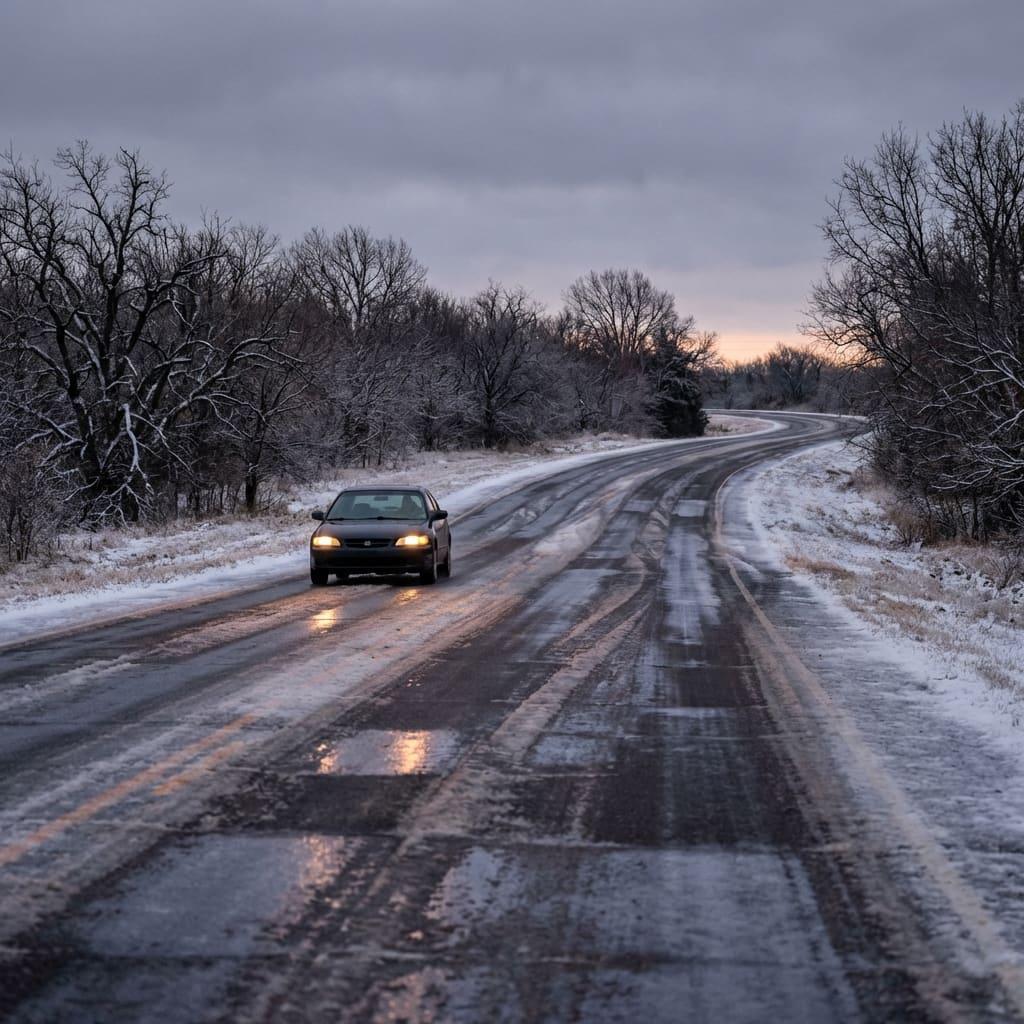
Black ice is a thin, nearly invisible layer of ice that forms on road surfaces and takes on the color of the pavement beneath it, making it virtually undetectable until a vehicle has already lost traction. It typically forms when temperatures drop rapidly after rain or snow, when moisture from fog or mist freezes on pavement that has cooled below 32 degrees, when melting snow or ice refreezes overnight, or when bridge and overpass surfaces—which cool faster than surrounding roadway because they are exposed to cold air on all sides—reach freezing temperatures while adjacent roads remain above freezing.
Black ice is especially dangerous on bridges, overpasses, shaded stretches of highway, and roads near bodies of water. Drivers often have no idea that conditions are icy until they attempt to brake or steer and discover that they have no traction. This invisible hazard is what makes black ice accidents so terrifying—and so legally complicated, because the "who knew what and when" questions central to negligence analysis become much harder to answer.
Can You Sue the Government for Icy Roads?
Oklahoma's Governmental Tort Claims Act (51 O.S. § 151 et seq.) governs when citizens can sue state and local government entities for negligence. While the statute waives sovereign immunity in many situations, it preserves immunity for certain categories of government action. Winter-weather road treatment often falls within those protected categories.
Under 51 O.S. § 155, the state and its political subdivisions retain immunity for several categories that often matter in ice cases, including discretionary policy decisions, weather-related conditions, and certain roadway-design or traffic-control decisions. In practice, decisions about when and where to salt or sand roads, how to prioritize winter-weather response, and how to allocate crews and equipment are difficult claims against a public entity.
The practical consequence is that in most cases, you cannot successfully sue the Oklahoma Department of Transportation or a city government simply for failing to treat an icy road. Government immunity is not absolute, though. Liability may need to be evaluated if the government itself created the hazard, if a government vehicle such as a snow plow or salt truck caused the accident through negligent operation, or if another statutory waiver applies. These exceptions are narrow, and proving them requires specific evidence.
Driver Liability in Black Ice Accidents
Oklahoma law requires all drivers to exercise reasonable care under the circumstances, and "the circumstances" includes the weather and road conditions at the time of travel. Reasonable care in winter weather means reducing speed below posted limits when conditions warrant it, increasing following distance to account for longer stopping distances on slick surfaces, ensuring the vehicle is equipped with tires in adequate condition, being especially cautious on bridges, overpasses, and shaded stretches of road, and avoiding unnecessary travel when conditions are genuinely hazardous.
If another driver caused your accident, the central question is whether they breached this duty of care. Evidence of breach includes driving at speeds that were unsafe for the conditions even if technically below the posted limit, following too closely to stop safely on a slick road, failing to reduce speed in areas known to be prone to icing, driving without headlights in reduced visibility, texting or otherwise engaging in distracted driving, and operating a vehicle with bald tires or mechanical deficiencies that impaired its ability to handle winter conditions.
Oklahoma follows modified comparative negligence, which means that if both drivers share fault, each driver's recovery is reduced by their percentage of responsibility. If you are found more than 50 percent at fault, you recover nothing under 23 O.S. §§ 13–14. For example, if you were driving 10 miles per hour over the speed limit when you hit a patch of black ice, and another driver who was following too closely rear-ended you, a jury might find you 30 percent at fault and the other driver 70 percent at fault. On $100,000 in damages, you would recover $70,000. The comparative negligence dimension makes evidence preservation and careful factual analysis especially important in black ice cases. A personal injury attorney experienced with weather-related accidents can evaluate the specific facts of your case.
Property Owner Liability for Icy Conditions
While government immunity often protects decisions about treating public roads, private property owners have a different set of obligations. Under Oklahoma premises liability law, property owners owe invitees a duty to use reasonable care to keep the premises reasonably safe. That duty may include inspecting for dangerous conditions, repairing or warning of known hazards, and taking reasonable steps to address foreseeable dangers, including ice accumulation the owner knows about or should discover through reasonable inspection.
Property owners may be liable for ice-related vehicle accidents or pedestrian slip-and-fall injuries in several circumstances. If the property owner created the hazard through a broken downspout, improper drainage, or roof runoff that freezes in a walkway, liability is stronger because the owner's own design or maintenance failure contributed to the condition. If the owner knew or should have known about the hazard through prior complaints, recurring ice in the same location, or a reasonable inspection, the failure to act becomes the focus of the claim. The legal question is whether the owner responded reasonably under the circumstances, not whether ice existed somewhere on the property.
Many defendants raise the "natural accumulation" defense, arguing that property owners should not be liable for ice and snow that naturally accumulate during a storm. Oklahoma courts have not definitively adopted a blanket natural accumulation rule, but defendants frequently argue that natural weather is an "act of God" that cannot create liability. The important distinction is between natural accumulation—snow and ice that falls uniformly and has not yet been addressed—and unnatural accumulation—ice caused by drainage problems, building design flaws, or actions by the property owner that concentrate water in specific areas where it freezes.
Common locations where property owner liability for icy conditions arises include apartment complexes (stairs, walkways, and parking lots), retail stores (entrances, parking lots, and sidewalks), hotels (entryways, parking areas, and outdoor staircases), office buildings (parking garages and loading docks), and restaurants (drive-through lanes and outdoor dining areas).
Multiple Vehicles: Chain Reaction Crashes
Black ice frequently causes chain reaction accidents in which multiple vehicles collide in rapid succession. Determining fault in these situations is complex but follows established negligence principles. The first driver to lose control may or may not be liable—if conditions were truly invisible and they were driving carefully, they may bear no fault. Following drivers, however, have a duty to maintain a safe following distance, and if they could not stop in time, their failure to account for the possibility of slick conditions may constitute negligence. Each driver's conduct is evaluated individually, and insurance companies and courts typically apportion fault among multiple drivers based on their specific actions and the evidence available.
What to Do After a Black Ice Accident
The immediate priorities after a black ice accident mirror those of any car accident, but with additional attention to weather-specific evidence. Check for injuries and call 911. Move to safety if possible, because icy roads mean additional collisions may follow. Turn on hazard lights to warn approaching drivers. When the police arrive, make sure the officer documents the road conditions, temperature, and any weather warnings in effect—this information will be critical to your claim.
Exchange information with the other drivers involved, and document the scene thoroughly. Photograph the road conditions, any visible ice accumulation, vehicle damage, the position of vehicles, and the weather conditions. Note the temperature and check whether any winter weather advisories were active at the time of the accident. These details establish the conditions that existed and help reconstruct what happened.
After leaving the scene, get medical attention even if your injuries seem minor—many injuries manifest fully only in the days following an accident. Understanding how delayed injury symptoms affect your case and your health is critical. Report the accident to your insurance company promptly, and preserve all evidence including damaged clothing and photographs of your injuries as they develop. Check whether traffic cameras or witnesses may have captured the conditions or the accident itself. And consult an attorney before giving a recorded statement to the other driver's insurance company.
Uninsured and Underinsured Motorist Coverage
Many black ice accidents involve drivers who lose control and carry only minimal insurance—or who leave the scene entirely. Uninsured/underinsured motorist (UM/UIM) coverage on your own policy protects you in these situations. UM coverage pays when the at-fault driver has no insurance. UIM coverage pays when the at-fault driver's insurance is insufficient to cover your damages.
Given Oklahoma's minimum insurance requirements of just $25,000 per person under 47 O.S. § 7-204, serious injuries frequently exceed the at-fault driver's policy limits. UM/UIM coverage can make the difference between a meaningful recovery and a recovery that covers only a fraction of your actual damages.
Statute of Limitations
Oklahoma's statute of limitations for personal injury claims is two years from the date of the accident under 12 O.S. § 95. Miss this deadline, and your claim is permanently barred. If you are considering a claim against a government entity—rare in ice cases but possible under the narrow exceptions described above—you must file a Tort Claim Notice within one year of the accident. Consult an attorney immediately if government liability is potentially involved, because the shorter deadline applies regardless of when you discover the basis for the claim.
Frequently Asked Questions
Can I sue the city for not salting the road?
Almost never. Decisions about when and where to salt roads are usually discretionary or weather-related government functions protected by immunity under the Oklahoma Governmental Tort Claims Act. Cities and the Oklahoma Department of Transportation are typically liable only in narrow circumstances, such as negligent operation of a government vehicle or a hazard the public entity itself created and for which a statutory waiver applies.
What if I was the only vehicle involved—I just slid off the road?
You may still have a claim if a property owner or, in rare circumstances, the government created the condition that caused you to lose control. You may also have UM coverage that applies if you can identify an uninsured at-fault party. However, single-vehicle loss-of-control accidents are often not compensable unless another party's negligence contributed to the hazard.
Do I have to prove the other driver was speeding?
Not necessarily. You must prove they breached their duty of care, and that breach can take many forms beyond exceeding a posted speed limit. Failing to reduce speed for conditions, following too closely for the road surface, or driving on bald tires can all constitute negligence even without proving a specific speed.
What if both drivers were driving carefully and just hit ice?
This is the hardest scenario. If both drivers were exercising reasonable care and conditions were truly unforeseeable, there may be no viable negligence claim against either driver. This is why UM/UIM coverage and collision coverage on your own policy are important—they provide recovery even when no one else is legally at fault.
Can I sue a private business if I slip on ice in their parking lot?
Possibly. The business has a duty to maintain reasonably safe conditions for customers. If ice accumulated and they failed to treat it, warn of it, or close the area within a reasonable time, they may be liable. The strength of the claim depends on how long the ice was present, what the business knew, and whether the accumulation was natural or caused by the property's design or maintenance.
How does comparative negligence apply in black ice cases?
Under Oklahoma's modified comparative negligence system, each driver's recovery is reduced by their percentage of fault. If you were driving too fast for conditions, you may bear partial fault even if the other driver was more negligent. If you are found more than 50 percent at fault, you recover nothing. Evidence of your driving speed, tire condition, and adherence to weather warnings all affect the fault analysis.
Should I file a claim with my own insurance even if the other driver was at fault?
Yes, in most cases. Notifying your own insurer protects your rights under the policy and preserves your access to UM/UIM coverage, collision coverage, and medical payments coverage. Your insurance company may also subrogate against the at-fault driver's insurer, recovering what they paid and protecting your experience rating.
Winter weather accidents are frustrating because the conditions themselves feel like the cause—and often, no one is legally liable for the weather. But when another driver's negligence, a property owner's failure to act, or unusual circumstances contributed to your crash, you may have a claim worth pursuing.
Injured in a Winter Weather Accident?
We can evaluate the circumstances of your black ice or winter weather accident and determine whether another party's negligence contributed to your crash.
Get a Free Consultation →This article is for general information only and is not legal advice.