
Key Takeaways
- Oklahoma's government entities can be held liable for dangerous road conditions: The Governmental Tort Claims Act provides a limited path for negligent road-maintenance claims, but it also imposes strict procedural requirements — including a one-year notice-of-claim deadline, a 90-day agency response period, and a 180-day window to file suit after denial — that can permanently bar your claim if missed.
- You must prove the government knew about the defect or should have known: Liability for road defects turns on whether the responsible entity had actual or constructive notice of the dangerous condition and failed to repair it or warn drivers within a reasonable time. Documenting the defect, photographing the scene, and checking whether prior complaints were filed are critical steps.
- Damage caps apply but substantial recovery is still possible: As amended in 2025, the GTCA caps recovery at $250,000 per person (or $375,000 for the state and larger municipalities) and $2,000,000 per occurrence. While these caps limit the maximum award, they still allow meaningful compensation for medical expenses, lost wages, and pain and suffering caused by a negligent government entity's failure to maintain safe roads.
Oklahoma drivers do not need an engineering report to know the problem: potholes proliferate after winter freeze-thaw cycles, rural county roads can crumble without enough maintenance, and even major highways develop pavement failures that may sit unrepaired long enough to hurt someone. When a pothole, road collapse, missing guardrail, or obscured road sign causes an accident, the question is not just whether someone was negligent — it is how to hold a government entity accountable under Oklahoma's strict procedural framework for tort claims against the state, a county, or a municipality.
Related TopicFor an overview of GTCA deadlines and damage caps, see our comprehensive guide.
GTCA Guide →Types of Road Defects That Cause Accidents
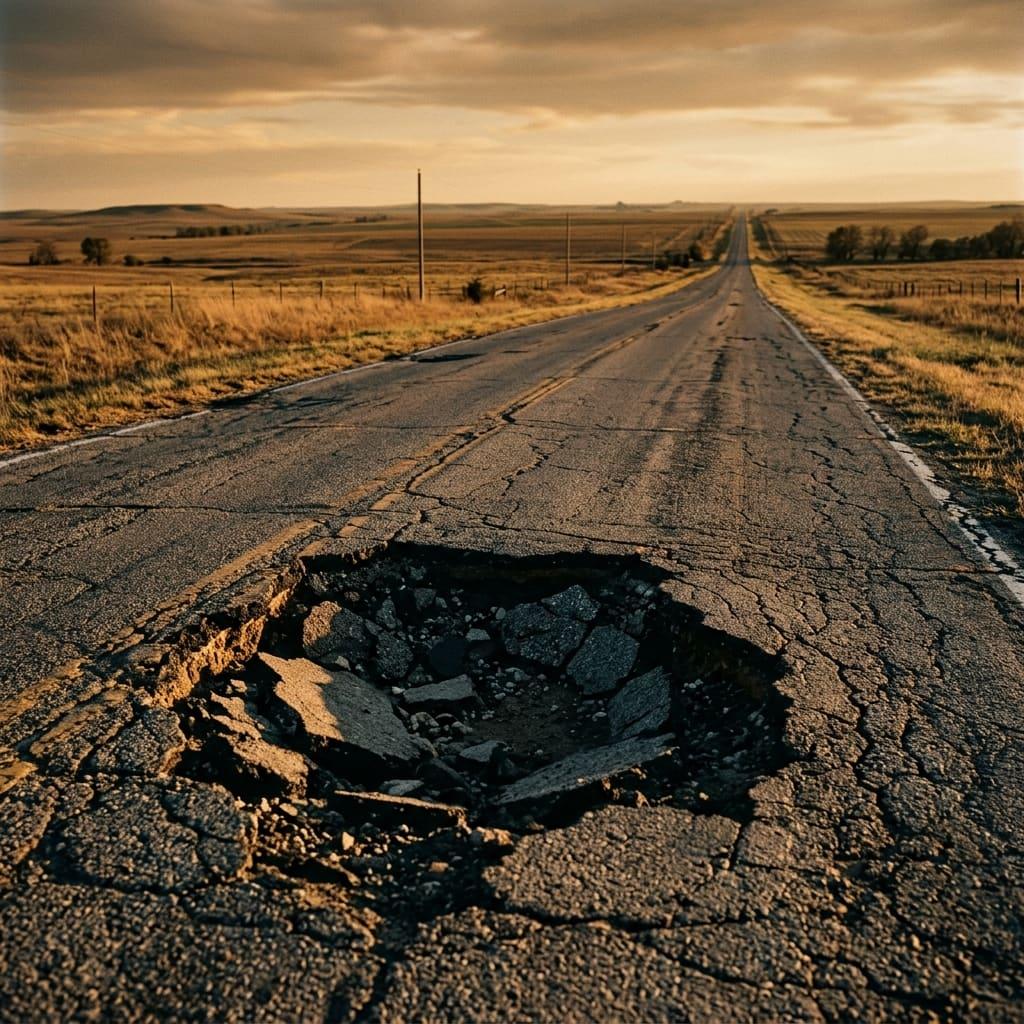
Road defects come in many forms, and each type creates a distinct set of hazards for drivers, motorcyclists, cyclists, and pedestrians. Potholes are the most common and most visible road defect in Oklahoma. They form when water infiltrates cracks in the pavement, expands during freezing temperatures, and weakens the underlying base material. When traffic loads then pass over the weakened surface, the pavement collapses. A pothole deep enough to swallow a tire can cause a driver to lose control instantly, and at highway speeds, the consequences are catastrophic.
Pavement deterioration beyond individual potholes also creates serious hazards. Rutting — where the road surface develops grooves from repeated heavy vehicle traffic — can channel rainwater and create hydroplaning conditions. Alligator cracking, where the pavement surface breaks into an interconnected pattern resembling reptile skin, signals structural failure that can disintegrate under load. Raised or depressed pavement edges at lane transitions and road shoulders create tripping hazards for pedestrians and control hazards for motorcyclists and cyclists.
Missing or damaged guardrails represent a different category of road defect. Guardrails exist to redirect vehicles away from embankments, bridge abutments, and other fixed objects. When a guardrail is damaged in a prior crash and not replaced, subsequent drivers face exposed hazards that the guardrail was designed to shield. Similarly, missing or obscured road signs — including stop signs, curve warnings, and speed advisories — deprive drivers of the information needed to navigate safely. Vegetation overgrowth that blocks sight lines at intersections creates the same danger.
Road design defects can also cause or contribute to accidents. Inadequate drainage that causes standing water across lanes, poorly designed curves without appropriate banking, insufficient lane markings after resurfacing, and construction zones without proper signage or barriers all create conditions that produce crashes. In these cases, liability may extend beyond the entity responsible for maintenance to the entity that designed or constructed the road.
The Governmental Tort Claims Act: Your Path to Recovery
When a road defect causes an accident in Oklahoma, the liable party is typically a government entity — the Oklahoma Department of Transportation (ODOT) for state highways, the county for county roads, or the municipality for city streets. Because government entities are protected by sovereign immunity, you cannot simply file a lawsuit the way you would against a private party. Instead, the Governmental Tort Claims Act (GTCA), codified at 51 O.S. § 151 et seq., provides the exclusive framework for bringing a claim.
The GTCA waives sovereign immunity under limited circumstances and imposes strict procedural requirements that must be followed precisely. Missing a single deadline will permanently bar your claim, regardless of how strong the underlying case is.
Filing the Notice of Tort Claim
Before you can file any lawsuit against a government entity, you must first submit a written Notice of Tort Claim to the entity responsible for the road. Under 51 O.S. § 156, this notice must be filed within one year of the date of the loss. The notice must be in writing and must include the date, time, place, and circumstances of the claim, the name of the entity, the amount of compensation requested, and — under § 156(E) — additional information the entity may require. Some deficiencies in the notice may be curable after demand, but substantive omissions can be fatal to the claim.
For a claim against a municipality, the notice is typically filed with the City Clerk. For a county, it is filed with the County Clerk. For the state or a state agency like ODOT, it is filed with the Office of Risk Management. Filing with the wrong entity or using improper service can be treated as a failure to provide notice, which is fatal to the claim.
The 90-Day Response Period
After you file the notice, the government entity has 90 days to investigate your claim and either approve it, deny it, or offer a settlement. Under 51 O.S. § 157, if the entity fails to approve or deny the claim within 90 days, the claim is deemed denied. You cannot file a lawsuit until the 90-day period expires or the claim is formally denied, whichever comes first.
The 180-Day Lawsuit Deadline
Once your claim is denied — either formally or by operation of the 90-day rule — you have 180 days to file a lawsuit in the appropriate district court. While § 157(B) allows the parties to agree in writing to extend the time to commence suit, the 180-day default is strictly enforced, and courts will dismiss cases filed even one day late. The 180-day window is among the shortest litigation deadlines in Oklahoma law. Compare this with the standard two-year statute of limitations for personal injury claims under 12 O.S. § 95(A)(3) — the GTCA gives you a fraction of that time.
Proving Government Liability for Road Defects
Filing a GTCA claim is only the procedural hurdle. To actually recover damages, you must prove that the government entity was negligent in maintaining the road. This requires establishing four elements: a duty to maintain the road, a breach of that duty, causation, and damages.
The duty element is generally straightforward. The government entity responsible for a road has a duty to maintain it in a reasonably safe condition for travel. ODOT maintains state highways. Counties maintain county roads. Municipalities maintain city streets. The challenge is identifying which entity is responsible for the specific road where the accident occurred, because jurisdiction lines are not always obvious — particularly in areas where state highways pass through municipal boundaries.
The breach element is where road defect cases are won or lost. The central question is whether the entity had notice of the defect and failed to act within a reasonable time. There are two types of notice that can establish liability. Actual notice means the entity knew about the specific defect — for example, because a citizen reported the pothole, a maintenance crew documented it in an inspection log, or a previous accident occurred at the same location. Constructive notice means the defect existed for long enough that the entity should have discovered it through reasonable inspection and maintenance procedures. A pothole that formed overnight after a storm may not give rise to constructive notice. A pothole that has been growing for months on a heavily traveled road creates a much stronger constructive-notice argument.
Documenting prior complaints is critical. Most municipalities and ODOT maintain databases of road maintenance requests filed by citizens. These records, obtainable through the Oklahoma Open Records Act, can establish that the entity knew about the specific defect weeks or months before your accident and failed to repair it. Neighboring businesses, residents, and regular commuters who can testify about the defect's history also provide powerful evidence of constructive notice.
Damage Caps and Exemptions
One of the most significant differences between a GTCA claim and a standard personal injury claim is the statutory damage cap. Under 51 O.S. § 154, as amended effective November 1, 2025, the maximum recovery against the state or a political subdivision with a population of 150,000 or more is $375,000 per person per occurrence, and $250,000 per person for smaller subdivisions. The aggregate cap is $2,000,000 per occurrence regardless of the number of claimants. These caps apply to the total judgment, including medical expenses, lost wages, and pain and suffering.
Even with the 2025 cap increase, catastrophic injuries can easily exceed the available recovery. A spinal cord injury or traumatic brain injury can produce lifetime damages well beyond the statutory ceiling. This is why identifying every possible defendant is essential in road defect cases. If a private contractor was responsible for road construction or maintenance, the contractor is not protected by the GTCA caps. If a private utility company's excavation work caused the road defect, the utility can be sued under standard negligence law without the GTCA limitations.
Punitive damages are not available against government entities under the GTCA. But they may be available against private defendants in the same case — for example, a construction company that knowingly covered a road defect without proper repair to save costs.
The GTCA also contains specific exemptions from liability listed in 51 O.S. § 155. Among the most relevant to road defect cases is the exemption for conditions of highways and roads that could not reasonably be expected to be known. This exemption protects government entities when a defect is genuinely new and undiscoverable — but it does not protect an entity that had actual or constructive notice of a dangerous condition and failed to act. Additionally, § 155.1 provides specific immunity limitations for claims involving state highway design and construction, which can complicate claims against ODOT where the alleged defect involves the original engineering of the road rather than a maintenance failure.
Evidence Preservation in Road Defect Cases
Evidence in road defect cases is uniquely perishable. The defect itself may be repaired — sometimes within days of your accident. Municipalities and ODOT often fast-track repairs at accident locations precisely because an accident demonstrates the hazard. Once the pothole is filled or the guardrail is replaced, the physical evidence of the defect is gone.
If you are physically able to do so after the accident, photograph and video the road defect from multiple angles, including measurements or size references like a shoe or a tire. Photograph the damage to your vehicle, the final resting position of the vehicle, any debris, and the surrounding road conditions including drainage, signage, and sight lines. Note the exact location using GPS coordinates from your phone. If you cannot do this yourself, ask someone at the scene — a witness, a family member, a first responder — to document the defect before leaving.
Your attorney should send a preservation letter to the government entity immediately, demanding that it preserve all records related to the road defect, including maintenance logs, inspection reports, complaint records, work orders, and any photographs or video of the location. Your attorney should also file an Open Records Act request for all maintenance and complaint records for the specific road segment.
Dashcam footage, if available, is invaluable. Nearby business surveillance cameras may have captured the accident. The police crash report should document the road condition and the defect.
Common Injuries in Road Defect Accidents
The injury profile in road defect accidents depends heavily on the type of defect, the speed of travel, and the vehicle involved. Potholes at highway speed can cause a driver to lose control, cross into oncoming traffic, or leave the roadway and strike fixed objects like trees, utility poles, or embankments. These scenarios produce the most severe injuries: traumatic brain injuries, spinal cord injuries, internal organ damage, and fatalities.
Motorcyclists and cyclists face the greatest risk from road defects because their vehicles provide no structural protection. A pothole or rut that a car might absorb can throw a motorcyclist from the bike entirely. Missing pavement markings at night leave motorcyclists unable to identify lane boundaries. Loose gravel from deteriorating road surfaces reduces traction to dangerous levels for two-wheeled vehicles.
Lower-speed pothole impacts still produce significant injuries. The jarring impact can cause whiplash, herniated discs, and steering-wheel injuries to the hands and wrists. Vehicle damage — bent rims, blown tires, suspension damage, and alignment problems — creates secondary accident risks if the driver loses control after the initial impact.
Frequently Asked Questions
Can I sue the city or county for a pothole accident?
Yes, if the facts fit within the Governmental Tort Claims Act waiver and no statutory exemption applies. Oklahoma municipalities, counties, and state agencies can face claims for negligent road maintenance, but you must follow strict procedural requirements: file a written Notice of Tort Claim within one year of the accident under 51 O.S. § 156, wait for the 90-day review period, and then file suit within 180 days of the claim denial. Missing any of these deadlines can permanently bar your claim.
How do I know which government entity is responsible?
The entity responsible depends on the road's classification. The Oklahoma Department of Transportation (ODOT) maintains state highways (numbered routes like SH-9 or US-77). Counties maintain county roads. Municipalities maintain city streets within their boundaries. When a state highway passes through a city, jurisdiction can be shared. Your attorney can determine the responsible entity by consulting ODOT's highway inventory and municipal boundary records.
What is the deadline to file a road defect claim in Oklahoma?
The critical deadline is the one-year Notice of Tort Claim requirement under 51 O.S. § 156. You must file a written notice with the government entity within one year of the date of the accident. After your claim is denied, you have only 180 days to file a lawsuit under 51 O.S. § 157. While § 157(B) allows the parties to agree in writing to extend the time to file suit, the default deadlines are strictly enforced.
Is there a cap on damages in road defect cases?
Yes. As amended in 2025, the GTCA caps recovery at $250,000 per person (or $375,000 for the state and larger municipalities) and $2,000,000 per occurrence under 51 O.S. § 154. Punitive damages are not available against government entities. However, if a private contractor or utility company contributed to the defect, those private defendants are not subject to the GTCA caps and can be sued under standard negligence law for uncapped damages.
What evidence do I need to prove a pothole caused my accident?
The most critical evidence includes photographs and video of the road defect (taken as soon as possible after the accident, before repairs are made), the police crash report documenting the road condition, vehicle damage photographs showing impact consistent with a road defect, maintenance and complaint records from the government entity (obtainable through the Oklahoma Open Records Act), and any dashcam or surveillance footage capturing the accident. Prior complaints about the same defect from other citizens are particularly powerful because they establish the government had actual notice of the hazard.
Does comparative negligence apply in road defect cases?
Yes. Oklahoma's modified comparative negligence system applies. The government entity will argue that you were partially at fault — for example, by driving too fast for conditions, failing to avoid a visible pothole, or not paying attention to the road. If the jury finds you more than 50% at fault, you recover nothing. If you are found 50% or less at fault, your damages are reduced by your percentage of fault but you can still recover.
Road defect accidents are among the most procedurally complex personal injury claims in Oklahoma. The GTCA's strict notice requirements, short deadlines, and damage caps create traps that can end cases before they begin. At Addison Law Firm, we handle every procedural step — filing the Notice of Tort Claim, obtaining maintenance records through the Open Records Act, and building the evidence that shows whether the government knew about the defect and failed to act. Contact us for a free, confidential consultation.
Injured by a Road Defect?
Pothole and road defect claims against government entities have strict deadlines that can permanently bar your case. Act quickly to preserve your rights.
Schedule a Free Consultation →This article is for general information only and is not legal advice.