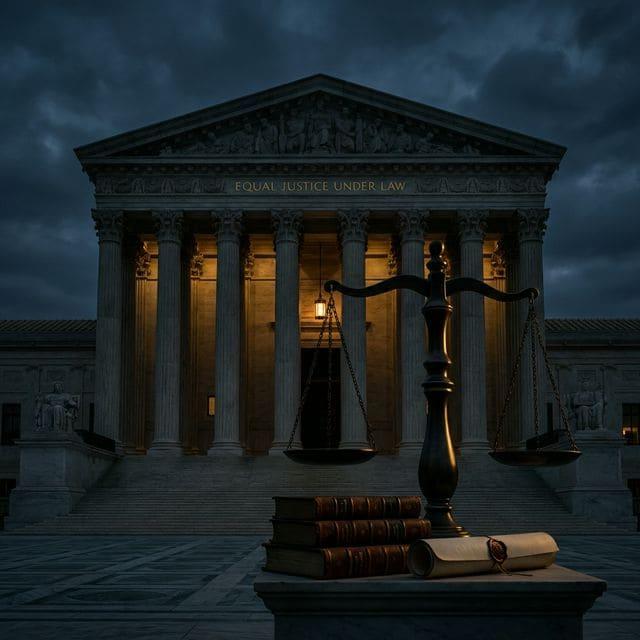

Special Edition — Breaking Legal Analysis
This article analyzes the Supreme Court's opinion in Learning Resources, Inc. v. Trump, issued on February 20, 2026. The ruling has broad implications for U.S. trade policy, business contracts, and import pricing.
Key Takeaways
- 6-3 Ruling, Fractured Rationale: A majority of the Supreme Court held that IEEPA does not authorize the President to impose tariffs, striking down the reciprocal and drug-trafficking tariff regimes enacted in 2025. The majority split 3-3 on reasoning — three Justices relied on the major questions doctrine while three concurred on statutory text alone. The three dissenters argued that tariffs have always been understood as a form of trade "regulation."
- Other Tariffs Remain: Tariffs imposed under Section 232, Section 301, and other statutory authorities are not affected by this ruling. The President may seek to re-impose tariffs through those procedural channels.
- Refunds Are Unresolved: Billions of dollars in collected duties may be refundable, but the Court did not address this. Importers should consult trade counsel immediately.
On February 20, 2026, the Supreme Court of the United States issued its most consequential decision on the separation of powers and trade in decades. In a splintered but decisive ruling, six Justices holding a majority agreed that the International Emergency Economic Powers Act (IEEPA) does not authorize the President to impose tariffs. The decision in Learning Resources, Inc. v. Trump, No. 24–1287 (Feb. 20, 2026), strikes down the entire architecture of tariffs that President Trump imposed beginning in 2025—including the "reciprocal" tariff regime affecting trading partners worldwide—and marks a decisive reaffirmation of congressional supremacy over trade policy.
This analysis unpacks the Court's reasoning across its several opinions, explains the practical consequences for businesses operating in Oklahoma and across the country, and identifies the significant open questions the ruling leaves unresolved.
Background: The President's High-Stakes Gamble on IEEPA
The International Emergency Economic Powers Act, enacted by Congress in 1977, grants the President a broad array of economic tools to respond to declared national emergencies involving threats originating primarily outside the United States. See 50 U.S.C. §1701. Under IEEPA, the President may, among other things, "regulate . . . importation or exportation of . . . any property in which any foreign country or a national thereof has any interest." §1702(a)(1)(B).
Beginning in early 2025, President Trump declared a series of national emergencies grounded in two distinct theories: first, that the "influx of illegal drugs from Canada, Mexico, and China" constituted an "unusual and extraordinary threat" to American national security; and second, that "large and persistent" U.S. trade deficits had hollowed out domestic manufacturing and imperiled critical supply chains. See Exec. Order Nos. 14193, 14194, 14195, 14257, 90 Fed. Reg. 9113–9121, 15041 (2025). Invoking IEEPA as his statutory authority for both emergency declarations, the President imposed sweeping tariff regimes:
- Drug trafficking tariffs: 25% duty on most Canadian and Mexican imports; 10% on Chinese imports (later escalated to 20%, and then to a stunning effective rate of 145% on most Chinese goods via a cascade of modifications).
- Reciprocal tariffs: A baseline duty of at least 10% on all imports from all trading partners, with dozens of nations subject to significantly higher "reciprocal" rates.
These tariffs applied notwithstanding any existing trade agreements and were modified repeatedly—sometimes within days—at the President's sole discretion.
Plaintiffs in two consolidated cases challenged the tariffs: Learning Resources, Inc., two small U.S. businesses that import educational toys from China, and V.O.S. Selections, Inc., five importers of wine and spirits joined by twelve States. Both sets of plaintiffs prevailed in the lower courts. The Federal Circuit, sitting en banc, held that IEEPA's text—specifically the phrase "regulate . . . importation"—does not encompass the imposition of tariffs because tariffs "are unbounded in scope, amount, and duration." V.O.S. Selections, 149 F.4th 1312, 1338 (Fed. Cir. 2025). The Supreme Court granted certiorari and expedited the cases for argument. On the threshold question of jurisdiction, the Court vacated the D.C. District Court's judgment and ordered dismissal for lack of jurisdiction, concluding that Congress vested exclusive jurisdiction over tariff-related claims in the Court of International Trade (CIT). See 28 U.S.C. §1581. The Federal Circuit's judgment in the V.O.S. Selections case—decided by the CIT, which does have that jurisdiction—was affirmed on the merits.
Read the Full Opinion
The complete slip opinion in Learning Resources, Inc. v. Trump, No. 24–1287 (Feb. 20, 2026), is available below.
The Majority Opinion: Narrowing IEEPA Through Statutory Text and Major Questions
Chief Justice Roberts authored the opinion of the Court as to the core holding, though the opinion is formally splintered. Parts I and II-A-1 (the statutory analysis) commanded a majority of six Justices; Parts II-A-2 and III (the major questions discussion) garnered only a plurality of three (Roberts, Gorsuch, and Barrett), with the liberal bloc declining to join.
The Statutory Argument: "Regulate . . . Importation" Does Not Mean "Tax Importation"
The Court first concluded that the phrase "regulate . . . importation" in 50 U.S.C. §1702(a)(1)(B) is simply not a grant of tariff power. This was the majority's narrower ground and commanded the broadest agreement.
The Court's textual analysis proceeded from the settled constitutional premise that the power to impose tariffs is categorically distinct from the power to regulate commerce. Article I, Section 8 of the Constitution explicitly vests in Congress both the power "[t]o regulate Commerce with foreign Nations" and, separately, the power "[t]o lay and collect Taxes, Duties, Imposts and Excises." See U.S. Const. art. I, §8, cls. 1, 3. The tariff power has thus long been understood as an expression of Congress's taxing authority—not its commerce regulatory authority. See Gibbons v. Ogden, 9 Wheat. 1, 201 (1824) (Marshall, C.J.) (recognizing Congress's distinct authority over duties and imposts); Nicol v. Ames, 173 U.S. 509, 515 (1899). Tariffs are taxes on imports—exercises of the taxing power—not merely regulations of the terms under which importation occurs.
Against this backdrop, the Court read IEEPA's "regulate . . . importation" language as the kind of regulatory authority Congress routinely delegates in the foreign affairs and national security context: the power to block transfers, void transactions, freeze assets, impose licensing requirements, and otherwise control the conditions of importation. It does not—because of its constitutional distinctiveness—encompass the power to impose a tariff that raises revenue from the transaction.
The Court found congressional practice confirming: every other statute in which Congress has specifically delegated tariff authority makes explicit reference to "duties" or "tariffs," caps the applicable rate, limits the duration, and imposes procedural prerequisites such as investigations by the International Trade Commission or the U.S. Trade Representative. See, e.g., 19 U.S.C. §§1338(d), 2132(a), 2253(a)(3)(A), 2411(c)(1)(B). The absence of any such language, any rate cap, any time limit, or any procedural requirement in IEEPA's conferral of "regulate . . . importation" authority, while not dispositive on its own, powerfully supports the conclusion that tariff authority was not among the powers delegated.
The Major Questions Plurality: Even If Ambiguous, Congress Must Speak Clearly
The three-Justice plurality (Roberts, Gorsuch, Barrett) went further, invoking the Court's major questions doctrine to apply an additional structural skepticism to the Government's reading of IEEPA.
The major questions doctrine, developed across FDA v. Brown & Williamson Tobacco Corp., 529 U.S. 120 (2000), West Virginia v. EPA, 597 U.S. 697 (2022), and Biden v. Nebraska, 600 U.S. 477 (2023), provides that when an executive agency or official claims authority to resolve a question of "vast 'economic and political significance,'" the Court will insist on a "clear congressional authorization" before crediting that claim. West Virginia, 597 U.S. at 721. The doctrine reflects the structural inference that when Congress intends to delegate massive policy authority to the Executive, it does so in explicit terms—not by burying that delegation in general or ambiguous statutory language.
The plurality reasoned that this doctrine applies "with particular force" when the purported delegation involves what the Framers called "the most complete and effectual weapon" in a legislature's arsenal: the power of the purse. The Federalist No. 58, at 359. The tariff power is not incidental to commerce regulation—it is a direct exercise of the core taxing function that Article I assigns exclusively to Congress. No reasonable interpreter, the plurality concluded, would expect Congress to have silently relinquished that power through IEEPA's general "regulate . . . importation" language.
The plurality also emphasized the complete lack of historical precedent. In IEEPA's fifty-year existence, no President prior to Trump had ever invoked the statute to impose tariffs of any magnitude. Presidents had deployed IEEPA to freeze assets, impose embargoes, and sanction foreign nationals—but always through non-tariff mechanisms, and always under other authorities when tariffs were the chosen tool. This "lack of historical precedent, coupled with the breadth of authority" the President now claimed, was itself a "telling indication" that the tariffs exceeded the President's legitimate authority under the statute. Nat'l Fed'n of Indep. Bus. v. OSHA, 595 U.S. 109, 119 (2022).
The Concurring Opinions: Finding Unanimity Through Different Routes
Justices Kagan, Sotomayor, and Jackson concurred in the judgment and joined Parts I, II-A-1, and II-B—the Court's statutory conclusion that "regulate . . . importation" simply does not reach the tariff power—but all three declined to join the major questions plurality. Part II-B, which attracted six votes in total, contains the Court's core textual and contextual analysis of IEEPA's language against the backdrop of other tariff statutes. Justice Kagan authored a separate concurrence for herself, Sotomayor, and Jackson (who also filed individually), taking the position that the statutory text is wholly sufficient to decide the case, and criticizing the plurality for invoking the major questions doctrine unnecessarily. This reservation is doctrinally significant: the liberal Justices are plainly resisting further entrenchment of the major questions doctrine as a tool for curbing executive regulatory authority across domains extending far beyond presidential emergency powers.
Justice Jackson filed her own separate concurrence to emphasize that the National Emergencies Act's congressional-termination mechanism—which requires a veto-proof joint resolution to end a declared emergency, 50 U.S.C. §1622—itself reflects a careful legislative judgment about the appropriate scope of executive emergency authority, one that the Court need not override through judge-made major questions analysis.
The Dissent: A Forceful Argument from History and Precedent
Justice Kavanaugh, joined by Justices Thomas and Alito, dissented vigorously, with Kavanaugh authoring the lead dissent. Justice Thomas also filed a separate dissenting opinion. The dissents' central argument is textual and historic: tariffs have, throughout American history, been understood as one of the primary means by which governments "regulate" foreign trade and commerce. Chief Justice Marshall, Justice Story, and James Madison all so understood the term. The tariff power exercised by Presidents Polk, Lincoln, and McKinley was openly described at the time as a form of trade "regulation." And when Congress enacted IEEPA's predecessor, the Trading with the Enemy Act, at least one President—invoking similar "regulate . . . importation" language—imposed tariffs, and Congress ratified that understanding.
Most significantly, the dissent argues that the majority's holding directly contradicts the Court's unanimous 1976 decision in Federal Energy Administration v. Algonquin SNG, Inc., 426 U.S. 548, which held that a similar "adjust the imports" phrase in Section 232 of the Trade Expansion Act of 1962 authorized tariff-like "license fees." The dissent views Algonquin as controlling and strongly criticizes the majority for effectively overruling it without acknowledgment.
Kavanaugh also raises a practical concern of enormous consequence: the Court's ruling immediately raises the question of refunds. Billions of dollars in tariff revenue have already been collected from importers under the invalidated IEEPA tariff regime. Whether—and through what mechanism—those sums must be returned to importers is a question the Court's opinion does not address. As Kavanaugh noted, that process could become an "absolute mess." Tr. of Oral Arg. 153–155.
Critically, the dissent emphasizes that the ruling does not foreclose the use of tariffs under other statutory authorities—including Section 122 of the Trade Act of 1974 (covering trade deficit imbalances), Section 201 (import relief for domestic industries), Section 301 (unfair trade practices), Section 338 of the Tariff Act of 1930, and the fully proceduralized Section 232 (national security). The President retains tariff authority under all of these statutes; today's ruling narrows only IEEPA.
What This Ruling Means: Practical Implications
For Businesses That Import Goods
For importers who have been paying the IEEPA-mandated duties—the baseline 10% "reciprocal" tariff and the staggering effective rate of up to 145% on Chinese goods—the ruling raises the immediate and urgent question of refunds. While the Court has not addressed this issue directly, importers should consult with trade counsel immediately to understand their rights to seek refund claims at the Court of International Trade, which retains exclusive jurisdiction over most tariff-related actions. See 28 U.S.C. §1581.
For Businesses That Incorporated Tariffs into Their Contracts
Many supply agreements, pricing schedules, and long-term service contracts executed over the past year incorporated the IEEPA tariffs as a baseline assumption—specifying, for example, that pricing reflected "current tariff rates" or that certain cost-escalation triggers were pegged to tariff exposure. The abrupt invalidation of those tariffs could trigger commercial contract disputes about whether terms must be renegotiated, whether force majeure or frustration-of-purpose doctrines apply, or whether either party has a windfall enrichment claim. Businesses with active supply agreements should review those documents immediately with business counsel.
For Oklahoma Small Businesses
Oklahoma businesses across multiple economic sectors are directly exposed to today's ruling. Agricultural exporters and equipment importers in the oil and gas supply chain have faced significant input cost increases as a direct result of the IEEPA tariff structure. Companies in Oklahoma's substantial aerospace supply chain—a sector deeply dependent on specialized imported components—have renegotiated contracts and altered purchasing timelines under the assumption that tariff costs were a permanent baseline. Oklahoma manufacturers who have benefited from price protection against foreign competition may now face renewed competitive pressure if tariffs are reduced or eliminated pending appeal. Any company in these categories should immediately audit its open purchase orders, supply agreements, and invoices to quantify potential tariff duty refund exposure and assess whether existing contract pricing assumptions need to be revisited.
For Trade Policy and the Executive Branch
The administration now faces the task of reimposing any desired tariff policy through statutory mechanisms that actually support that authority: principally, the Section 301, 201, and 232 procedures, each of which requires investigation timelines, public comment, and reporting that the IEEPA regime was designed to circumvent. Congress may also be prompted to revisit the scope of IEEPA or to clarify its tariff statutes. For parties who face adverse rulings and need to understand their options for further review, Tenth Circuit appellate procedure remains an important consideration as these cases develop in lower courts following this remand.
How the Court Split
| Justice | Position |
|---|---|
| Roberts, C.J. | Plurality (Parts I, II-A-1, II-A-2, II-B, III)¹ |
| Gorsuch | Plurality (all parts) |
| Barrett | Plurality (all parts) |
| Sotomayor | Concurrence in judgment (Parts I, II-A-1, II-B) |
| Kagan | Concurrence in judgment (Parts I, II-A-1, II-B — authored) |
| Jackson | Concurrence in judgment (Parts I, II-A-1, II-B + separate) |
| Thomas | Dissent (filed separately) |
| Alito | Dissent (joined Kavanaugh) |
| Kavanaugh | Dissent (authored; joined by Thomas and Alito) |
¹ Parts I, II-A-1, and II-B commanded six votes (the "majority" on the statutory holding). Parts II-A-2 and III (the major questions reasoning) commanded only three votes (the plurality).
The result: 6-3 on the ultimate holding that IEEPA does not authorize these tariffs. The Court fractured 3-3-3 on the rationale, with the plurality invoking major questions, the liberal concurrence relying on pure statutory interpretation, and the conservative dissenters reading the statute in the President's favor.
Frequently Asked Questions
Does this ruling eliminate all of the tariffs that were imposed?
The ruling directly invalidates the tariffs the President imposed solely on IEEPA authority—the reciprocal tariffs and drug trafficking tariffs described in this opinion. Existing tariffs imposed under Section 232 (the longstanding steel and aluminum tariffs, for example) or Section 301 (on specific Chinese goods) remain in effect unless separately challenged. The Court was explicit that other tariff statutes were not before it.
Can the President re-impose tariffs under different statutory authority?
Yes. The dissenters pointed out—and the majority did not dispute—that Section 122, Section 201, Section 301, Section 338, and Section 232 all potentially authorize the President to impose tariffs, subject to their respective procedural requirements. An administration seeking to replicate the IEEPA regime via Section 232 (national security) would need to proceed through investigations by the Secretary of Commerce and meet specific findings requirements.
Will importers get refunds?
This is the most practically urgent open question. The Court did not address refund liability. Importers who paid IEEPA-mandated duties will likely need to file timely protests and refund claims at the Court of International Trade under 19 U.S.C. § 1514. Those who have already missed the 180-day deadline for protest may have more limited options. Trade counsel should be consulted immediately.
Does this ruling affect trade deals struck while the IEEPA tariffs were in place?
This is another unresolved question. The dissent flagged that IEEPA tariffs were used as leverage in trade negotiations culminating in agreements with China, the United Kingdom, Japan, and potentially others. The effect of invalidating the tariff instrument on those agreements' continuing validity is uncertain and will require diplomatic as well as legal analysis.
What is the major questions doctrine and why did only three Justices apply it?
The major questions doctrine is a judicial principle providing that when the executive claims authority to resolve a question of vast economic or political significance, courts must insist on clear congressional authorization. Only three Justices (Roberts, Gorsuch, Barrett) applied it here because the other three Justices in the majority believed the statutory text alone was sufficient to invalidate the tariffs without invoking an additional interpretive framework. The doctrine remains controversial: the liberal Justices view it as a judicial tool that can be used to curb executive regulatory authority beyond what the statutory text requires.
Does this ruling change anything for consumers who already paid higher prices?
Not directly. Consumer price increases caused by businesses passing tariff costs through are market effects, not duties owed to the government. The refund question applies to importers who paid duties directly to U.S. Customs — they may seek refund through the Court of International Trade. Consumers who paid higher retail prices do not have a direct claim for refund under trade law, though competitive market forces should eventually reduce prices as the tariff-inflated costs are removed from the supply chain.
SCOTUS Ruling Affecting Your Business?
Whether you are pursuing tariff refunds, renegotiating contracts, or evaluating trade compliance exposure, our team can help you navigate the fallout from today's decision.
Contact Addison Law →This article is for general information only and is not legal advice. The opinions expressed herein are those of the author and do not constitute legal advice regarding any specific matter.