
Key Takeaways
- Construction Zones Are Dangerous: ODOT and OTA reported more than 7,125 Oklahoma work-zone collisions in a recent five-year period, with 91 deaths and 1,294 injuries. Later national work-zone data shows Oklahoma deaths remained a serious problem in 2023 and 2024.
- Liability Can Extend Beyond the Other Driver: When a construction zone crash is caused by inadequate signage, improper traffic control, missing barriers, or poorly designed lane shifts, the construction company, the general contractor, and even ODOT or the Oklahoma Turnpike Authority may share liability.
- Government Defendants Have Special Rules: Claims against ODOT and municipalities are governed by the Governmental Tort Claims Act, which imposes short notice deadlines and damage caps. Missing those deadlines can permanently bar your claim.
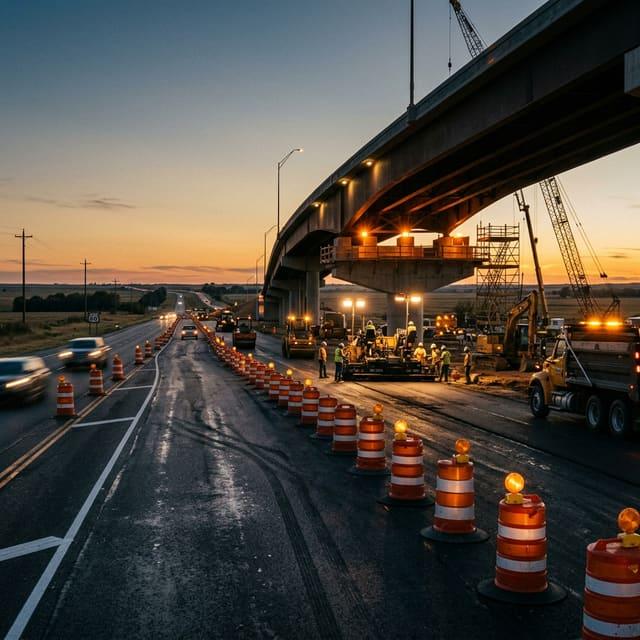
Every construction season, Oklahoma highways become harder to navigate. The Oklahoma Department of Transportation and Oklahoma Turnpike Authority manage roadway projects that narrow lanes, shift traffic patterns, and drop speed limits across busy corridors. The I-40 and I-44 interchange in Oklahoma City, the Turner Turnpike, stretches of I-35 through Norman and Edmond — all of these can funnel thousands of vehicles per day through compressed, unfamiliar driving environments. And every year, people are seriously hurt or killed because of it.
The numbers are sobering. ODOT and OTA reported that, in a recent five-year period, 91 people were killed and 1,294 were injured in more than 7,125 Oklahoma work-zone collisions. National Work Zone Safety Information Clearinghouse data later listed 32 Oklahoma work-zone fatalities in 2023 and 27 in 2024. Those numbers underscore how dangerous these environments are for workers and motorists alike.
What many Oklahoma drivers do not realize is that a construction zone crash is not always just a "car wreck." The legal analysis is often fundamentally different from a standard rear-end collision or intersection accident, because construction zone crashes can involve multiple layers of fault — the other driver, the construction company, the traffic control subcontractor, the engineering firm that designed the traffic pattern, and the government agency that authorized the project.
Why Construction Zone Crashes Are Different
A typical car accident involves two drivers. The question is usually simple: who was at fault? Construction zone crashes add a layer of complexity because the driving environment itself may have been unreasonably dangerous — and someone other than the drivers may be responsible for that.
Construction zones alter the physical roadway in ways that create foreseeable hazards. Lanes narrow. Shoulders disappear. Concrete barriers channel traffic inches from heavy equipment. Temporary lane markings may be confusing, faded, or contradictory. Merge points force vehicles together at speed. And all of this happens while workers, equipment, and loose materials occupy space that would normally be part of the roadway.
When one of these environmental conditions contributes to a crash, the question is no longer just "which driver was at fault." It becomes: was the work zone set up safely? Were proper traffic control devices in place? Were lane transitions designed to give drivers adequate warning and space? Were barriers positioned to protect both workers and motorists? The answers to these questions determine whether the construction company, the traffic control subcontractor, or the government agency that designed the work zone shares legal responsibility for the crash.
Who Can Be Held Liable
Construction zone accident liability can extend well beyond the at-fault driver. Understanding the full range of potentially responsible parties is critical to maximizing recovery, because the other driver's minimum liability insurance — often just $25,000 per person under Oklahoma law — may be nowhere near sufficient to cover serious injuries.
The other driver. If another driver was speeding, tailgating, distracted, or intoxicated in the work zone, they may be liable under ordinary negligence principles. Oklahoma law under 47 O.S. § 11-806 doubles fines for speeding in construction zones when workers are present, and 47 O.S. § 11-1302 imposes penalties for certain work zone violations. These statutes reflect Oklahoma's recognition that construction zone driving demands heightened care, and a driver's violation of a safety rule can become strong evidence of negligence.
The construction contractor. The company performing the construction work has a duty to maintain a reasonably safe work zone. This includes properly positioning signs, cones, barrels, and barriers; maintaining visible lane markings; providing adequate lighting for nighttime work; and ensuring that the transition from normal traffic to the work zone gives drivers sufficient warning to slow down and merge safely.
When a construction company cuts corners — using too few signs, failing to replace knocked-down barrels, leaving debris in travel lanes, or creating confusing merge patterns — it can be held liable for crashes that result. This liability exists independent of whether an at-fault driver was also negligent. Under Oklahoma's comparative negligence framework, fault can be apportioned among all responsible parties, which means the construction company may bear a percentage of liability even if a distracted driver was also at fault.
Traffic control subcontractors. Many construction projects use specialized traffic control companies to design and implement work zone traffic patterns, set up signage, and manage lane closures. These companies often operate under standards set by the Manual on Uniform Traffic Control Devices (MUTCD), which is the federal standard for work zone traffic control. If the traffic control plan was deficient — if signs were placed too close to the lane shift, if advance warning was inadequate, or if taper distances violated applicable standards — the traffic control subcontractor may be independently liable.
Government entities. When a construction zone crash is caused by a deficiency in the project design or the government agency's failure to inspect or enforce traffic control standards, the government entity that authorized the project may be liable. However, claims against government defendants in Oklahoma are governed by the Governmental Tort Claims Act (GTCA), which imposes significant procedural hurdles.
Under the GTCA, a claimant must file a written notice of claim with the government entity within one year of the date of the loss. This is dramatically shorter than the two-year statute of limitations that applies to private defendants under 12 O.S. § 95. The GTCA also caps damages — the specific cap depends on the county's population and whether the entity is a state agency or a political subdivision. Missing the one-year notice deadline is almost always fatal to the claim.
Design professionals. The firm that designed the traffic control plan or the temporary road configuration may be liable if the design itself created an unreasonably dangerous condition. Engineering firms are held to professional standards of care, and a flawed work zone design — one that creates blind merges, insufficient deceleration distances, or sight-line obstructions — can form the basis of a professional negligence claim.
Common Causes of Construction Zone Crashes in Oklahoma
Understanding what causes these crashes helps identify who is responsible.
Inadequate advance warning. Drivers need time to process that they are approaching a work zone, reduce speed, and change lanes. The MUTCD specifies minimum distances for advance warning signs based on road speed. When signs are missing, obscured, or placed too late, drivers may not have enough time to react — particularly on high-speed highways like I-44 or the Turner Turnpike where traffic is moving at 70+ mph.
Confusing lane shifts and merges. Poorly designed lane transitions are among the most dangerous features of any work zone. When lane markings are contradictory — when the old striping is still visible alongside the new temporary markings — drivers cannot determine which lane to follow. This confusion leads to side-swipe collisions, sudden braking, and rear-end crashes.
Missing or damaged traffic control devices. Construction zones are dynamic environments. Barrels get knocked over. Signs blow down. Cones are displaced by passing trucks. The construction company has a duty to inspect and maintain traffic control devices throughout the project, not just at initial setup. A work zone that was properly configured on Monday may be dangerously deficient by Wednesday if damaged devices are not replaced.
Debris in travel lanes. Loose gravel, construction materials, and equipment protruding into travel lanes create hazards that can cause drivers to swerve, lose control, or suffer tire blowouts and vehicle damage. The construction company is responsible for keeping travel lanes clear of debris.
Inadequate lighting. Oklahoma construction projects often continue through the night, particularly on high-traffic corridors where daytime closures would cause unacceptable delays. Nighttime work zones require additional lighting, reflective delineators, and enhanced signage. When these measures are absent or insufficient, the risk of crashes increases dramatically.
What Construction Zone Injuries Look Like
The combination of high speed, compressed lanes, and rigid barriers makes construction zone injuries particularly severe. Motorists in work zones are often channeled between concrete jersey barriers with no shoulder or escape route, meaning that even a minor loss of control can result in a high-energy impact.
Common injuries include traumatic brain injuries from sudden deceleration, spinal cord injuries from barrier strikes, crush injuries when vehicles are pinned against concrete barriers, and severe burns when fuel tanks rupture on impact. Rear-end collisions in work zones are also disproportionately dangerous because traffic often slows abruptly — a trailing vehicle moving at highway speed may strike a stopped vehicle with enormous force.
These are not fender-benders. Construction zone crashes frequently produce the kind of catastrophic injuries that require extensive medical care, long-term rehabilitation, and permanent lifestyle changes. The damages in these cases can include past and future medical expenses, lost wages and earning capacity, pain and suffering, and — in cases involving egregious negligence by the construction company — punitive damages.
What to Do After a Construction Zone Crash
The steps you take immediately after a work zone crash can make or break your case — particularly because critical evidence in these cases is temporary by nature.
Document the work zone conditions. If you are able, photograph the scene extensively. Capture the signage (or lack of it), the lane markings, the position of barrels and barriers, any debris in the roadway, and the lighting conditions. Work zones change daily — the conditions that caused your crash may be "fixed" within hours, destroying the evidence of the deficiency.
Get the construction company's information. Signs at the entrance to every work zone identify the contractor. Note the company name, project number, and any contact information posted on construction signage. This information is essential for identifying the correct defendants.
Get a complete medical evaluation. Do not dismiss symptoms as minor. The adrenaline that follows a crash can mask serious injuries that develop over hours or days, including concussions, internal bleeding, and spinal injuries.
Do not give recorded statements. The at-fault driver's insurer and the construction company's insurer will both want your recorded statement as quickly as possible. Decline politely. These statements are used to minimize your claim, not to help you.
Contact an attorney quickly. Construction zone evidence is uniquely perishable. Lane configurations change. Damaged traffic control devices are replaced. Daily inspection logs are overwritten. A personal injury attorney experienced with construction zone cases will move immediately to preserve project files, traffic control plans, inspection logs, dashcam footage from construction vehicles, and any available highway camera footage.
Frequently Asked Questions
How long do I have to file a claim after a construction zone accident?
For claims against private defendants — the other driver, the construction company, the traffic control subcontractor — the statute of limitations in Oklahoma is generally two years from the date of the accident under 12 O.S. § 95. However, if your claim involves a government defendant such as ODOT or a municipality, you must file a written notice of claim within one year under the Governmental Tort Claims Act. This shorter deadline makes prompt legal consultation critical.
Can I sue the construction company even if another driver caused the crash?
Yes. Oklahoma follows a comparative negligence system, meaning fault can be shared among multiple parties. If the work zone was improperly set up — missing signs, confusing lane shifts, inadequate lighting — the construction company can bear a percentage of fault even if another driver was also negligent. This matters because the construction company's insurance policy is typically far larger than an individual driver's.
What if the construction zone looked fine to me before the crash?
You do not need to prove that you personally noticed a deficiency. The question is whether the work zone met objective safety standards — the MUTCD, ODOT specifications, and the project's traffic control plan. Expert witnesses, typically traffic engineers, evaluate these standards and compare them to the actual conditions at the time of the crash. Deficiencies that are not obvious to a driver traveling at highway speed may be clear to an expert reviewing the traffic control plan.
Are construction zone accidents more valuable than regular car accidents?
Not automatically, but they often involve more severe injuries because of the confined lanes and rigid barriers. They can also involve multiple defendants — the construction company, the general contractor, a traffic control subcontractor, or a government entity — which may create more recovery paths than a claim limited to one driver's personal auto policy. Cases involving egregious private-party safety violations may also support claims for punitive damages.
What evidence is important in a construction zone crash?
The traffic control plan — the document that specifies exactly how the work zone should be configured — is the single most important piece of evidence. It establishes the standard against which the actual conditions are measured. Daily inspection logs, project correspondence, dashcam footage from construction vehicles, and expert analysis of sign placement, taper distances, and sight lines are all critical. Because work zones change constantly, this evidence must be preserved quickly through legal demands to the construction company and the government agency.
Do doubled fines for speeding in work zones affect my injury claim?
The doubled fines under 47 O.S. § 11-806 are criminal penalties — they do not directly increase your civil recovery. However, a traffic citation for a work zone speeding violation is strong evidence of negligence that can be used in your civil case to establish that the other driver was at fault. Similarly, if the other driver was charged under 47 O.S. § 11-1302 for a work zone violation, that charge supports your claim.
My crash happened in a work zone but no workers were present. Does that matter?
For criminal penalties, some statutes like the doubled speeding fine apply only when workers are present. But for civil liability, what matters is whether the work zone created an unreasonably dangerous condition — regardless of whether workers were physically present at the moment of the crash. If confusing lane markings, missing signs, or debris contributed to your accident, the construction company's negligence extends 24 hours a day, not just during active work hours.
Injured in a Construction Zone?
Work zone evidence disappears fast — lane configurations change, signs are replaced, and inspection logs are overwritten. Contact us now so we can preserve the evidence that proves what went wrong.
Free Case Evaluation →This article is for general information only and is not legal advice. Every construction zone accident involves unique facts. If you have been injured, consult a qualified attorney to evaluate your specific situation.