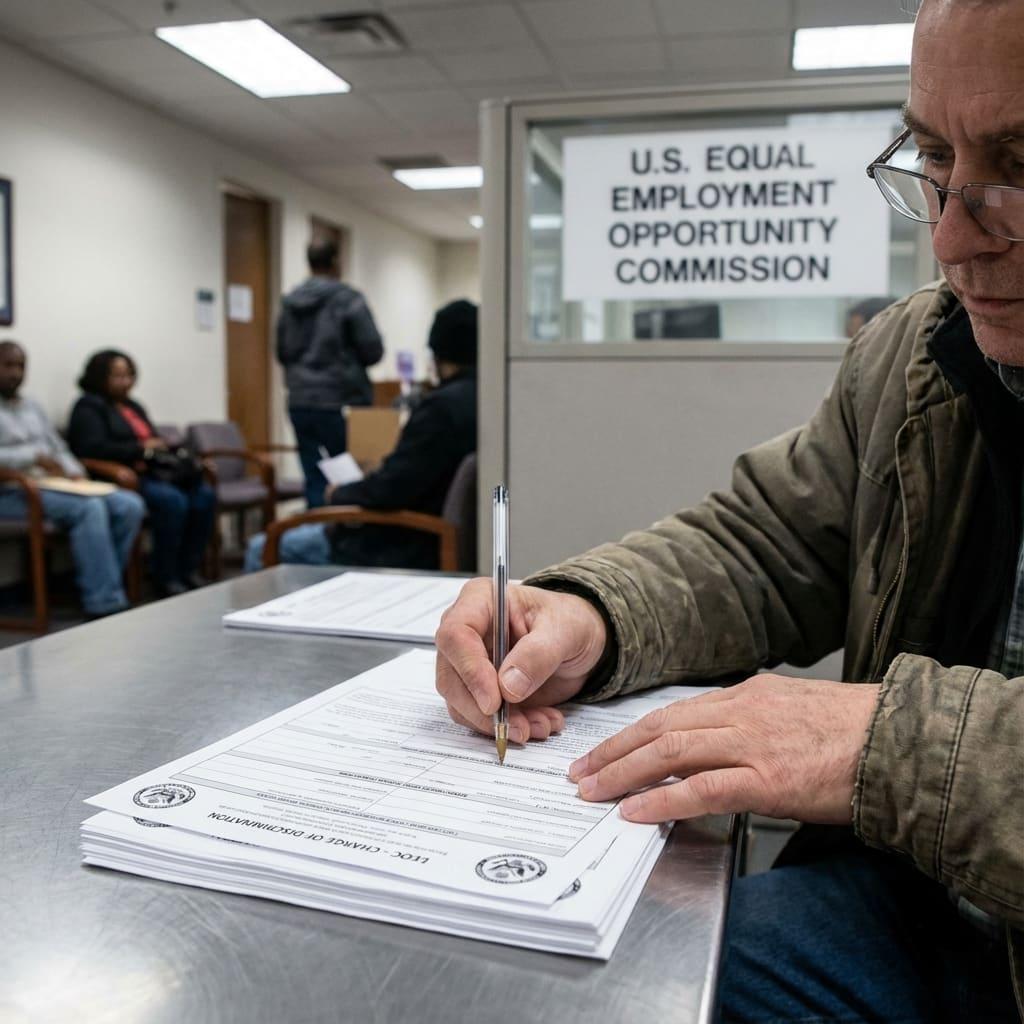

Key Takeaways
- File First: You usually must file a charge with the Equal Employment Opportunity Commission or the Oklahoma Attorney General's Office of Civil Rights Enforcement before bringing discrimination claims. This step is mandatory for most federal and state discrimination claims.
- Deadlines Are Short: Federal claims in Oklahoma often use a 300-day Equal Employment Opportunity Commission deadline, while Oklahoma state-law claims generally require filing within 180 days.
- The Charge Is Step One: Filing opens the door to investigation, mediation, and ultimately—if needed—a lawsuit in federal or state court.
You were fired because of your race. Denied a promotion because of your sex. Harassed because of your religion. You want to sue. But before you can file most discrimination lawsuits, federal and Oklahoma law require a mandatory first step: filing a charge or complaint of discrimination.
This administrative process exists for a reason—to give employers notice, allow for investigation, and encourage resolution before litigation. But it's also a trap for the unwary: miss the deadline or file incorrectly, and you may lose your day in court entirely.
What Are the Federal and Oklahoma Agencies?
The Equal Employment Opportunity Commission (EEOC) is the federal agency responsible for enforcing federal anti-discrimination laws, including:
- Title VII of the Civil Rights Act (race, color, religion, sex, national origin)
- Age Discrimination in Employment Act (ADEA) (age 40+)
- Americans with Disabilities Act (ADA) (disability)
- Genetic Information Nondiscrimination Act (GINA)
- Pregnant Workers Fairness Act (PWFA)
- Equal Pay Act (EPA)
The EEOC has field offices throughout the country, including one in Oklahoma City.
Oklahoma's state agency is the Office of Civil Rights Enforcement (OCRE) within the Oklahoma Attorney General's Office, which enforces the Oklahoma Anti-Discrimination Act (OADA). This state law mirrors many federal protections and can reach smaller employers than some federal statutes, subject to statutory exceptions.
The EEOC and the Office of Civil Rights Enforcement coordinate on employment discrimination charges, but you should not assume a filing preserved every state and federal claim unless the charge or complaint confirms the filing path. Ask for cross-filing in writing and keep copies of everything submitted.
Why You Must File Before Suing
Federal law generally requires that before you can bring a discrimination lawsuit under Title VII, the ADA, GINA, or the Pregnant Workers Fairness Act, you must:
- File a charge of discrimination with the EEOC (or equivalent state agency)
- Receive a "Right to Sue" letter from the EEOC
This is commonly called exhausting your administrative remedies, and the charge process is set out in 42 U.S.C. § 2000e-5. In Fort Bend County v. Davis, the Supreme Court held that Title VII's charge-filing rule is a mandatory claim-processing requirement, not a limit on the court's subject-matter jurisdiction. A court generally must enforce the rule when the employer raises it on time, but the defense can be forfeited. That distinction matters, but it is no reason to skip the charge process.
Note on the ADEA: Age discrimination claims under the ADEA have different exhaustion rules. You must file a charge with the EEOC, but you do not need to receive a right-to-sue letter before filing suit. You may file a federal lawsuit 60 days after filing your charge. This is an important distinction that can affect your litigation timeline.
The purpose: The charge process gives the agency and employer notice, permits investigation, and creates an opportunity for voluntary resolution before litigation.
Filing Deadlines: Don't Miss These
The deadlines for filing a charge are strict—and missing them can be fatal to your case. The EEOC's Oklahoma timeliness guidance explains the federal filing window for this state.
Title VII, ADA, GINA, and PWFA: commonly 300 days in Oklahoma for covered employers; the federal threshold is generally 15 employees
ADEA: commonly 300 days in Oklahoma for covered employers; the federal threshold is generally 20 employees
Equal Pay Act: No charge required, but lawsuit must be filed within 2 years (3 years for willful violations)
OADA: generally 180 days from the last alleged unlawful employment practice
In practice, many claimants in Oklahoma file with the EEOC to preserve federal claims and separately confirm whether state-law claims have been preserved. Do not treat the 300-day federal deadline as a safe deadline for every Oklahoma claim.
Bottom line: Don't wait. The safest approach is to file promptly—ideally within 180 days—to preserve all options.
What Triggers the Deadline?
For most discrete acts, the clock starts when the act occurs—not when you hire a lawyer or decide to take action.
For discrete acts (termination, demotion, denial of promotion), the deadline runs from the date of that action.
Hostile-environment claims, compensation discrimination, and constructive-discharge claims can use different accrual rules. Those exceptions are fact-specific; they are not a reason to delay filing.
How to File a Charge
You can file a charge or complaint:
- Online through the EEOC's Public Portal
- In person at the EEOC's Oklahoma City field office
- By mail to the EEOC or the Oklahoma Attorney General's Office of Civil Rights Enforcement
- Through an attorney who handles the filing process
A charge is a formal written complaint that includes:
- Your personal information
- The employer's name and address
- The dates of the discriminatory conduct
- A description of what happened
- The basis for the charge (race, sex, disability, etc.)
The charge doesn't need to be as detailed as a court complaint, but it should accurately describe the conduct. Its factual allegations and identified legal bases can limit a later lawsuit, so amendments should be made promptly if new retaliation or another basis arises.
Keep a Complete Charge File
Save the submitted charge, intake questionnaire, attachments, filing confirmation, agency correspondence, and every notice showing when it was received. Write down the dates of each discriminatory or retaliatory act. Confirm whether the filing was shared with Oklahoma's Office of Civil Rights Enforcement, and keep the envelope or electronic notice that transmits any Notice of Right to Sue. Those records can decide whether a later filing is timely.
When you file with the EEOC, ask whether the charge will be cross-filed or shared with the Office of Civil Rights Enforcement. When preserving Oklahoma claims matters, confirm the state filing directly rather than relying on an assumption.
What Happens After You File
The EEOC or state agency may investigate your charge. This can include:
- Requesting documents from the employer
- Interviewing witnesses
- Reviewing policies and personnel files
- Requesting a written response from the employer (a "position statement")
Investigation timing varies substantially by office, case, and workload.
The EEOC offers voluntary mediation as an alternative to investigation. If both you and the employer agree, a neutral mediator attempts to facilitate a resolution.
Mediation can be faster than investigation and may produce a settlement without litigation. However, it's optional, and either party can decline.
After investigation (if one occurs), the agency issues a determination:
- Cause finding: The agency believes there is reasonable cause to find discrimination occurred.
- No cause finding: The agency did not find sufficient evidence of discrimination. This doesn't mean you can't sue—it just means the agency won't pursue the case.
Either way, you can usually request a Right to Sue letter and proceed to court once the applicable waiting period or agency process allows it.
The Right to Sue Letter
The Notice of Right to Sue opens the court-filing window for many federal claims. Once issued:
- You have 90 days to file a lawsuit in federal court
- This deadline is strictly enforced
- The letter confirms that you've exhausted administrative remedies
You can request a Notice of Right to Sue before the investigation concludes. After 180 days have passed, the EEOC generally must issue the notice on request. Before 180 days, the agency issues it only if it expects that it cannot finish the investigation within that period.
Many claimants request the Right to Sue letter after the 180-day mark so they can proceed to litigation without waiting for an agency investigation that may take years. The right timing depends on the claim, the agency, and case strategy.
Common Agency Mistakes to Avoid
Missing the Filing Deadline: This is the most common and most damaging mistake. If you're even a day late, your claim may be barred.
Filing with the Wrong Agency: Some claims have specific agency requirements. For example, federal employee discrimination claims go through the agency's internal Equal Employment Opportunity process before the EEOC.
Failing to Name the Right Employer: If you were employed by a subsidiary, franchise, or contractor, make sure the charge correctly identifies the responsible employer.
Not Preserving Claims: The factual allegations and legal bases in the charge can limit a later lawsuit. If retaliation occurs after filing, notify the agency promptly and ask whether the charge should be amended.
Ignoring the 90-Day Lawsuit Deadline: Once you receive the Right to Sue letter, the clock starts immediately. Missing the 90-day window means missing your chance to sue.
Oklahoma-Specific Considerations
The OADA covers:
- Race, color, religion, sex, national origin, age, disability, and genetic information
- Employers generally beginning with one or more employees, subject to statutory definitions and exclusions—including an exclusion for Native American tribes
- 180-day filing deadline
Claims under the OADA can be filed with the Oklahoma Attorney General's Office of Civil Rights Enforcement and may also be connected to an EEOC charge when properly cross-filed or shared. Confirm the filing route instead of assuming.
Some retaliation claims — particularly whistleblower, wage, safety, or public-policy claims — may have different filing requirements and may not require this charge process at all. An attorney can help determine which rules apply.
Frequently Asked Questions
Can I file a charge without an attorney?
Yes. The EEOC process is designed to be accessible to individuals without lawyers. However, the charge you file can define the scope of your later lawsuit, so getting legal advice is strongly recommended.
What if I file late?
If you miss the deadline, you may lose the right to bring federal claims. Some exceptions exist (equitable tolling), but they're narrow and hard to prove. Don't count on exceptions—file on time.
Does filing a charge mean I'm suing my employer?
No. A charge is an administrative complaint, not a lawsuit. It starts an investigation or mediation process. Many federal claims require a Notice of Right to Sue before suit, but Age Discrimination in Employment Act claims and Equal Pay Act claims follow different rules.
Can my employer retaliate against me for filing a charge?
No. Retaliation for filing an EEOC charge is itself illegal under Title VII and other laws. If your employer retaliates, document it immediately and consider amending your charge to include retaliation. Learn more about workplace retaliation claims in Oklahoma.
How long does the process take?
It varies widely. If 180 days have passed, you may request a Notice of Right to Sue rather than wait for the investigation to finish. Whether that is wise depends on the claim and the evidence already available.
What happens if the EEOC finds "no cause"?
An agency no-cause determination does not adjudicate the lawsuit. The charging party may still receive a Notice of Right to Sue and ask a court to decide the claim, subject to the applicable deadlines and proof requirements.
For many federal and Oklahoma discrimination claims, the administrative process is the required first step. A careful charge preserves the facts, identifies the responsible employer, and keeps the correct filing paths open.
At Addison Law, we represent Oklahoma employees in workplace discrimination cases and administrative charge proceedings. Our attorneys can help you file a proper charge, preserve your claims, and decide whether litigation is the right next step when the agency process concludes. If you have experienced discrimination, do not wait until the deadline passes.
Experienced Workplace Discrimination?
The EEOC deadline is strict. We can help you protect the filing window and decide what comes next.
Schedule a Free Consultation →This article is for general information only and is not legal advice. Source status checked July 12, 2026.