
Key Takeaways
- Tornado Damage Claims Can Be Underpaid: Storm-claim disputes often turn on narrow scoping, depreciation, causation disputes, and policy-language arguments. Knowing the tactics gives you leverage.
- Bad Faith Law Protects You: Oklahoma recognizes a common-law bad faith claim when an insurer acts unreasonably, and 36 O.S. § 3629 can shift attorney's fees in covered insurance disputes. A strong case may include policy benefits, consequential damages, fees, interest, and potentially punitive damages.
- What You Do Now Matters: The steps you take before and immediately after a storm — documenting your property, understanding your policy, and preserving evidence — directly affect whether your insurer can shortchange you later.
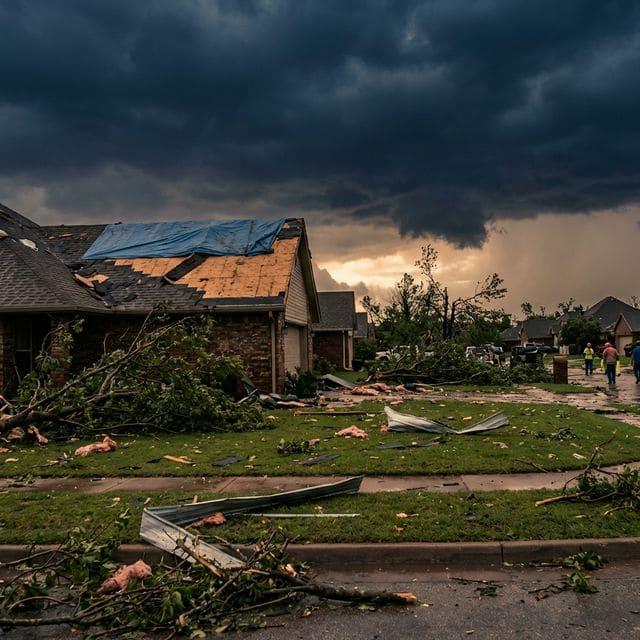
Oklahoma averages more than 50 tornadoes a year. January 2026 has already produced five confirmed tornadoes, including an EF2 that tore through Purcell, ripped the roof off a home, and damaged a semi-truck on I-35. November 2024 storms caused nearly $44 million in property damage across Oklahoma County alone. Peak season — late April through early June — is only weeks away. And when it arrives, Oklahoma homeowners will face two storms: the one that damages their property, and the one that follows when they file an insurance claim.
The second storm is the one most people are unprepared for. Every year, thousands of Oklahoma families discover that the insurance company they have been paying premiums to for years is less interested in making them whole than in minimizing its own payout. Understanding how this process works — and what your rights are when it breaks down — can mean the difference between rebuilding your life and being left with a fraction of what you are owed.
How Oklahoma Insurers Handle Storm Claims
When a tornado or severe storm damages your home, the process should be straightforward: you file a claim, an adjuster inspects the damage, and the insurer pays what it costs to repair or replace what was lost. In practice, that process is designed at every stage to reduce the insurer's exposure.
The First Adjuster Is Not Your Advocate
The adjuster your insurance company sends to inspect your property works for the insurance company. Their job is to document the damage in a way that supports the lowest defensible payout. This does not mean every adjuster is dishonest — many are competent professionals doing their job fairly. But the incentive structure is unmistakable: the company profits when claims are paid at the lowest possible amount.
Common adjuster tactics include attributing storm damage to pre-existing conditions or normal wear, scoping repairs narrowly so that related damage is excluded from the estimate, using pricing databases that may not reflect labor and materials in your specific market, and photographing damage selectively to support a lower estimate. If the adjuster's initial estimate feels low, do not guess. Compare it against the policy, the photographs, and an independent repair estimate.
Depreciation and "Actual Cash Value" Games
Most Oklahoma homeowners policies are written on a "replacement cost" basis, meaning the insurer should pay what it actually costs to repair or replace the damaged property with materials of similar kind and quality. But insurers rarely pay the full replacement cost upfront.
Instead, they issue an initial payment based on "actual cash value" — which is the replacement cost minus depreciation. The theory is that your ten-year-old roof was not worth as much as a new roof, so the insurer deducts for age and wear. The remaining depreciation is supposed to be paid once you complete repairs and submit documentation, known as the "recoverable depreciation" payment.
The problems emerge in how depreciation is calculated. Many insurers aggressively depreciate building components — sometimes including labor costs, overhead, and other line items the policyholder may have a basis to challenge. Labor does not wear out in the same way a shingle does. Whether labor depreciation is allowed depends on the policy language and current law, so the actual cash value calculation deserves a close review before you accept it.
The Delay Playbook
Time is the insurer's most powerful weapon. The longer a claim stays open, the more pressure builds on the homeowner to accept whatever is offered. Your roof is tarped. You may be living in a hotel or with family. Contractors are booked for months after a major storm. Every week that passes without resolution costs you money, stress, and negotiating leverage.
Oklahoma law requires insurers to acknowledge claims promptly and to complete their investigation within a reasonable time. But "reasonable" is elastic, and delay can become a pressure tactic. When an insurer repeatedly asks for the same information, ignores repair evidence, or lets a covered claim sit without a clear explanation, the conduct may cross from slow handling into bad faith.
Common delay tactics include repeatedly requesting documentation the policyholder has already provided, sending second and third adjusters to "re-inspect" the damage, claiming they need to investigate whether the damage was caused by the specific storm event in question rather than a prior event, and requiring policyholders to submit to recorded statements or examinations under oath before processing the claim.
Oklahoma Bad Faith Law: Your Counterweight
Oklahoma has some of the strongest insurance bad faith protections in the country. When an insurer crosses the line from aggressive claims handling to unreasonable conduct, the policyholder is not limited to recovering the amount of the original claim. Oklahoma law provides powerful additional remedies.
Common-Law Bad Faith and 36 O.S. § 3629
Oklahoma's bad faith claim is a common-law claim recognized by the Oklahoma Supreme Court. It arises when an insurer breaches the implied duty of good faith and fair dealing by handling the claim unreasonably. 36 O.S. § 3629 is different. It requires the insurer to respond to a proof of loss within the statutory framework and can shift attorney's fees and costs to the prevailing party in covered disputes.
A successful storm-claim case may yield the amount owed under the policy, consequential damages caused by the insurer's conduct, reasonable attorney's fees and costs when the fee statute applies, interest, and punitive damages if the insurer's conduct was sufficiently egregious.
The potential availability of attorney's fees is particularly important in storm damage cases. Many homeowners do not challenge low estimates because they assume they cannot afford an attorney. Fee-shifting can make a valid dispute economically possible to pursue, but it depends on the statute, the policy, the outcome, and the way the claim is presented.
What Makes a Denial "Bad Faith"?
Not every denied or underpaid claim constitutes bad faith. Insurers are entitled to investigate claims, interpret policy language, and make reasonable coverage determinations. Bad faith occurs when the insurer's conduct is unreasonable under the circumstances — when there is no legitimate basis for the denial or delay, or when the insurer ignores evidence supporting the claim.
Examples of bad faith conduct in storm damage cases include denying a claim without conducting any meaningful investigation, relying on an adjuster's estimate that is so low it has no reasonable basis, refusing to pay for damage that is clearly covered under the policy, failing to communicate with the policyholder about the status of their claim, and interpreting policy exclusions in a way that contradicts the plain language of the policy.
The Oklahoma Supreme Court has emphasized that the bad faith standard is an objective one: would a reasonable insurer have handled the claim this way? If the answer is no, the insurer is exposed to bad faith liability regardless of its subjective intent.
SB 726 Did Not Become Oklahoma Law
In 2025, State Farm requested SB 726, a bill that would have exempted property insurance claims from the 15% interest provision in 36 O.S. § 3629 — a rule that makes claim delay expensive for insurers. The House rejected it 72-18. That matters for two reasons: the interest provision still applies to property claims, and no failed bill created any new pre-suit requirement for Oklahoma bad faith claims.
The attempted change still offers a practical lesson: insurers understand the financial exposure created by Oklahoma bad faith law and will keep looking for ways to narrow it. If your storm damage claim has been denied or underpaid, get advice based on current law, not stale bill summaries or carrier talking points.
Steps to Protect Yourself Before the Storm
The best time to prepare for an insurance dispute is before you have one. The following steps can dramatically strengthen your position if you ever need to file a storm damage claim.
Document Your Property Now
Walk through your home — inside and out — and take comprehensive video and photographs. Record the condition of your roof, siding, windows, fencing, outbuildings, and landscaping. Note the brand, model, and approximate age of major systems like HVAC units, water heaters, and appliances. Store this documentation in the cloud or on a device that will not be in the home during a storm.
This pre-storm documentation serves two purposes. First, it establishes a baseline that forecloses the insurer's argument that damage was pre-existing. Second, it helps your contractor or public adjuster prepare an accurate repair estimate by showing the materials and finishes that need to be matched.
Read Your Policy
Most homeowners have never read their insurance policy. This is understandable — the documents are dense and filled with jargon. But there are specific provisions you should understand before a storm hits.
Know your deductible. Many Oklahoma homeowners policies now include a separate "wind and hail" deductible that is a percentage of the home's insured value rather than a flat dollar amount. A 2% wind/hail deductible on a home insured for $300,000 means you pay the first $6,000 out of pocket — far more than the standard $1,000 or $2,500 deductible that applies to other losses.
Know the difference between replacement cost and actual cash value coverage. Know whether your policy covers the full cost of code upgrades if your home must be brought up to current building codes during repairs. Know your policy's time limits for filing claims, completing repairs, and submitting documentation for recoverable depreciation.
Understand Your Policy Limits
Your policy has a coverage cap — the maximum the insurer will pay for a covered loss. If your home is underinsured, no amount of negotiation will make the insurer pay more than the policy limit. Review your coverage annually and adjust it as construction costs increase, which they have substantially in Oklahoma since 2020.
What to Do After a Storm
When a tornado or severe storm damages your property, the steps you take in the first hours and days are critical.
Protect yourself first. Do not enter a structurally compromised building. If you must return to retrieve essentials, document the conditions as you go.
Make emergency repairs to prevent further damage. Cover holes in the roof with tarps. Board broken windows. Remove standing water. These are called "mitigation" efforts, and your policy requires you to take reasonable steps to prevent additional damage. Keep every receipt — your insurer is obligated to reimburse these costs.
Document everything. Before any cleanup or permanent repairs, photograph and video every area of damage from multiple angles. Include wide shots for context and close-ups for detail. Photograph damaged personal property before discarding it. Create an inventory of damaged items with descriptions, approximate ages, and estimated replacement costs.
File your claim promptly. Contact your insurer as soon as possible. Follow up in writing — an email to your agent confirming the date of loss, the nature of the damage, and when you reported it. This creates a paper trail that protects you if the insurer later claims you delayed reporting.
Get your own estimate. Do not rely solely on the insurer's adjuster. Hire a reputable, licensed contractor to provide an independent repair estimate. The gap between the insurer's estimate and an independent estimate is often substantial, and having your own estimate gives you a concrete basis for negotiation. For larger losses, consider hiring a public adjuster — a licensed professional who represents policyholders in the claims process.
Do not sign a release until you understand what you are agreeing to. Insurers sometimes include release language in settlement checks or accompanying documents that waives your right to seek additional payment. Read everything before signing, and consult an attorney if the language is unclear.
When to Get a Lawyer Involved
Not every storm damage claim requires an attorney. If your insurer processes your claim promptly and pays a fair amount, count yourself fortunate. But if you encounter any of the following situations, it is time to consult a storm damage insurance attorney:
Your claim has been denied outright with an explanation that does not match what your policy says. Your insurer's estimate is dramatically lower than your contractor's estimate and the insurer refuses to negotiate meaningfully. Your claim has been open for months with no resolution and no clear explanation for the delay. Your insurer is depreciating disputed line items, reducing your actual cash value payment below what appears reasonable. You have been asked to submit to an examination under oath, which can signal that the insurer is preparing a coverage defense. The damage is extensive enough that the financial stakes justify professional representation.
Oklahoma's bad faith framework — including potential attorney's fees — means that qualified attorneys can often represent homeowners in serious storm damage disputes on a contingency basis. You should not let the assumed cost of legal representation prevent you from challenging an unfair claim outcome.
Frequently Asked Questions
How long does my insurance company have to process a storm damage claim in Oklahoma?
Oklahoma law does not specify a rigid deadline, but the Oklahoma Insurance Department's regulations require insurers to acknowledge claims promptly and complete investigations within a reasonable timeframe. As a practical matter, if your claim has been pending for more than 30 to 45 days without meaningful progress, the insurer may be engaging in the kind of delay that supports a bad faith claim.
Can my insurer deny my claim because my roof was old?
Age alone is not a valid basis for denial if the damage was caused by a covered storm event. Your policy covers storm damage regardless of the age of your roof — though the age may affect the depreciation applied to the initial actual cash value payment. If your insurer denies your claim entirely because your roof was "at the end of its useful life," that denial may constitute bad faith.
What is the difference between a public adjuster and a contractor estimate?
A contractor provides an estimate for what it will cost to repair the damage. A public adjuster is a licensed professional who reviews your policy, documents the loss, and negotiates with your insurer on your behalf. Public adjusters typically charge a percentage of the claim proceeds (often 10-15%). Both can be valuable, but they serve different roles. For larger or more complex losses, a public adjuster's expertise in navigating the claims process can be worth the fee.
Should I accept the insurance company's first offer?
Do not accept it until you understand what it covers and what it leaves out. The initial offer is typically based on the insurer's adjuster's estimate, which may be lower than the actual cost of repairs. You have every right to negotiate, submit your own estimate, and request a re-inspection. Accepting the first offer without getting an independent assessment is one of the most common and costly mistakes homeowners make after a storm.
Does SB 726 mean I have to give pre-suit notice before suing my insurance company?
No. SB 726 failed in 2025 and did not add a new Oklahoma pre-suit notice requirement for bad faith claims. You still need to follow the policy, preserve proof of loss, and comply with any deadlines that do apply, which makes it important to consult an attorney early rather than relying on outdated summaries.
What if my insurer says the damage was caused by a previous storm?
This is a common tactic, especially after Oklahoma experiences multiple storm events in a short period. The insurer bears the burden of proving that the damage was caused by a prior event rather than the one you reported. Your pre-storm documentation (photographs, video, prior inspection reports) is your best defense against this argument. If the insurer cannot point to specific evidence of prior damage, attributing your loss to an earlier storm is unreasonable.
Can I choose my own contractor, or do I have to use the insurer's preferred vendor?
You have the right to hire any licensed contractor you choose. Your insurer may recommend or even pressure you to use a "preferred vendor" or contractor from their network, but you are under no legal obligation to do so. Insurer-preferred vendors may have financial relationships with the insurer that create conflicts of interest. Choosing your own contractor ensures that someone whose loyalty is to you — not the insurance company — is assessing the damage and performing the repairs.
Storm Damage Claim Denied or Underpaid?
If your insurance company is dragging its feet, lowballing your claim, or denying coverage you paid for, Addison Law Firm can help. We represent Oklahoma homeowners in insurance bad faith cases on contingency — you pay nothing unless we recover for you.
Get a Free Consultation →This article is for general information only and is not legal advice.