
Key Takeaways
- Three Classes of Gaming: The Indian Gaming Regulatory Act classifies all gaming into three categories — each with different regulatory requirements and different degrees of state involvement.
- Compacts Are Required for Class III: Slot machines, banked table games, and sports betting generally require a valid Tribal-State Compact or federal substitute procedure.
- Revenue Requirements: Tribal gaming revenues must be used for government operations, general welfare, economic development, or charity — not unlimited private distribution.
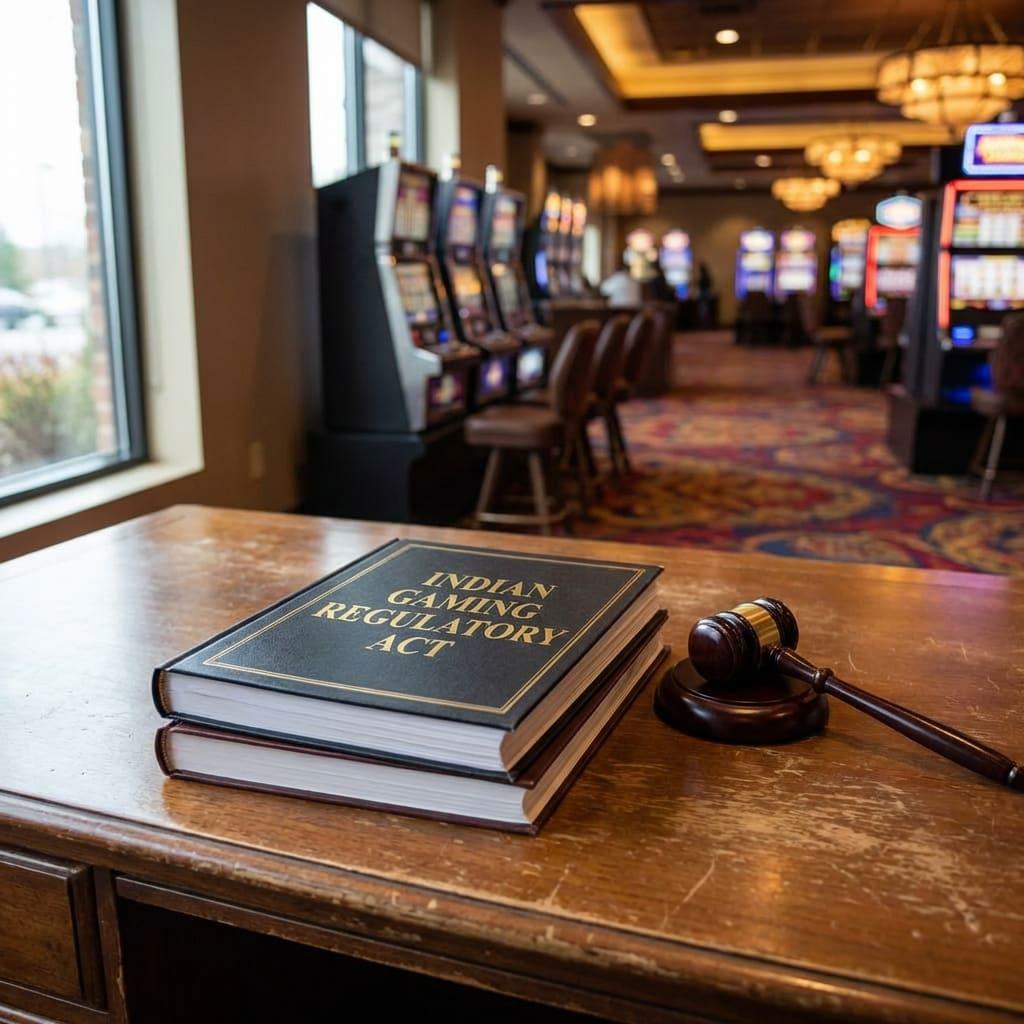
If you've visited an Oklahoma tribal gaming facility, you've participated in an industry built on a specific federal law: the Indian Gaming Regulatory Act of 1988, codified at 25 U.S.C. § 2701 et seq. IGRA did not just permit tribal gaming — it created the regulatory framework that makes modern tribal gaming operations possible, balancing tribal sovereignty with state interests and federal oversight in a structure that remains both powerful and contested more than three decades later.
Before IGRA, the legal landscape for tribal gaming was chaotic. The Supreme Court's 1987 decision in California v. Cabazon Band of Mission Indians established that states could not regulate gaming on sovereign tribal land where the state permitted similar gambling activities elsewhere. This ruling left tribes free to operate essentially unregulated gaming operations — a result that concerned states, Congress, and many tribes themselves. IGRA was Congress's compromise: a framework that affirmed the right of tribes to conduct gaming on tribal lands, provided a federal regulatory structure, and created mechanisms for tribal-state cooperation on the most economically significant forms of gaming.
The Three Classes of Gaming
IGRA's genius — and its complexity — lies in its three-tiered classification system. Each class carries different regulatory requirements, different enforcement mechanisms, and fundamentally different relationships between tribal, state, and federal authority.
Class I gaming encompasses traditional tribal games associated with ceremonies, celebrations, or social activities with minimal prizes. These games are exclusively regulated by the tribe itself. No federal or state oversight applies, and no compact or ordinance is required. Class I gaming represents the purest expression of tribal sovereignty over gaming — the tribe decides what traditional games to offer and how to regulate them, period.
Class II gaming includes bingo and games "similar to bingo" — including pull-tabs, lotto, punch boards, and certain electronic aides to bingo — as well as non-banked card games like poker played against other players rather than the house. Class II gaming is regulated jointly by the tribe and the National Indian Gaming Commission, with no state involvement required. Many machines that look like slot machines in Oklahoma casinos are actually Class II electronic bingo devices — mathematically based on bingo patterns rather than random number generation, even though the player experience closely resembles a traditional slot machine. This classification has been the subject of extensive litigation, because the economic distinction between a Class II electronic bingo machine and a Class III slot machine matters enormously: one requires state cooperation and revenue sharing, the other does not.
Class III gaming is everything else — the casino-style operations most people think of when they hear "tribal gaming." Slot machines with random number generators, blackjack, craps, roulette, sports betting, and all other banked card games fall into Class III. This category generates much of the revenue people associate with casino gaming, and it comes with the most significant regulatory requirements: a Tribal-State Compact or federally approved substitute procedure must be in place before Class III gaming can lawfully operate.
The Tribal-State Compact
The compact requirement is IGRA's most consequential and most controversial provision. For Class III gaming, tribes must negotiate and enter into a valid compact with the state government unless federal Secretarial Procedures apply. The compact defines the scope of authorized gaming — which specific games can be offered — and establishes the regulatory framework including licensing requirements, audit standards, and tort liability provisions. Most importantly for many negotiations, the compact determines the exclusivity fees — the revenue share paid to the state, typically justified as consideration for the exclusive right to offer specific types of gaming within the state.
In Oklahoma, the Model Tribal Gaming Compact approved by voters in 2004 through State Question 712 provides the standard framework for many tribal gaming operations. Exclusivity fees generally range from 4% to 10% depending on the game type, with the state receiving a portion of net revenue in exchange for the tribe's exclusive right to offer covered games. Disputes over compact renewals, exclusivity fee calculations, and proposed sports-betting changes have defined recent political battles between tribes and state officials.
IGRA requires states to negotiate compacts in good faith, but the Supreme Court's decision in Seminole Tribe v. Florida significantly limited one enforcement path by holding that Congress could not abrogate state sovereign immunity for tribal suits against states under IGRA. When states refuse to negotiate, tribes may pursue federal Secretarial Procedures through a regulatory process, but that path is slow, technical, and politically contested. The practical result is that compact negotiations require legal, political, and sovereign-to-sovereign strategy.
The National Indian Gaming Commission
IGRA created the National Indian Gaming Commission (NIGC) as an independent federal regulatory agency housed within the Department of the Interior. The NIGC's responsibilities include approving Tribal Gaming Ordinances before any tribe can begin gaming operations, reviewing and approving management contracts between tribes and third-party gaming operators, conducting audits and compliance investigations, and enforcing federal gaming regulations through civil penalties, closure orders, and other enforcement actions.
The NIGC's oversight role is most significant for Class II gaming, where it serves as the primary federal regulator. For Class III gaming, regulatory authority is shared among the tribe, the state under compact terms, and federal oversight in areas such as ordinances, management contracts, and enforcement. This layered regulatory structure creates complexity, but it also provides accountability mechanisms that protect tribal gaming revenues from mismanagement or diversion.
Tribal Gaming Ordinances
Before a tribe can operate any gaming activity, it must enact a Tribal Gaming Ordinance approved by the NIGC Chair. The ordinance must establish that the tribe retains sole proprietary interest in all gaming activity — preventing outside parties from controlling tribal gaming operations. It must specify that net revenues are used for approved purposes: government operations, general welfare programs, economic development, charitable contributions, or funding for local government agencies. And it must require independent annual audits of all gaming operations.
These requirements ensure that gaming revenue serves the tribal community rather than enriching private operators. When tribes make per capita distributions of gaming revenue to individual members, the ordinance must include a revenue allocation plan approved by the Secretary of the Interior — an additional layer of oversight designed to balance individual distributions against the needs of tribal government and community services.
Why IGRA Matters Today
IGRA remains the bedrock of tribal economic independence. Across the country, tribal gaming generates tens of billions of dollars in annual revenue, funding healthcare, education, infrastructure, law enforcement, and cultural preservation programs that would otherwise depend heavily on federal funding. In Oklahoma, tribal gaming operations employ thousands of people and generate economic activity that ripples throughout the state economy.
But IGRA was drafted in 1988, before the internet, before mobile betting, and before the sports betting revolution triggered by the Supreme Court's 2018 decision in Murphy v. NCAA. Today's gaming landscape raises questions that IGRA's drafters never anticipated. Does a bet placed on a mobile device physically located off tribal land but processed through a server on tribal land "occur" on tribal land for IGRA purposes? Can existing compacts be interpreted to authorize sports betting, or do new compact provisions need to be negotiated? In Oklahoma, sports betting remains a legislative and compact-negotiation issue rather than a live, generally authorized market.
These questions will shape the next decade of Indian gaming — and the answers will determine whether IGRA's framework adapts to modern gaming or becomes an obstacle that requires congressional action to update. For tribal leaders, gaming commissioners, and industry partners, understanding IGRA's structure is essential for navigating both current operations and future strategy.
At Addison Law, we advise tribal governments on IGRA compliance, compact strategy, NIGC regulatory matters, and the full range of tribal sovereignty issues that affect gaming operations. Contact us to discuss how we can help protect your tribe's gaming enterprise.
Frequently Asked Questions
What's the difference between Class II and Class III gaming?
Class II includes bingo and bingo-like games, including certain electronic aids to bingo, regulated by the tribe and the NIGC without state compact approval. Class III covers everything else — slots, blackjack, sports betting, and other banked games — and generally requires a Tribal-State Compact or federal substitute procedure. Some machines that look like slot machines are Class II electronic bingo devices, a distinction with significant legal and financial implications.
Do tribes have to share gaming revenue with the state?
For Class III gaming, the Tribal-State Compact typically includes exclusivity fees — a revenue share paid to the state in exchange for the tribe's exclusive right to offer certain types of gaming. In Oklahoma, these fees generally range from 4% to 10% depending on the game type. Class II gaming does not require revenue sharing with the state.
Can tribes offer sports betting under IGRA?
Sports betting is generally treated as Class III gaming, so it requires authorization through a Tribal-State Compact or lawful substitute procedure. Oklahoma has not enacted a regulated sports-betting framework; our 2026 Oklahoma sports-betting status guide tracks the latest bill history and compact issues.
What happens if a tribe operates gaming without a valid compact?
Class III gaming without a valid Tribal-State Compact or federal substitute procedure is generally unlawful. The NIGC can issue closure orders, assess civil fines, and take enforcement action. In limited circumstances, federal Secretarial Procedures can substitute for a compact when the IGRA process has been followed, but this path is lengthy and politically uncertain.
How many tribal gaming facilities operate in Oklahoma?
Oklahoma has one of the country's largest tribal gaming markets. The Model Tribal Gaming Compact framework, approved by Oklahoma voters in 2004 through State Question 712, provides the standardized agreement structure for many operations. The scope and economic significance of this market make IGRA compliance particularly consequential in the state.
Can non-tribal entities manage a tribal casino?
Yes, but with significant regulatory oversight. IGRA requires that any management contract between a tribe and a third-party gaming operator be reviewed and approved by the NIGC. Management fees are capped (typically at 30%, or 40% in exceptional circumstances), contracts are limited to seven years, and the tribe must retain sole proprietary interest in gaming activity. These provisions ensure that tribal gaming operations ultimately serve tribal communities rather than outside investors.
What role does the Secretary of the Interior play in tribal gaming?
The Secretary of the Interior has several critical roles: approving revenue allocation plans for per capita distributions, authorizing Secretarial Procedures when states refuse to negotiate compacts in good faith, and overseeing the NIGC's regulatory functions. The Secretary's approval is also required for certain land-into-trust applications that affect gaming eligibility under IGRA's "Indian lands" requirements.
Need Tribal Gaming Compliance Counsel?
From drafting ordinances to navigating NIGC audits and compact negotiations, we help tribes protect their gaming operations.
Contact Our Tribal Law Practice →This article is for general information only and is not legal advice.