
Key Takeaways
- Waivers are enforceable in Oklahoma — but only conditionally: In Schmidt v. United States, 1996 OK 29, the Oklahoma Supreme Court held that a release is enforceable only if its language clearly and unambiguously covers the claim, the parties had no vast disparity of bargaining power, and enforcement would not violate public policy.
- No waiver covers everything: The Schmidt Court said an exculpatory clause "will never avail to relieve a party from liability for intentional, willful or fraudulent acts or gross, wanton negligence." A signed release does not end the analysis when the conduct went beyond ordinary carelessness.
- A posted sign is not the same as a signed waiver: Under 15 O.S. § 212.1, a unilateral notice by which a for-profit business tries to exempt itself from negligence liability for personal injury is "void as against public policy and wholly unenforceable." A unilateral notice is different from a signed agreement.
- Children are different: In Wethington v. Swainson (W.D. Okla. 2015), a federal court applying Oklahoma law held that a minor could disaffirm the release she signed and predicted that the Oklahoma Supreme Court would not enforce a pre-injury waiver signed by parents on a child's behalf.
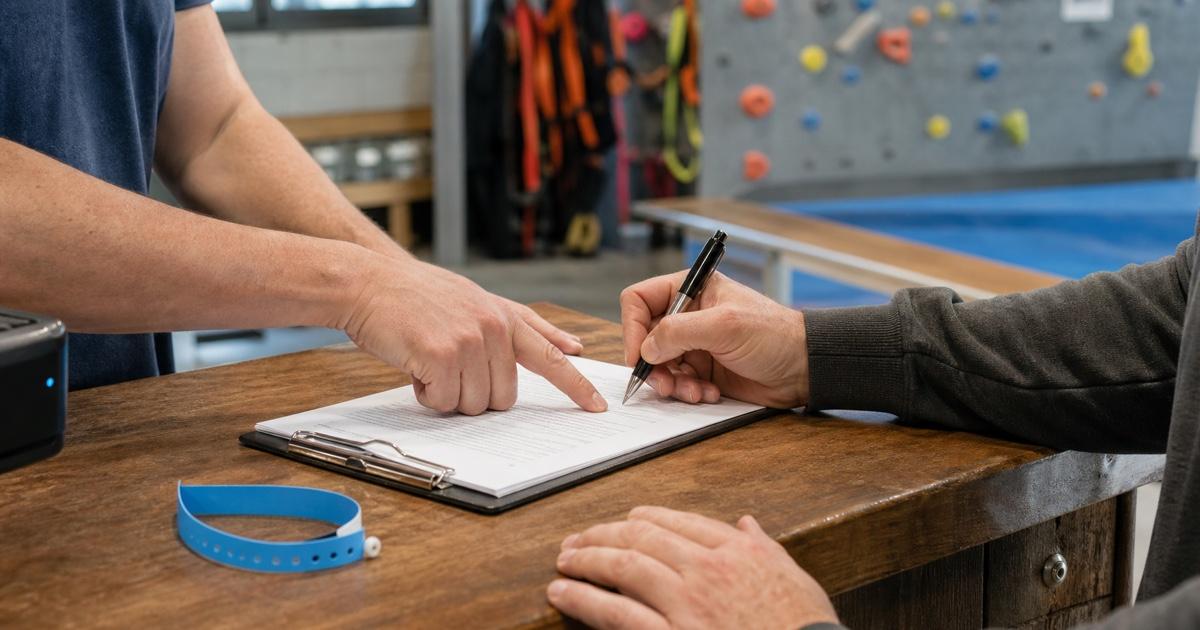
Before the trampoline park, the gym, the climbing wall, the go-kart track, or the boat rental counter lets you in, someone slides a form across the desk: a release of liability. Most people sign without reading, and many assume that signature means no lawsuit, ever, no matter what happens. Oklahoma law is more complicated — and more protective — than that. Courts here do enforce waivers, and anyone who signs one should take it seriously. But enforcement comes with strict conditions, several categories of conduct can never be waived, and waivers signed by or for children stand on much weaker footing. This guide explains what the Oklahoma Supreme Court has actually held, where the limits are, and what questions matter if you were seriously hurt after signing one.
This is general information, not legal advice, and no article substitutes for a lawyer's review of a specific document and specific facts. Our firm handles personal injury and premises liability cases across Oklahoma.
The controlling test: Schmidt v. United States
The modern framework comes from Schmidt v. United States, 1996 OK 29, 912 P.2d 871. Elizabeth Schmidt was injured in a horseback riding accident at a government-operated stable at Fort Sill after signing a rental agreement releasing the stable "from any liabilities or claims arising from my participation." She sued in federal court, and the United States District Court for the Western District of Oklahoma certified the enforceability question to the Oklahoma Supreme Court.
Answering in 1996, the Court held that exculpatory clauses for personal injury can be valid in Oklahoma — but only if three preconditions are met: (1) the clause's language clearly, definitely and unambiguously displays an intent to insulate the defendant from the type of liability the plaintiff seeks to impose; (2) no vast disparity of bargaining power existed between the parties when the agreement was signed; and (3) enforcement would not violate public policy.
The procedural posture matters. The Supreme Court did not decide whether Ms. Schmidt's waiver was enforceable — it answered the certified legal questions and sent the case back, stating that "[t]he validity of the Schmidt/Stables exculpatory clause in suit depends on the outcome of the fact-finding investigation to be conducted in the certifying court." Schmidt supplies the test; whether a given waiver passes it is a case-by-case question.
Prong by prong: how the test works
Clear and unambiguous language. The release must "clearly and cogently (1) demonstrate an intent to relieve that person from fault and (2) describe the nature and extent of damages from which that party seeks to be relieved." The released tortfeasor, the wrongful conduct covered, and the type and extent of damages must all fall fairly within the parties' contemplation. A waiver is read against what it actually says, not what the business later wishes it said.
Bargaining power. Courts look at two things: how important the activity was to the signer's physical or economic well-being, and how much free choice the signer had to go elsewhere. Manning satisfied this prong where the participant could decline and was given alternatives. An essential service or a setting without meaningful choice may present a different question.
Public policy. A waiver cannot injure public health, public morals, or confidence in the administration of law, and cannot destroy the security of individual rights to personal safety. The Schmidt Court gave a historical example: agreements exonerating a common carrier from negligence liability have long been held invalid.
When the language is too vague: Burd v. KL Shangri-La Owners
Oklahoma has also applied Schmidt to reject a signed release. In Burd v. KL Shangri-La Owners, L.P., 2003 OK CIV APP 31, 67 P.3d 927, a tennis-league player signed a preseason form that purported to release "any facility." She was later injured at a resort she did not know would be on the league schedule when she signed.
The trial court granted summary judgment to the resort, but the Oklahoma Court of Civil Appeals reversed. The court held that the general release was insufficient under Schmidt: the resort was unnamed and unknown when the form was signed, the form did not identify the risks or duration of the waiver, and the signature could have acknowledged league rules or roster participation rather than an intent to release that resort from negligence liability. Burd shows why a signature alone does not end the analysis.
What a waiver can never cover
Two additional limits apply even when the three-part Schmidt test is otherwise met.
First, by statute, 15 O.S. § 212 makes contracts void that attempt "to exempt any one from responsibility for his own fraud, or willful injury to the person or property of another or violation of law, whether willful or negligent."
Second, the Schmidt Court stated flatly that an exculpatory clause "will never avail to relieve a party from liability for intentional, willful or fraudulent acts or gross, wanton negligence." Gross negligence is defined by 25 O.S. § 6 as the "want of slight care and diligence." A waiver therefore may bar an ordinary-negligence theory but cannot excuse gross or wanton negligence. That does not establish gross negligence; the theory still must be supported by the evidence.
One caution the case law makes equally clear: labels are not enough. In Manning v. Brannon (discussed below), the plaintiff argued gross negligence on appeal, but the court found he had pleaded and tried the case on ordinary negligence only, with no gross-negligence evidence or jury instructions — so the waiver controlled. A gross-negligence theory must be properly preserved and supported by evidence.
Posted signs and unilateral notices: 15 O.S. § 212.1
Oklahoma draws a sharp line between a signed contract and a posted notice. Under 15 O.S. § 212.1, any notice by which a for-profit business serving the general public "seeks to exempt the business entity from liability for personal injury caused by or resulting from any acts of negligence" is "deemed void as against public policy and wholly unenforceable."
For a for-profit business serving the public, a unilateral sign or similar notice cannot by itself exempt the business from liability for personal injury caused by negligence. Section 212.1 does not make every ticket or receipt irrelevant; Manning distinguishes unilateral notices from a plain and unambiguous written contract the participant understood, signed, and accepted.
When detailed waivers are enforced
Anyone tempted to dismiss waivers as unenforceable should read Manning v. Brannon, 1998 OK CIV APP 17, 956 P.2d 156. Clark Manning took a skydiving course in 1992, watched a video in which an attorney explained the release, and signed and initialed the exculpatory contract in fourteen places. On his third jump, both parachutes deployed simultaneously; he cut away the main chute, spiraled, and was injured falling into a pond. He sued, and a McClain County jury found both sides 50% negligent and awarded him damages.
The Oklahoma Court of Civil Appeals reversed in a published, precedential opinion. Applying Schmidt, the court held the release was clear and unambiguous, that Manning had free choice (he was offered his money back and the names of other facilities), and that a waiver for a high-risk sport like skydiving does not violate Oklahoma public policy. Because the evidence showed nothing beyond ordinary negligence, the signed release barred the claim as a matter of law — the skydiving operator won, and the jury verdict for Manning was wiped out. One judge dissented, arguing a jury should decide such questions. Manning is the cautionary tale: a well-drafted, well-executed waiver, met with an ordinary-negligence case, can defeat the claim entirely.
The more recent decision in Combs v. West Siloam Speedway Corp., 2017 OK CIV APP 64, 406 P.3d 1064, reached the same result with a one-page racetrack form that the plaintiff characterized as a "Staff Sign in" sheet. The form was expressly titled as a release, identified the categories of people and entities protected, and repeatedly covered negligence. The court affirmed summary judgment for the defendants. It also held that the plaintiff's allegations of recklessness did not create a trial issue without supporting evidence. Read together, Burd and Combs show that substance and proof matter more than the label placed on the paper or the claim.
Children and waivers: Wethington v. Swainson
The rules shift substantially when the injured person is a minor. An important published decision applying Oklahoma law is Wethington v. Swainson, 155 F. Supp. 3d 1173 (W.D. Okla. 2015). Sixteen-year-old Makenzie Wethington went skydiving at an Oklahoma facility with her parents present. She signed and initialed the release; her parents signed a "ratification by parent/guardian" section agreeing to be bound. Her parachute malfunctioned and she was seriously injured. The operator moved for summary judgment on the release.
Ruling in December 2015, the federal court held the release was facially valid under the Schmidt test — and then refused to enforce it against Makenzie, on two grounds. First, a minor's contract is voidable at the minor's election, and her right to rescind "is unaffected by the approval or consent of a parent"; filing the lawsuit itself disaffirmed the release. Second, surveying the national case law, the court predicted the Oklahoma Supreme Court would hold that a pre-injury exculpatory agreement "signed by parents on behalf of their minor children, is unenforceable." The court's policy analysis relied in part on the minor-settlement law in effect in 2015, which required judicial approval before a parent could settle a child's existing claim. The outcome was split: the minor's negligence claim survived and went forward, while her mother's own individual claims were barred by the release the parents had signed for themselves.
Oklahoma amended 12 O.S. § 83 effective November 1, 2024. The current statute permits a limited out-of-court process for certain minor settlements with net proceeds above $1,500 and no more than $25,000, subject to its affidavit, deposit, and fund-protection requirements. That procedural amendment did not decide whether a parent's pre-injury waiver binds a child or overrule Wethington. It does mean the opinion's discussion of the then-existing settlement procedure should be read in its historical context. Our minor-settlement guide explains the current procedure.
Wethington has two important limits. It is a federal district court's prediction of Oklahoma law — the Oklahoma Supreme Court itself has not squarely decided whether a parental pre-injury waiver binds a child, so the question is not finally settled. And the decision did not leave businesses unprotected: the mother's own claims were still barred by what she signed. Families should not assume a waiver is meaningless — or that it is bulletproof.
What this means in practice
If you or your child was seriously hurt after signing a waiver, the document is the beginning of the analysis, not the end. The questions that matter track the law above: What does the release actually say, and does its language cover this defendant and this kind of harm? Was it a signed agreement or only a unilateral notice? Is there evidence the operator's conduct went beyond ordinary negligence? Was the injured person a minor? Those facts help determine whether the waiver reaches the claim and whether another rule makes it unenforceable. The analysis usually requires both the signed document and evidence about the incident.
If a claim is not barred by the waiver, Oklahoma's ordinary tort rules and defenses may still apply, including comparative negligence. The underlying duty may also depend on the setting, including the rules in our premises liability guide. Waiver questions often arise in recreation cases, including boat rentals and swimming facilities.
Deadlines
A waiver does not extend the filing deadline. Many Oklahoma negligence claims have a two-year limitations period under 12 O.S. § 95, but important exceptions apply. Our statutes of limitations guide covers the different rules for claims involving minors, and claims against a government entity have the much shorter notice process described in our GTCA guide.
Frequently asked questions
I signed a waiver at the gym. Can I still sue if I was hurt?
Sometimes. A signed gym waiver that meets the Schmidt test can bar an ordinary negligence claim. But it cannot bar claims for gross negligence, willful injury, or fraud, and it only covers what its language actually describes. Whether your facts fit an exception requires reviewing the document and the evidence.
My child signed a waiver at a trampoline park. Does it bar their claim?
Under Wethington, a minor can generally disaffirm a contract they signed, and the federal court predicted Oklahoma would not enforce a pre-injury waiver signed by parents on a child's behalf — though the Oklahoma Supreme Court has not finally resolved the parental-waiver question. A parent's own claims may still be barred by what the parent signed. These cases warrant prompt legal review.
The business just had a sign saying they're not responsible for injuries. Does that count?
If the sign was only a unilateral notice from a for-profit business serving the public, no. Section 212.1 makes that kind of negligence disclaimer unenforceable. A signed agreement requires the separate Schmidt analysis.
Are waivers ever thrown out even when an adult signed them?
Yes. A release may fail when its language does not clearly cover the claim or defendant, when there was a vast disparity of bargaining power, or when enforcement would violate public policy. It also cannot excuse gross or wanton negligence, willful injury, or fraud under 15 O.S. § 212 and Schmidt.
Every case is different, and nothing here is a prediction or guarantee about any particular claim. If you or a family member was seriously injured after signing a release — or at a business that claims a waiver protects it — an Oklahoma attorney can review the document and the facts. Contact us for a free consultation.
A Signature Is Only Part of the Story
Keep the release, incident report, photos, video, and messages about what happened. The wording of the document and the evidence both matter.
Talk to an Oklahoma Injury Lawyer