
Key Takeaways
- Asking Is Illegal, Not Just Requiring: The federal Employee Polygraph Protection Act, 29 U.S.C. § 2002, makes it unlawful for most private employers to "require, request, suggest, or cause" an employee or applicant to take a lie detector test — and separately illegal to fire, discipline, or refuse to hire someone for declining one or based on a test's results.
- Government Jobs Are Different: The Act does not apply to federal, state, or local government employers (29 U.S.C. § 2006(a)). That is why an Oklahoma police department or sheriff's office can lawfully polygraph applicants while a private company generally cannot.
- You Can Sue: An employer who violates the Act is liable to the affected worker for relief including employment, reinstatement, promotion, and lost wages and benefits, in federal or state court, with a three-year deadline (29 U.S.C. § 2005(c)). The U.S. Department of Labor can separately assess a civil penalty of up to $26,262 per violation at 2026 rates.
For most Oklahoma workers, the answer is no — a private employer cannot make you take a lie detector test, and cannot legally even ask. The federal Employee Polygraph Protection Act of 1988 makes it unlawful for private employers engaged in commerce to require, request, suggest, or cause any employee or job applicant to take a lie detector test, to use or ask about the results of one, or to fire, discipline, or refuse to hire anyone for declining. The protection is broad, but it is not universal: government employers are exempt, and a handful of narrow private-sector exemptions exist for certain theft investigations, security firms, and drug manufacturers — each hedged with strict conditions that employers routinely get wrong. This article explains who the Act covers, when a polygraph can lawfully be requested in Oklahoma, and what you can do if you were tested, pressured, or fired.
This article is general legal information, not legal advice about any specific situation. Polygraph disputes turn on exactly who asked for what, when, and in writing — details that need individual review.
The Federal Rule: No Tests, No Asking, No Punishment
The Employee Polygraph Protection Act (EPPA) works in three layers. Under 29 U.S.C. § 2002, a covered private employer may not (1) directly or indirectly require, request, suggest, or cause any employee or prospective employee to take a lie detector test; (2) use, accept, refer to, or inquire about the results of any lie detector test; or (3) discharge, discipline, discriminate against, or deny employment or promotion to anyone who refuses a test or based on a test's results. A fourth provision prohibits retaliation against workers who file complaints or testify in proceedings under the Act.
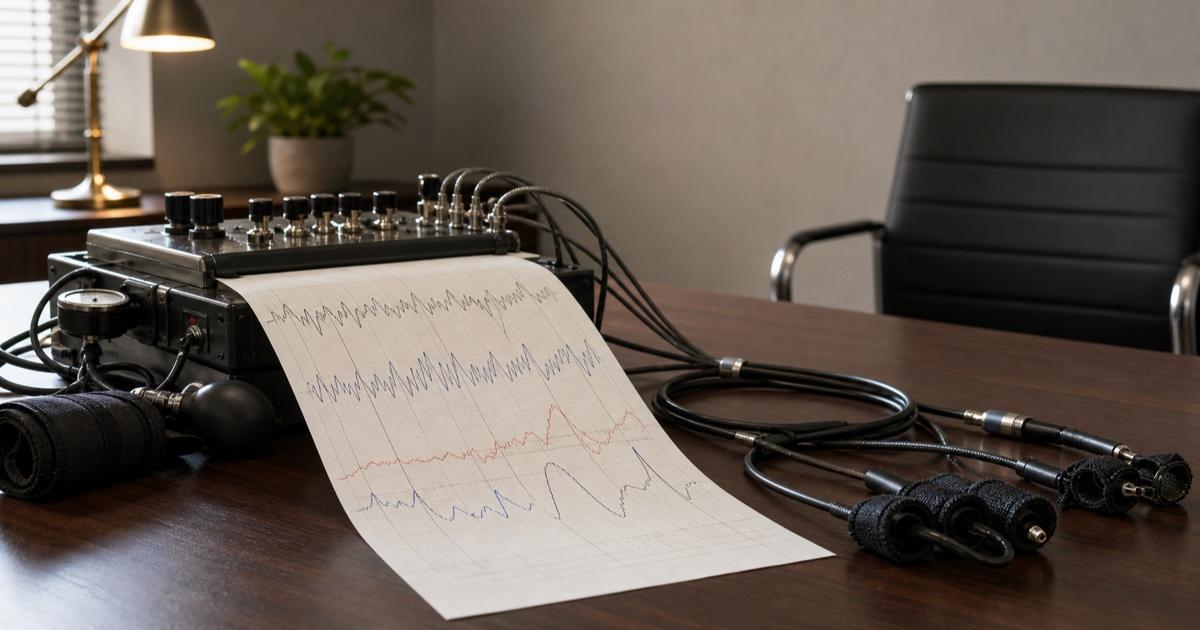
The statute's definition of "lie detector" is wider than the polygraph machine most people picture. Under 29 U.S.C. § 2001(3), it includes "a polygraph, deceptograph, voice stress analyzer, psychological stress evaluator, or any other similar device (whether mechanical or electrical)" used to render a diagnostic opinion about honesty. An employer who runs a recorded phone interview through voice-stress software is inside the statute just as surely as one who wires an employee to a polygraph. Because the definition is limited to devices, however, it does not reach written honesty questionnaires (29 C.F.R. § 801.2(d)(2)) or drug testing — Oklahoma drug testing is governed by a separate framework covered in our workplace drug testing guide.
Employers are also required to post a notice of EPPA rights where employee notices are customarily posted (29 U.S.C. § 2003). If you have never seen the poster, that is itself a detail worth mentioning to a lawyer.
Why Government Jobs Are Different
The Act simply "shall not apply" to the United States government, any state or local government, or any political subdivision (29 U.S.C. § 2006(a)). In practical Oklahoma terms: a city police department, county sheriff's office, or state agency can lawfully make a polygraph part of its hiring process, and many law enforcement agencies do. Separate federal exemptions also allow the federal government to test certain national-security and intelligence personnel and contractors (29 U.S.C. § 2006(b)–(c)).
The exemption belongs to the government as employer. It does not give private companies doing business with the government a general license to test their workers.
The Narrow Private-Sector Exemptions
Three exemptions let some private employers use a polygraph — and only a polygraph. Because the exemptions in 29 U.S.C. § 2006(d)–(f) are written in terms of "polygraph test" rather than "lie detector test," voice stress analyzers and similar devices remain off-limits for private employers even when an exemption applies.
The ongoing-investigation exemption is the one Oklahoma employees most often encounter. Under 29 U.S.C. § 2006(d), an employer may request — never compel — a current employee to take a polygraph only if all four conditions are met: the test is part of an ongoing investigation into an economic loss to the employer's business, such as theft or embezzlement; the employee had access to the property involved; the employer has a reasonable suspicion that the employee was involved; and, before the test, the employer gives the employee a signed written statement describing the specific incident, the loss, the employee's access, and the basis for suspecting that particular employee. The Department of Labor's implementing regulation, 29 C.F.R. § 801.12, spells out those requirements in detail, including that the statement must be signed by someone authorized to bind the company, kept for at least three years, and delivered to the employee at least 48 hours — not counting weekends and holidays — before the test. A vague hunch, or a blanket demand that everyone on the shift take a test after inventory comes up short, does not satisfy the statute.
The security-services exemption (29 U.S.C. § 2006(e)) allows certain employers whose primary business is providing armored car, security-alarm, or other security personnel to polygraph prospective employees — but only applicants who would actually protect the kinds of facilities and assets the statute lists, such as power facilities, water supplies, public transportation, currency, and proprietary information.
The controlled-substances exemption (29 U.S.C. § 2006(f)) allows employers authorized to manufacture, distribute, or dispense Schedule I–IV controlled substances — pharmaceutical manufacturers and similar businesses — to test applicants who would have direct access to those drugs, and current employees only as part of an ongoing investigation of misconduct involving loss or injury to the employer's manufacture, distribution, or dispensing of those drugs, where the employee had access to the person or property under investigation.
Even When a Test Is Allowed, Strict Rules Apply
The three private-sector exemptions come with a second statute attached. Under 29 U.S.C. § 2007, an employer relying on the ongoing-investigation exemption may not fire or discipline an employee based on a polygraph chart or a refusal to take the test without additional supporting evidence; under the security and drug exemptions, the test or refusal cannot be the sole basis for adverse action.
The same section gives every examinee a bill of rights. The employee may end the test at any time. The examiner may not ask questions about religious beliefs, racial opinions, political beliefs, sexual behavior, or union activities. Before the test, the employee must receive written notice of the date, time, and place, the right to consult legal counsel or an employee representative before each phase, the nature of the instrument, and every question to be asked — no surprise questions are permitted during the test itself. Afterward, before any adverse action, the employer must interview the employee about the results and hand over a copy of the examiner's written opinion and the questions with the charted responses. A test must run at least 90 minutes, and an examiner may not run more than five in a day.
The examiner must also carry a minimum $50,000 bond or equivalent professional liability coverage and hold a current license from the state where the test is given, if that state requires one (29 U.S.C. § 2007(c)). Oklahoma does: the Polygraph Examiners Act, 59 O.S. § 1457, makes it unlawful to administer a polygraph "without first securing a license." The Legislature continued the Polygraph Examiners Board through July 1, 2031 in the enrolled version of SB 1463, which became law without the Governor's signature on May 6, 2026 and took effect July 1, 2026. An unlicensed examiner is not a technicality: under § 2007(c), the federal exemption does not apply unless the examiner is licensed where state law requires it.
Finally, results are confidential. Under 29 U.S.C. § 2008, the examiner may disclose test information only to the examinee, someone the examinee designates in writing, the employer that requested the test, or a court, government agency, arbitrator, or mediator under a court order. The employer may disclose information to those same recipients, with one narrow addition: it may report an admission of criminal conduct to a government agency, and nothing more.
What Oklahoma Law Adds — and What It Does Not
Oklahoma's own polygraph statute regulates the examiners, not employers: the Polygraph Examiners Act sets licensing, qualification, and board-governance rules for the people who administer tests. The Oklahoma Supreme Court said it plainly in Pearson v. Hope Lumber & Supply Co., 1991 OK 112, 820 P.2d 443: the Act "does not purport to limit the actions of an employer," and Oklahoma "has not enacted legislation regarding the use of a polygraph as a condition of employment." The court therefore refused to recognize a state public-policy wrongful-discharge claim for a worker fired in 1985 for refusing to sign a blanket polygraph consent form during an inventory-shortage investigation. Pearson did not decide the later-enacted federal Act, which is now the protection Oklahoma private-sector workers generally use. Federal law expressly leaves room for states to be stricter — 29 U.S.C. § 2009 preserves any state law or collective bargaining agreement "more restrictive with respect to lie detector tests" — but in Oklahoma the federal floor is the operative rule.
That matters for strategy. An EPPA claim is a federal statutory claim with its own remedies and deadline; it can be brought in federal or state court, and it does not depend on Oklahoma's at-will employment exceptions. If the polygraph demand came bundled with other misconduct — say, the demand followed a discrimination complaint — the EPPA claim may sit alongside a retaliation claim or other theories. Our article on wrongful termination myths explains how at-will employment actually works in Oklahoma and where the exceptions come from.
What You Can Do If You Were Tested, Pressured, or Fired
The Act has real teeth, and using them is time-sensitive.
A private lawsuit. Under 29 U.S.C. § 2005(c), an employer who violates the Act "shall be liable" to the affected employee or applicant for legal or equitable relief, including employment, reinstatement, promotion, and payment of lost wages and benefits. You do not have to file with the Department of Labor first. The action may be filed in any federal or state court of competent jurisdiction, but no later than three years after the date of the alleged violation. A court may award costs, including attorney's fees, to the prevailing party — which can be the employer — in its discretion.
A Department of Labor complaint. The Wage and Hour Division enforces the Act. The Secretary of Labor may assess a civil money penalty — up to $26,262 per violation at 2026 rates (29 C.F.R. § 801.42(a)) — and may sue to enjoin violations and obtain reinstatement and lost wages.
No fine-print waivers. Under 29 U.S.C. § 2005(d), EPPA rights cannot be waived by contract — an application form or handbook acknowledgment "consenting" to lie detector testing is unenforceable. The only valid waiver is one contained in a written settlement, signed by the parties, of a pending EPPA action or complaint.
Evidence in these cases is often better than employees expect: the demand may be in a text or email, the written statement the ongoing-investigation exemption requires either exists or it does not, and the examiner's license, notices, question lists, and charts are all records the law required someone to create and keep. If a firing followed a refusal, the timeline itself does much of the work — a pattern familiar from other firing-after-protected-activity cases.
Asked to Take a Lie Detector Test at Work?
For most private-sector Oklahoma workers, even the request is illegal — and firing you for refusing, with nothing else behind it, is a federal violation with a three-year deadline to act. The written demands, notices, and examiner records that prove these cases are documents the law required someone to keep.
Talk to an Employment LawyerFrequently Asked Questions
Can an Oklahoma employer make a polygraph part of a job application?
A private employer almost never can. The Act prohibits requiring or even requesting a lie detector test from a "prospective employee," and refusing to hire someone for declining is a separate violation under 29 U.S.C. § 2002(3). The exceptions are narrow: government employers are exempt entirely, and certain security-services firms and controlled-substance businesses may polygraph applicants for specific sensitive positions under 29 U.S.C. § 2006(e) and (f). If you were asked to take a pre-hire polygraph for an ordinary private-sector job — retail, an office, a warehouse — that request itself likely violated federal law.
Something was stolen at work and my employer wants me to take a polygraph. Can I refuse?
Yes. Even when the ongoing-investigation exemption applies, the statute only allows the employer to request a test — you can say no, and under 29 U.S.C. § 2007(a) the employer cannot fire or discipline you for refusing without additional supporting evidence of your involvement. Be clear-eyed about what that means: the statute says the access-and-suspicion evidence that justified the request in the first place "may serve as additional supporting evidence," and so can anything you said before, during, or after the test (29 C.F.R. § 801.20). Refusing is lawful; it is not a shield against a firing the employer can otherwise document. Before any lawful request, you are entitled to a signed written statement describing the specific loss, your access to it, and the specific reasons you are suspected, delivered at least 48 hours — excluding weekends and holidays — before the test, per 29 U.S.C. § 2006(d) and 29 C.F.R. § 801.12. If your employer skipped the written statement, tested the whole shift without individualized suspicion, or fired you for saying no with nothing else to point to, those are exactly the facts an EPPA claim is built on.
My employer used voice stress analysis, not a polygraph. Does the law still apply?
Yes — and the employer's position is worse, not better. "Lie detector" under 29 U.S.C. § 2001(3) expressly includes a voice stress analyzer and psychological stress evaluator. And because the private-sector exemptions in § 2006(d)–(f) authorize only "polygraph" tests, a private employer cannot use voice stress technology on employees or applicants even in a theft investigation that would otherwise qualify. The exemptions never reach non-polygraph devices.
Can a new employer ask whether I ever took or failed a polygraph at an old job?
A covered private employer may not "use, accept, refer to, or inquire concerning" the results of any lie detector test you have taken, under 29 U.S.C. § 2002(2). Disclosure is restricted from the other direction too: 29 U.S.C. § 2008 limits who can receive polygraph information to the examinee, a person the examinee designates in writing, the employer that ordered the test, or a recipient under court order. A prior employer or examiner passing your results to a prospective employer is a separate problem from the asking.
Talk to an Oklahoma Employment Lawyer
If you were asked to take a lie detector test, tested without the notices the law requires, or fired or passed over after refusing one, federal law gives you enforceable rights and a three-year window to use them. Our Oklahoma employee rights lawyers handle these disputes statewide as part of our employment law practice. Contact us for a confidential consultation. This article is general information, not legal advice, and does not create an attorney-client relationship.