Key Takeaways
- Rider bias can affect value: Insurance companies may use stereotypes about riders to discount claims, so the case needs objective evidence from the start.
- Oklahoma's helmet law is limited: Adults can legally ride without a helmet under 47 O.S. § 12-609, but helmet evidence can still become a causation fight in head-injury cases.
- Left-turn crashes deserve close proof: A driver turning across an oncoming motorcycle is a common serious-crash pattern, and the investigation should focus on visibility, signal timing, speed, and right of way.
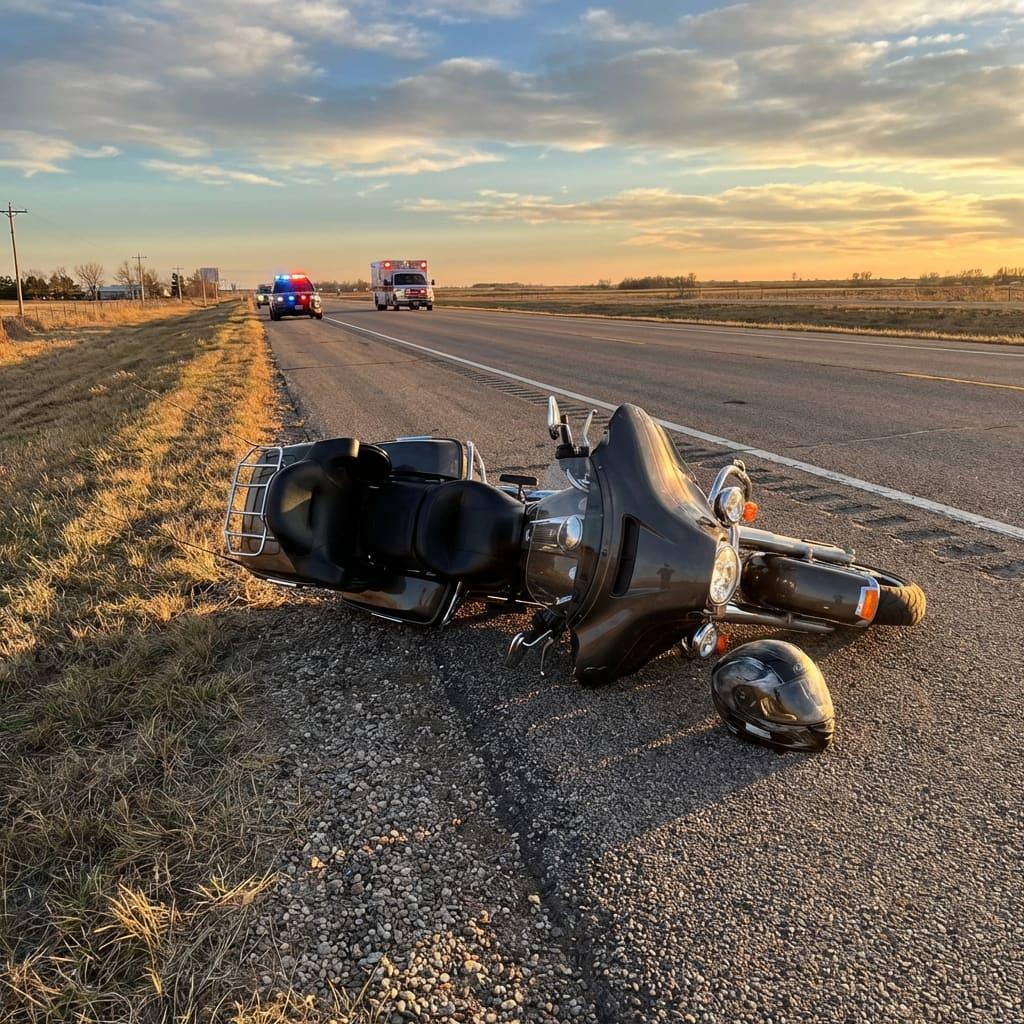
Motorcycle accidents in Oklahoma produce some of the most devastating injuries we see — traumatic brain injuries, spinal cord damage, multiple fractures, severe road rash requiring skin grafts, and internal organ damage that changes lives permanently. But the physical injuries are only half the battle. Motorcycle accident victims can face a challenge that people injured in car accidents often do not: bias against riders in the claims process, from the initial police report to settlement negotiations and trial.
This bias is not imagined. Motorcycle riders are overrepresented in fatal crashes, and insurance companies often try to turn that vulnerability into a story about assumed risk. Understanding how that story operates — and how evidence counters it — is essential to protecting a motorcycle accident claim in Oklahoma.
The Bias Against Motorcyclists Is Practical
When a person on a motorcycle is injured, some adjusters and jurors instinctively assign at least partial blame to the rider before they know the facts. The assumptions include beliefs that the rider was "probably speeding," accepted the risk by riding, was weaving through traffic, or should have been more visible. These are not conclusions drawn from evidence; they are stereotypes that have to be confronted with proof.
Insurance companies are aware of this bias and may use it in claim valuation. An adjuster evaluating a motorcycle claim may not approach it the way they approach a car accident claim involving similar injuries and similar liability. They know that if the case goes to trial, some jurors may default to blaming the rider. That risk can drive lower initial offers, more aggressive negotiation tactics, and a willingness to fight liability.
The result is that motorcycle accident victims with clear liability and severe injuries can receive initial settlement offers that do not reflect the actual evidence. Overcoming that discount requires deliberate strategy.
How Bias Damages Your Case at Every Stage
Police Reports Often Reflect Officer Assumptions
The bias problem starts at the crash scene. Investigating officers sometimes approach motorcycle accidents with assumptions that would never apply to car-versus-car collisions. We have reviewed police reports that speculate about the rider's speed without any physical measurements, note the motorcycle's "sport-style" or "racing-style" appearance as if the bike's aesthetics are relevant to fault, accept the driver's account that they "didn't see the motorcycle" without questioning why they failed to look, and treat the outcome as somehow inevitable rather than the result of a specific driver's negligence.
These biased reports create problems downstream because insurance adjusters and defense attorneys treat police reports as objective accounts. If the report implicitly blames the rider, every subsequent negotiation begins from a disadvantaged position.
Insurance Adjusters Weaponize Stereotypes
Adjusters may identify and emphasize anything that fits public stereotypes. They may highlight aftermarket exhaust systems to imply recklessness, describe ordinary riding gear as character evidence, point to the absence of a helmet even though Oklahoma adults can legally ride without one, and characterize the rider's choice of motorcycle as evidence of personality traits relevant to fault.
These tactics are designed to make the victim feel that a jury would punish them for being a motorcyclist — and to pressure them into accepting a settlement far below their claim's actual value. An experienced motorcycle accident attorney recognizes these tactics and refuses to let them drive the negotiation.
Jury Selection Requires Specialized Attention
If a motorcycle case goes to trial, the most important battle often happens before opening statements — during jury selection. Without rigorous voir dire, the jury may include members who simply cannot give a motorcyclist a fair hearing. These potential jurors may believe that riding a motorcycle is inherently reckless, that injuries are the rider's own fault for choosing a dangerous vehicle, or that the rider "had it coming." Identifying and removing these biased prospective jurors through careful questioning is one of the most critical skills a motorcycle accident trial lawyer can bring to the case.
Overcoming Bias: What Actually Works at Trial
Successfully trying a motorcycle accident case requires a different approach than a standard auto accident case.
Humanize the rider before the jury sees a motorcyclist. Before any discussion of the accident, collision dynamics, or injuries, the jury needs to see the victim as a person — a parent, a spouse, a professional, a community member. We present family photographs, career accomplishments, volunteer work, and the practical reasons the person rides. Many riders commute on motorcycles for fuel efficiency, use them for errands, or ride as a family tradition. When the jury sees a person first and a motorcycle rider second, stereotypes lose their power.
Establish the driver's clear negligence with objective evidence. Every motorcycle case must remove any ambiguity about who caused the crash. We rely on traffic camera footage, independent witness testimony, accident reconstruction analysis, and physical evidence at the scene. The more clearly we establish that a specific driver committed a specific negligent act — running a red light, failing to yield, changing lanes without checking mirrors — the less room the jury has to default to blaming the rider. We also demonstrate that the collision would have caused identical injuries regardless of vehicle type, undermining the implication that the motorcycle itself is the problem.
Address bias directly rather than pretending it doesn't exist. In voir dire and opening statements, it is usually better to name the specific assumptions the defense may rely on, explain why they are not evidence, and ask jurors to decide the case on collision facts, medical proof, and damages — not preconceptions about riders.
Common Causes of Motorcycle Accidents
The most frequent causes of motorcycle crashes — nearly all involving negligent drivers — follow predictable patterns that experienced attorneys know how to prove.
Left-turn collisions are a common serious two-vehicle motorcycle crash pattern. A driver turns left in front of an oncoming motorcycle, claiming afterward that they "didn't see" the rider. In many cases, the legal question is not whether motorcycles are visible in the abstract; it is whether that driver kept a proper lookout and yielded before turning.
Lane-change and merge crashes happen when drivers fail to check blind spots before moving into an adjacent lane occupied by a motorcycle. Side-view mirrors alone are often insufficient. When a driver fails to keep a proper lookout and a rider is struck, that failure can establish liability.
Rear-end impacts and following-distance failures affect motorcyclists at intersections and in stop-and-go traffic, where the consequences of being struck from behind are catastrophic compared to a car-on-car fender bender. A motorist who rear-ends a motorcycle at even moderate speed can cause life-changing injuries.
Intersection violations — running red lights, rolling through stop signs, and failing to yield at uncontrolled intersections — account for a significant percentage of motorcycle fatalities. These collisions tend to involve high closing speeds and result in the most severe injuries.
Oklahoma-Specific Legal Considerations
The No-Helmet Defense
Oklahoma does not require helmets for riders who are 18 or older, as provided by 47 O.S. § 12-609. Despite this, insurance companies may argue that an unhelmeted rider's injuries should be discounted because they failed to "mitigate" damages. That argument has limits. Helmet evidence should be tied to medical causation; it should not reduce compensation for injuries a helmet would not have prevented, such as leg fractures, internal injuries, spinal injuries, or road rash. An attorney experienced in motorcycle litigation can challenge an overbroad helmet defense.
Comparative Negligence
Oklahoma's modified comparative negligence system allows an injured rider to recover damages even if they were partially at fault — as long as their share of fault does not exceed 50%. Your recovery is reduced by your percentage of responsibility. For example, if a jury finds the driver 80% at fault and the rider 20% at fault, and total damages are $500,000, the rider recovers $400,000. This framework means that partial fault — even if alleged — does not eliminate your claim. It also means that fighting to minimize any attributed fault percentage directly increases your recovery.
Uninsured and Underinsured Motorist Coverage
Many motorcycle accidents involve drivers carrying only minimum insurance or no coverage at all. When the at-fault driver's policy is insufficient to cover your injuries, your own motorcycle uninsured and underinsured motorist coverage becomes the critical safety net. Riders should review their UM/UIM limits before a crash because this coverage may be the main protection when the person who caused the wreck cannot pay the full loss.
Damages in Motorcycle Accident Cases
Because motorcycles provide virtually no structural protection, injuries tend to be far more severe than in car accidents involving similar collision forces. Common damages include extensive medical expenses for emergency care, surgeries, hospitalization, and long-term rehabilitation; lost income during recovery and reduced future earning capacity if injuries are permanent; pain and suffering reflecting both physical agony and emotional trauma; disfigurement from scarring, amputation, or permanent visible injuries; loss of enjoyment of life including the inability to ride; and wrongful death claims when crashes prove fatal, providing compensation for the family's lost financial support, companionship, and funeral expenses. An experienced personal injury attorney who handles motorcycle cases specifically understands how to document and present these damages effectively.
Protecting Your Claim After a Motorcycle Crash
If you've been injured in a motorcycle accident, the steps you take immediately afterward significantly affect the strength of your claim:
- Get immediate medical attention — even if you feel okay. Adrenaline masks serious injuries, and delayed treatment creates gaps that insurance adjusters exploit.
- Document everything — photograph the scene, vehicle positions, road conditions, your injuries, and damage to your motorcycle and gear.
- Get witness contact information — independent witnesses who saw the driver's negligence are invaluable.
- Don't give recorded statements to the other driver's insurance company. Adjusters are trained to elicit statements that can be used against you.
- Preserve your gear — your helmet, jacket, gloves, and boots may be evidence of the forces involved in the crash.
- Contact an attorney before accepting any settlement offers. Early offers often do not account for the full medical, wage, and long-term evidence.
Frequently Asked Questions
Does not wearing a helmet reduce my motorcycle accident claim in Oklahoma?
Oklahoma does not require helmets for riders who are 18 or older under 47 O.S. § 12-609. While insurance companies may argue that helmet choice should reduce your recovery, the issue should be limited to injuries a helmet plausibly could have prevented or reduced. It should not be used to discount unrelated injuries such as leg fractures, internal injuries, spinal cord damage, or road rash.
What is the most common cause of fatal motorcycle accidents?
Left-turn collisions are one of the most common serious two-vehicle motorcycle crash patterns. Drivers turn left in front of oncoming motorcycles, often claiming they "didn't see" the rider. The key questions are whether the motorcycle was visible, whether the driver had a duty to yield, and whether objective evidence supports the rider's account.
How do insurance companies exploit bias against motorcyclists?
Adjusters open with lowball offers because they know juries sometimes hold bias against riders. They highlight aftermarket modifications, leather gear, and helmet choice to imply recklessness. They rely on the "thrill-seeker" stereotype to depress the perceived value of claims. Countering these tactics requires an attorney who understands motorcycle litigation specifically — not just personal injury cases generally.
Can I still recover damages if I was partially at fault for the motorcycle crash?
Yes. Oklahoma's modified comparative negligence system allows recovery if you are 50% or less at fault. Your damages are reduced proportionally by your share of fault. If you are found 20% responsible and your total damages are $200,000, you recover $160,000. Many motorcycle cases involve allegations of partial fault that can be successfully challenged with proper evidence and expert testimony.
Why are motorcycle accident injuries typically more severe than car accident injuries?
Motorcycles offer virtually no structural protection. Riders lack airbags, seat belts, crumple zones, and the steel cage that surrounds vehicle occupants. Even moderate-speed collisions can result in traumatic brain injuries, spinal cord damage, multiple fractures, severe road rash, and amputations — injuries that often require multiple surgeries and years of rehabilitation.
Should I hire an attorney who specifically handles motorcycle cases?
Yes. Motorcycle litigation involves unique challenges — rider bias, helmet evidence, accident reconstruction for two-wheeled vehicles, and insurance adjuster tactics specific to rider claims. You want an attorney who understands those issues and can explain them with evidence.
What if the other driver's insurance company says I was speeding?
Insurance adjusters frequently allege speeding to shift blame onto riders, even without evidence. Accident reconstruction experts can calculate actual speeds based on physical evidence — skid marks, crush damage, debris patterns, and vehicle rest positions. Event data recorder ("black box") data from the other vehicle can also confirm pre-crash speeds and braking. Unsupported speed allegations should be challenged with objective evidence.
Injured in a Motorcycle Crash?
Insurance companies may use rider bias to pay less. We know how to counter those tactics with evidence and fight for the supported value of your claim.
Get a Free Consultation →This article is for general information only and is not legal advice.