
Key Takeaways
- Property Owners Have a Duty: Under Oklahoma premises liability law, property owners must take reasonable steps to protect visitors from foreseeable criminal acts.
- Foreseeability Is Key: If the owner knew or should have known about crime risks on the property through prior incidents, nearby crime, complaints, or obvious security failures, liability may follow.
- The Criminal Isn't the Only Defendant: While the attacker is criminally responsible, a property owner may also be civilly liable if preventable security failures contributed to the attack.
When you're robbed in a parking garage, assaulted in an apartment stairwell, or attacked in a hotel room, the criminal is obviously to blame. But there's often a second responsible party: the property owner who failed to provide adequate security. This is the legal theory of negligent security — a subset of premises liability law that holds property owners accountable when their security failures contribute to criminal attacks on their premises.
These cases matter because they may provide a realistic path to compensation for crime victims when a property owner's preventable security failures contributed to the attack. Criminal proceedings focus on the attacker; a negligent security claim focuses on whether the property owner failed to take reasonable steps against foreseeable crime.
The Legal Duty Property Owners Owe
Oklahoma premises liability law imposes a duty on property owners and occupiers to maintain their property in a reasonably safe condition for visitors. The scope of that duty depends on the visitor's status. Invitees — people invited onto the property for business purposes, including customers, tenants, and hotel guests — are owed the highest duty of care. Property owners must inspect the premises for dangerous conditions, warn of or repair known hazards, and take reasonable steps to protect against foreseeable harm, including foreseeable criminal acts. Licensees (social guests and others on the property with permission but not for business purposes) must be warned of known, hidden dangers. Trespassers are generally owed minimal duty, with certain exceptions involving children or known trespassers.
Most negligent security cases involve invitees — customers at stores, guests at hotels, tenants and visitors at apartment complexes, and patrons at bars and restaurants. For these plaintiffs, the key question is not whether the duty exists but whether the criminal attack was foreseeable.
The Core Question: Was the Attack Foreseeable?
Property owners are not insurers of visitor safety. They are only liable for foreseeable criminal acts: attacks they knew about or should have anticipated based on the circumstances. The strongest evidence of foreseeability is often prior criminal activity on the same property. Previous assaults, robberies, or break-ins on the property, complaints from tenants or guests about safety concerns, police reports and calls for service at the address, and crime affecting neighboring properties in the immediate area can all support an argument that the property owner should have anticipated criminal activity.
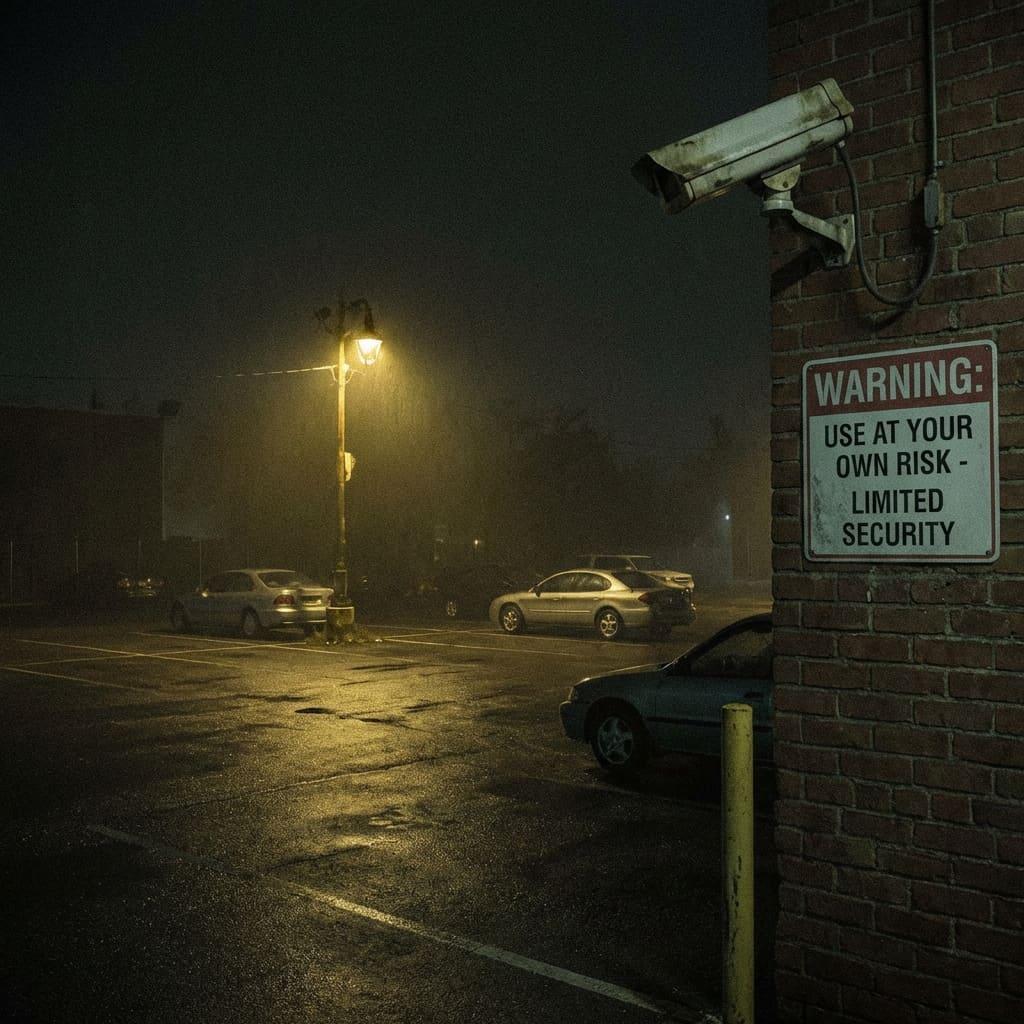
Even without prior incidents on the specific property, foreseeability may be supported by high crime rates in the surrounding neighborhood, the type of business, or the property's own characteristics, such as isolation, poor lighting, and a lack of physical barriers. Sometimes the security failure itself is powerful evidence: a hotel with no locks on guest room doors, an apartment complex with a broken security gate that has gone unrepaired for months, or a parking garage with no lighting and disabled cameras.
What "Negligent Security" Actually Looks Like
Negligent security claims focus on what the property owner failed to do: the gap between the security measures that were reasonable under the circumstances and what was actually provided. Inadequate lighting is one of the most common failures. Dark parking lots, stairwells, and common areas create opportunities for criminals to hide and approach victims, and proper lighting is a basic measure that can reduce risk.
Broken or absent locks and gates are equally common, particularly in apartment complexes where security gates don't function, exterior doors have broken locks, or units aren't re-keyed between tenants. In high-crime areas or venues with predictable risks (nightclubs, late-night convenience stores), the failure to hire security guards or off-duty police officers may constitute negligence. Non-functional security systems — cameras that aren't monitored, alarm systems that are disabled, emergency call boxes that don't work — create a dangerous illusion of safety that may actually attract victims to locations they would otherwise avoid.
The failure to respond to known dangers is particularly egregious: ignoring tenant complaints about suspicious individuals, declining to evict tenants engaged in criminal activity, or refusing to call police about known trespassers. And sometimes the criminal is an employee — a security guard, maintenance worker, or hotel staff member. When the employer failed to conduct background checks or ignored warning signs about that employee, they bear direct responsibility.
Where These Cases Arise
Certain property types see a disproportionate share of negligent security claims because their characteristics create predictable crime risks. Apartment complexes owe tenants reasonable security, yet broken security gates and intercoms, inadequate lighting in parking areas and hallways, and failure to address known criminal activity by other tenants remain disturbingly common. Hotels and motels create a unique vulnerability because guests are sleeping in an unfamiliar environment and trusting that their rooms are secure — malfunctioning door locks, unmonitored access to guest floors, and allowing unauthorized persons to access guest information all create dangers that travelers cannot protect themselves against.
Parking lots and garages can be dangerous because of their isolation and limited visibility, and missing lighting, cameras, patrols, or emergency call stations can increase the risk. Shopping centers and retail stores draw customers who expect a reasonably safe experience but may face understaffed security and poorly lit peripheral areas. Bars and nightclubs combine alcohol, crowds, and late hours in ways that create predictable risks, including insufficient bouncers, failure to remove aggressive patrons, overserving intoxicated customers, and inadequate parking lot security.
Proving a Negligent Security Case
A negligent security claim requires proving four elements: duty (the property owner owed you a duty of care — for invitees, this is usually straightforward), foreseeability (the criminal attack was foreseeable based on prior incidents, crime data, or obvious security deficiencies), breach (the property owner failed to take the reasonable security measures the situation demanded), and causation (the security failure was a substantial factor in allowing the crime to occur).
Causation is often the most fiercely contested element. Defense attorneys argue that the attacker would have acted regardless of security measures. Plaintiffs counter with evidence that reasonable security can deter opportunistic crime, that the specific security failure enabled the attack (the attacker entered through the broken gate or hid in the unlit stairwell), and that similar properties used better security practices. Expert witnesses, including security consultants, criminologists, and former law enforcement professionals, are often essential to establish what reasonable security measures would have been and how they would have changed the outcome.
The Damages Crime Victims Face
The injuries from violent crimes are often devastating and extend far beyond the physical. Medical expenses for emergency treatment, surgery, hospitalization, physical therapy, and future care for permanent injuries can be substantial. Lost wages and reduced earning capacity compound the financial burden, particularly when injuries prevent returning to work.
But the deepest wounds are often psychological. Crime victims frequently develop post-traumatic stress disorder, generalized anxiety and depression, panic attacks, fear of returning to similar locations, sleep disturbances and nightmares, and relationship difficulties that can persist for years. These harms may be compensable when supported by the evidence. Scarring and disfigurement from assault injuries can also support damages for their lasting impact on appearance and quality of life.
In egregious cases — where the property owner consciously ignored known dangers — punitive damages may be available under Oklahoma law (23 O.S. § 9.1) to punish the conduct and deter similar negligence.
What to Do After an Attack
If you've been the victim of a crime on someone else's property, call 911 immediately — getting police and medical help is the priority, and the police report is essential evidence. Get medical treatment and document all injuries, as some injuries like internal bleeding or traumatic brain injury aren't immediately apparent. If you can safely do so, don't leave the scene without documenting conditions.
Within days, return to the scene (with someone else for safety) and photograph the lighting conditions at the same time of day or night as the attack, any broken locks, gates, or fences, non-functional cameras or call boxes, and the path the attacker used. Talk to other tenants, employees, or visitors — they may know about prior incidents or ongoing security problems. Preserve clothing and personal items damaged in the attack. Through an attorney, request the property's security incident reports, maintenance records for security equipment, and 911 call history. And consult a personal injury attorney as early as possible — negligent security cases are complex, requiring investigation, expert analysis, and a deep understanding of what security measures were reasonable under the circumstances.
The statute of limitations for personal injury claims in Oklahoma is two years from the date of injury. Missing this deadline bars the claim.
Frequently Asked Questions
Can I sue both the attacker and the property owner?
Yes. You can pursue claims against both. In practice, collectability is often different for the attacker and the property owner, especially when insurance coverage may be available for the civil premises claim.
What if the attacker is never caught?
You can still sue the property owner. Your claim is against them for negligent security, not against the criminal. You do not need a criminal conviction — or even an arrest — to pursue a civil negligent security case.
Does the property owner's liability reduce the criminal's responsibility?
No. They may both be legally responsible for different conduct: the attacker for the assault, and the property owner for failing to take reasonable steps against foreseeable crime. Fault allocation, collectability, and insurance coverage are separate questions.
What if I was partially at fault (for example, I ignored warning signs)?
Oklahoma's comparative negligence rules apply. Your recovery is reduced by your percentage of fault. Under 23 O.S. § 13, you can still recover as long as your fault does not exceed 50% — a plaintiff who is exactly 50% at fault can still recover, but one who is 51% or more at fault is barred.
Do apartments have to provide specific security measures?
Oklahoma law doesn't mandate specific security measures for apartments. However, landlords must maintain the property in a reasonably safe condition and address foreseeable risks. What's "reasonable" depends on the circumstances, including the crime rate in the area, prior incidents, and the vulnerability of the tenant population.
How long do I have to file a negligent security claim?
Oklahoma's statute of limitations for personal injury — including negligent security — is two years from the date of injury under 12 O.S. § 95. Missing this deadline permanently bars the claim. However, evidence preservation concerns make acting quickly essential — security camera footage is often overwritten within 30 to 90 days.
Can a negligent security claim be brought alongside a criminal case?
Yes. The criminal case against the attacker and the civil negligent security claim against the property owner are separate proceedings. You do not need to wait for the criminal case to conclude — and in many cases, the criminal case never reaches trial or the attacker is never identified. The civil claim focuses on the property owner's failure to prevent the attack, not on proving the attacker's guilt.
Violent crime changes lives. When a property owner's negligence contributed to that crime, a civil claim can pursue compensation and encourage safer property practices. At Addison Law, we handle negligent security and premises liability cases throughout Oklahoma. We investigate security failures, engage qualified experts when needed, and pursue accountability from responsible property owners. Contact us for a free, confidential consultation.
Attacked Due to Poor Security?
Security footage and maintenance records disappear quickly. We can evaluate foreseeability, security failures, and available coverage.
Get a Free ConsultationThis article is for general information only and is not legal advice.