
Updated Source Note
This article addresses the school bus crash near Elgin, Oklahoma, that occurred on March 2, 2026. Facts are drawn from Oklahoma Highway Patrol information reported by KSWO and KOCO, along with statements from Elgin Public Schools Superintendent Nate Meraz. The crash investigation may include facts not yet public.
Key Takeaways
- Students Were Hurt: Initial Oklahoma Highway Patrol reporting listed 13 people injured after a semi-truck rear-ended an Elgin school bus on I-44. Follow-up local reporting said 15 students were evaluated by doctors, with two transported to OU Medical Center and expected to recover.
- Children's Injury Claims Follow Special Rules: Oklahoma law treats injury claims involving minors differently. Section 12 O.S. § 96 can extend a child's filing time, while Section 83 supplies settlement safeguards, including a limited out-of-court process for certain smaller net recoveries.
- Multiple Parties May Be Liable: In a crash between a commercial truck and a school bus, potential defendants may include the truck driver, motor carrier, vehicle owner, and a party responsible for maintenance or loading. A school-district claim depends on separate immunity, notice, and fault questions.
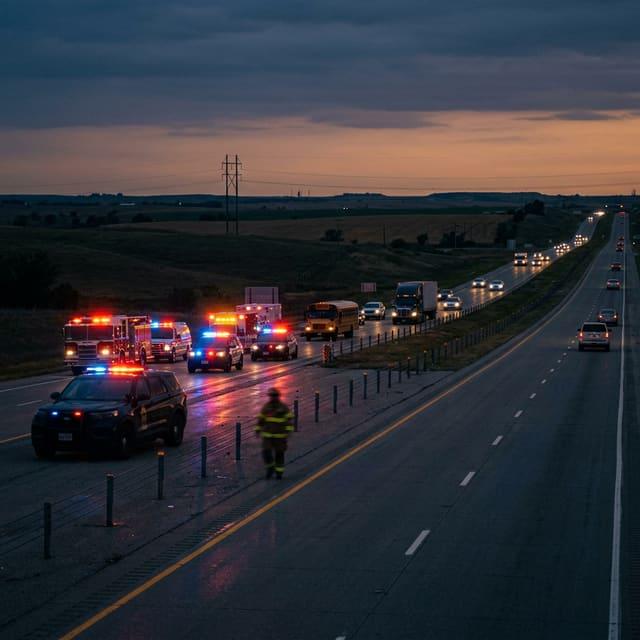
On the afternoon of Monday, March 2, 2026, a semi-truck rear-ended Elgin Public Schools Bus 25 on Interstate 44 near Medicine Park in the Lawton area of Comanche County. Oklahoma Highway Patrol information reported by KSWO listed 39 passengers on the bus and 13 people injured in the preliminary collision report. Follow-up reporting from KSWO said 15 students were evaluated by doctors, two students were transported to OU Medical Center, one had already returned home, and the other was expected to be released. No fatalities were reported in the sources reviewed for this update.
The crash shut down all lanes of I-44 and backed up traffic for miles in both directions. Governor Kevin Stitt deployed additional Oklahoma Highway Patrol resources to the scene. In a statement to families, Elgin Public Schools Superintendent Nathaniel Meraz praised the bus driver's response: "Our Elgin PS bus 25 was hit from behind by a semi-trailer truck while traveling on I-44. The bus driver did a tremendous job of handling the bus once hit."
This article is not about assigning blame in a crash that is still under investigation. It is about explaining the legal framework that Oklahoma families need to understand when children are injured in a commercial vehicle collision — because the rules that apply to children's injury claims are different from those that apply to adults, and the insurance and liability landscape in a crash like this is far more complex than most families realize.
How School Bus Crashes Differ from Ordinary Car Accidents
School bus accidents occupy a unique legal space. They involve children who cannot advocate for themselves, institutional defendants with government immunity protections, and commercial vehicles subject to federal safety regulations. Understanding these differences matters because they shape every aspect of the legal process — from who can be sued to how long families have to act.
When a school bus is struck by a commercial truck, the analysis does not begin with the bus. It begins with the truck. Semi-trucks operating on interstate highways are governed by the Federal Motor Carrier Safety Regulations (FMCSRs), codified at 49 C.F.R. Parts 390–399. These regulations impose detailed requirements on drivers and carriers regarding hours of service, vehicle maintenance, driver qualifications, cargo securement, and post-accident testing. A rear-end collision — particularly one severe enough to push a full-size school bus into a cable barrier — raises immediate questions about whether the truck driver was following too closely, was fatigued, was distracted, or was operating a vehicle with defective brakes or other mechanical issues.
The trucking liability chain in a crash like this can extend well beyond the driver. In an auto hauler scenario, the driver, the motor carrier, the owner of the truck, the broker who arranged the load, and the entity responsible for maintaining the vehicle may all bear some share of liability. Oklahoma courts follow a comparative negligence framework under 23 O.S. §§ 13–14, which means that fault can be apportioned among multiple defendants — and as long as the injured party is not more than 50 percent at fault, they can recover damages proportionate to the defendants' combined share of responsibility.
Children's Injury Claims Under Oklahoma Law
When a child is injured, Oklahoma law supplies special procedures designed to protect the minor's interests. The procedure depends on the claim, the amount the child would receive, and whether a guardian ad litem, guardian, or conservator has been appointed. A release should not be signed until the correct process is identified.
Under 12 O.S. § 96, the filing time for a minor's personal injury claim can be extended because the child is under a legal disability. For an adult, the general limitations period is two years after a personal-injury claim accrues under 12 O.S. § 95. For a child, Section 96 often allows an action within one year after the disability of minority is removed, but families should not use that extra time as a reason to delay investigation.
Section 96 does not extend the Oklahoma Governmental Tort Claims Act notice period. A claim against a school district generally requires notice within one year after the loss occurs, even when the injured person is a minor.
This saving provision exists because children ordinarily cannot litigate claims on their own. It gives an injured child a limited period after the legal disability ends, subject to the statute's exceptions and other claim-specific deadlines.
That said, the practical reality is that families should not wait. Evidence degrades. Witnesses forget. Trucking companies overwrite electronic data. The longer families delay, the harder it becomes to build a strong case — even if the statute of limitations technically allows it. The critical window for preserving trucking evidence is measured in days, not years.
Many minor settlements proceed through district-court approval. Section 12 O.S. § 83 also permits a narrow out-of-court process when no guardian ad litem, guardian, or conservator has been appointed and the net proceeds, as the statute defines them, are more than $1,500 but no more than $25,000. That route requires a sworn affidavit, deposit into a protected account, and compliance with the statute's restrictions on the funds. Other settlements may require court review.
These safeguards exist for good reason. Insurance companies know that families under financial pressure — facing mounting medical bills and lost wages from caring for an injured child — are vulnerable to accepting inadequate settlements. Court review, when required, and Section 83's affidavit and deposit rules protect the child's long-term interests.
A minor ordinarily brings a lawsuit through a parent or another proper representative acting as next friend. In an appropriate case, the court may appoint a guardian ad litem to protect the child's interests separately from a parent's individual claims.
Trucking Company Liability: What the Evidence Will Show
In any rear-end collision involving a commercial truck, the following driver faces hard questions. A driver who strikes the vehicle ahead may have failed to maintain a safe following distance, failed to keep a proper lookout, or failed to control speed. A rear-end impact is strong evidence of negligence, though the final allocation of fault depends on the full investigation.
But the investigation will not stop with the driver. A motor carrier may be vicariously liable for an employee driver's negligence within the scope of employment and may face direct claims based on its own conduct. Leased equipment and contractor relationships require a separate analysis; the contract's label does not decide liability. Federal leasing regulations, including 49 C.F.R. § 376.12, can matter, but the available theory depends on the operating authority, lease documents, control, and crash facts.
The critical evidence in a crash of this severity includes:
- Electronic Logging Device (ELD) data showing the driver's hours of service in the days before the crash — whether the driver had exceeded maximum driving hours or had taken required rest breaks
- Available engine-control-module, event-data, telematics, and video records, which may record speed, braking, acceleration, or other information before impact
- Driver qualification files including the driver's CDL status, medical certification, training history, and prior safety violations
- Maintenance and inspection records showing whether the vehicle's brakes, tires, and safety systems were properly maintained
- Post-accident drug and alcohol testing records, when 49 C.F.R. § 382.303 requires testing — including a fatal crash, or a qualifying nonfatal crash when the commercial driver receives a moving-violation citation within the regulatory window
This evidence has a limited shelf life. ELD data may be overwritten. Dashcam footage may be recorded over. The truck itself may be repaired before it can be inspected. A prompt, specific preservation notice identifies the evidence the carrier should retain and may become important if relevant material later disappears. Whether a legal preservation duty existed, and whether a sanction is available, depends on the facts, timing, relevance, foreseeability of litigation, and governing law.
Insurance Coverage in a School Bus Crash
The insurance landscape in a crash involving both a school district vehicle and a commercial truck involves multiple layers of coverage.
The trucking company's liability insurance. Covered for-hire interstate motor carriers must maintain minimum financial responsibility under 49 C.F.R. Part 387. The applicable minimum depends on the operation and cargo; $750,000 is the federal minimum for many general-freight operations. The actual policies, endorsements, and any excess coverage still must be obtained and reviewed.
The school district's coverage. Oklahoma school districts are subject to the Governmental Tort Claims Act (GTCA), which limits the liability of government entities. Under 51 O.S. § 154, as amended by SB 1168 effective November 1, 2025, the current default limit for a school district or other political subdivision is $250,000 to any claimant for any number of claims for other loss arising from one act, accident, or occurrence, with a $2,000,000 aggregate limit. The separate $375,000 limit applies to the state, qualifying cities and counties, and the entity identified in § 152(12)(s); the school-district default does not turn on Comanche County's population. Whether a school-district claim exists also depends on a statutory waiver, fault, timely notice, and other defenses. If the truck caused the crash, the motor carrier and its insurers may provide the principal private recovery source.
Uninsured/underinsured motorist coverage. Families should also review their own auto insurance policies. Oklahoma's uninsured/underinsured motorist (UM/UIM) coverage may provide an additional layer of protection if the trucking company's policy limits prove insufficient to cover the full extent of the children's injuries.
What Families Should Do Right Now
If your child was on Elgin Bus 25 on Monday afternoon, here are the immediate steps you should take — even if your child seems fine right now.
Get a thorough medical evaluation. Children often cannot articulate the nature or severity of their injuries. Adrenaline, fear, and the desire to appear "okay" in front of their parents can mask serious symptoms. Internal injuries, concussions, spinal cord injuries, and soft tissue damage may not present obvious symptoms for hours or days after a crash. Take your child to the emergency room or their pediatrician immediately. Follow up with any recommended specialists. Document everything.
Preserve your own evidence. Write down everything your child told you about the crash while their memory is fresh. Save any text messages, voicemails, or communications from the school district. Photograph any visible injuries — bruising, swelling, abrasions — with timestamps. If your child complains of pain, headaches, dizziness, or behavioral changes in the coming days and weeks, document those as well.
Do not sign anything from the trucking company or its insurer. Within days, sometimes hours, of a serious crash, trucking companies and their insurers may reach out to families. They may offer a quick settlement, request a recorded statement, or ask you to sign what appears to be a routine form. Do not sign anything. Do not give a recorded statement. Any settlement offered before the full extent of your child's injuries is known may be inadequate. A child's settlement must use the procedure that Section 83 requires for that recovery, including court review when required and statutory fund protection.
Consult an attorney who handles trucking and children's injury cases. These cases involve specialized knowledge — federal trucking regulations, evidence preservation timelines, minor settlement procedures, and complex insurance coverage analysis. A bus accident attorney experienced with commercial vehicle crashes can begin the evidence preservation process immediately and ensure your child's rights are protected from the outset.
The Broader Picture: School Bus Safety in Oklahoma
Oklahoma does not require seat belts on full-size school buses. This is consistent with federal rules: the National Highway Traffic Safety Administration requires lap-shoulder belts on small school buses, but not on larger school buses. Full-size school buses rely on "compartmentalization" — closely spaced, high-backed, energy-absorbing seats — as their primary occupant protection system. Rear-end impacts from a heavy commercial vehicle can still create injury mechanisms that deserve careful investigation, including passengers being thrown from their seats, struck by objects, or injured by deformation of the bus structure itself.
Whether the lack of seat belts contributed to the severity of injuries in this crash is a factual question that the investigation will address. But it is context that families should understand as they evaluate their children's injuries and the claims that may follow.
Frequently Asked Questions
How long do families have to file a lawsuit for their child's injuries?
Under Oklahoma law, a minor's personal injury filing time can be extended under 12 O.S. § 96, often allowing an action within one year after the child turns 18. However, families should not wait — critical evidence from the trucking company can be lost or destroyed within days or weeks of the crash.
Does my child need to be visibly injured to have a claim?
No. Many serious injuries — including concussions, traumatic brain injuries, internal bleeding, and soft tissue damage — do not produce immediately visible symptoms. Any child who was on the bus during the crash should receive a thorough medical evaluation regardless of whether they appear injured.
Who pays for my child's medical bills?
In most school bus-versus-truck crashes where the truck was at fault, the trucking company's liability insurance is the primary source of compensation. The school district may also have coverage, though its liability is limited under the Governmental Tort Claims Act. Your own auto insurance UM/UIM coverage may provide an additional layer.
Can I settle my child's injury claim without going to court?
Sometimes, but only through the procedure Oklahoma law permits. Many minor settlements require district-court review. Section 12 O.S. § 83 provides a limited out-of-court route when no guardian ad litem, guardian, or conservator has been appointed and the child's net recovery is more than $1,500 but no more than $25,000. The required affidavit, protected deposit, and restrictions on the funds still apply.
What if the trucking company contacts me directly?
Be courteous but say as little as possible. Do not provide a recorded statement, sign any documents, or discuss the details of your child's injuries. Refer any inquiries to your attorney. Trucking companies and their insurers are experienced at gathering information that can later be used to minimize your child's claim.
What kind of compensation can my child recover?
Depending on the severity of injuries, compensation may include past and future medical expenses, pain and suffering, emotional distress, and any long-term effects on the child's quality of life. In cases involving egregious misconduct — such as a driver operating in violation of hours-of-service regulations — punitive damages may also be available.
Should I wait to see if the school district offers to pay for medical care?
No. While the school district may help with immediate medical expenses, its liability is capped under Oklahoma law, and any assistance it provides does not prevent you from pursuing a separate claim against the trucking company. Securing independent medical evaluation and legal representation protects your child's full range of potential recovery — not just the out-of-pocket medical costs visible today.
Was Your Child on the Elgin Bus?
If your child was injured in the I-44 school bus crash, time matters. Contact us so we can begin preserving critical evidence and protecting your family's rights.
Free Consultation →This article is for general information only and is not legal advice. The facts described are based on preliminary reports and may change as the investigation progresses.