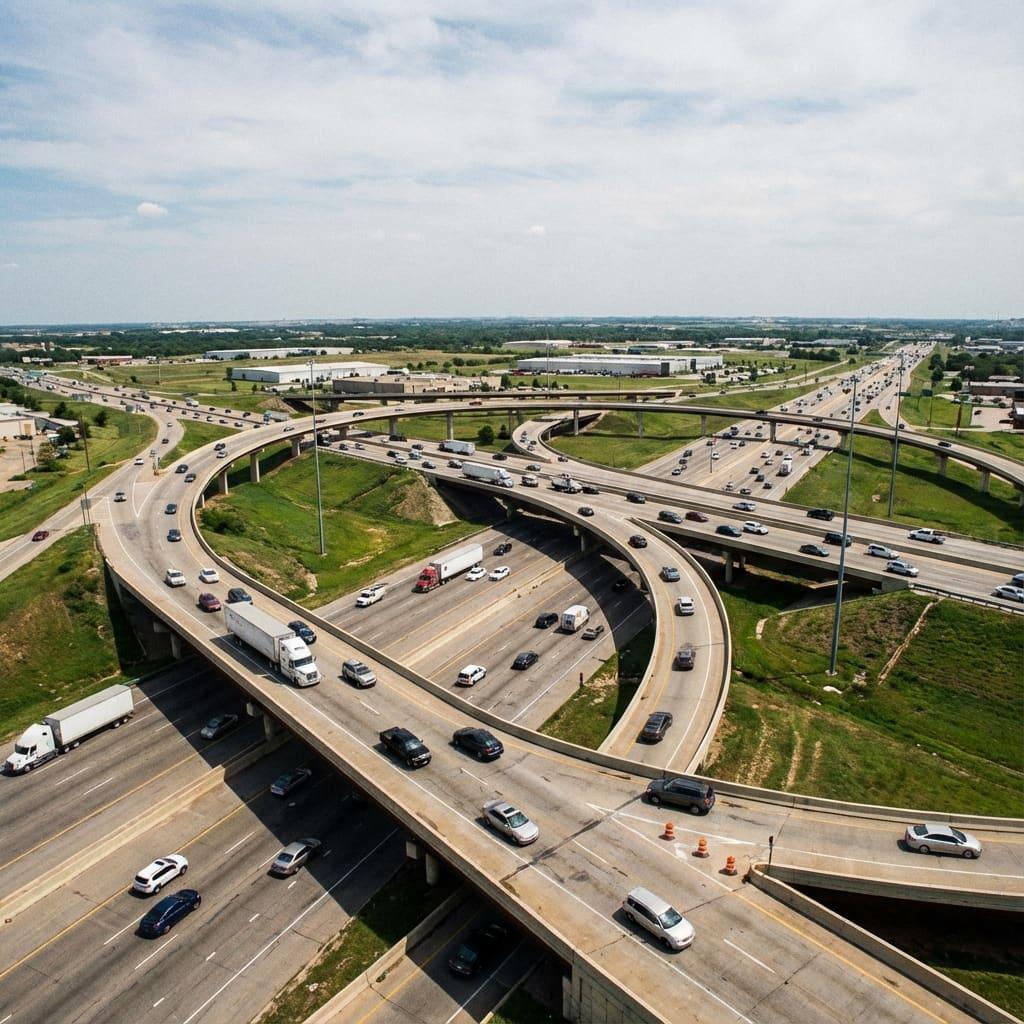

Key Takeaways: 2024 Oklahoma Numbers
- 645 total fatalities: Final National Highway Traffic Safety Administration data shows Oklahoma traffic deaths fell from 711 in 2023 to 645 in 2024, a 9.3% decrease.
- 225 alcohol-impaired-driving fatalities: That category rose from 177 in 2023 to 225 in 2024 even as the state's total fell.
- Use the final file carefully: The 2024 figures are final Annual Report File data. A national 2025 early estimate is not a final Oklahoma state count.
The National Highway Traffic Safety Administration's final 2024 file recorded 645 Oklahoma traffic fatalities, down from 711 in 2023. The same table shows a serious countertrend: Oklahoma alcohol-impaired-driving fatalities increased from 177 to 225.
The NHTSA 2024 final report is the best source for year-to-year national and state comparisons. The Oklahoma Highway Safety Office crash-data portal provides Oklahoma-specific dashboards and reports. The two sources answer different questions, and preliminary estimates should not be mixed with final counts.
Oklahoma vs. the Nation
Nationally, NHTSA's final report counted 39,254 traffic deaths in 2024, a 4.3% decrease from 2023, with the fatality rate falling to 1.19 deaths per 100 million vehicle miles traveled. NHTSA's 2025 early estimate projected 36,640 national deaths, a 6.7% decrease from 2024, and a 1.10 fatality rate. That early estimate does not supply a final 2025 Oklahoma count.
Oklahoma's total fell 9.3% from 2023 to 2024, compared with the 4.3% national decline. Those percentages describe one year of fatality counts; they do not by themselves establish whether a particular Oklahoma road, county, or driver group is more dangerous. A rate comparison requires the matching exposure measure and final data for the same period.
What the final table shows—and what it does not
The verified 2024 NHTSA table supports a specific Oklahoma statement: alcohol-impaired-driving fatalities rose from 177 to 225 while total traffic fatalities fell. It does not prove that alcohol caused every crash in that category, establish fault in an individual case, or provide a complete ranking of every contributing factor.
Impairment does not require a criminal conviction before it becomes relevant to a civil case. Oklahoma's driving-under-the-influence provisions appear in 47 O.S. § 11-902. A criminal prosecution and an injured person's civil claim use different parties, purposes, and burdens of proof.
Seat-belt evidence presents a separate legal question. 47 O.S. § 12-420 says seat-belt use or nonuse is submitted in an Oklahoma civil suit unless the plaintiff is under sixteen. What effect the evidence has depends on the injuries and proof; nonuse does not establish who caused the collision.
Where Crashes Happen
Use the Oklahoma Highway Safety Office portal to select the county, road-user type, severity, and period before drawing a geographic conclusion. Total crashes, fatal crashes, deaths, population rates, and vehicle-mile rates measure different things. A road should not be labeled “most dangerous” without defining the measure and year.
For an individual pedestrian collision, statewide data cannot replace the scene evidence: signal timing, sight lines, lighting, impact location, video, witness accounts, vehicle data, and the movements of each road user.
Who's Getting Hurt
Use the state dashboard to select the road-user group, county, year, and severity measure instead of treating an older aggregate as current. Pedestrian, motorcycle, passenger-vehicle, and commercial-vehicle cases also call for different evidence.
Commercial-vehicle crashes also require a different evidence plan. Carrier records, driver qualification materials, hours-of-service data, inspections, maintenance, dispatch communications, and electronic-control-module data may be relevant. Our Oklahoma truck-accident guide explains that investigation.
What the Trends Show
The national picture improved meaningfully in 2024 and 2025. NHTSA reported 39,254 U.S. traffic fatalities for full-year 2024 — a 4.3% decline from 2023 — and estimated 36,640 traffic fatalities for 2025, another 6.7% decline. The estimated 2025 fatality rate was 1.10 deaths per 100 million vehicle miles traveled.
Oklahoma's 2024 fatality count improved from 711 to 645 according to NHTSA's Annual Report File. But alcohol-impaired-driving fatalities rose by 48. That mixed picture is why one total should not be presented as proof that every important safety measure improved.
Using crash data responsibly
For public planning, use the newest official dataset and state whether it is preliminary or final. Record the table, filter, and download date so the result can be reproduced. For litigation, aggregate data usually does not prove how one collision happened. Build the individual record from physical evidence, testimony, medical proof, applicable safety rules, and qualified expert analysis when the dispute warrants it.
For Crash Victims
These statistics represent real people with real injuries and real legal rights. When crashes are caused by distracted, impaired, or negligent drivers, injured victims and their families have legal recourse.
Oklahoma follows modified comparative negligence rules. If you were partially at fault, your recovery is reduced; if your negligence was greater than the combined negligence of the defendants, recovery is barred. Understanding what caused the crash, preserving short-lived evidence, and identifying coverage matter far more to an individual claim than the statewide average. Our Oklahoma car-accident page explains the claim process.
Frequently Asked Questions
How many car accidents happen in Oklahoma each year?
NHTSA's final file reports deaths, not the complete number of Oklahoma crashes. It recorded 711 Oklahoma fatalities in 2023 and 645 in 2024. Use the Oklahoma Highway Safety Office portal for the crash-count measure and year you need.
Where can I find current Oklahoma crash data?
Use the Oklahoma Highway Safety Office crash-data portal for state dashboards and reports. Define the period and measure—total crashes, fatal crashes, rate, or a specific road-user group—before comparing roads or counties.
Does Oklahoma have a texting-while-driving law?
Yes. Oklahoma prohibits specified hand-held electronic-device use while operating a motor vehicle. The current language and exceptions are in 47 O.S. § 11-901d.
What should I do if I'm in a crash caused by a negligent driver?
Prioritize safety and medical care, report the crash, photograph the scene and vehicles when safe, identify witnesses and cameras, and preserve the damaged vehicle and digital data. Do not guess about injuries or fault. See our first-72-hours checklist.
Can failure to wear a seat belt reduce my compensation?
Oklahoma law makes seat-belt use or nonuse admissible in a civil suit unless the plaintiff is under sixteen. The evidence concerns injury causation and damages, not whether the other driver caused the collision. Its effect is case-specific.
How does comparative negligence affect my Oklahoma car accident case?
Oklahoma uses a modified comparative negligence system under 23 O.S. §§ 13–14. If you were partially at fault, your damages are reduced by your percentage of fault. If you were more than 50% at fault, you recover nothing. For example, if you were 20% at fault and your damages were $100,000, you would receive $80,000.
What are the most common injuries in Oklahoma crashes?
Crash injuries can include brain, spinal, orthopedic, internal, and soft-tissue injuries, but this article's fatality data does not rank injury frequency. Seek emergency care for serious symptoms and prompt medical advice for new or worsening symptoms.
Injured in a Crash?
You may have legal options. The consultation is free, and we can help you understand your rights.
Request a Car-Accident Consultation →This article is for general information only and is not legal advice. Sources checked July 13, 2026: NHTSA's final 2024 Annual Report File, NHTSA's 2025 early national estimate, the Oklahoma Highway Safety Office data portal, and current Oklahoma motor-vehicle statutes.