
Key Takeaways
- Conflicting Accounts Are Common: Drivers may misremember, shade the facts, or deny fault. Do not assume the truth will speak for itself.
- Evidence Beats Claims: Physical damage patterns, surveillance footage, witness statements, and vehicle data recorders can contradict false narratives — but this evidence can disappear within days if you don't act.
- Disputed Liability Requires Evidence: Under Oklahoma's comparative negligence system, conflicting accounts can affect fault percentages and any recovery. Photographs, video, witness accounts, vehicle data, and contemporaneous records may help resolve the dispute.
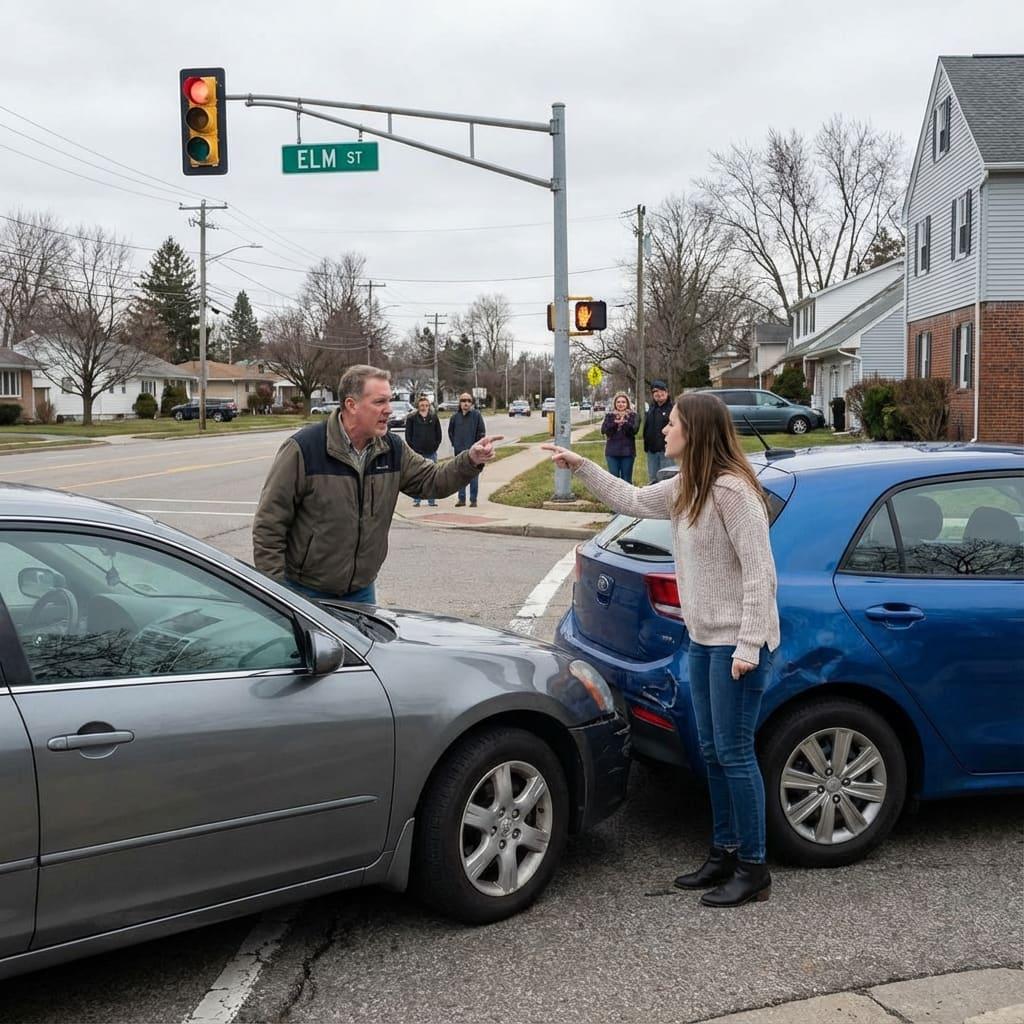
You were stopped at a red light when the other driver rear-ended you at highway speed. The impact was violent, unmistakable, and entirely their fault. But when you file your insurance claim, you discover their version of events bears no resemblance to what actually happened. They told their adjuster you cut them off. Or that you slammed on your brakes for no reason. Or that the light was green on their side. Suddenly, what should have been a straightforward claim becomes a contested one — and the claim file contains two competing accounts.
Conflicting stories are common in car accident cases. Insurance adjusters who hear conflicting accounts do not automatically believe the injured person — they look for evidence that supports or undermines each version. If you do not have that evidence, the liability dispute becomes harder. Understanding why people give false or mistaken accounts, how to gather evidence that exposes those accounts, and how the legal system handles disputed liability is critical to protecting your claim.
Why At-Fault Drivers Lie — and Why It Matters
The motivations behind post-accident dishonesty are varied, but they follow predictable patterns that an experienced attorney recognizes immediately.
The most common motivation is simple self-preservation. The driver who caused the accident knows — or quickly learns — that admitting fault may mean higher insurance premiums, potential out-of-pocket costs, and exposure to a personal injury lawsuit. The financial incentive to shade the truth can be substantial, particularly in serious injury cases.
Some drivers genuinely misperceive or misremember the accident. Car crashes happen in fractions of a second, under conditions of extreme stress. Adrenaline distorts perception. Fear creates false memories. A driver who ran a red light may genuinely believe the light was yellow — not because they're lying, but because their brain reconstructed the event in a way that protects their self-image. These sincere-but-wrong accounts are harder to combat than deliberate lies because the witness believes what they're saying.
Then there is framing. Many drivers call their insurance company before making a formal statement. The questions an adjuster asks — and the questions not asked — can shape the story in ways that shift blame. By the time the adjuster memorializes the insured's "recorded statement," the account may be more polished than the first version given at the scene.
Finally, some crashes involve outright fraud — staged accidents, phantom injuries, or coordinated schemes to extract insurance payments. These cases require forensic investigation and often involve law enforcement.
Whatever the driver's motivation, the practical effect is identical: your clear-cut case just became disputed, and the burden of disproving the lie falls on you.
The Evidence That Proves What Really Happened
The single most important thing to understand about disputed-liability cases is that physical evidence and objective data often resolve the dispute. Vehicle damage, camera footage, and physics are harder to spin than a self-serving statement. When an at-fault driver fabricates a version of events, there is often a trail of objective evidence that contradicts them — if you know where to look and act before it disappears.
Physical Damage Tells an Unambiguous Story
Vehicle damage patterns are among the most powerful tools for disproving false accident narratives. The location, direction, and severity of impact damage on both vehicles tell a story that is nearly impossible to fabricate. A rear-end collision leaves damage on the back of your car and the front of theirs — regardless of what anyone claims about who cut off whom. The debris field shows where the impact occurred. Skid marks reveal vehicle speed and braking behavior. Post-impact resting positions, combined with basic physics, indicate how the collision unfolded.
An accident reconstructionist can analyze this evidence with scientific precision and provide expert testimony about what actually happened. In some cases, the at-fault driver's account is physically impossible given the damage patterns — tires that skidded in a direction inconsistent with their claimed trajectory, impact angles that could not have occurred the way they described, or debris scattered in locations that contradict their narrative. When objective evidence conflicts with a driver's story, credibility becomes a central issue.
Surveillance and Video Footage
Cameras are nearly ubiquitous, and in accident cases, footage is often the single most decisive piece of evidence. Traffic cameras operated by a city or the Oklahoma Department of Transportation may have captured the collision. Business surveillance systems at gas stations, banks, restaurants, and retail stores frequently record exteriors and parking lots. Dashcams — both yours and the other driver's — may provide conclusive footage. Doorbell and similar residential cameras may also capture neighborhood accidents.
The critical issue with video evidence is time. Most surveillance systems overwrite footage within days or weeks. If you don't request preservation immediately, the evidence disappears forever. This is one of the most important reasons to involve an attorney early — we send preservation letters to businesses, request traffic camera footage from municipalities, and subpoena dashcam recordings before they can be deleted or "lost."
Witness Testimony
Independent witnesses who have no stake in the outcome carry enormous weight in disputed-liability cases. A bystander who watched the accident from the sidewalk, a driver in the adjacent lane who saw the light change, an employee at a nearby business who heard the impact and looked up — these people provide accounts untainted by financial interest. Their testimony directly contradicts the at-fault driver's fabricated version and gives the jury a credible third-party perspective.
The challenge is that witnesses leave the scene. If you don't collect names and phone numbers before they drive away, you may never find them again. Canvassing nearby businesses the day of the accident, or returning the next day at the same time to find regular commuters who may have witnessed the crash, can identify witnesses you didn't even know existed.
The Police Report and Inconsistent Statements
The investigating officer's report documents what both drivers said at the scene, what the officer observed, and any citations issued. While police reports aren't automatically admissible at trial, they serve a critical function: they create a contemporaneous record. Oklahoma law requires prompt notice of crashes involving injury, death, or property damage above the statutory threshold under 47 O.S. § 10-107 and related written-report rules under 47 O.S. § 10-108. Having officers document the scene while evidence is fresh and memories haven't been revised is invaluable.
More importantly, when the at-fault driver tells the police one story at the scene and tells their insurance company a different story days later, that inconsistency devastates their credibility. Juries understand that the first account — given under stress, before the person had time to think about consequences — is more likely to be truthful than the polished version delivered to an insurance adjuster.
Phone Records and Vehicle Data
Modern technology creates evidence trails that most people don't consider. Cell phone records can show whether the at-fault driver was on a call or sending texts at the time of impact. Vehicle telematics in modern cars may record speed, braking force, steering input, and other pre-crash data. Event data recorders — the "black box" present in many newer vehicles — preserve seconds of pre-crash information including throttle position, brake application, speed, and seatbelt status. This data can help prove that the other driver was speeding, failed to brake, or was distracted — regardless of their verbal claims.
What to Do in the First 72 Hours
The actions you take immediately after a crash determine whether evidence survives long enough to prove your case. Understanding these critical first steps can make the difference between a strong claim and a disputed one.
Call police and insist on a report, even for accidents that appear minor. Take photographs of everything — damage to all vehicles, the overall scene, skid marks, debris, traffic signals, road conditions, weather, and license plates. Get witness contact information before they leave. Write down your detailed account of what happened as soon as possible while your memory is fresh. Do not argue with the other driver about fault at the scene, and do not admit any responsibility — even a reflexive "I'm sorry" can be twisted.
Most importantly, do not give a recorded statement to the other driver's insurance company without first consulting an attorney. Adjusters are trained to ask questions designed to elicit responses that can be used against you, and once you've made a recorded statement, you cannot take it back.
How Lies Affect the Value of Your Claim
The other driver's dishonesty does more than complicate the factual dispute — it directly impacts what your case is worth. Under Oklahoma's comparative negligence system, fault is divided between the parties, and your recovery is reduced by your percentage of responsibility. If the other driver succeeds in shifting even 20% of the blame to you through a false narrative, a $500,000 case becomes a $400,000 case. If they push your alleged fault above 50%, you recover nothing. An experienced personal injury attorney can counter these false narratives before they take hold.
Insurance adjusters who hear two conflicting accounts may propose a compromise fault split or assign you partial fault before the investigation is complete. Having strong evidence from the outset makes that harder and forces the insurer to address the facts rather than rely on its insured's self-serving account.
When It Goes to Trial
If your case reaches a courtroom, the other driver's lie becomes a liability for their side. Inconsistent statements between the police report, the insurance company's file, written discovery responses, and deposition testimony create a devastating impeachment trail. A skilled trial attorney knows precisely how to highlight these contradictions through cross-examination, making the witness's dishonesty the dominant theme of the trial rather than a side issue.
Jurors pay close attention to credibility. A witness caught in one material lie can lose credibility on more than that single point. This is why inconsistent statements, impeachment evidence, and objective proof matter so much in a disputed-liability case.
Frequently Asked Questions
What if the other driver lies to the police about the accident?
The police report is not the final word. You have the right to provide your own statement, submit evidence such as photographs and dashcam footage, and request a supplemental report. If the officer issued a citation to the other driver, that supports your version. In litigation, the physical evidence and witness testimony — not the police report — determine the outcome.
Can I sue someone for lying about a car accident?
The lies themselves are typically addressed by presenting contradictory evidence in the insurance claim or lawsuit. You don't usually file a separate lawsuit for the lying — instead, the dishonesty is exposed during the claims process or at trial, where it damages the other driver's credibility across every issue. In rare cases involving deliberate fraud, additional legal claims may be available.
What evidence is most effective at proving the other driver is lying?
Video footage is the most powerful because it is objective and contemporaneous. After that, physical damage patterns analyzed by an accident reconstructionist, independent witness testimony, cell phone records proving distraction, and vehicle data recorder information are all highly effective at exposing false narratives.
Should I accept the insurance company's determination of fault?
No. Insurance adjusters make preliminary fault determinations based on the information available to them — which often includes the other driver's self-serving account. You are not bound by this determination. An attorney can present evidence the adjuster didn't consider or didn't weigh properly, and can challenge the fault allocation through negotiation, mediation, or litigation.
How quickly should I hire an attorney if the other driver is lying?
Immediately. Evidence disappears quickly — surveillance footage is overwritten, witnesses' memories fade, and vehicle damage is repaired. An attorney can send preservation letters, retain accident reconstructionists, and begin investigation while the evidence still exists. Waiting weeks or months to take action dramatically weakens your ability to disprove the other driver's false account.
The Other Driver Is Lying About What Happened?
We use physical evidence, witness testimony, and expert analysis to test false accounts and prove what happened.
Get a Free Consultation →This article is for general information only and is not legal advice.