
Key Takeaways
- Oklahoma Schools Can Search — on Reasonable Suspicion: Under 70 O.S. § 24-102, a superintendent, principal, teacher, or school security officer may, upon reasonable suspicion, detain and search a student or the student's property for dangerous weapons, controlled dangerous substances, alcoholic beverages, or missing or stolen property. The search must be conducted by a person of the same sex as the student and witnessed by at least one other authorized person.
- Strip Searches Are Banned Outright: The statute says a search must be reasonably related to its objective and "not excessively intrusive," and it goes further than the Constitution requires: in no event may a student be strip searched, and no clothing may be removed during a warrantless search except cold weather outerwear, shoes, and hand and head coverings — and religious head coverings may not be removed at all. HB 1634, effective November 1, 2023, added shoes and hand and head coverings to the items that may be removed (before then, only cold weather outerwear could be) and protected religious head coverings.
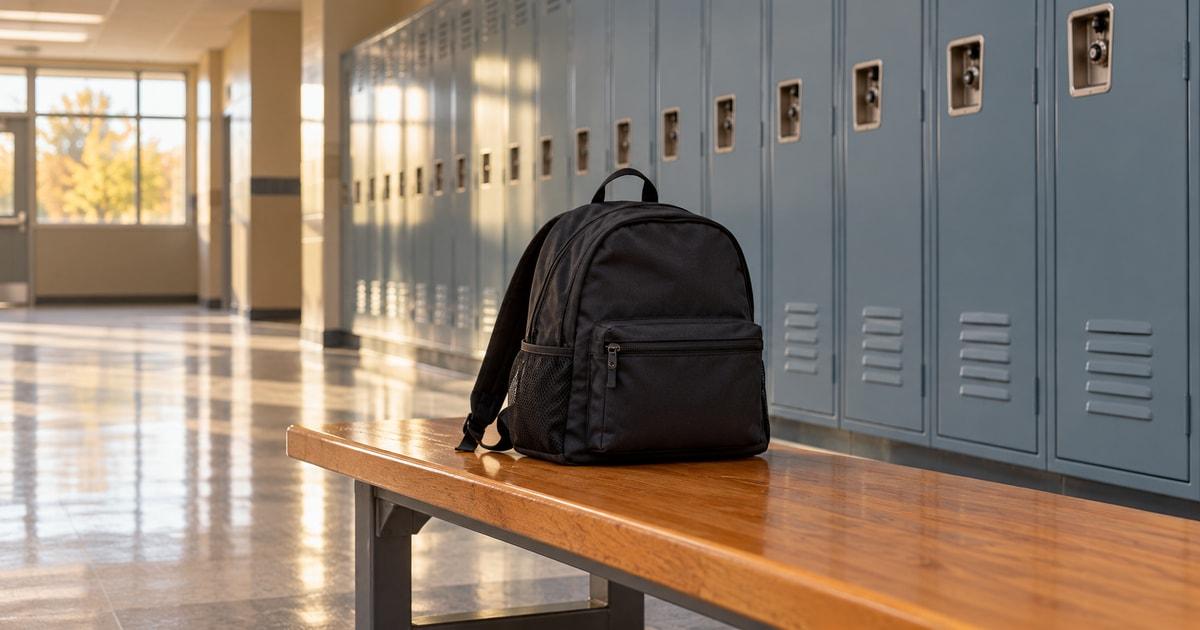
- Lockers Are Different from Backpacks: Under the same statute, students have no reasonable expectation of privacy toward school officials in school lockers, desks, or other school property, which may be opened and examined at any time, no reason required. A backpack or phone the student owns is the student's own property, and the reasonable-suspicion rules apply.
- The Constitution Sets a Floor: In New Jersey v. T.L.O. (1985), the U.S. Supreme Court held the Fourth Amendment applies to school officials but requires neither a warrant nor probable cause — a school search must be justified at its inception and reasonable in scope. In Safford Unified School District #1 v. Redding (2009), the Court held a strip search of a 13-year-old for ibuprofen violated the Fourth Amendment.
Yes — an Oklahoma public school can search your child's backpack, purse, pockets, or phone, but only within real limits. Under 70 O.S. § 24-102, school officials need reasonable suspicion, the statute authorizes searches for specific things — dangerous weapons, drugs, alcohol, or missing or stolen property — and the search's scope must be reasonably related to that objective and not excessively intrusive given the student's age and sex and the nature of the suspected infraction. School lockers and desks are a different story: they are school property, and the statute says students have no privacy right in them against school officials. And one line is absolute — Oklahoma law flatly forbids strip searching a student. This article walks through what the statute allows, what the U.S. Supreme Court has said about student searches, where a search crosses the line, and what parents can do when one already has.
This article is general legal information, not legal advice. Whether a particular search was lawful depends on exactly what the officials suspected, what they searched, and how far they went — fact questions no article can answer in advance.
What Oklahoma's Statute Allows
Oklahoma has a specific student-search statute, 70 O.S. § 24-102, and most school searches rise or fall on its terms. The statute gives the superintendent, principal, teacher, or security personnel of a public school the authority, "upon reasonable suspicion," to detain and search — or authorize the search of — any pupil or property in the pupil's possession. It applies on school premises, while the student is in transit under the school's authority, and at any school-sponsored or school-authorized function, so a search at an away football game or on the activity bus is governed by the same rules as a search in the hallway.
The statute also says what officials may search for: dangerous weapons; controlled dangerous substances as defined in the Uniform Controlled Dangerous Substances Act; alcoholic beverages as defined in the Oklahoma Alcoholic Beverage Control Act; and missing or stolen property, if that property is reasonably suspected to have been taken from a pupil, a school employee, or the school during school activities. That list matters, but it is not the whole constitutional test. T.L.O. allows a search for evidence that a student violated the law or school rules, and the Oklahoma Court of Criminal Appeals has described school searches the same way (In re F.S.E., 1999 OK CR 51, ¶ 6, 993 P.2d 771). A search for something outside § 24-102's list, such as a nicotine vape, does not get the statute's express authorization, and we are not aware of an Oklahoma appellate decision deciding what that means, so the school's written policy and the facts behind the search matter even more.
There are process requirements, too. The search must be conducted by a person of the same sex as the student, and it must be witnessed by at least one other authorized person — of the same sex if practicable. Officials who conduct or authorize a search may detain the student and preserve anything prohibited that turns up, and a student found in possession of a listed item faces the discipline process the school code provides.
The Constitutional Floor: T.L.O.
Underneath the statute sits the Fourth Amendment, and the controlling case is one most school administrators can cite from memory. In New Jersey v. T.L.O., 469 U.S. 325 (1985), a teacher caught a 14-year-old freshman smoking in a school bathroom. She denied it, and an assistant vice principal searched her purse — finding cigarettes, rolling papers, and then marijuana and evidence of dealing. The New Jersey Supreme Court suppressed the evidence; the U.S. Supreme Court reversed, with New Jersey prevailing and the evidence reinstated.
Writing for the Court, Justice White held that the Fourth Amendment applies to searches by public school officials, who act as representatives of the State and not merely as stand-ins for parents. But school officials need neither a warrant nor probable cause. The test is reasonableness under all the circumstances, measured in two steps. First, the search must be justified at its inception — there must be reasonable grounds to suspect it will turn up evidence that the student violated the law or school rules. Second, it must be reasonable in scope — the measures used must be reasonably related to the search's objectives and not excessively intrusive in light of the student's age and sex and the nature of the infraction.
Oklahoma's statute tracks that two-step framework almost word for word. The practical point for parents: "reasonable suspicion" is a lower bar than the probable cause police need for a warrant, but it is not nothing. The standard asks for reasonable grounds to suspect, based on specific facts rather than a bare hunch. T.L.O. left open whether the suspicion must be individualized (469 U.S. at 342 n.8), but in an ordinary search of one student's bag the question is what pointed to that student, and whether a particular tip or observation cleared that bar is often the first fight in any challenge.
Where a Search Crosses the Line: Safford
The Supreme Court showed where scope limits bite in Safford Unified School District #1 v. Redding, 557 U.S. 364 (2009). An Arizona assistant principal suspected 13-year-old Savana Redding of distributing prescription-strength ibuprofen at school. Staff searched her backpack and outer clothing and found nothing — then had her pull out her bra and the elastic of her underwear. No pills were found. Her mother sued under Section 1983.
Justice Souter's opinion for the Court held that the strip search violated the Fourth Amendment. The suspicion justified searching the backpack and outer clothing, but as the Court put it, the content of the suspicion failed to match the degree of intrusion: nothing suggested the pills were dangerous in quantity or hidden in her underwear. At the same time, the Court held the individual officials were protected by qualified immunity, because lower courts had been divided enough that the right was not clearly established — and it sent the claim against the school district itself back down for further proceedings. Redding won on the violation and lost on damages against the individuals; the officials won immunity.
Oklahoma students get more protection than Safford requires. Section 24-102 does not weigh strip searches case by case — it prohibits them, full stop. "In no event shall a strip search of a student be allowed," and during a warrantless search no clothing may be removed except cold weather outerwear, shoes, and hand and head coverings. Religious head coverings are expressly excluded even from that short list. Both the shoes-and-coverings language and the religious head-covering exclusion came from HB 1634 (effective November 1, 2023); before that amendment, only cold weather outerwear could be removed. A school official in Oklahoma who orders a student to disrobe is not in a gray area.
Lockers and Desks vs. Backpacks and Phones
The statute draws a sharp property line, and parents are often surprised by which side things fall on.
School lockers, desks, and other school property belong to the school. Under subsection D of § 24-102, students have no reasonable expectation of privacy toward school administrators or teachers in their contents. School officials may open and examine a locker or desk at any time, and "no reason shall be necessary for such search." The statute requires schools to tell students this in the student discipline code — so the locker warning in the handbook is not boilerplate; it is the statute working as designed.
A backpack, purse, jacket, or phone the student owns is the student's property, not the school's. Searching it requires the statute's reasonable suspicion and must respect the statute's scope limits. Phones deserve a special word. Oklahoma now requires each public school district to adopt a "bell to bell" policy barring student use of cell phones and similar personal devices during the school day. District policies may allow exceptions for emergencies and health monitoring. That requirement, codified at 70 O.S. § 1-126, began with SB 139 for the 2025–26 school year and was made permanent by HB 1276 in 2026, as the Governor's office announced. Taking up a phone for violating that policy does not itself authorize a search of its contents. Searching what is on the phone is a separate, more intrusive step. A phone is "property in the possession of the pupil," so a search of one under § 24-102 needs the statute's reasonable suspicion and scope limits — but a modern phone holds vastly more personal information than a purse or a jacket pocket, and how far school officials may dig through messages, photos, and accounts under the T.L.O. scope prong is an area courts are still working out. Neither § 24-102 nor the Supreme Court's school cases squarely answers it. A parent whose child's phone was searched at length — especially one whose accounts were opened or whose data was copied — should treat that as a question for a lawyer, not a settled rule in either direction.
When Police or SROs Are Involved
Everything above describes searches by school personnel — the superintendent, principal, teacher, or school security the statute names. T.L.O. itself involved a school administrator acting on his own, and the Court expressly reserved the standard for searches "conducted by school officials in conjunction with or at the behest of law enforcement agencies" (469 U.S. at 341 n.7). The lower reasonable-suspicion standard is built on the school's special custodial role, not on a general shrinking of students' rights.
When a police officer or school resource officer directs or conducts the search, the picture gets more complicated. In one juvenile case, the Oklahoma Court of Criminal Appeals upheld a search of a student's car on school grounds where police assisted at an assistant principal's request, reasoning that a school official may use law enforcement to assist "so long as the public school official has a reasonable suspicion as to the student under investigation or search." In re F.S.E., 1999 OK CR 51, ¶ 9, 993 P.2d 771. That decision does not settle searches that police initiate or direct for their own investigative purposes, and courts elsewhere have divided on them. What standard governs a police-involved school search — and when an SRO counts as school security rather than law enforcement — are exactly the kinds of facts that change a case's value and should be reconstructed early: who initiated the search, who did the searching, and for whose purposes. The same boundary shows up in the related context of police questioning students, and families dealing with an SRO incident that went beyond a search should read our guides to school resource officer excessive force and restraint and seclusion in Oklahoma schools.
What Parents Can Do
If a search already happened, start with the record while memories are fresh. Ask the school, in writing, for its account: who ordered the search, what suspicion justified it, who conducted and witnessed it, what was searched, and what was found. Ask whether the search was recorded — hallway and office cameras are common — and ask the school to preserve any footage. Write down your child's account the same day, in their words.
Then match the facts against the statute's checklist. Was there articulable suspicion, or a hunch? Was the object of the search on the statute's list? Was the searcher the same sex as your child, with a witness present? Was clothing removed beyond what subsection B allows? Was the thing searched your child's property or the school's?
Many disputes are resolved at the school level, through the discipline process. But a search that crossed constitutional lines can support a civil claim under Section 1983 — Safford itself was such a case — and the deadlines that govern those claims are covered in our guide to Section 1983 limitations periods. Qualified immunity is a real obstacle, as Safford also shows, which is why the strength of these cases turns on how clearly the facts can be established. If your child was physically injured during a school incident, that is a separate analysis, covered in our guide to children injured at school in Oklahoma.
Frequently Asked Questions
Does the school need a warrant or my permission to search my child?
No. Under New Jersey v. T.L.O., public school officials need neither a warrant nor probable cause, and Oklahoma's statute does not require parental consent or notification before a search. What the law requires is reasonable suspicion and a scope that stays proportional to the suspicion. Oklahoma's statute expressly authorizes searches for weapons, drugs, alcohol, and missing or stolen property. Searches for other rule violations still face T.L.O.'s constitutional limits, and whether they have authority under the Oklahoma statute is a separate question; district policy does not settle it. District policy may also add notice steps, so ask for it.
Can the school search my child's locker without telling anyone?
Yes. Under 70 O.S. § 24-102, lockers, desks, and other school property may be opened and examined by school officials at any time, with no reason required, because students have no reasonable expectation of privacy in school property as against school officials. Schools are required to say so in the student discipline code.
Can the school make my child remove clothing during a search?
Only within narrow limits. Strip searches of students are flatly prohibited in Oklahoma. During a warrantless search, the only clothing that may be removed is cold weather outerwear, shoes, and hand and head coverings — and religious head coverings may not be removed at all. A search that went beyond that violated the statute, and depending on the facts may also have violated the Fourth Amendment under Safford.
What if a police officer, not the principal, searched my child?
The rules above are written for school personnel. When law enforcement directs or conducts a school search, which standard applies is a harder and less settled question, and the answer can change both a suppression fight and a civil claim. Who initiated the search, who performed it, and for whose purposes are the facts that matter — preserve them early and have a lawyer evaluate them.
Talk to an Oklahoma Civil Rights Lawyer
A search that humiliates a child — or one that turns into discipline, charges, or worse — deserves a hard look at how it actually happened, not just the school's summary of it. Addison Law Firm evaluates student search cases through our unlawful search practice, and our guide to suing the police in Oklahoma explains how civil rights claims work more broadly when law enforcement is involved.
Contact us for a free consultation.
This article is general information, not legal advice, and does not create an attorney-client relationship.