Key Takeaways
- Severe weather does not automatically eliminate liability: Oklahoma's "act of God" defense is narrow. A driver, employer, or public entity may still be responsible when reasonable precautions could have reduced the danger.
- Drivers must adjust to storm conditions: Oklahoma law requires motorists to drive at a reasonable and prudent speed for the conditions. The posted speed limit is not a safe-harbor during tornado warnings, blinding rain, or hail.
- Fault can be shared: A storm-related crash may involve driver negligence, employer pressure, poor road maintenance, missing warnings, or a combination of causes.
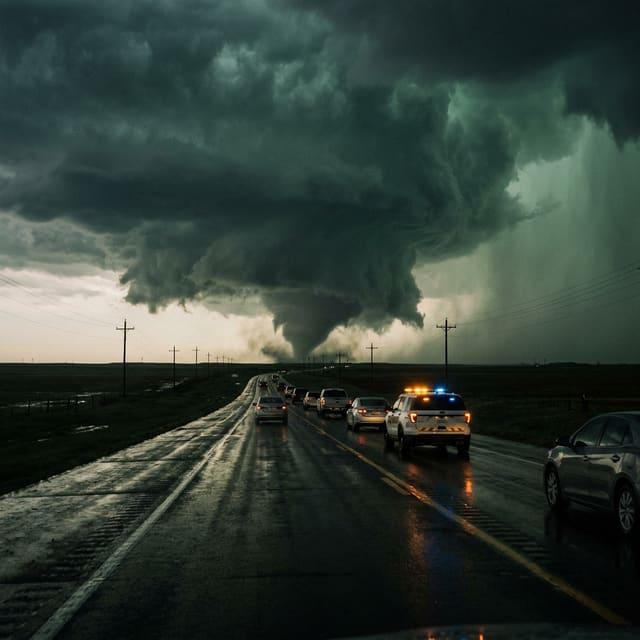
Oklahoma's tornado season arrived early this year. The National Weather Service's 2026 Oklahoma tornado data recorded an EF-2 tornado west of Fairview in Major County on March 5, 2026. The tornado crossed the U.S. 60 area, tracked about seven miles, and killed two people in a vehicle. A second Major County tornado later moved from west of Orienta toward Cleo Springs. These aren't abstract statistics — they are reminders that Oklahoma roads during storm season can become some of the most dangerous places in the state.
When a crash happens during severe weather, the instinct is to blame the storm. But Oklahoma law doesn't let drivers, employers, or government entities off the hook simply because the sky turned dark. Liability in weather-related car accidents depends on whether the parties involved took reasonable steps to protect themselves and others — and in many cases, someone's negligence turns a dangerous situation into a deadly one. If you've been in a car accident during a storm, understanding who is legally responsible is the first step toward recovery.
The "Act of God" Defense and Its Limits
The legal concept most people associate with weather-related accidents is the "act of God" defense — the idea that some events are so extraordinary and unforeseeable that no human being can be held responsible for the resulting harm. In Oklahoma, this defense has deep roots in common law, but its application is far more limited than defendants and insurance companies suggest.
For an act of God defense to succeed in Oklahoma, the defendant generally has to show that the event was natural in origin and that the natural event, rather than human negligence, was the proximate cause of the harm. That is where many storm defenses become fact-intensive. Tornadoes, severe thunderstorms, hail, flash flooding, and high winds are foreseeable risks in Oklahoma even though the exact path and timing may not be. Watches, warnings, radar, road reports, and emergency alerts can all matter when deciding whether a driver, dispatcher, employer, or public entity had time to take reasonable precautions.
This means the important question is usually not just whether the weather contributed to the crash. It is whether someone failed to respond reasonably to conditions that were known or knowable. A driver who continues at highway speed through a tornado-warned area, a trucking company that dispatches loads into the path of a supercell, or a municipality that fails to address a road known to flood may have made the danger worse in a legally meaningful way.
Driver Duty of Care in Severe Weather
Oklahoma law imposes a general duty on all motorists to drive with reasonable care under the circumstances — and "circumstances" explicitly includes weather conditions. Under 47 O.S. § 11-801, no person shall drive a vehicle at a speed greater than is reasonable and prudent under the conditions then existing, including weather. Speed limits are maximum speeds for ideal conditions; when visibility drops, roads become wet, or winds intensify, drivers are required to reduce speed accordingly.
This duty extends beyond speed. Drivers must maintain proper lookout, use headlights and wipers, maintain safe following distances, and — when conditions become truly dangerous — pull off the road when it can be done safely. Oklahoma emergency management agencies routinely advise motorists to avoid driving during tornado warnings, seek shelter in sturdy buildings, and never try to outrun a tornado in a vehicle. A driver who ignores those precautions and causes a crash may be negligent even though the storm was part of the event.
The standard is objective: what would a reasonable driver do under the same conditions? If visibility is near zero, if hail is striking the windshield, or if the road is flooding, pressing ahead may breach the duty of care. Under Oklahoma's comparative negligence framework established by 23 O.S. § 13, even if the injured party bears some responsibility — say, for also being on the road during the storm — they can still recover as long as their fault doesn't exceed 50 percent. The analysis turns on each party's conduct, not on a blanket storm exception.
Employer Liability for Requiring Travel in Dangerous Weather
Some of the most devastating storm-related accidents involve workers who had no choice but to be on the road. Delivery drivers, truckers, field service workers, utility crews, and countless other employees are regularly instructed to maintain schedules regardless of weather conditions. When an employer requires or pressures an employee to drive into known severe weather, and the employee is injured, the employer may bear significant liability.
Under the doctrine of respondeat superior, employers can be liable for negligent acts employees commit within the scope of employment. If an employee causes a crash while driving in severe weather on company business, the employer may share liability. Employer fault can also be direct: if the employer knew or should have known about dangerous weather conditions and nonetheless directed employees to drive, that decision may be its own basis for liability. This is particularly relevant for trucking companies subject to federal safety regulations. Hours-of-service rules, cargo securement standards, and general safety obligations under the Federal Motor Carrier Safety Regulations all require carriers to consider road and weather conditions. A trucking company that knowingly dispatches a loaded tractor-trailer into a tornado-warned corridor may face a punitive-damages argument if the facts show reckless disregard.
Even outside the trucking context, employers that send workers into dangerous conditions face exposure. Oklahoma's workers' compensation system provides no-fault benefits for on-the-job injuries, and the exclusive-remedy rule generally bars employees from suing their own employer in tort. However, where a third party — another driver, a government entity, or a negligent third-party company — contributed to the crash, the injured worker may pursue a personal injury claim against that third party in addition to workers' comp benefits. Understanding the interplay between workers' compensation and third-party liability is essential to maximizing recovery.
Municipal and Government Liability
Roads don't maintain themselves, and road design matters enormously during severe weather. Drainage systems that can't handle flash flooding, intersections without functioning traffic signals during power outages, roads without adequate signage warning of known flooding zones, and bridges prone to ice accumulation or wind vulnerability — all of these represent potential failures by the government entities responsible for road construction and maintenance.
Oklahoma's Governmental Tort Claims Act (51 O.S. § 151 et seq.) governs liability claims against state and local government entities. The GTCA provides a limited waiver of sovereign immunity, allowing claims for injuries caused by the negligence of state employees acting within the scope of their employment. For storm-related car accidents, this means a plaintiff can potentially sue a municipality or the state for failing to maintain drainage systems that were known to flood during heavy rain, failing to deploy barricades or close roads in areas with recurring flash flooding, failing to repair road surfaces or signage damaged by prior storms, and failing to maintain traffic signal backup systems during power outages. These claims have specific procedural requirements — including notice provisions and shortened filing deadlines — that make early legal consultation critical. The GTCA is a complex statute, and missing a procedural step can bar an otherwise valid claim.
Insurance Complications in Storm-Related Crashes
Weather-related accidents often create insurance nightmares. When a tree falls on your car, that's a comprehensive claim. When another driver hydroplanes into you, that's a liability claim against the other driver's policy. When a tornado throws debris that causes a multi-car pileup, sorting out which insurance applies — collision, comprehensive, liability, or uninsured/underinsured motorist coverage — becomes enormously complicated.
Oklahoma requires drivers to carry minimum liability insurance, but the mandatory minimums of $25,000 per person and $50,000 per accident are often inadequate for serious injuries. When a storm-related crash involves severe injuries — spinal cord damage, traumatic brain injuries, multiple surgeries — the at-fault driver's policy limits may be exhausted long before the medical bills stop accumulating. This is where uninsured or underinsured motorist coverage becomes essential. Oklahomans who carry underinsured motorist coverage can access their own policy to make up the difference when the at-fault driver's coverage falls short.
Insurance companies have a well-documented history of using severe weather as a pretext to deny or undervalue legitimate claims. The adjuster's playbook includes arguing the crash was caused by the weather rather than the other driver's negligence, attributing vehicle damage to pre-existing conditions "revealed" by the storm, and delaying investigations until evidence degrades. Preserving evidence immediately after a storm-related crash — photographs, dashcam footage, weather reports, witness contact information — is critical. The storm may wash away physical evidence, and memories fade quickly when dozens of accidents happen on the same night. If you've been hurt in a storm-related crash, gathering and preserving evidence should begin immediately after addressing medical needs.
What to Do After a Severe Weather Crash
The aftermath of a storm-related accident combines the urgency of a normal car crash with the chaos of a natural disaster. Emergency services may be stretched thin. Roads may be blocked. Cell service may be intermittent. Despite these challenges, the steps you take in the first hours and days after the crash will shape your ability to recover compensation.
Seek medical attention immediately, even if your injuries seem minor. Delayed symptoms are common in car accidents, and the adrenaline and stress of surviving a storm can mask serious injuries for hours or days. Document the scene to the extent it's safe to do so — photographs of the vehicles, the road conditions, the weather, any signage or signals that were malfunctioning, and any visible injuries. Obtain a police report, as law enforcement documentation of weather conditions, road closures, and the circumstances of the crash provides valuable evidence. Note the time and location precisely, as weather data — including NWS warnings, radar imagery, and storm reports — can be correlated to your accident to establish what conditions existed and what was foreseeable.
Do not give a recorded statement to any insurance company before consulting an attorney. Insurers will attempt to lock you into a narrative that minimizes their exposure, and storm-related crashes present unique opportunities for insurers to shift blame to the weather. An experienced personal injury attorney can help you navigate the overlapping liability and insurance issues that make severe weather cases particularly complex. Many of these cases involve multiple potential defendants — other drivers, employers, trucking companies, government entities — and identifying all responsible parties early is essential to maximizing your recovery. Contact our office if you've been injured in a weather-related crash — consultations are free, and you never pay unless we recover compensation for you.
Frequently Asked Questions
Can the other driver claim the weather caused the accident, not their driving?
They can try, but the "act of God" defense is narrow in Oklahoma and heavily dependent on the facts. Severe weather — including tornadoes, thunderstorms, and flash flooding — is foreseeable in this state, particularly during spring and fall storm seasons. If the other driver could have slowed down, pulled over safely, or avoided driving altogether, a jury may find that the driver's choices, not the weather alone, caused the crash.
Am I partly at fault for driving during a tornado warning?
Possibly, and Oklahoma's comparative negligence system accounts for this. Under 23 O.S. § 13, your compensation is reduced by your percentage of fault — but you can still recover as long as your fault doesn't exceed 50 percent. Even if you chose to be on the road during a warning, the other driver's decision to speed, tailgate, or drive recklessly in the same conditions is independently negligent. Each party's conduct is evaluated separately.
Can I sue my employer if they made me drive in dangerous weather?
Usually not in ordinary tort if the injury occurred in the course of employment, because workers' compensation is generally the exclusive remedy against your employer. But employer conduct can still matter to workers' compensation, intentional-tort questions in rare cases, and third-party claims. If another driver, a trucking company, or a public entity also contributed, you may pursue a personal injury claim against that third party in addition to workers' compensation benefits.
What if a road flooded and there were no warning signs?
The government entity responsible for that road may be liable under the Governmental Tort Claims Act. If the area was known to flood during heavy rain and the municipality failed to post warnings, deploy barricades, or maintain adequate drainage, their negligence contributed to the crash. GTCA claims have strict procedural requirements, including short notice deadlines, so consulting an attorney quickly is important.
Does my car insurance cover tornado damage and crash damage differently?
Yes. Damage caused directly by the tornado — flying debris, hail, a tree falling on your car — is typically a comprehensive claim. Damage from a collision with another vehicle during the storm is a collision claim if you're at fault, or a liability claim against the other driver if they're at fault. If the at-fault driver is uninsured or underinsured, your uninsured or underinsured motorist coverage comes into play. Sorting out which coverage applies often requires professional guidance, especially when damage has multiple causes.
How long do I have to file a claim after a storm-related accident?
Oklahoma's general statute of limitations for personal injury claims is two years from the date of the accident under 12 O.S. § 95. However, claims against government entities under the GTCA have much shorter notice deadlines — typically one year — and failing to provide timely notice can bar your claim entirely. Given these varying deadlines, consulting an attorney as soon as possible after the accident protects your rights. See our guide on Oklahoma statutes of limitations for more detail.
Injured in a Storm-Related Crash?
Severe weather does not automatically end the liability analysis. If another driver, an employer, or a public entity failed to take reasonable precautions, you may have a claim. Our attorneys handle weather-related accident cases across Oklahoma.
Free Consultation — No Fee Unless We Win →This article is for general information only and is not legal advice.