Key Takeaways
- A Store Owes Reasonable Care, Not Guaranteed Safety: An injured shopper must establish the store's duty, a failure to use reasonable care, and an injury caused by that failure. An accident or a crowded sale alone does not establish liability.
- Advance Warning and Unfolding Danger Both Matter: Taylor v. Hynson, 1993 OK 93, addresses notice of an imminent assault. Bray v. St. John Health System, 2008 OK 51, also recognizes a duty to take precautions when the business's character or past experience gives it reason to anticipate dangerous third-party conduct. Neither case decided a Black Friday crowd claim.
- Federal Crowd Guidance Is Not a Shopper's Cause of Action: The Occupational Safety and Health Administration's retail crowd-management recommendations address worker safety. They suggest practical precautions but do not automatically establish a store's notice, negligence, or liability to a customer.
- Employees and Shoppers Have Different Routes: A covered employee's claim against the employer generally belongs in workers' compensation. A separate claim requires a legally responsible party outside the applicable immunity, not merely a different company name.
- Do Not Wait on Deadlines: An ordinary Oklahoma negligence claim generally has a two-year limit. A claim against the person who intentionally assaulted you may have a one-year limit. State-law claims against a government entity can require written notice within one year, before a lawsuit can begin.
You may have a claim against an Oklahoma store after a Black Friday crowd injury, but being hurt in the rush does not by itself prove negligence. The question is whether the retailer failed to take reasonable precautions against a danger it knew or should have anticipated, and whether that failure caused your injury. A door rush, an escalating fight, and a falling merchandise display can raise different liability questions. The store's event plan, past experience, staffing, and response to what was happening all matter.
This article is general legal information, not legal advice. Whether a particular store is liable for a particular crowd injury depends on the facts — what the store expected, what it prepared, what its employees saw, and what the video shows.
The Legal Starting Point: What a Store Owes the Shoppers It Invites
A customer shopping in an Oklahoma store is generally a business invitee. The owner must use ordinary care to keep the premises reasonably safe, subject to the limits explained in our premises liability guide. For injuries involving other shoppers, two Oklahoma Supreme Court decisions help explain the duty: Taylor v. Hynson, 1993 OK 93, 856 P.2d 278, and Bray v. St. John Health System, Inc., 2008 OK 51, 187 P.3d 721.
An invitor generally has no duty to protect a customer against a third person's criminal assault. That rule has exceptions; it does not end the inquiry when the business knew of unfolding danger or had reason to anticipate harmful conduct.
Taylor arose from an attack at a fast-food restaurant. The customer's evidence was that three men had been harassing patrons inside, that the manager asked them to leave but never confirmed they had gone, and that she declined a witness's request to call police before the men assaulted the customer outside. The trial court granted the restaurant summary judgment, and the Court of Civil Appeals affirmed. The Oklahoma Supreme Court vacated that opinion, reversed the judgment, and remanded for further proceedings. Factual disputes about the manager's knowledge and response prevented summary judgment; the opinion did not award damages or report a later jury verdict.
Taylor requires a reasonable response when the business knows or has reason to know an assault is occurring or imminent. Bray addresses an additional basis for precautions: the place or character of the business, or its past experience, can give it reason to anticipate careless or criminal third-party conduct even without advance knowledge of a particular person's actions. In Bray, evidence of earlier crimes in hospital parking areas supported a duty to take precautions. The Court reversed summary judgment for the hospital; whether its precautions were adequate remained a factual question.
Neither opinion involved a retail crowd surge. Applying their principles to a sale requires evidence about that event. Advertising a large sale is relevant context, not automatic proof that the retailer should have anticipated a particular assault or crush injury. Prior surges, crowd size, bottlenecks, staff observations, and available precautions may make the difference.
Crowd Cases Also Show Why a Store Can Win
In Shircliff v. Kroger Co., 1979 OK CIV APP 18, 593 P.2d 1101, a job applicant was hurt in a dispute over cutting into a crowded application line. The Court of Civil Appeals affirmed judgment for the store at the close of the plaintiff's evidence. The crowd was visible to the applicant as well as the store, and the evidence did not show the store anticipated the attack or had a practical opportunity to prevent it. The court nevertheless recognized that a dangerous crowd can require action when the business learns of the danger and has time to respond. This older intermediate-appellate decision is a useful comparison, not a Black Friday holding.
In Johnson v. Mid-South Sports, Inc., 1991 OK 17, 806 P.2d 1107, the Oklahoma Supreme Court affirmed summary judgment for a wrestling promoter after an unknown spectator knocked a seated patron onto a ramp. The majority found no basis for anticipating that post-match attack and concluded the promoter had exercised reasonable care by providing ushers and police. The dissent would have sent the case to a jury. Both Johnson and Shircliff predate Bray; neither should be treated as a categorical exemption from crowd precautions. They show why foreseeability, response, and causation need evidence, not assumptions about what a busy event must have been like.
What Federal Crowd-Management Guidance Does and Does Not Establish
The federal Occupational Safety and Health Administration (OSHA) publishes Crowd Management Safety Guidelines for Retailers to help protect workers at large retail events. Its recommendations include trained crowd-management personnel, barriers with turns and breaks, lines that start away from entrances, admission in small groups, tickets or wristbands for high-demand items, occupancy controls, clear exits, and an emergency plan.
In an archived 2014 letter to retail chief executives, OSHA urged crowd-management planning after a worker's death during a Black Friday door rush. That is historical worker-safety guidance, not a new rule imposing liability for every customer injury.
The fact sheet expressly creates no new compliance requirements. It does not give a shopper a separate OSHA claim, prove that a particular retailer received a warning, or automatically establish negligence. Whether these recommendations are admissible or useful in a customer-injury case depends on the issue and the evidence. They provide practical questions to investigate; the plaintiff must still prove the state-law claim.
How Black Friday Injuries Actually Happen — and Where Liability Points
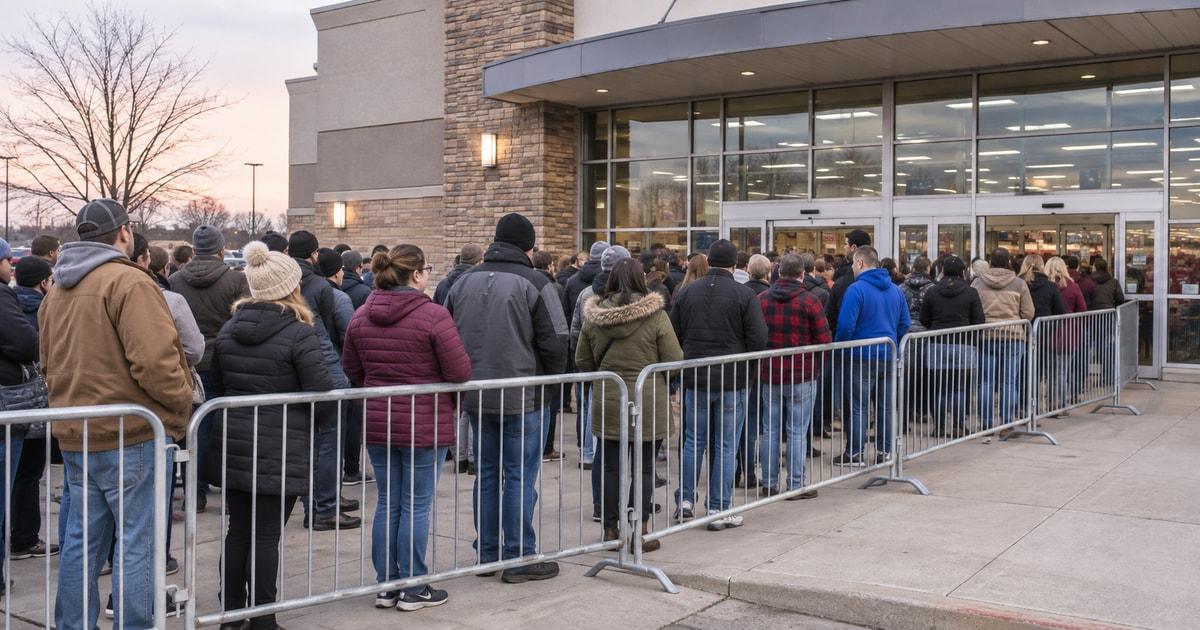
The door rush. The classic case: a crowd builds for hours, the doors open, and people in front are pushed down and stepped on by people in back who may never see them. The liability questions are about preparation. Did the store use barriers, staged entry, or staff at the doors? Had past events at the same store drawn unruly crowds? What did the store's own event plan — if one exists — call for, and was it followed?
Fights and shoving over merchandise. A sudden assault without warning presents a different case from a confrontation staff watch escalate. Taylor addresses notice of imminent danger; Bray also requires examining whether the business had reason to anticipate harmful conduct and take precautions beforehand. Neither makes the store an insurer against another shopper's actions. Our guide to negligent security claims covers the broader framework.
Falling displays and merchandise. Pallet displays stacked high for volume, grabbed at by a crowd, can come down on someone who never touched them. These are ordinary premises claims about how the display was built, stocked, and monitored during the event.
Spills, debris, and obstructed aisles. A crowd does not excuse an unsafe display or an unaddressed spill. A claim still requires proof about the condition, whether the store created it or had the required notice, and how it caused the injury. An open and obvious condition can affect whether the store owed a duty at all; it is not merely a percentage-of-fault argument. In Wood v. Mercedes-Benz of Oklahoma City, 2014 OK 68, the Supreme Court recognized a limited exception where the business created a hazard and knew a contractor's employees had to encounter it to do their work. That fact-specific ruling does not eliminate the open-and-obvious rule for every shopper.
If You Were Working the Sale, Not Shopping It
An employee injured while working the sale generally starts with workers' compensation rather than a negligence lawsuit against the covered employer. Under 85A O.S. § 5, immunity can extend beyond the direct employer, including to coworkers and qualifying contractors. Calling a defendant a separate contractor does not settle the issue.
A claim against an outside wrongdoer may still be available if that person or company bears legal responsibility and is not protected by the applicable immunity. Have an attorney check employment relationships and coverage before assuming a mall owner, staffing company, or security contractor can be sued. Our workers' compensation exclusivity guide explains the distinction. Compensation claims have their own notice and filing requirements.
Section 5 also has a narrow intentional-tort exception requiring proof of a willful, deliberate, specific intent to cause injury. Negligent crowd planning, even when serious, does not by itself meet that test. Get advice about coverage, the proper forum, and any exception before filing competing claims.
What the Store Will Argue
Expect disputes about notice, reasonable precautions, causation, and your own conduct. Marketing, event history, and staffing may help show what the retailer should have anticipated, but a large advertised crowd does not by itself prove a breach of duty. You must connect the alleged failure to the injury.
For an ordinary negligence claim, 23 O.S. § 13 bars recovery if your negligence exceeds the combined negligence of the defendants. Section 14 reduces recoverable damages in proportion to your negligence. Assumption of risk is a separate defense, not another name for comparative negligence. Oklahoma's Constitution, article 23, § 6, treats contributory negligence and assumption of risk as factual questions for the jury.
The store may also point to the shopper who pushed you. A store's own negligent precautions or response can still matter, but identifying the responsible actors, proving what happened, and addressing their respective conduct may be difficult. An unidentified shopper does not automatically establish or defeat the store claim.
What to Do After a Crowd Injury
Get medical attention promptly, especially after being crushed or trampled. Report the injury to management when safe and ask for an incident report. Photograph the entrance, barriers, display, or other relevant conditions, and collect witness contact information. Keep receipts, messages, and any sale advertising you relied on.
Ask promptly for relevant surveillance video and event records to be preserved. Retention periods vary; do not assume footage will remain available while you recover. A preservation letter can identify what should be kept, but it does not guarantee the evidence exists or will be recovered.
Filing Deadlines Can Differ by Defendant and Claim
An ordinary personal-injury negligence action generally has a two-year filing period under 12 O.S. § 95(A)(3). An assault or battery claim against an intentional wrongdoer generally has a one-year period under subsection (A)(4). Do not assume that the deadline for a store-negligence claim also applies to the person who attacked you.
If a state-law claim involves a government entity, 51 O.S. § 156 generally requires written notice within one year. Under § 157, a claim is ordinarily deemed denied after 90 days unless resolved or denied earlier, and suit generally must begin within 180 days after denial. The correct recipient, applicable immunity, and any valid extension require separate attention. Our government tort claims guide and limitations guide explain the broader rules. Get advice early rather than assuming an exception preserves the claim.
A child's age alone does not extend that government-notice period. Do not assume the rules for an injured child suing a private store also preserve a claim against a public entity.
Frequently Asked Questions
Can I sue a store if I was trampled in a Black Friday door rush in Oklahoma?
Potentially. You must establish that the store owed a duty, failed to use reasonable care against a danger it knew or should have anticipated, and caused your injury through that failure. Crowd size, earlier problems, bottlenecks, staffing, and the response to warnings may matter. OSHA's worker-safety guidance does not itself establish a shopper's claim, and the fact that the store advertised a sale does not shift your burden of proof.
Another shopper shoved me and I was hurt. Is that the store's problem or theirs?
Possibly both, depending on the proof. Taylor addresses a business's reasonable response to imminent danger, while Bray also recognizes precautions against harmful conduct the business should anticipate from its character or past experience. A sudden assault without warning may not support a claim against the store. Not finding the shopper does not automatically defeat a claim, but you still must prove the store's own negligence caused your injury. An assault or battery claim generally has a one-year limit, while ordinary negligence generally has a two-year limit.
I was working the sale and got hurt when the doors opened. Can I sue my employer?
For a covered work injury, workers' compensation is generally the exclusive remedy against the employer. Its immunity can also protect coworkers and qualifying contractors under 85A O.S. § 5. A separate claim requires a responsible defendant outside that protection; a different business name alone is not enough. Promptly report the injury and get advice about compensation deadlines and any viable outside-party claim.
The store says I assumed the risk by shopping on Black Friday. Is that a real defense?
It can be raised, but merely shopping on Black Friday does not resolve it. Assumption of risk and comparative negligence are distinct defenses; Oklahoma Constitution article 23, § 6 makes them factual questions for the jury. For an ordinary negligence claim, 23 O.S. § 13 bars recovery if your negligence exceeds the defendants' combined negligence, and 23 O.S. § 14 provides the proportional reduction. Your knowledge, conduct, and the circumstances of the crowd matter; the outcome is not decided simply by labeling the sale crowded.
Evaluating the Store's Crowd Precautions
A crowd-injury claim requires more than showing a busy store and a serious injury. The work is identifying the danger, what precautions were reasonable, and how the alleged failure caused harm. Addison Law Firm's retail-store injury practice addresses these premises claims. Contact the firm to discuss what happened. This article is general information, not legal advice, and does not create an attorney-client relationship.
Hurt in a Holiday Shopping Crowd?
The store's preparation, staff response, and available evidence matter. Learn more about Addison Law Firm's retail-store injury practice, or contact the firm about what happened.
Contact Addison Law Firm