
Key Takeaways
- You Can Decline Permission: Saying "I do not consent to a search" makes your position clear. It does not prevent a search supported by a warrant or another lawful basis. Do not physically resist.
- A Yes Must Be Voluntary: Courts examine the whole encounter, including pressure, threats and the person's ability to understand. In a noncustodial encounter, police do not have to prove you knew you could refuse.
- Broad Permission Can Mean a Broad Search: Courts measure scope by what a reasonable person would understand from the exchange. Permission to search a car for drugs can include containers that could hold them.
- Withdrawal Needs Clear Communication: If you change your mind, say so directly. An ambiguous complaint may not end consent. Withdrawal does not undo a completed lawful search or eliminate another legal basis to continue.
Yes. You can refuse to give police permission to search in Oklahoma. A calm "I do not consent to a search" is enough to state that choice; you do not have to argue or explain why. But refusing permission and preventing a search are different things. An officer may have a warrant or another lawful basis that does not depend on your agreement. If you do agree, what you authorize matters, and changing your mind requires a clear message to the officer conducting the search.
The Fourth Amendment limits searches by Oklahoma officers, and the federal decisions discussed below explain how courts apply it.
Refusing Permission Is Not Physical Resistance
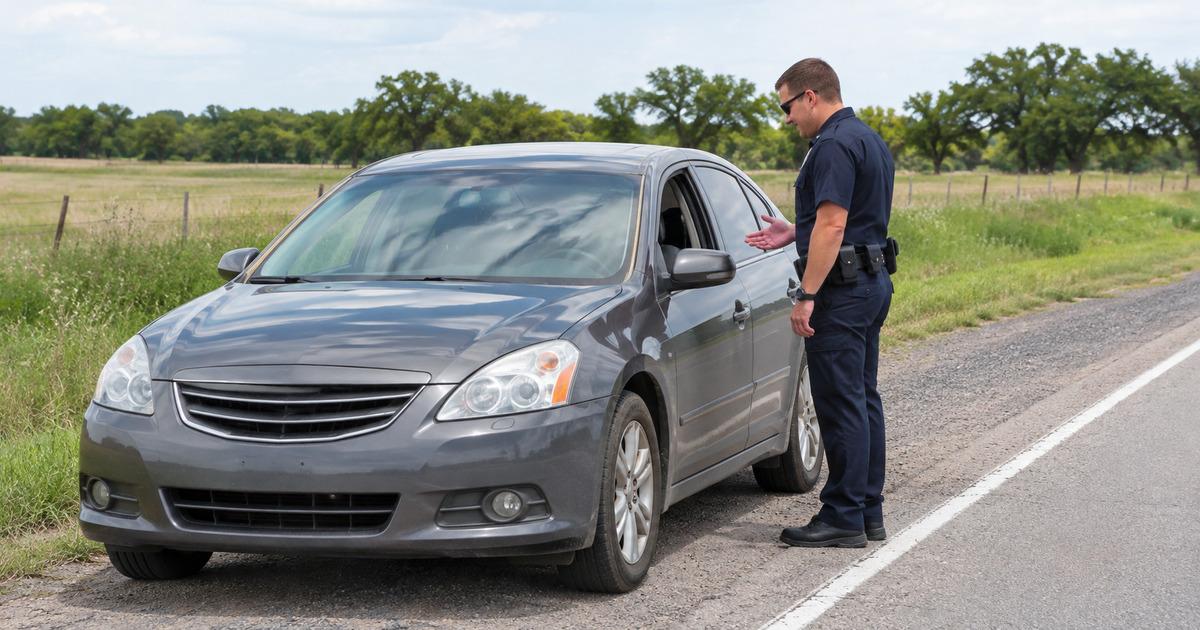
A request to search is not itself a legal command. You can decline without grabbing your belongings from an officer, blocking a doorway or interfering with the search. Keep your hands visible and avoid sudden movements. If officers proceed over your objection, repeat your position calmly and save the dispute for a lawyer and the court.
Refusal alone does not supply reasonable suspicion to detain you. In Florida v. Bostick, 501 U.S. 429, 437 (1991), the Supreme Court explained that declining cooperation, without more, does not justify a detention. That does not mean officers must ignore other facts they already know or later lawfully discover.
Nor does declining a search cancel separate legal duties. A driver's obligation to produce a license is different from permission to look through the car. Our guide to showing identification to Oklahoma police addresses those rules. Driving-under-the-influence testing and refusal rules also present separate issues, including the blood-draw questions we cover separately; do not apply general consent-search advice to a request for a chemical test.
What Makes Consent Voluntary?
The government cannot justify a search simply by showing that an officer asked and someone said yes. It must establish voluntary consent, rather than submission to pressure or asserted authority.
In Schneckloth v. Bustamonte, 412 U.S. 218 (1973), police stopped a car for lighting violations. An occupant who said the car belonged to his brother agreed to a search, and officers found stolen checks. The Supreme Court rejected a rule requiring the prosecution to prove that the person knew he could refuse. The government won: the Court reversed the federal appeals court's contrary decision.
The holding addressed consent from a person not in custody. It requires examination of all the circumstances, not a signed waiver or a particular warning. Knowing you can refuse is relevant, but it is not a prerequisite to voluntary consent in that setting.
That inquiry makes details important: the officer's words and tone, threats, repeated demands, the number of officers, the person's age and understanding, and any language barrier. A polite tone does not erase an implied threat. Feeling nervous does not automatically invalidate consent either. A recording may show that an apparent yes was freely given, or that it followed pressure the written report leaves out.
"We Have a Warrant" Is Different From "May We Search?"
In Bumper v. North Carolina, 391 U.S. 543 (1968), officers announced that they had a search warrant before a grandmother allowed them into her home. The prosecution later relied on her consent, not the warrant, to defend the search.
The Supreme Court rejected that position. Agreeing after an officer asserts authority to search is not, by itself, voluntary consent. The defendant won reversal and a remand because the rifle found in the search had been improperly admitted, and the error was not harmless.
The lesson is not that saying no defeats a warrant. A valid warrant can authorize a search without your consent. Rather, compliance with an asserted warrant cannot simply be relabeled permission if the government does not establish that warrant as a lawful basis. Do not physically challenge an officer's claim; preserve the words used and any warrant paperwork for counsel.
How Much Does "Go Ahead" Authorize?
Consent has boundaries, but an unstated boundary may not be the one a court recognizes. In Florida v. Jimeno, 500 U.S. 248 (1991), an officer said he was looking for narcotics and obtained general permission to search a car. The officer opened a closed paper bag on the floor and found cocaine.
The Supreme Court held that the permission reasonably included the bag, which could hold drugs. The government won reversal of the Florida court's suppression ruling and a remand. Officers did not need a separate request for that bag under those circumstances.
The test is what a typical reasonable person would have understood from the conversation. The stated object of the search matters. Looking for a large stolen object and looking for small packets of drugs do not necessarily authorize examination of the same spaces.
You may limit your own consent. If you agree only to a particular area or task, say that before the search begins. "You may look in the trunk, but I do not consent to opening any bags" states a limit more clearly than silently expecting officers to avoid your luggage. Read a consent form before signing; broad written permission can conflict with the narrow permission you thought you gave.
Jimeno also distinguished opening a paper bag from prying open a locked briefcase. That was a discussion of the boundary, not a holding about a briefcase searched in that case. General permission is not unlimited authority to destroy property, but do not assume that every movement of a panel or opening of a container exceeds it. The words, object and method of the search all matter.
Can You Withdraw Consent After the Search Starts?
You can withdraw your own permission for further searching. Communicate that directly: "I withdraw my consent. I do not agree to any further search." Say it to the officer conducting the search. Do not try to communicate withdrawal by taking something from the officer or physically obstructing the work.
The Tenth Circuit, whose decisions bind Oklahoma's federal trial courts, has upheld a finding that ambiguous objections did not withdraw consent. In United States v. Gregoire, 425 F.3d 872, 880-81 (10th Cir. 2005), a driver had broadly authorized a vehicle search. He later referred to wanting to get home and questioned whether the search was illegal.
The court read those remarks in context and deferred to the trial court's finding that permission had not been withdrawn or limited. It affirmed the judgment and sentence. It did not prescribe a mandatory script, and it acknowledged that another reading of the evidence was possible. The practical point is to state your decision, not leave officers to infer it from impatience or a question.
Withdrawal works prospectively. It does not make evidence already lawfully found disappear. If officers have developed probable cause supporting the automobile exception, or obtain a warrant, they may have a different basis to continue. The sequence matters: what had officers discovered before you withdrew permission, and what did they search afterward?
Does Refusal Let Police Keep You at a Traffic Stop?
Not by itself. In Rodriguez v. United States, 575 U.S. 348 (2015), the Supreme Court rejected the idea that officers get a few extra minutes for a dog sniff simply because the delay is short. Extending a traffic detention for an unrelated investigation requires independent reasonable suspicion unless the encounter has genuinely become consensual.
The rule does not turn only on whether the ticket or license has been handed back. It asks when the traffic tasks were, or reasonably should have been, completed and whether unrelated investigation added time. A question that does not prolong an otherwise lawful stop is different from holding someone longer to obtain permission or wait for a dog.
The Court vacated the appellate judgment and remanded; it left the independent reasonable-suspicion issue for the lower court. It did not order automatic suppression. Our traffic-stop and drug-dog article explains that timing issue in more detail.
What Refusal Cannot Decide
Consent is one possible justification for a search, not the only one. A valid warrant, probable cause satisfying the automobile exception, or an emergency meeting the applicable legal standard may authorize action despite your objection. Each has requirements; an officer's assertion that an exception applies does not settle whether it actually did.
Different places also have different protections. A search of a home's interior is not interchangeable with a vehicle search. Searching a phone's data raises issues beyond opening a paper bag. See our guides to police entry into a home and police phone searches for those questions.
Preserve the Exchange, Not Just the Search Results
Write down the request, your response, any limits you stated and any later withdrawal. Record who heard each statement. Keep consent forms, warrants, receipts and your original recordings. Note when officers found each item, especially if you changed your mind partway through.
Ask promptly about preserving body-camera and dash-camera recordings, dispatch audio and relevant reports. Our guide to body-camera retention explains why delay can matter. A short clip of your objection may help, but the surrounding conversation can determine whether permission was voluntary or what it covered. Preserve the whole recording rather than only an edited excerpt.
If you face criminal charges, ask a criminal defense lawyer about challenging the evidence and meeting the court's deadlines. A possible civil claim under 42 U.S.C. § 1983 is separate. It requires its own analysis of the constitutional violation, responsible defendants, injury and defenses such as qualified immunity. Neither a search over an objection nor suppression of evidence guarantees damages. City or county liability is not automatic because an officer works there. Addison Law Firm's unlawful-search practice addresses the civil side; criminal and civil deadlines require separate attention.
Oklahoma Section 1983 claims generally have a two-year limitations period. Federal law determines when the claim accrues, generally when you knew or had reason to know of the injury, so have counsel calculate your deadline promptly. Under Felder v. Casey, 487 U.S. 131 (1988), a state tort notice requirement cannot be imposed on a Section 1983 claim; Oklahoma's Governmental Tort Claims Act notice procedure is therefore not a prerequisite to that federal claim.
Frequently Asked Questions
Can I refuse a police search if I have nothing to hide?
Yes. You do not need an incriminating reason to withhold permission. Say so clearly and calmly. Refusal alone does not justify detention, but it does not defeat a warrant or other independently lawful search authority.
Do officers have to tell me I can say no?
In the setting addressed by Schneckloth, a roadside stop where the person who consented was not under arrest, no particular warning or proof that you knew of the right to refuse is required. Knowledge is one factor in deciding voluntariness. The absence of a warning does not automatically invalidate a search, and a warning does not automatically make consent voluntary.
If I agree to a car search, can police open my bags?
Possibly. Jimeno upheld opening a paper bag during a broadly authorized car search for drugs. What the officer said they were looking for, the permission you gave and any limits you communicated matter. Broad consent does not mean every destructive method is allowed.
What if I said yes, then told the officer to stop?
Preserve exactly what you said, who heard it and when. Clear withdrawal ends permission for further searching based on that consent, but it does not erase prior lawful discoveries or prevent action on another lawful basis. Gregoire shows why an ambiguous complaint may not be treated as withdrawal.
Does refusing a search mean I can leave immediately?
No. You may still be lawfully detained for the original stop or another supported reason. You can ask whether you are free to leave, but do not walk away or drive off over a disputed detention. Refusing permission to search and ending an encounter are separate questions.
Was Your Refusal Ignored?
The request, your response and the officer's claimed authority all matter. Contact Addison Law Firm to discuss whether an Oklahoma search raises a civil rights claim.
Discuss Your Civil RightsThis article is general information, not legal advice, and does not create an attorney-client relationship.