Key Takeaways
- 19th Street and I-35 is a high-risk corridor: Heavy traffic, speed differentials, ramps, service roads, and dense commercial turns create predictable crash conflicts.
- Jurisdiction matters after a crash: Whether Oklahoma Highway Patrol or Moore Police Department responds depends on exactly where you crash — on the interstate, service roads, or surface streets.
- Nearby surveillance footage can make or break your case: Businesses along 19th Street often have security cameras that capture crashes, but footage is deleted quickly without preservation letters.
If you live in Moore, you know the feeling: you exit I-35 onto 19th Street, and immediately, the tension rises. Cars are weaving to reach big-box stores, traffic is backing up from the lights, and drivers are distracted by rows of shops and restaurants. That combination makes the corridor a predictable place for disputed crash claims.
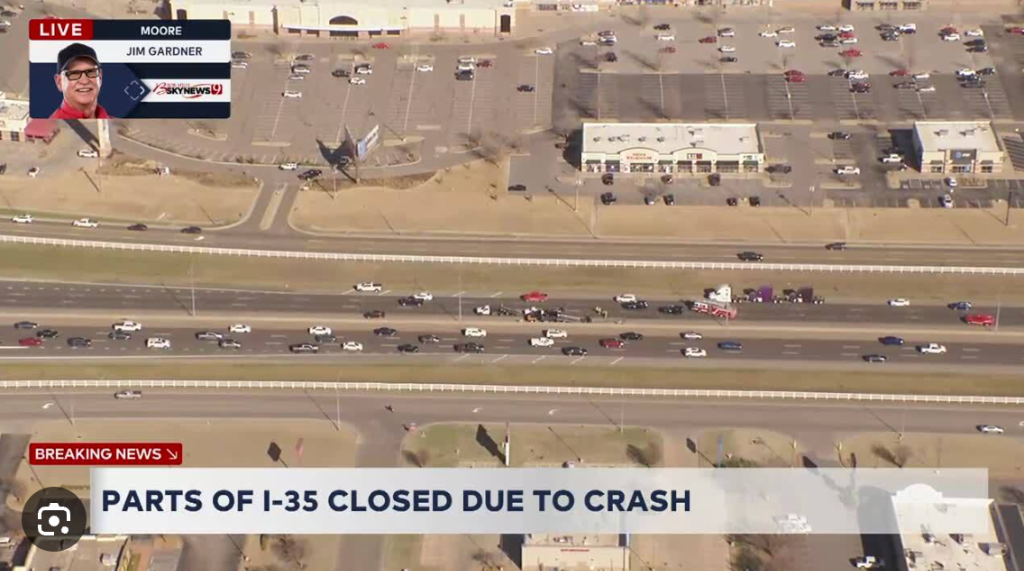
The City of Moore points residents and businesses to current City and Oklahoma Department of Transportation (ODOT) traffic counts, and ODOT has separately identified growing I-35 congestion between Moore and Norman. Heavy volume does not prove fault in any one wreck, but it explains why crashes in this corridor often require quick evidence preservation and a careful look at lane position, signal timing, ramps, service roads, and nearby cameras.
Why 19th and I-35 Is a Crash Magnet
The intersection of Interstate 35 and 19th Street — along with its surrounding service roads, ramps, and feeder streets — creates overlapping conflict points. Understanding why this area is difficult helps explain why fault should be decided from evidence, not from an adjuster's quick assumption that both drivers must share blame.
The volume alone is heavy. As a primary retail hub for Moore and much of south Oklahoma City, this corridor sends drivers through repeated conflict points — someone turning left across traffic to reach a parking lot, someone braking suddenly because they missed a turn, someone accelerating toward the highway while merge lanes are already full.
The road design compounds the problem. Traffic from the interstate, service roads, and turning lanes converges in ways that create dozens of points where vehicle paths cross. Drivers must navigate multiple lane changes just to reach their destination, and the signage and lane markings — while adequate on paper — don't account for the cognitive overload that comes from processing so many simultaneous decisions. When you're trying to find a store entrance while checking mirrors for merging traffic and watching the car ahead brake for a pedestrian, something eventually gives.
Distraction is endemic to this corridor. Dense commercial signage competes for drivers' attention. GPS devices prompt last-second turns. Phone use — already dangerous anywhere — is amplified here because drivers are actively searching for unfamiliar destinations. And the speed differential between cars exiting the highway at 60-plus miles per hour and stop-and-go city traffic creates the conditions for particularly violent rear-end collisions, the most common crash type in this corridor.
While 19th and I-35 draws the most attention, other local intersections carry significant risk. The crossing at 4th Street and Telephone Road is another high-volume intersection with confusing lane assignments that catch unfamiliar drivers off guard. Just west of the highway, 19th and Telephone Road handles overflow traffic from the retail district and sees frequent broadside collisions from drivers running yellow lights. South Sooner Road and S.E. 134th Street is now designated the Emily Gaines Memorial Intersection after the fatal 2019 crash that led to the Emily Gaines verdict against a former Moore police officer and the City of Moore. And as development continues pushing south, SW 34th and the I-35 service roads are seeing an increasing number of high-speed wrecks — a pattern likely to worsen as commercial growth creates the same conditions that make 19th Street so dangerous.
What to Do After a Crash in Moore
A crash in this busy corridor presents challenges you usually will not face in a residential neighborhood accident. 47 O.S. § 10-107 requires immediate notice to law enforcement after injury or death crashes, and 47 O.S. § 10-108 separately addresses written collision reports in certain unresolved cases. Knowing the law is just the starting point. What you do in the minutes and hours after a high-traffic Moore crash can affect the strength of your claim.
Get to safety first. Traffic on 19th Street does not stop for your accident. If your vehicle is drivable and you are not injured, move to a nearby parking lot immediately. Staying in the travel lane on 19th Street or the I-35 service road drastically increases your risk of a secondary collision — and secondary crashes at high-traffic intersections are often more severe than the initial impact because approaching drivers aren't expecting stopped vehicles in a moving lane.
Know which agency will respond. Jurisdiction in this area can be confusing, and it matters for your case. Crashes on I-35 itself or on the entrance and exit ramps generally fall under Oklahoma Highway Patrol jurisdiction. Crashes on 19th Street and other surface roads are handled by the Moore Police Department. If you crash on a service road, the lines blur — dispatch will determine who responds based on your exact location. Be as precise as possible when calling 911, because the responding agency produces the crash report you'll need for your insurance claim and any potential lawsuit.
Look for cameras immediately. This is one of the biggest advantages — and biggest time-sensitive opportunities — of crashing near 19th Street's commercial corridor. Many of the businesses facing the road operate exterior surveillance systems. Target, Lowe's, banks, gas stations, and restaurants may have cameras that captured your crash from angles the police report can't replicate. The problem is timing: most commercial surveillance systems overwrite their footage within days, sometimes within 48 hours. If you identify a potential camera source at the scene, your attorney can send a formal preservation letter demanding that the business retain the footage. Without that letter, the evidence disappears.
Don't fall into the "wait and see" trap. Adrenaline masks pain — that's physiology, not exaggeration. In a high-impact zone like I-35 and 19th, soft tissue injuries, whiplash, and spinal injuries are common, and many victims walk away from the scene feeling fine only to discover serious problems days later. Delayed injury symptoms affect a large percentage of accident victims, and insurance companies exploit treatment gaps ruthlessly. If you wait three days to see a doctor, the adjuster will argue that your injuries must not be serious — or that they were caused by something other than the crash. Go to the doctor the same day, even if you feel okay.
Get your incident number. Moore Police Department crash reports can take several days to process. Make sure you get the specific incident number from the officer at the scene. You'll need it to obtain the official report, which is the foundation of your insurance claim.
Understanding Your Rights After a Moore Intersection Crash
Oklahoma follows a modified comparative negligence system, meaning you can recover damages even if you were partially at fault — as long as your share of responsibility is 50% or less. Insurance companies know this, and they exploit it aggressively in intersection crashes. They'll argue that you should have anticipated dangerous conditions at a busy intersection, that you changed lanes improperly, or that you were distracted by your phone — even when their insured is the one who ran the red light.
The duty to drive safely rests with every motorist. A driver who fails to yield, runs a red light, or rear-ends you in stopped traffic cannot escape liability simply because the intersection is known to be busy. In fact, the well-documented dangers of these intersections can actually strengthen your case: if everyone knows this corridor is dangerous, the at-fault driver should have exercised greater caution, not less.
If you're involved in a crash at a high-traffic Moore intersection, the first 72 hours are critical. Getting medical attention promptly protects both your health and your legal claim. Insurance companies often argue that delayed treatment means the injuries are unrelated, even when delayed symptoms from whiplash and soft tissue damage are medically plausible. Understanding how your case value is determined — including factors like medical expenses, lost wages, and the severity and permanence of your injuries — helps you set realistic expectations and avoid accepting a lowball offer out of frustration.
Why You Need a Local Attorney for Moore Intersection Cases
Insurance adjusters love treating Moore intersection crashes as "routine fender benders." They assign shared fault with minimal investigation, claim you should have seen the other driver coming, and make lowball offers designed to close the file as cheaply as possible. They count on you not knowing that their characterization of your crash is a strategy, not an objective assessment.
We know these intersections. We know the lane markings, the signal timing issues, the sight-line problems, and the common excuses negligent drivers use to shift blame. We know how to identify nearby cameras, preserve footage before it is deleted, and use that evidence to test the adjuster's version of events. If you've been hit on 19th Street or anywhere in the Moore corridor, a personal injury attorney can evaluate your case. Contact us to make sure you are not stuck paying for someone else's mistake.
Frequently Asked Questions
What should I do immediately after a crash at 19th and I-35 in Moore?
Move to safety if you can — a nearby parking lot is ideal. Call 911 and be precise about your location so dispatch sends the right agency. Take photos of all vehicles, damage, road conditions, and traffic signals. Get contact information from witnesses, and look for nearby business surveillance cameras that may have captured the crash. Most importantly, seek medical attention the same day, even if you feel fine at the scene.
Who investigates crashes on the I-35 service roads in Moore?
Jurisdiction can be ambiguous on service roads. Generally, Oklahoma Highway Patrol handles the interstate and on/off ramps, while Moore Police Department handles surface streets. The 911 dispatcher will coordinate the correct agency based on your exact location, so be as specific as possible when calling — reference the nearest cross street or business if you can.
How long do I have to file a claim after a car accident in Moore, Oklahoma?
Under Oklahoma's statute of limitations, you generally have two years from the date of the accident to file a personal injury lawsuit under 12 O.S. § 95. However, you should report the crash to your insurance promptly and begin building your case as soon as possible. Evidence degrades, witnesses forget details, and surveillance footage gets overwritten — all of which weaken your position the longer you wait.
Can I still recover damages if I was partially at fault for the intersection crash?
Yes. Oklahoma uses modified comparative negligence, which means you can recover damages as long as you are 50% or less at fault. Your recovery is reduced by your percentage of fault — so if you are found 20% responsible and your damages total $100,000, you would recover $80,000. Insurance companies frequently try to inflate your fault percentage in intersection crashes, particularly by claiming you should have anticipated dangerous conditions or failed to keep a proper lookout. Don't accept their characterization without consulting an attorney who understands the specific intersection dynamics.
What if the other driver's insurance says the crash was just a minor fender bender?
Do not accept an insurance company's characterization of your crash. Injuries from even low-speed collisions — particularly whiplash and soft tissue injuries — can take days or weeks to fully manifest. Get a medical evaluation, preserve all evidence, and consult an attorney before accepting any settlement offer. What insurance companies call a "minor" crash often produces injuries that require months of treatment.
How can nearby business cameras help prove my crash case?
Many businesses along 19th Street — including Target, Lowe's, banks, and restaurants — operate exterior surveillance cameras that may have captured your crash from a clear vantage point. The critical issue is timing: most systems overwrite footage within days or weeks. An attorney can send a formal preservation letter requiring the business to save the footage before it is deleted. This footage can be decisive in establishing fault, especially when the at-fault driver disputes what happened.
Injured in a Moore Intersection Crash?
We know these intersections, and we know how insurance companies try to minimize your claim. Let us handle the fight while you focus on recovering.
Get a Free Consultation →This article is for general information only and is not legal advice.