
Key Takeaways
- ODOT Gives Drivers a Broad Safety Instruction: The Oklahoma Department of Transportation tells drivers to move over or slow down for any stationary vehicle displaying flashing lights, including an ordinary car with its hazards on. The text of 47 O.S. § 11-314 is less seamless: subsection B's opening coverage includes that catchall, but paragraph B(1)'s multilane lane-change list omits it. That drafting gap makes the precise statutory lane-change duty for an ordinary hazard-lit car less certain than ODOT's public instruction.
- Violations Carry Serious Fines: Under the fine schedule added effective November 1, 2023, a violation is the offense of endangerment of an emergency worker, with fines of $1,000 for a first offense and $2,500 for a second when no emergency worker is injured or killed — rising to as much as $5,000 if an emergency worker is injured and $10,000 if an emergency worker is killed.
- A Violation Can Matter in a Civil Case: Oklahoma recognizes negligence per se, but courts first decide whether a statute supplies a suitable civil standard. The lane-change command is concrete for the emergency, maintenance, and wrecker vehicles paragraph B(1) specifically repeats. The omitted catchall and the fallback duty to use due caution and reduce speed make the analysis less certain for an ordinary hazard-lit car. Howard v. Zimmer, Inc., 2013 OK 17; Chartney v. City of Choctaw, 2019 OK CIV APP 26.
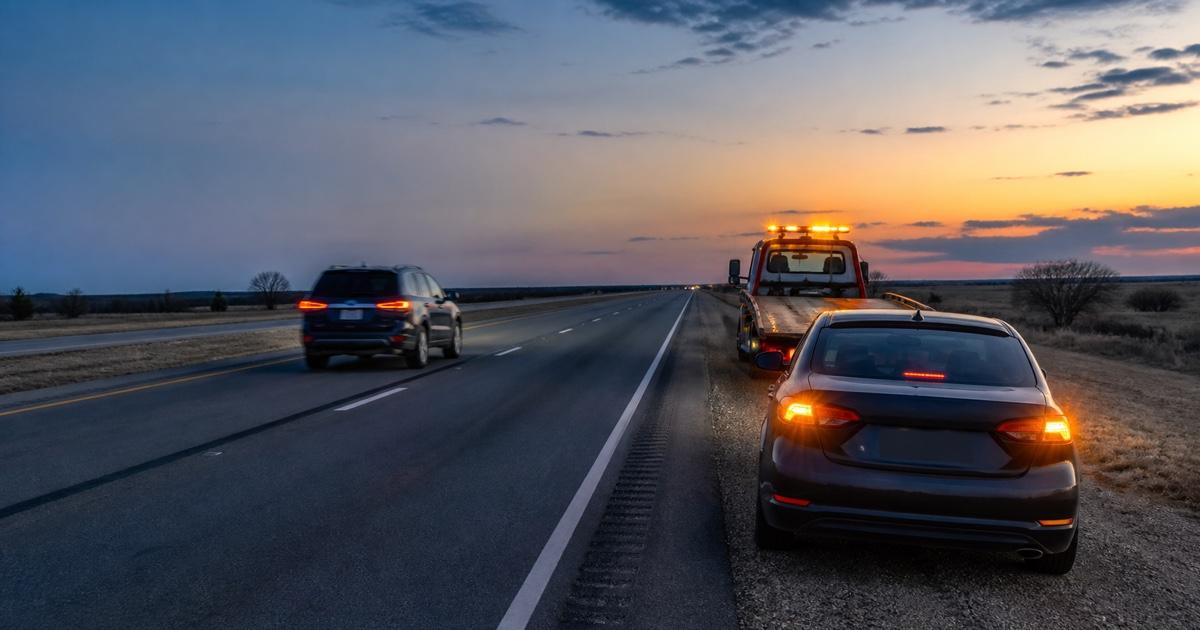
The Oklahoma Department of Transportation gives drivers a simple safety instruction: when approaching any stopped vehicle with flashing lights — an emergency vehicle, a highway maintenance truck, a licensed wrecker, or another motorist with hazard lights on — move into a non-adjacent lane when possible and safe, or slow down and proceed with caution. The statute at 47 O.S. § 11-314 starts with that broad coverage, but its multilane lane-change paragraph repeats the emergency, maintenance, and wrecker categories while omitting the catchall for any stationary flashing-light vehicle. That drafting gap means ODOT's broad instruction should not be confused with a settled judicial construction of the lane-change clause for an ordinary hazard-lit car. If you or a family member was hit while stopped on the shoulder — changing a tire, waiting for a tow, or working a roadside job — the statute and ODOT's safety guidance still matter to the civil fault analysis.
This article is general legal information, not legal advice about any specific crash. Whether the Move Over Law applies, and what a violation means for a claim, depends on facts that need individual review.
What the Law Requires
Section 11-314 splits the instruction by road type. Subsection B first names emergency vehicles, state and turnpike maintenance vehicles, licensed wreckers with specified flashing lights, and the catchall "a stationary vehicle that is displaying flashing lights." On a highway with two or more lanes running the same direction, paragraph B(1) requires due caution and, when possible and safe, a move into a lane not adjacent to an emergency vehicle, maintenance vehicle, or licensed wrecker. It does not repeat the catchall stationary flashing-light vehicle in that lane-change list. If a lane change is unavailable or unsafe, B(1) calls for due caution and a safe speed. On other highways, B(2) calls for due caution and a safe speed without repeating any category.
The statute's opening coverage includes a stationary authorized emergency vehicle, a Department of Transportation maintenance vehicle, a Turnpike Authority maintenance vehicle, a licensed wrecker displaying flashing amber, red, or blue lights in any combination — and, in the catchall that surprises many drivers, "a stationary vehicle that is displaying flashing lights." According to the Oklahoma Department of Transportation, that language came from Senate Bill 89 in 2019, which extended the safety-zone law to any vehicle with flashing lights, including a civilian car with its hazards on, effective November 1, 2019. ODOT's public guidance applies the move-over-or-slow instruction to all of them. The official statutory text, however, still contains the B(1) omission described above, and we are not aware of a published Oklahoma appellate decision resolving it.
In plain terms: the family stopped on the I-35 shoulder with a blown tire and hazard lights flashing is within subsection B's opening coverage and ODOT's broad safety message. Whether B(1)'s omitted catchall creates the same statutory lane-change command that applies to a trooper, maintenance vehicle, or licensed wrecker remains a question of statutory construction.
The Bernardo-Mills Law: What Changed in 2023
The section already had a name before 2023: Bernardo's Law, given to it by the Legislature in 2021. What House Bill 2684 added, effective November 1, 2023, was a second name and — for the first time — real money. Before that amendment, § 11-314 stated the duty but carried no fine schedule of its own. The bill's House author said the added name honors John Mills, a tow truck operator killed while working along U.S. Highway 69, according to Capitol Beat OK.
Under the current statute, a driver who violates the move-over duty commits the offense of endangerment of an emergency worker. When no emergency worker is injured or killed, the fine is a flat $1,000 for a first offense and $2,500 for a second. When the violation injures an emergency worker, the offense becomes aggravated endangerment, with a fine of up to $5,000 — and up to $10,000 if an emergency worker is killed, in addition to any other penalty authorized by law.
Two things here are worth knowing. First, the enhanced fines turn on injury or death of an "emergency worker," but neither § 11-314 nor Title 47's definitions define that term. Subsection B's opening coverage includes an ordinary car stopped with its hazards on, subject to the B(1) drafting gap described above. Whether the person standing beside that car is an "emergency worker" for purposes of the $5,000 and $10,000 fines is another open question, and it is the kind of gap a prosecutor and a defense lawyer will read in opposite directions.
Second, the statute contains an escape hatch — but only on the ticket side. Under subsection F, a driver cannot be cited or convicted of endangerment if the violation resulted, in whole or in part, from mechanical failure of the driver's own vehicle or from the negligence of another person or an emergency worker. That provision decides whether a traffic charge sticks. It does not decide who pays for an injury. Civil fault is a separate question under ordinary negligence and comparative-fault rules.
Why the Statute Matters in an Injury Claim
A traffic citation is not a lawsuit, and a fine paid to the court does not compensate the person lying in a hospital bed. But a statutory violation can do heavy lifting in a civil negligence case through the doctrine of negligence per se.
The Oklahoma Supreme Court explained the doctrine in Howard v. Zimmer, Inc., 2013 OK 17, an answer to a certified question from the Tenth Circuit in which the court held — in the injured plaintiff's favor — that Oklahoma law permitted a negligence per se claim built on a federal regulation. Along the way, the court restated the elements: negligence per se substitutes a statutory standard for the common-law duty of reasonable care, and it applies when the claimed injury was caused by the violation, the injury is of the type the statute was intended to prevent, and the injured person is one of the class the statute was intended to protect.
Section 11-314's opening coverage expressly includes a person stopped on the shoulder with flashing lights, which gives an injured plaintiff a strong argument that the law addresses this roadside danger. Two cautions, though. Oklahoma courts decide for themselves whether a statute is a fit standard for civil liability, and the Court of Civil Appeals has held that a negligence per se instruction is not appropriate where a statute's terms do not impose positive, objective standards. Chartney v. City of Choctaw, 2019 OK CIV APP 26. The lane-change command is concrete for the emergency, maintenance, and wrecker vehicles B(1) repeats. For an ordinary hazard-lit car, the omitted catchall creates a threshold statutory-construction question. The fallback — proceed with due caution and reduce speed to a safe speed — also reads much like the ordinary reasonable-care standard. We are not aware of a published Oklahoma appellate decision resolving either issue under § 11-314. A lawyer should evaluate them before pleading negligence per se or asking for a jury instruction.
Even without negligence per se, the statute and ODOT's public guidance frame the fault story. Oklahoma juries decide comparative fault, and a defendant who passed a visible roadside hazard without giving safe clearance or reducing speed still has to answer for that choice under ordinary negligence. Our explainer on the Oklahoma 51% bar covers how fault percentages control who can recover and how much.
If You Were the One Stopped on the Shoulder
Expect the passing driver's insurer to argue that the stopped person contributed to the crash — stopped too close to the travel lane, no flashers, walked into the roadway. Some of those arguments have force in some cases; many do not. A few points to keep in view:
- Hazard lights matter. Since the 2019 amendment, they bring an ordinary stopped car within subsection B's opening coverage and ODOT's move-over-or-slow guidance, although B(1)'s multilane lane-change list omits that catchall. Evidence that your flashers were on — witness statements, dashcam footage, vehicle data — is worth preserving immediately.
- Subsection C is not aimed at an ordinary stranded driver. It says only that the move-over duty does not excuse the operator of a stopped emergency, maintenance, or wrecker vehicle "from the consequences of reckless disregard for the safety of all persons and property upon the highway." If you were in your own car with the hazards on, that provision is not about you. If you were working a wrecker or a maintenance truck, your own conduct can still be considered.
- Commercial trucks that stop on the highway have their own federal warning-device duties, which we cover in our article on stopped trucks and warning devices. In a car-versus-truck shoulder crash, both sets of rules can be in play at once.
Roadside crashes also tend to be severe, because the stopped person is often outside the vehicle — standing at a jack, loading a wrecker, or flagging traffic — with no steel around them. Injury documentation, scene photographs, and early witness identification matter more than in a typical fender case, and they disappear fast.
What to Do After a Shoulder or Roadside Crash
The first steps look like any serious wreck: get medical care, report the crash, and preserve what you can. The move-over angle adds a few specific items worth raising with a lawyer early — whether the investigating officer cited the passing driver under § 11-314, whether nearby cameras or dashcams captured your flashing lights, and whether the passing driver had room to change lanes. Traffic and lane-position evidence is exactly the kind of proof that vanishes when vehicles are repaired and camera footage cycles.
If a passing driver hit you or someone you love while stopped on an Oklahoma road, our car accident practice team can evaluate how the Move Over Law fits your case. There is no fee to ask.
Frequently Asked Questions
Does Oklahoma's Move Over Law apply to ordinary cars with hazard lights on?
ODOT says yes: its public guidance tells drivers to move over or slow down for any stopped vehicle with flashing lights. The statute's opening coverage has included any "stationary vehicle that is displaying flashing lights" since November 1, 2019. But on a multilane road, paragraph B(1)'s lane-change list omits that catchall while repeating emergency vehicles, maintenance vehicles, and licensed wreckers. Until an Oklahoma appellate court resolves that wording, it is safer to treat ODOT's broad move-over instruction as safety guidance and evaluate the precise statutory duty in the specific case.
What if I could not change lanes when I passed a stopped vehicle?
For the emergency, maintenance, and wrecker vehicles paragraph B(1) specifically lists, a lane change is required only when possible and consistent with road, weather, and traffic conditions. If it is unavailable or unsafe, the paragraph calls for due caution and a safe speed. ODOT gives the same move-over-or-slow instruction for any stationary flashing-light vehicle, but the statutory catchall omission for an ordinary hazard-lit car remains the ambiguity discussed above.
What are the fines for violating the Move Over Law?
Under the fine schedule House Bill 2684 added effective November 1, 2023, the fine is a flat $1,000 for a first offense and $2,500 for a second when no emergency worker is injured or killed. If the violation injures an emergency worker, the fine rises to as much as $5,000; if an emergency worker is killed, as much as $10,000, in addition to any other penalty authorized by law.
Can a Move Over Law violation help my injury case?
It can. Oklahoma's negligence per se doctrine may allow a statutory violation to establish breach of duty when the statute supplies a suitable civil standard, the violation caused the injury, the injury is the type the statute was designed to prevent, and the injured person is in the protected class. For an ordinary hazard-lit car, counsel first has to confront B(1)'s omitted catchall rather than assume the lane-change clause applies. Even if a court declines to use § 11-314 as a negligence per se standard, passing a visible roadside hazard without safe clearance or reduced speed is still conduct a jury can weigh under ordinary negligence.
Why did Oklahoma add Mills to the Move Over Law's name?
The bill's House author said the 2023 amendment added the name of John Mills, a tow truck operator killed while working along U.S. Highway 69. The Legislature had already called the section Bernardo's Law since 2021. The updated name reflects the people the statute most visibly protects: tow operators, first responders, and road workers who do their jobs a few feet from live traffic.
Hit While Stopped on an Oklahoma Roadside?
If a passing driver failed to give safe clearance or reduce speed near a visible roadside hazard, Oklahoma law may have a lot to say about your claim. Addison Law Firm reviews roadside and shoulder crash cases across Oklahoma. The consultation is free, and we only get paid if we recover for you.
Request a Free Consultation