
Key Takeaways
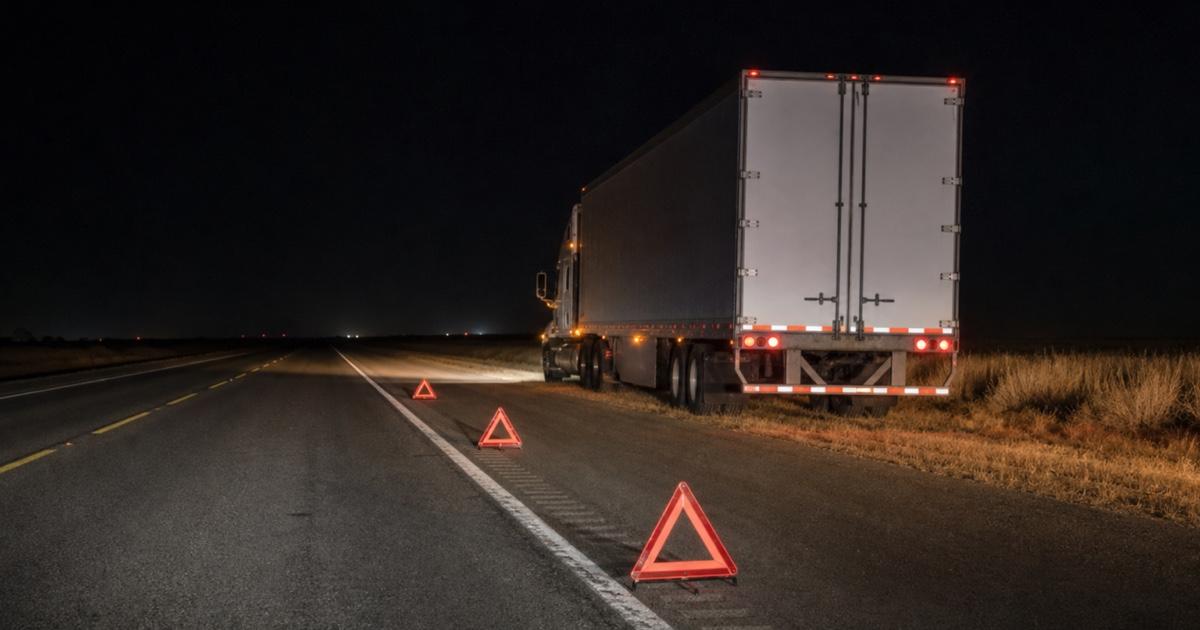
- There Is a Specific Federal Rule, and It Has a Clock: Under 49 C.F.R. § 392.22, a covered commercial motor vehicle stopped on the traveled portion or the shoulder of a highway — for any reason other than a necessary traffic stop — must immediately turn on its hazard flashers and place the required warning devices "as soon as possible, but in any event within 10 minutes." The rule specifies exactly where each device goes.
- An Oklahoma Case Shows What These Fights Look Like: In Whittenburg v. Werner Enterprises, a Werner truck got stuck across a dark Oklahoma highway during a U-turn and no one put out the reflective markers that were in the truck. Those facts were undisputed. But the verdict did not stand: the Tenth Circuit reversed and ordered a new trial because of how plaintiff's counsel argued the case in closing. It is a useful map of the issues, not a scoreboard.
- "They Broke a Rule" Is Not the Same as Negligence Per Se: Having already reversed on other grounds, the Whittenburg panel added guidance for the new trial: on those facts, Oklahoma's stopping-and-parking statute could not support a negligence per se instruction because the truck became stuck rather than being stopped or parked. That passage was not the court's basis for reversal, but the point behind it matters. The statute or regulation has to actually fit what happened.
A stopped tractor-trailer can be misread as safely parked, especially at night. In Whittenburg v. Werner Enterprises, the approaching pickup driver testified that he saw the truck's headlights, believed they came from a large vehicle parked on the opposite shoulder, did not slow, and struck the tractor-trailer blocking the highway. Warning evidence can help explain what an approaching driver actually saw and had time to understand.
Federal regulations anticipate this. They do not treat a stopped truck as a passive object. When the rule applies, they treat it as a roadside hazard the driver must actively mark. Whether that was done — and how fast — can be central to the case.
This article is general information, not legal advice. Whether Part 392 applies to the vehicle and operation, whether an exception applies, the version of each rule in force on the crash date, and the facts of the stop all matter.
The Rule: 49 C.F.R. § 392.22
49 C.F.R. § 392.22 is titled "Emergency signals; stopped commercial motor vehicles." It has two parts, and both matter.
Hazard flashers, immediately. Subsection (a) provides that whenever a commercial motor vehicle "is stopped upon the traveled portion of a highway or the shoulder of a highway for any cause other than necessary traffic stops," the driver "shall immediately activate the vehicular hazard warning signal flashers and continue the flashing until the driver places the warning devices required by paragraph (b)." Note the reach: this is not limited to the travel lane. A covered commercial motor vehicle on the shoulder falls within the rule, subject to the exceptions below. And note what flashers are not — subsection (a) says they may be used at other times "in addition to, but not in lieu of," the warning devices.
Three devices, within ten minutes, in specified places. Subsection (b)(1) requires the driver, "as soon as possible, but in any event within 10 minutes," to place the warning devices required by § 393.95:
- One on the traffic side, about 10 feet from the truck, toward approaching traffic;
- One about 100 feet from the truck, in the center of the lane or shoulder the truck occupies, toward approaching traffic; and
- One about 100 feet from the truck, in that same lane or shoulder, in the direction away from approaching traffic.
The special rules in (b)(2) matter just as much:
- Hills, curves, and obstructions. If the truck is stopped within 500 feet of a curve, the crest of a hill, or another obstruction to view, the driver must place the warning device in the direction of that obstruction "a distance of 100 feet to 500 feet from the stopped commercial motor vehicle so as to afford ample warning to other users of the highway." The 100-foot default is not the answer here. The driver has to choose a distance within that range that actually warns approaching traffic, and how far back that needed to be is a fact question.
- Divided or one-way roads. On a divided or one-way highway — including a divided interstate — the placement changes: one device at 200 feet and one at 100 feet toward approaching traffic in the occupied lane or shoulder, plus one on the traffic side within 10 feet of the rear of the truck.
- Fusees. A driver using fusees must place a lighted fusee at each required location, keep at least one burning at each location while the truck remains stopped, and remove them before the truck moves.
- Daylight. The rule still requires three triangles or three lighted fusees within 10 minutes during daylight hours, subject to the business-or-residential-district exception.
- Business or residential districts. Warning devices are not required inside a municipality's business or residential district, except when lighted lamps are required and street or highway lighting is insufficient to make the truck "clearly discernable at a distance of 500 feet."
- Leaking flammable material. No flame-producing signal may be lit or placed except at a distance that assures prevention of fire or explosion.
What Counts as a Warning Device — and What Changed in 2026
49 C.F.R. § 393.95 sets the equipment side. Except for units towed in driveaway-towaway operations, a truck, truck tractor, or bus must carry one of two options under subsection (f): three bidirectional emergency reflective triangles conforming to Federal Motor Vehicle Safety Standard No. 125, or at least six fusees — plus as many additional fusees as § 392.22 requires. Other warning devices "may be used in addition to, but not in lieu of," the required ones, and only if they do not reduce the required devices' effectiveness. Subsection (g) separately bars flame-producing devices on specified vehicles carrying explosives, flammable gas, flammable liquid, or compressed gas as motor fuel.
This is worth checking carefully, because the rule changed recently. FMCSA published Parts and Accessories Necessary for Safe Operation; Liquid-Burning Flares, 91 Fed. Reg. 7867, 7870 (Feb. 19, 2026), effective March 23, 2026, removing references to liquid-burning flares from the warning-device requirements in Parts 392 and 393. Page 7867 is where the rule begins; page 7870 contains the amendatory text. For a crash before March 23, 2026, the version in force on the crash date controls, so counsel should pull the point-in-time text rather than assume the current eCFR applies.
One practical point about equipment: if the vehicle uses the triangle option, the triangles are only useful if they are on the truck, reachable, and actually deployed. Section 393.95 requires carrying the selected equipment. Section 392.22 requires using the warning devices when its stopping rule applies. A carrier that can produce an equipment list has answered the first question, not the second.
Oklahoma Has a Separate Disabled-Vehicle Rule
Oklahoma's current disabled-vehicle warning statute, 47 O.S. § 12-408, overlaps with the federal regulation but is not a copy of it. Outside a municipality, it applies when a covered truck, bus, truck tractor, trailer, semitrailer, pole trailer, or vehicle towing a manufactured home is disabled on the traveled portion or shoulder. It excludes a "lightweight vehicle," generally one with a manufacturer's gross vehicle weight rating of 10,000 pounds or less, and subsection G separately exempts farm-tag vehicles used exclusively for farming and ranching.
When lighted lamps are required, the state statute calls for one listed warning device immediately at the traffic side and then three listed devices as soon as possible and within the fusee's burning period. When those lighted devices are not required, subsection D calls for two red flags, one about 100 feet ahead and one about 100 feet behind. It also has separate placement rules for hills, curves, divided highways, and certain hazardous-material vehicles.
The wording differences matter. Section 12-408 still lists liquid-burning flares, while FMCSA's 2026 amendment removed them from the federal requirements. The federal amendment changed Parts 392 and 393; it did not rewrite the Oklahoma statute. Which provisions govern, and how overlapping state and federal requirements fit together, depends on the vehicle, carrier and operation, location, lighting conditions, and crash date.
Whittenburg v. Werner Enterprises: An Oklahoma Truck, a Dark Highway, and Markers Never Placed
Whittenburg v. Werner Enterprises, Inc., 561 F.3d 1122 (10th Cir. 2009), is a published Tenth Circuit decision on appeal from the Western District of Oklahoma involving an unmarked tractor-trailer blocking a dark Oklahoma highway. It is instructive in two directions at once.
What happened. On the morning of December 1, 2003, driver-trainee Marisela Neff was driving a Werner truck while her trainer, Jon Morlan, dozed in the sleep seat. After realizing she had taken a wrong turn onto Oklahoma Highway 325, she woke Morlan, who consulted a map and advised a U-turn. Part-way through the U-turn the truck got stuck and stayed jammed in the highway, blocking the road in both directions with its headlights shining toward oncoming traffic. Morlan got out to assess the truck. Neff saw headlights approaching, ran into the middle of the highway waving a flashlight, and when that did not work, went back to the truck to sound the horn and turn on more lights. Mack Whittenburg, approaching in a pickup, testified he saw only the truck's headlights shining down the opposite side of the road, believed they came from a large vehicle parked on the opposite shoulder, did not slow, and collided with the truck.
The Tenth Circuit recorded two facts as undisputed: it was dark with little or no ambient light, and "neither Ms. Neff nor Mr. Morlan placed reflective warning markers, available in their truck, on the highway." There was reflective tape on the truck's sides; whether Whittenburg could have seen it at that angle was disputed, and he testified he did not.
Procedural posture and result — read this part carefully. The jury returned a substantial verdict for Whittenburg and reduced it for comparative fault. The defendants appealed. The Tenth Circuit reversed and remanded for a new trial. The reason had nothing to do with warning devices. Plaintiff's counsel had built more than half of his closing argument around an imaginary letter from Werner to Whittenburg's children, stuffed with invented admissions the company never made and with attacks on the defense for daring to defend the case. The panel — Judges McConnell, Ebel, and Gorsuch, with Judge Gorsuch writing — called this a violation of "the cardinal rule of closing argument: that counsel must confine comments to evidence in the record and to reasonable inferences from that evidence," and found a new trial required given the extent of the remarks, the absence of curative action, and the size of the verdict.
So Whittenburg is not a plaintiff's victory to cite for a proposition. The judgment was wiped out, and the Tenth Circuit treated the jury's apportionment as one sign that the improper argument had worked. The split is not a benchmark. What the case provides is a useful map: a published federal decision, on Oklahoma facts, showing which questions a stopped-truck case turns on, plus a hard warning that the way a case is argued can undo an otherwise strong record.
The Negligence Per Se Trap
Whittenburg has a third section that is easy to skip and easy to overstate. The court had already reversed on the closing argument and said it did not need to reach the remaining issues. It then gave the trial court direction about an additional error "that should be avoided in the new one." That discussion is useful guidance, but it was not the holding that produced the reversal.
The district court had instructed the jury it could find negligence per se from a violation of any of three Oklahoma motor-vehicle statutes. The panel described the versions of Okla. Stat. tit. 47, § 11-301(A) and § 11-309(1) then before it as rules aimed at keeping drivers in a single lane, and particularly the right lane unless passing. Neither fit because no one alleged the Werner drivers were improperly in the left lane or changed lanes imprudently. Both statutes have been amended since the crash; current § 11-309(1) is the single-lane rule alone.
The third is the one that matters here. Okla. Stat. tit. 47, § 11-1001(A)(1) is "aimed at preventing people from 'stop[ping], park[ing], or leav[ing] standing' their vehicles in unsafe positions." The panel said it did not apply on the record before it because "neither party alleged that Werner's drivers stopped or parked their truck across Highway 325; it is undisputed that the truck became stuck despite the intentions of the Werner drivers to make a legal U-turn and continue driving." The statute "too, therefore, was erroneously offered as a basis for a finding of negligence per se."
The lesson is precise. A truck ending up in the road is not automatically a truck that was parked in the road. If the theory is negligence per se, the statute's actual terms have to match what the driver did. In Whittenburg, two facts did the work: no one alleged that the drivers stopped or parked, and it was undisputed that the truck became stuck against their intentions. Where the driver's conduct is contested, or the claim is that a disabled truck was left standing in the lane, the analysis is different because § 11-1001(A)(1) reaches vehicles "left standing" whether attended or unattended. Ordinary negligence and a regulation like § 392.22 — which covers a vehicle stopped "for any cause" other than a necessary traffic stop — may also reach conduct the parking statute does not. The case has to be built on the right rule. See our discussion of the Oklahoma liability chain in trucking cases.
Oklahoma ordinary-negligence law supplies a separate path. In Dirickson v. Mings, 1996 OK 2, 910 P.2d 1015, the Oklahoma Supreme Court said a stopped vehicle that poses a danger generally carries a duty to use reasonable care to warn approaching traffic, and failure to warn may be negligent even without a specific regulatory duty. The court did not decide whether the statutes cited there were violated; it reversed summary judgment because reasonable people could differ on causation. That is different from using an inapplicable statute to establish negligence per se.
Can a Federal Trucking Rule Support Negligence Per Se?
Yes, in principle — but not automatically. In Howard v. Zimmer, Inc., 2013 OK 17, 299 P.3d 463, the Oklahoma Supreme Court held that a federal regulation can support negligence per se under Oklahoma law. The plaintiff still must show that the violation caused the injury, that the rule was meant to prevent that kind of injury, and that the plaintiff belongs to the class the rule was designed to protect.
Covel v. Rodriguez, 2012 OK 5, 272 P.3d 705, is an illustration, not the framework. The trial court gave a negligence per se instruction that listed federal motor-carrier safety regulations. The Oklahoma Supreme Court did not hold that each listed regulation automatically established negligence per se. It concluded only that, reviewed as a whole, the instructions contained no prejudicial misstatement or fundamental error. That deferential affirmance shows that federal trucking regulations have appeared in Oklahoma negligence per se instructions, but Howard supplies the governing test. Whether § 392.22 meets that test in a stopped-truck case still depends on the rule's purpose, the facts, and causation.
Oklahoma's Stopping Statute, on Its Own Terms
Where it does apply, 47 O.S. § 11-1001 provides that upon any highway outside a business or residence district, no person shall stop, park, or leave standing a vehicle — attended or unattended — on the paved or main-traveled part of the highway when it is practicable to do so off that part. And "in every event," an unobstructed width must be left for other vehicles to pass, and "a clear view of such stopped vehicles shall be available from a distance of four hundred (400) feet in each direction."
That 400-foot clear-view requirement may be a useful reference point even outside a negligence per se theory when the facts fit subsection (A).
The Defense You Should Expect
A common carrier defense in a stopped-truck case is: our truck was visible, and your client should have seen it. That often puts sight distance, lighting, speed, and the police report's narrative at issue. In Whittenburg, the Tenth Circuit recorded that apportionment was "hotly disputed, with considerable competing evidence presented by both sides."
Oklahoma applies comparative negligence, and a plaintiff who is more than 50% at fault recovers nothing — see Oklahoma's 51% bar and our overview of comparative negligence in Oklahoma. The defense will ask what the approaching driver saw, how fast that driver was traveling, and whether there was time to react. The plaintiff's case has to answer those questions while reconstructing what the truck's crew did or failed to do in the minutes before impact.
This is also why the ten-minute clock in § 392.22 matters so much as a factual anchor. It converts a vague dispute about reasonableness into a timeline question: when did the truck stop, and what was placed on the road, when?
The Evidence That Decides These Cases
The record either builds that timeline or it does not, and most of it degrades fast.
- The truck's own data. Engine control module and telematics data can establish the moment the truck stopped and the moment of impact — the two ends of the ten-minute window. See our guide to the truck ECM and black box.
- Dispatch and messaging. A driver who is stuck usually tells someone. Qualcomm or similar messaging, dispatch logs, and phone records can show when the carrier knew the truck was disabled and what it told the driver to do.
- The triangles themselves. Whether they were deployed, where, and when. Scene photographs, the trooper's measurements, and the position of the devices in post-crash photos. If the photos show they were still stored on the truck, that matters.
- Photographs before anything moves. Lighting, sightlines, the angle of the trailer, the presence or absence of conspicuity tape, and whether headlights were pointed at oncoming traffic. In Whittenburg, the truck's headlights shining toward oncoming traffic were central to how the plaintiff misread the scene.
- The driver qualification and training file. Whittenburg involved a trainee driving while her trainer slept. What the carrier trained about disabled-vehicle procedure — and whether it was followed — is a direct question. See negligent hiring of truck drivers.
- A preservation letter, early. Carriers overwrite ECM data and recycle logs on their own schedules. See trucking evidence preservation and spoliation of evidence in Oklahoma.
Our first 72 hours after a semi-truck crash guide covers the sequence in more detail.
Related Situations
- Jackknifes and rollovers. A jackknifed truck blocking lanes raises the same warning-device questions plus a separate question about why it jackknifed. See truck brake failure and negligent maintenance.
- Underride. Striking the side or rear of a trailer at night is often also an underride case, which changes the injury profile and adds a possible claim about the trailer's guards and conspicuity tape. See underride truck accidents.
- Debris and spilled cargo. A truck stopped because it lost part of its load presents both problems at once. See unsecured cargo and road debris.
- Who is on the hook. Depending on the facts, the driver may not be the only responsible party. See who can be sued after an Oklahoma truck wreck and trucking minimum insurance and the MCS-90.
Frequently Asked Questions
The truck was on the shoulder, not in my lane. Does the rule still apply?
The shoulder itself does not create an exception. If the vehicle and operation are covered, § 392.22(a) applies to a commercial motor vehicle "stopped upon the traveled portion of a highway or the shoulder of a highway for any cause other than necessary traffic stops." The placement rules in (b)(1) likewise refer to "the traffic lane or shoulder occupied by the commercial motor vehicle." Whether the truck's position on the shoulder contributed to the crash is a separate, factual question.
How long does a truck driver have to put out warning triangles?
When triangles are the vehicle's required warning devices and the rule applies, § 392.22(b)(1) says the driver shall place them "as soon as possible, but in any event within 10 minutes." The hazard flashers, by contrast, must be activated "immediately" under (a) and kept flashing until the devices are placed. Ten minutes is an outer limit, not an allowance — "as soon as possible" comes first in the sentence for a reason.
If the driver didn't put out triangles, do I automatically win?
No. A regulatory violation is not an automatic judgment. You still have to prove the violation caused your injuries and prove your damages, and the defense will still argue comparative fault. Whittenburg is a caution on both points: even with undisputed evidence that no warning markers were placed on a dark highway, the plaintiff's verdict was reversed on appeal for reasons unrelated to the warning devices. Whether a violation supports a negligence per se instruction is a question for counsel and the court based on the specific facts and the specific statute or regulation.
The truck broke down. Isn't that just bad luck?
Not necessarily. When § 392.22 applies, it reaches a commercial motor vehicle stopped "for any cause other than necessary traffic stops." A mechanical failure explains why the truck stopped. It does not by itself answer whether the driver complied with an applicable warning rule. Separately, why the truck broke down may itself be a maintenance question.
What if the truck's hazard flashers were on?
That helps the carrier but does not end the analysis. Section 392.22(a) is explicit that flashers may be used "in addition to, but not in lieu of," the warning devices required by paragraph (b). When the rule applies and no exception fits, flashers do not replace the required warning devices.
How long do I have to file?
Deadlines vary by claim and can be short. An Oklahoma personal injury claim is generally subject to a two-year limitations period under 12 O.S. § 95(A)(3), but accrual, tolling, wrongful death, and any claim involving a government entity can change the analysis, and more than one deadline can apply at once. The specific dates should be confirmed for the specific claim rather than assumed. Evidence deadlines are the more urgent problem: ECM data and dispatch logs can be gone long before any filing deadline arrives.
Talk to Someone Who Handles These Cases
Stopped-truck cases turn on a short, reconstructable window: the truck stopped, and then required warning devices either were or were not placed around it. The proof of what happened in those minutes lives in the truck's own electronics, in dispatch messages, and in scene photographs taken before anything was moved. All of it is on someone else's retention schedule. If you or a family member was hurt in a collision with a stopped or disabled truck in Oklahoma, contact us for a free, confidential consultation. This article is general information, not legal advice, and does not create an attorney-client relationship.
Hit a Stopped or Disabled Truck in Oklahoma?
ECM data, dispatch logs, and scene photographs are on short retention cycles. The ten-minute window has to be documented before it can be argued about.
Talk to a Trucking Lawyer