Key Takeaways
- Knocking First Is a Constitutional Rule, Not a Courtesy: In Wilson v. Arkansas (1995), the U.S. Supreme Court held that the centuries-old knock-and-announce principle is part of the Fourth Amendment's reasonableness requirement, and in Richards v. Wisconsin (1997) it refused to create any blanket exception — officers need case-specific reasons to dispense with the announcement. Oklahoma has codified its own version of the rule at 22 O.S. § 1228.
- Suppression Is Not the Only Question: In Hudson v. Michigan (2006), the Supreme Court held that a knock-and-announce violation, standing alone, does not require throwing out the evidence. Civil damages may remain available, but liability, causation, qualified immunity, and the identity of the officers still matter. For an innocent family with no criminal case, a civil damages claim may be the available route.
- Who You Sue Depends on Whose Badge It Was: Raids by Oklahoma city police or sheriff's deputies are challenged under Section 1983. Raids by federal agents follow a different route — and the Supreme Court's unanimous 2025 decision in Martin v. United States, which arose from an FBI wrong-house raid, clarified when the Federal Tort Claims Act allows those suits while leaving significant defenses intact.
In April 2025, roughly twenty armed federal agents executed a pre-dawn search warrant at an Oklahoma City home as part of a human-smuggling investigation. The family inside — a mother and her daughters, all U.S. citizens who had moved in only weeks earlier — were ordered out of the house before they could dress, and agents seized their phones, laptops, and cash savings as evidence. The family said the names on the warrant were not theirs. The Department of Homeland Security first said the prior residents were the intended targets, then said the warrant targeted the property itself, according to Associated Press reporting. This was a dispute over a right-address, wrong-occupants search, not a claim that agents entered an address absent from the warrant. Mistaken raids are not hypothetical in Oklahoma. When one happens, the family left standing in the wreckage has real legal options — but which options, and against whom, depends on facts that need to be pinned down quickly.
Weeks after that Oklahoma City raid, the U.S. Supreme Court decided a case that speaks directly to this situation. This post explains the constitutional rules that govern how officers may enter a home, why the usual criminal-court remedy is useless to an innocent family, and how civil claims against local police and federal agents actually work.
The Knock-and-Announce Rule Is Constitutional Law
The requirement that officers knock and announce themselves before breaking into a home is older than the United States. In Wilson v. Arkansas, 514 U.S. 927 (1995), a unanimous Supreme Court held that this common-law principle "forms a part of the reasonableness inquiry under the Fourth Amendment." The Court reversed the Arkansas Supreme Court, which had treated announcement as optional, and remanded for a reasonableness determination. Wilson did not make the rule absolute — the Court recognized that threats to officer safety or the likely destruction of evidence can justify an unannounced entry.
Two years later, in Richards v. Wisconsin, 520 U.S. 385 (1997), the Court rejected Wisconsin's attempt to create a blanket no-knock exception for all felony drug investigations. To dispense with knocking, officers must have "a reasonable suspicion that knocking and announcing their presence, under the particular circumstances, would be dangerous or futile, or that it would inhibit the effective investigation of the crime." The standard is case-by-case, not category-by-category. (On the specific facts before it, the Court concluded the officers' no-knock entry was justified, so Mr. Richards himself did not win suppression — but the categorical rule he challenged was struck down.)
Oklahoma's Own Statute: 22 O.S. § 1228
Oklahoma codifies the same idea for search warrants. Under 22 O.S. § 1228, a peace officer may break open a door or window to execute a search warrant only when one of two things is true: the officer "has been refused admittance after having first given notice of his authority and purpose," or the magistrate who issued the warrant inserted an instruction that no warning is necessary because exigent circumstances exist — danger to human life, likely destruction of evidence, risk of resistance or escape, or similar grounds listed in the statute.
That second clause matters. In Oklahoma, a true no-knock entry on a search warrant is supposed to be authorized in advance by a judge, based on reasonable cause spelled out in the warrant itself. Whether the warrant contained that instruction — and what the officers told the judge to get it — is one of the first things an attorney will examine after a violent entry.
One caution: Section 1228 governs Oklahoma peace officers executing state warrants. Federal agents — like those in the Oklahoma City raid above — answer to the Fourth Amendment's knock-and-announce rule and the federal entry statute, 18 U.S.C. § 3109. The principle overlaps, but the source of law differs.
Why the Exclusionary Rule Won't Help an Innocent Family — and What Will
In criminal cases, the usual consequence of an illegal search is suppression: the evidence gets thrown out. But in Hudson v. Michigan, 547 U.S. 586 (2006), a 5–4 Supreme Court held that a knock-and-announce violation, standing alone, does not require suppression of the evidence found inside. The majority identified civil suits as one deterrent, but Hudson did not guarantee damages in any particular case.
For a family whose home was raided by mistake, this cuts in an unexpected direction. There is no criminal case and no evidence to suppress, so the exclusionary rule was never going to help. A civil damages action may be the available route, but a knock-and-announce timing violation alone may support only limited damages and still faces questions about causation, qualified immunity, and which government actors were involved. In a wrong-house case, the stronger theories often concern the unlawful entry, the seizure of people or property, and any excessive force. See our page on warrantless home entry for how these cases are built.
When a Mistake Violates the Constitution — and When It Doesn't
Not every wrong-address entry creates liability, and it is important to be honest about that. In Maryland v. Garrison, 480 U.S. 79 (1987), officers searched the wrong third-floor apartment because they reasonably believed the floor held only one unit. The Supreme Court held the warrant was valid and the officers' mistake was "objectively understandable and reasonable," so the search stood. The constitutional question is not simply whether officers got the address wrong — it is whether they made a reasonable effort to ascertain and identify the place to be searched, and whether they stopped once the error became apparent.
The Tenth Circuit — the federal appeals court whose decisions bind Oklahoma's federal district courts — confronted a botched raid in Harte v. Board of Commissioners of Johnson County, 864 F.3d 1154 (10th Cir. 2017). Kansas deputies conducted a military-style morning raid on a family home based on a garden-store visit and field tests that misidentified wet tea leaves as marijuana. On appeal from summary judgment, a divided panel affirmed the dismissal of the family's excessive force and municipal liability claims but reversed summary judgment on their unlawful search and seizure claims, sending those claims back for further proceedings. The case's later history is a caution: after a second appeal in 2019, a jury ultimately returned a verdict for the officers on the narrow claim that survived and awarded the family no damages. Wrong-house and bad-warrant cases are winnable, but they are hard-fought — early evidence preservation and precise legal theories matter enormously.
Suing Local Police: Section 1983
If the raid was carried out by city police or county deputies, the vehicle is 42 U.S.C. § 1983, which allows damages claims against state and local officials who violate constitutional rights. These cases raise the doctrines we cover elsewhere on this site: individual officers will assert qualified immunity, and claims against the city or county itself must satisfy the policy-or-custom requirements of Monell liability. The basics of building a claim are covered in our guides to Section 1983 claims and suing the police in Oklahoma, and the filing deadlines are discussed in our post on the Section 1983 statute of limitations.
State-law tort claims against an Oklahoma city or county run through the Governmental Tort Claims Act, with its strict notice requirements and exemptions — see our GTCA overview for how those claims interact with federal ones.
Suing Federal Agents: What Martin v. United States Changed
The April 2025 Oklahoma City raid was federal, and federal raids follow different rules. Section 1983 does not apply to federal officers, and the Supreme Court has narrowed the judge-made Bivens remedy nearly to the vanishing point — we explain that landscape in our post on suing federal agents for excessive force.
That leaves the Federal Tort Claims Act, and here there is important recent news. In Martin v. United States, 605 U.S. 395 (2025), decided June 12, 2025, a unanimous Supreme Court took up a case with facts strikingly like the Oklahoma City raid: in 2017, an FBI SWAT team executing warrants in Atlanta battered down the door of the wrong house, detonated a flash-bang grenade, and held an innocent couple and a child at gunpoint before realizing the mistake. The Eleventh Circuit had thrown the family's FTCA suit out. The Supreme Court vacated that judgment and remanded. Writing for the Court, Justice Gorsuch held that the FTCA's law-enforcement proviso in 28 U.S.C. § 2680(h) — which covers assault, battery, false imprisonment, false arrest, abuse of process, and malicious prosecution by federal investigative or law-enforcement officers — overrides only the intentional-tort exception, not the separate discretionary-function exception, and that the Supremacy Clause gives the United States no freestanding defense in FTCA suits.
Martin produced a mixed result. It removed the Eleventh Circuit's freestanding Supremacy Clause defense, but it also confirmed that the discretionary-function exception may still bar negligent or intentional tort claims. A court must decide whether that exception applies and then use the relevant state's tort law for any surviving claim. The Eleventh Circuit heard argument on remand on March 25, 2026; the Supreme Court's decision did not resolve the merits of the family's claims. Anyone considering an FTCA claim should also know it begins with a mandatory administrative claim to the agency on a strict deadline — a step covered in our federal-agents post linked above.
What to Do After a Wrong-House Raid
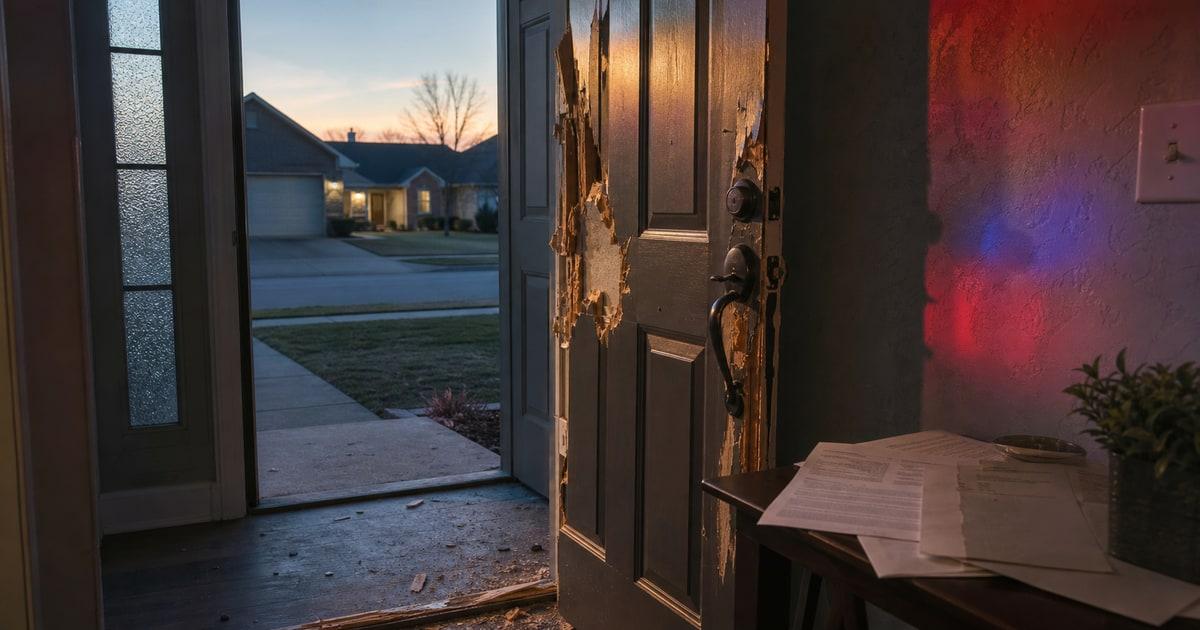
The first days matter. Photograph every part of the damage — doors, frames, windows, flash-bang scorch marks — before anything is repaired. Keep the warrant and any inventory or receipt the officers left; if they left nothing, write down every agency name, badge number, and vehicle marking you can remember. Get medical care for physical injuries and document psychological harm, especially for children. Request body camera footage, if any officer wore a camera, and dispatch records promptly, because retention windows can be short — our guide to police body camera footage in Oklahoma explains how. And do not repair-and-forget: an itemized record of seized or destroyed property, from cash to electronics, becomes the damages backbone of the case.
Frequently Asked Questions
The officers had a warrant. Doesn't that end the case?
No. A warrant must be supported by probable cause and must describe the right place, and officers must execute it reasonably — including the manner of entry and what they do once an error becomes apparent. Garrison shows that a reasonable mistake may defeat liability, but a warrant obtained on stale or sloppy information, or executed at an address officers should have known was wrong, is a different matter.
The raid was by ICE or the FBI, not local police. Can we still sue?
Potentially, yes. Federal raids are analyzed under the FTCA and, in narrow circumstances, Bivens. The Supreme Court's 2025 Martin decision confirmed the FTCA's law-enforcement proviso reaches intentional torts like assault and false imprisonment committed during a raid, though government defenses remain. The procedural steps — starting with an administrative claim — are strict and unforgiving.
The officers took our phones and cash and haven't returned them. Is that part of a claim?
Seized property should be documented in a return or inventory, and unreturned or destroyed property can be part of the damages in a civil claim. Keep every receipt and record of what was taken. Recovery routes differ depending on whether the seizing agency was state or federal.
Do we have a deadline?
Yes — every route has one, and some are short. Federal administrative claims, Section 1983 suits, and GTCA notices each run on their own clocks, and the GTCA's notice window in particular is measured in months, not years. The safest course is to have an attorney calendar the deadlines immediately; see our statute of limitations post for the Section 1983 timeline.
Every case is different, and nothing here is a prediction or guarantee about any particular claim. If officers raided your home by mistake — whether they wore a city, county, or federal badge — an Oklahoma civil rights attorney can evaluate the warrant, the entry, and the damages while the evidence is still fresh. Contact us for a free consultation.
The Door They Broke Is Evidence
Photograph the damage before repairs, keep the warrant and property inventory, and request body camera footage quickly. What you preserve in the first week often decides what a lawyer can prove later.
Talk to an Oklahoma Civil Rights Lawyer