
Key Takeaways
- Freight brokers can face direct negligent-selection claims: The Supreme Court's 2026 Montgomery decision rejected broad FAAAA preemption for motor-vehicle-safety negligent-hiring claims.
- "Chameleon carriers" are a known problem: Some carriers shut down, reopen under new names, and continue dangerous operations — and sophisticated brokers know how to identify them.
- Broker liability can mean the difference between full and inadequate compensation: When the trucking company's insurance is insufficient for catastrophic injuries, holding the broker accountable provides additional recovery.
After a serious trucking accident, you will quickly discover that multiple potential defendants may bear responsibility: the driver, the trucking company (the motor carrier), the cargo shipper, and often a freight broker who arranged the load. The broker's first defense is usually the same — "We're just a middleman. We don't own the truck. We don't employ the driver. Sue the carrier." Sometimes that defense matters. But it can also obscure the broker's own selection decision. Brokers must keep transaction records under 49 C.F.R. Part 371 and maintain FMCSA-required financial security. When a broker negligently selects a dangerous carrier, a direct negligence claim may be available.
What Freight Brokers Do
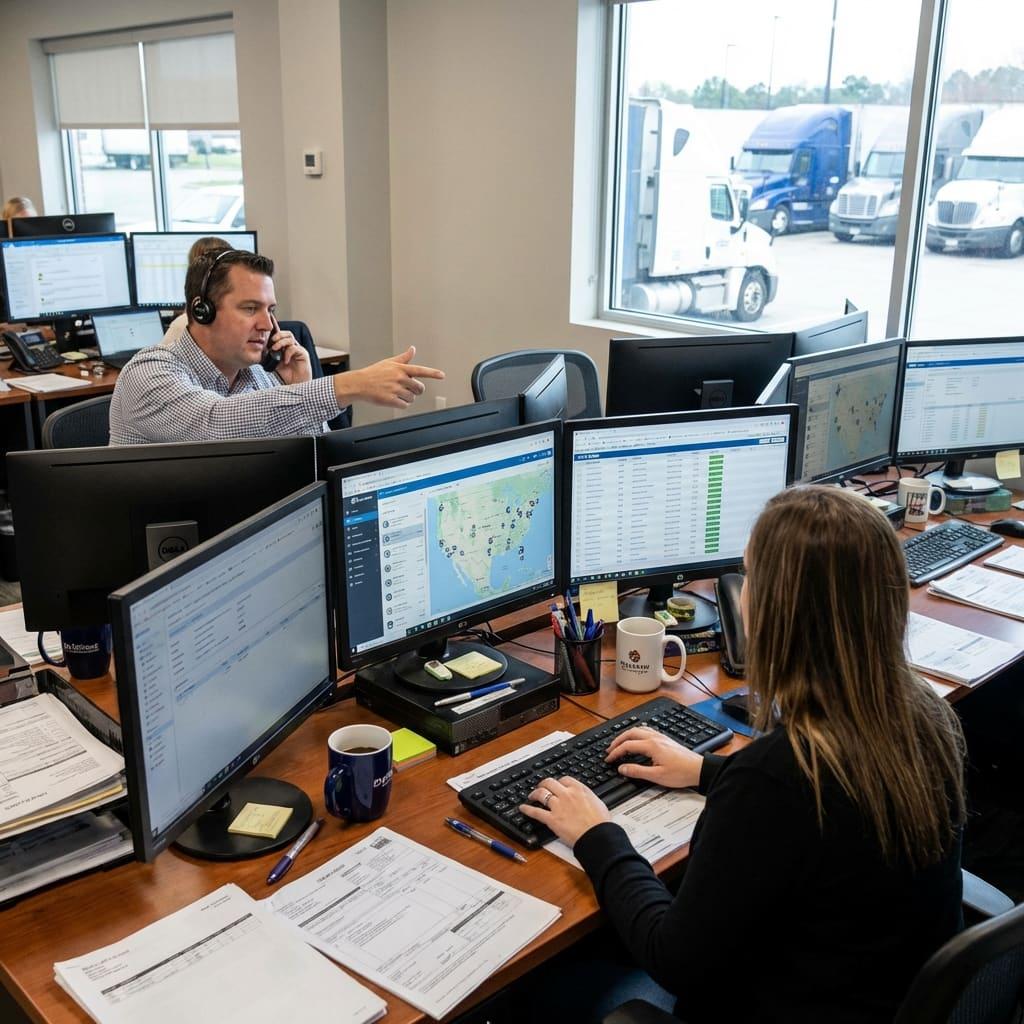
Freight brokers serve as intermediaries in the commercial trucking industry, connecting shippers—companies with goods to move—with motor carriers that have trucks available to haul those loads. Brokers are licensed by the Federal Motor Carrier Safety Administration (FMCSA) and play a significant role in determining which carriers end up on the road with specific loads. They find carriers for shippers' freight, negotiate rates between the parties, manage the logistical paperwork, and take a percentage of the freight charge as their profit.
What brokers emphasize—and what their entire liability defense is built upon—is that they do not exercise operational control over how carriers run their businesses. They do not own the trucks, they do not employ the drivers, and they do not supervise the day-to-day operations of the carriers they hire. This distinction is legally significant, but it does not provide the blanket immunity that brokers claim it does.
The Traditional Defense: "Independent Contractor"
Brokers defend against liability by arguing that they have no vicarious liability for carrier negligence because carriers are independent businesses rather than employees, brokers exercise no control over truck operations or driver supervision, and the relationship is purely transactional. For pure vicarious liability claims, this defense frequently succeeds. Courts generally do not hold brokers responsible for a carrier's negligence simply because the broker arranged the load.
But vicarious liability is not the only theory available—and the broker's relentless focus on it is designed to distract from the theory that actually does apply.
Negligent Selection: When Brokers Create the Danger
Brokers have a duty to exercise reasonable care in selecting the carriers they hire. When a broker awards a load to a carrier with a known history of safety violations, inadequate insurance, or regulatory problems, the broker is not functioning as an innocent middleman. It may be participating in placing a dangerous vehicle on the road. This gives rise to a direct negligence claim — not based on the carrier's conduct alone, but on the broker's own failure to exercise reasonable care. The major 2026 development is Montgomery v. Caribe Transport II, LLC, where the Supreme Court held that the FAAAA's safety exception preserves negligent-hiring claims against brokers when the claim concerns motor-vehicle safety.
To establish broker negligent selection, you must prove four elements. First, the broker had a duty to exercise reasonable care in selecting the carrier. Second, the broker breached that duty by hiring a carrier that a reasonable broker in the industry would not have selected. Third, the carrier's unfitness—the specific characteristic that should have disqualified it—caused or contributed to the accident. Fourth, you suffered damages as a result.
The critical question is what constitutes a breach of the duty of care, and industry standards combined with FMCSA data provide important evidence. A reasonable broker should verify that the carrier holds valid operating authority, maintains legally required insurance, has not been rated unsafe, and does not present obvious red flags in publicly available FMCSA safety data. Safety Measurement System data is a screening tool rather than a formal safety rating, so the analysis should focus on what a reasonable broker would have understood from the carrier's authority, insurance, safety history, out-of-service data, crash information, and other available warnings. When brokers skip readily available checks — or discover red flags and choose to ignore them because the carrier offered a low rate — they create evidence of negligent selection.
The "Chameleon Carrier" Problem
One of the most dangerous patterns in the trucking industry is the "chameleon carrier"—a company that accumulates a terrible safety record, shuts down its operations (often just ahead of an FMCSA enforcement action), and reopens under a new name and new operating authority to escape its history. The same dangerous trucks, the same unqualified drivers, and the same corner-cutting management continue operating under a fresh identity.
Sophisticated brokers know how to identify chameleon carriers, and the signs are often apparent to anyone conducting reasonable due diligence. A carrier with brand-new operating authority but experienced drivers, connections to recently closed carriers that can be identified through FMCSA records, unusually low rates that suggest the carrier is cutting corners on safety and maintenance, and minimal corporate history combined with personnel who have extensive industry experience all raise red flags that a competent broker should recognize. Brokers who fail to investigate these warning signs—or who recognize them and hire the carrier anyway because the rate is favorable—are engaging in exactly the kind of negligent selection that gives rise to direct liability.
Oklahoma Law on Broker Liability
Oklahoma follows general negligence principles, and a broker who negligently selects a carrier may be held directly liable — not vicariously, but based on its own breach of duty — for the harm that results. After Montgomery, brokers have a weaker argument that the FAAAA categorically preempts motor-vehicle-safety negligent-selection claims. Oklahoma courts still must evaluate the ordinary negligence questions: whether it was foreseeable that hiring the specific carrier could result in the type of harm that occurred, what reasonable brokers in the industry do to vet carriers as a matter of standard practice, what information the broker could have discovered through reasonable investigation using publicly available databases like FMCSA's SAFER and SMS systems, and whether the carrier's unfitness — the characteristic that should have disqualified it — was causally connected to what actually caused the accident.
This last element is particularly important. It is not enough to show that the carrier had a generally poor safety record. You must demonstrate a connection between the specific deficiency the broker should have identified and the specific failure that caused the crash. If a broker hired a carrier despite an alarming pattern of hours-of-service violations, and the accident was caused by a fatigued driver who had exceeded legally permitted driving hours, that causal link is strong.
Why Brokers Fight So Hard
Freight brokers resist liability claims with unusual intensity, and understanding their motivation helps explain the tactics you will encounter. Their insurance premiums are directly affected by claims history, liability findings could affect their surety bond requirements, negative outcomes spread quickly in an industry that runs on reputation and relationships, and their business models are built on the assumption that they are insulated from carrier-caused harm. This resistance does not mean brokers are immune from liability. It means they are motivated to narrow the case and will invest significant resources in doing so.
Investigating Broker Liability
Building a broker liability case requires targeted investigation into three areas. First, discovery into the broker's own vetting practices reveals what standards the broker claimed to follow, whether it actually followed those standards for the specific carrier involved, what information the broker reviewed or chose to ignore, and who within the broker's organization made the selection decision. Second, the carrier's safety history leading up to the load assignment must be examined in detail, including FMCSA safety data, prior crashes and violations, out-of-service history, and any complaints from other brokers or shippers. Third, industry expert testimony is typically needed to establish what a reasonable broker would have done with the information available, what red flags should have triggered rejection of the carrier, and how the defendant broker's practices compared to industry standards and regulatory expectations.
This investigation often reveals that the broker's vetting was either perfunctory or nonexistent—that the selection was driven by price rather than safety, and that readily available information would have shown the carrier to be an unacceptable risk. Understanding the full trucking liability chain is essential to identifying every party that contributed to creating the danger.
Frequently Asked Questions
What is the difference between a freight broker and a motor carrier?
A motor carrier is the trucking company that owns or leases the truck and employs or contracts with the driver. A freight broker is an intermediary who connects shippers with carriers, arranging loads and negotiating rates. Brokers do not own trucks or employ drivers, but they do choose which carriers handle specific loads—and that selection decision is where negligent selection liability arises.
Can I sue both the broker and the trucking company?
Yes. In catastrophic trucking accident cases, multiple parties in the liability chain may be liable. You can pursue claims against the driver, the motor carrier, the freight broker, and potentially the shipper—all in the same lawsuit. This is especially important when any single defendant's insurance is insufficient to cover your damages fully.
How do I know if a freight broker was involved in my trucking accident?
Bill of lading documents, shipping records, and carrier contracts will identify whether a broker arranged the load. This information is typically obtained through discovery in litigation. Your attorney can subpoena these records from the trucking company, the broker, and the shipper to identify all parties in the chain.
What is a "chameleon carrier" and how does it affect my case?
A chameleon carrier is a trucking company that accumulates a dangerous safety record, shuts down, and reopens under a new name and new operating authority to escape its history. If a broker placed your load with a chameleon carrier and failed to identify the connection to the predecessor company through reasonable due diligence, that failure is strong evidence of negligent selection.
What evidence is needed to prove broker negligent selection?
You need evidence that the broker failed to adequately vet the carrier before assigning the load. This includes the carrier's operating authority, insurance status, formal safety rating if any, FMCSA safety data, crash history, out-of-service rates, insurance adequacy, and the broker's own vetting file. You also need to demonstrate that the carrier's unfitness was causally connected to the accident.
Why is evidence preservation so important in trucking cases?
Trucking companies and brokers control critical evidence—ECM data, driver logs, maintenance records, carrier vetting documentation, and internal communications. This evidence can be overwritten, deleted, or conveniently lost within days of an accident. Sending preservation demands immediately is essential to preventing spoliation.
Can a broker be liable even if the carrier had valid operating authority?
Yes. Valid operating authority is a minimum regulatory requirement, not a guarantee of safety. A carrier can hold valid authority while simultaneously having troubling public safety data, a history of crashes, and repeated violations that a reasonable broker should have considered. The question is not whether the carrier was technically authorized to operate, but whether a reasonable broker exercising due diligence would have selected it.
Injured in a Truck Accident?
Broker liability is just one piece of the puzzle. We investigate all potentially liable parties — including freight brokers who may have negligently put a dangerous carrier on the road — so the available recovery sources are not missed.
Schedule a Free Consultation →Learn more about our trucking accident practice.
This article is for general information only and is not legal advice.