
Key Takeaways
- Wrong-Way Crashes Are Disproportionately Fatal: Although wrong-way collisions account for a small fraction of all highway crashes, they often produce head-on impacts at highway speeds, making them among the most severe crashes on Oklahoma roads.
- Impairment Is a Major Warning Sign: National wrong-way crash research identifies alcohol impairment as a major risk factor. When impairment caused the crash, Oklahoma law may allow punitive damages in addition to compensatory recovery.
- Multiple Defendants May Be Liable: Beyond the wrong-way driver, potential defendants can include commercial alcohol sellers, government entities responsible for unsafe ramps or signage, and vehicle owners who knowingly entrusted a car to an unfit driver.
On March 5, 2026, an Oklahoma State trooper arrested a man driving the wrong direction on Interstate 35 in Oklahoma County before he entered the westbound Turner Turnpike — also traveling the wrong way. His blood alcohol content tested at more than double the legal limit. Multiple vehicles, including an 18-wheeler, had to swerve to avoid a head-on collision. Just one month earlier, a wrong-way driver on I-35 in Oklahoma City caused a head-on crash that hospitalized two people. The impaired driver in that incident was also arrested for DUI — and for assaulting the Oklahoma Highway Patrol troopers who responded.
These are not isolated events. Wrong-way crashes on Oklahoma's highways are a recurring and dangerous pattern. Unlike rear-end collisions or sideswipes, wrong-way crashes often produce head-on impacts. When two vehicles approaching each other at highway speeds collide, the combined force can exceed what ordinary vehicle safety systems are designed to absorb. The injuries can be catastrophic. And in many cases, the crash was preventable.
Why Wrong-Way Crashes Are So Deadly
The physics are simple and brutal. In a typical highway crash — a rear-end collision, for example — the speed differential between the two vehicles determines the force of impact. If a car traveling 70 mph strikes a car traveling 60 mph, the effective collision speed is 10 mph. The damage is often manageable.
In a head-on wrong-way crash, the speeds are additive. Two cars approaching each other at 70 mph can create an effective collision speed of 140 mph. At those forces, crumple zones may collapse. Airbags deploy but may not absorb enough energy. Seat belts restrain occupants but cannot prevent every violent deceleration injury, including traumatic brain injuries, spinal cord damage, chest trauma, and internal injuries.
National wrong-way crash research describes these crashes as relatively rare but unusually severe because they are typically head-on collisions on divided highways. AAA Foundation research found 2,921 fatal wrong-way crashes on divided highways from 2010 through 2018, causing 3,885 deaths. In simple terms, a wrong-way crash is not common, but when it happens the injury risk is often severe.
What Causes Wrong-Way Driving
Understanding why drivers enter highways going the wrong direction is critical to building an effective legal case, because the cause of the wrong-way entry often determines who is liable.
Alcohol and Drug Impairment
Impairment is one of the dominant factors. National Transportation Safety Board and AAA Foundation research have both identified alcohol impairment as heavily overrepresented in fatal wrong-way crashes, with roughly 60% of fatal wrong-way drivers alcohol-impaired in the studied data. At high levels of impairment, drivers lose the ability to read signs, process visual cues, and understand that they are traveling against traffic. They may not even realize they are on a highway.
This matters legally because impairment creates multiple avenues of liability. The impaired driver is liable for negligence — and their intoxication provides strong evidence supporting punitive damages. But liability may also extend to the establishment that served the driver alcohol before they got behind the wheel, or to the vehicle owner who knew the driver was intoxicated and handed over the keys.
Confusion at Interchanges and Ramps
Some wrong-way entries are caused not by impairment but by confusing road design. Oklahoma's highway system includes interchanges where on-ramps and off-ramps are positioned in ways that can disorient drivers — particularly at night, in construction zones, or in rural areas where lighting is limited. Older interchange designs, cloverleaf ramps, and intersections where the off-ramp crosses a surface street can create situations where a sober, attentive driver makes a wrong turn and enters the highway traveling the wrong direction.
When confusing road design contributes to a wrong-way entry, the government entity responsible for that interchange — the Oklahoma Department of Transportation (ODOT), the Oklahoma Turnpike Authority (OTA), or the local municipality — may share liability for failing to design, sign, or illuminate the interchange adequately.
Elderly Drivers and Medical Events
Some wrong-way incidents involve elderly drivers experiencing cognitive decline, confusion, or medical events such as strokes or diabetic emergencies. These cases raise sensitive but important legal questions about driver fitness and whether the driver should have been behind the wheel at all. Liability beyond the driver usually requires a concrete theory such as negligent entrustment: for example, a vehicle owner who knew, or should have known, that the driver was unfit and still handed over the keys.
Liability in Wrong-Way Crash Cases
Oklahoma follows a comparative negligence system under 23 O.S. § 13, which means fault is allocated among all responsible parties. In wrong-way crash cases, multiple defendants may bear responsibility.
The Wrong-Way Driver
The driver who entered the highway going the wrong direction is usually the primary defendant. Driving the wrong way on a divided highway can violate 47 O.S. § 11-301, which requires vehicles to be driven on the right half of the roadway. A traffic-safety violation can support negligence per se when the statute was designed to protect the injured person from the type of harm that occurred. Causation, damages, and comparative fault still have to be proven.
If the driver was intoxicated, the case for liability is even stronger. DUI is a criminal offense under 47 O.S. § 11-902, and the criminal violation provides additional evidence for the civil negligence claim. More importantly, driving while intoxicated and entering a highway the wrong way can support a request for punitive damages — damages designed to punish the wrongdoer and deter similar conduct. Oklahoma allows punitive damages when the defendant's conduct satisfies the standards in 23 O.S. § 9.1.
Bars and Restaurants — Dram Shop Liability
Oklahoma recognizes dram shop liability for commercial establishments that sell or serve alcohol to a noticeably intoxicated person in circumstances recognized by Oklahoma law. If the wrong-way driver was overserved at a bar or restaurant before the crash, the establishment that sold or served the alcohol may be independently liable for damages.
Dram shop claims can matter in wrong-way cases for two reasons. First, a very high blood-alcohol result may support an argument that the driver was visibly intoxicated before service ended, although the timing and witness evidence still matter. Second, a commercial establishment may have liability insurance that provides an additional source of recovery beyond the driver's personal auto policy.
Government Entities — Inadequate Signage and Detection Systems
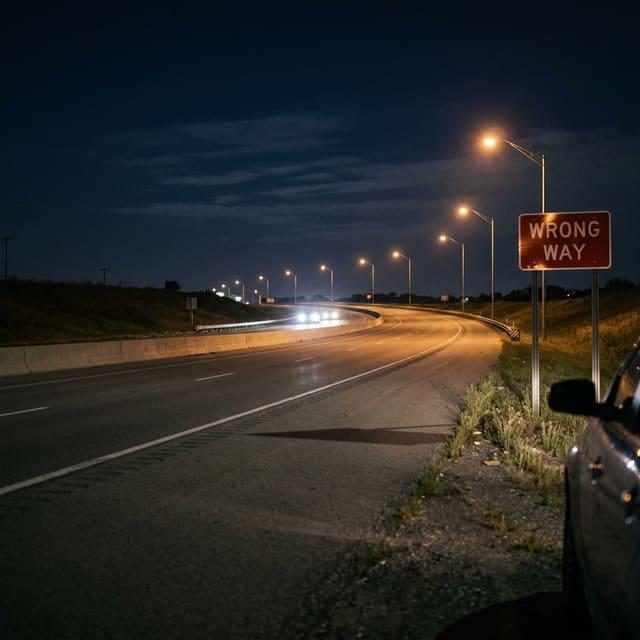
ODOT, OTA, and local municipalities have a duty to design and maintain roadways to be reasonably safe for motorists. This includes installing and maintaining proper signage at highway ramps — "WRONG WAY" signs, "DO NOT ENTER" signs, one-way directional arrows, and reflective markers that are visible at night.
When a wrong-way entry occurs at a location with missing, obscured, or inadequate signage, the government entity may share liability. However, claims against government defendants in Oklahoma are governed by the Governmental Tort Claims Act (GTCA), which requires filing a written notice of claim within one year of the incident. This deadline is significantly shorter than the two-year statute of limitations for claims against private defendants, and missing it is typically fatal to the claim.
Some states and municipalities have begun installing wrong-way detection systems, including sensors that detect vehicles traveling the wrong direction and trigger flashing warning signs. Where such systems exist but fail, or where prior wrong-way incidents made a ramp a known danger, those facts may be relevant to the liability analysis. Government defendants can still raise Governmental Tort Claims Act defenses, including arguments about discretionary design or planning decisions.
Vehicle Owner — Negligent Entrustment
If the wrong-way driver was operating someone else's vehicle, the vehicle owner may be liable under Oklahoma's negligent entrustment doctrine. A vehicle owner who lends their car to a person they know — or should know — is intoxicated, unlicensed, or otherwise unfit to drive can be held liable for the resulting damages. This theory can add a separate defendant whose own conduct — and whose applicable coverage — must be investigated; it does not by itself create additional insurance or increase the available limits.
Damages in Wrong-Way Crash Cases
Because wrong-way crashes involve head-on impacts at highway speeds, the injuries tend to be catastrophic and the damages substantial. Recoverable damages in Oklahoma wrong-way crash cases include:
Medical expenses — both past and future. Wrong-way crash survivors frequently require emergency surgery, intensive care, multiple subsequent surgeries, and long-term rehabilitation. Spinal cord injuries, traumatic brain injuries, and severe orthopedic trauma can generate medical costs well into the millions of dollars over a lifetime.
Lost wages and diminished earning capacity. Catastrophic injuries often prevent victims from returning to their prior employment — or to any employment at all. The economic loss extends beyond missed paychecks to include the reduced lifetime earning potential caused by permanent disability.
Pain and suffering. Oklahoma allows recovery for physical pain, emotional distress, and loss of quality of life. In wrong-way cases involving permanent disability, chronic pain, and psychological trauma, these damages can be substantial.
Loss of consortium. When a wrong-way crash devastates a victim's ability to participate in family relationships, their spouse may have an independent claim for loss of consortium.
Punitive damages. When the wrong-way driver was intoxicated, punitive damages may be available if the evidence meets Oklahoma's enhanced proof standard. Under 23 O.S. § 9.1, a jury may award Category I punitive damages for reckless disregard, capped at the greater of $100,000 or the amount of actual damages. Higher categories require proof of intentional and malicious conduct, and the no-cap category also requires a court finding of life-threatening conduct beyond a reasonable doubt.
Wrongful death. When a wrong-way crash is fatal, the victim's family can pursue a wrongful death claim under 12 O.S. § 1053, seeking recovery for the full range of damages including the decedent's lost future earnings, the family's loss of companionship, and funeral and burial expenses.
What to Do After a Wrong-Way Crash
If you or a family member has been involved in a wrong-way collision, the following steps are critical:
Get emergency medical treatment immediately. Head-on crashes at highway speeds produce severe injuries that may not be immediately apparent due to adrenaline and shock. Some serious injuries develop symptoms over hours or days, including internal bleeding, traumatic brain injuries, and spinal trauma.
Preserve evidence from the scene. If you are able, photograph everything — the vehicles, the roadway, the signage (or absence of signage) at the nearest ramp, skid marks, debris fields, and your own injuries. Ask witnesses for their contact information. In wrong-way cases, scene evidence is critical to determining where and how the driver entered the highway.
Request the crash report. The Oklahoma Highway Patrol or responding law enforcement agency will prepare a crash report that documents the direction of travel, any DUI testing, and the investigating officer's findings about how the wrong-way entry occurred.
Do not give recorded statements to insurance companies. The at-fault driver's insurer will contact you quickly. Their goal is to minimize the claim. Recorded statements are one of their primary tools for creating evidence they can use against you later. Decline politely and consult an attorney first.
Contact a personal injury attorney immediately. Wrong-way crash cases are complex, involving multiple defendants, multiple insurance policies, potential government claims with short deadlines, and substantial damages. An experienced personal injury attorney will move quickly to preserve evidence — including bar receipts and surveillance footage from establishments the driver visited before the crash, highway camera footage, and the driver's phone records.
Frequently Asked Questions
How common are wrong-way crashes in Oklahoma?
Wrong-way crashes on divided highways are relatively infrequent compared to other collision types, but they are disproportionately deadly. Oklahoma experiences multiple wrong-way incidents on its interstates and turnpikes each year, with I-35, the Turner Turnpike, and I-44 among the most common locations. In early 2026 alone, Oklahoma has seen multiple wrong-way DUI incidents on I-35 — including one on February 5 that hospitalized two people and another on March 5 involving a driver with a BAC over double the legal limit.
Can I sue a bar that overserved the wrong-way driver?
Possibly. Oklahoma recognizes dram shop liability when a commercial alcohol seller serves a noticeably intoxicated person and the legal requirements for causation and foreseeability are met. If the wrong-way driver was overserved before the crash, the bar or restaurant may be independently liable for your damages.
What if the wrong-way driver died in the crash?
You can still pursue a claim. The claim is typically presented against the deceased driver's estate and available insurance. Depending on the facts, dram shop claims against establishments that overserved the driver, negligent-entrustment claims, or government claims for unsafe roadway conditions may also need to be evaluated. The death of the at-fault driver does not eliminate the victim's right to recovery.
How long do I have to file a lawsuit after a wrong-way crash?
For claims against the wrong-way driver and other private defendants, the statute of limitations in Oklahoma is generally two years from the date of the crash under 12 O.S. § 95. However, claims against government entities such as ODOT or a municipality require filing a written notice of claim within one year under the Governmental Tort Claims Act. This shorter deadline applies even if the private-party statute of limitations has not yet expired.
What is negligence per se, and why does it matter in wrong-way cases?
Negligence per se means that violating a safety statute can establish the duty-and-breach portion of a negligence claim when the statute protects the injured person from the kind of harm that occurred. Driving the wrong way on a divided highway is strong evidence of negligence, but the victim still must prove causation, damages, and defeat any comparative-fault defenses.
Are punitive damages available in wrong-way DUI crashes?
They may be. Oklahoma allows punitive damages when the evidence satisfies 23 O.S. § 9.1, including clear and convincing proof of reckless disregard for the rights of others. Driving while intoxicated and entering a highway the wrong way can support that request, but the court and jury still decide whether the statutory standard is met.
What if I was partially at fault — for example, I was speeding when the crash occurred?
Oklahoma's comparative negligence system allows you to recover damages even if you were partially at fault, as long as your fault does not exceed 50%. Your recovery is reduced by your percentage of fault. In a wrong-way crash, the wrong-way driver will usually bear the central responsibility, but insurers may still look for arguments about speed, lookout, impairment, or avoidability. Those defenses need to be tested against the physical evidence.
Injured in a Wrong-Way Crash?
Wrong-way collisions are among the most devastating crashes on the road. If you or a family member has been injured — or if you have lost a loved one — we can help you identify every responsible party and pursue every available source of recovery under Oklahoma law.
Free Case Evaluation →This article is for general information only and is not legal advice. Every wrong-way crash involves unique facts. If you have been injured, consult a qualified attorney to evaluate your specific situation.