
Key Takeaways
- Oklahoma law requires habitable conditions: Under the Oklahoma Residential Landlord and Tenant Act, landlords must maintain dwelling units and common areas in a fit, habitable, and safe condition, including supplied electrical, plumbing, heating, and structural systems.
- Common areas are usually the landlord's responsibility: Stairwells, parking lots, hallways, pools, and shared facilities are typically within the landlord's control. Injuries caused by known or discoverable hazards in those areas can support a premises-liability claim.
- Your lease may not defeat the claim: Lease provisions that waive statutory maintenance obligations or broadly disclaim liability for negligent maintenance are often unenforceable under Oklahoma law.
The broken stairwell handrail that was reported three months ago. The parking lot pothole that has swallowed tires all winter. The security gate that has not closed properly since last summer. The mold behind the bathroom wall that keeps coming back no matter how many times you clean it. These are not just annoyances. They are the conditions that can lead to broken bones, traumatic brain injuries, respiratory disease, and assault. When a known dangerous condition injures a tenant or visitor at an Oklahoma apartment complex, the landlord, property manager, or another responsible party may be legally accountable.
Oklahoma's Residential Landlord and Tenant Act (41 O.S. § 118) imposes specific duties on landlords to maintain rental properties in a fit and habitable condition. When those duties are breached and a tenant is injured as a result, the landlord may be liable under the statute, Oklahoma's general premises liability framework, or both. This article explains what conditions give rise to claims, what landlords are required to do, and how injured tenants can protect evidence.
What the Law Requires of Oklahoma Landlords
The Oklahoma Residential Landlord and Tenant Act does not leave maintenance obligations to the whims of the lease. Under 41 O.S. § 118, every landlord must make all repairs and do whatever is necessary to keep the dwelling unit and premises in a fit and habitable condition, keep all common areas of the building, grounds, facilities, and appurtenances in a clean, safe, and sanitary condition, and maintain in good and safe working order all electrical, plumbing, sanitary, heating, ventilating, air-conditioning, and other facilities and appliances supplied by the landlord.
These obligations are not optional. A landlord cannot contract around them — lease provisions that attempt to waive the landlord's maintenance duties or disclaim liability for injuries caused by negligent upkeep are void under 41 O.S. § 113. If your lease says "tenant assumes all risk" or "landlord is not responsible for injuries on the premises," that language is unenforceable as applied to the landlord's statutory obligations.
For personal injury claims specifically, Oklahoma courts have held that landlords owe tenants in common areas — hallways, stairwells, parking lots, pools, and other shared spaces that the landlord retains control over — the duties of care applicable to invitees, the highest standard under premises liability law. In these areas, the landlord must not only fix known hazards but actively inspect for dangerous conditions, anticipate foreseeable risks, and take reasonable steps to protect tenants from preventable harm. The duty within the leased unit itself is governed by the statutory obligations of § 118 and the terms of the rental agreement.
The Most Dangerous Conditions in Oklahoma Apartments
Apartment injuries are not random accidents. They follow predictable patterns that reflect the most common forms of deferred maintenance and landlord neglect.
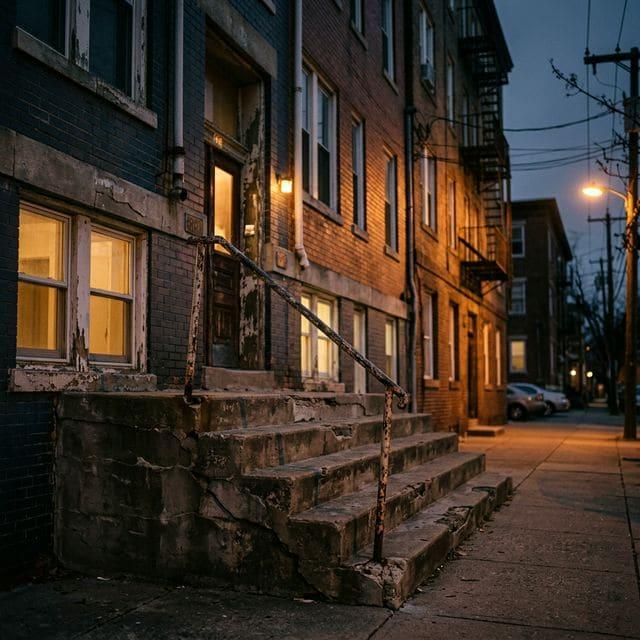
Stairwells and walkways account for some of the most severe injuries in apartment complexes. Crumbling concrete steps, loose or missing handrails, uneven surfaces, missing treads, and inadequate lighting in stairwells all create fall hazards that can produce broken hips, traumatic brain injuries, spinal cord damage, and lacerations. When a landlord knows, or should know through reasonable inspection, that a staircase is deteriorating and fails to repair it, the landlord may be liable for injuries that result. The same analysis applies to hallways with torn carpeting, walkways with tripping hazards, and breezeways with broken flooring.
Parking lots are another major source of injuries. Potholes that are deep enough to cause falls, ice that accumulates because of inadequate drainage or failure to salt and sand, crumbling curbs, broken wheel stops, and poor lighting that creates hiding spots for criminals all fall within the landlord's duty to maintain. Whether the injury is a fractured wrist from a fall on an uneven surface or something far worse, when parking lot conditions deteriorate and the landlord fails to repair them, the resulting injuries are compensable.
Mold and environmental hazards produce a different category of harm — respiratory illness, allergic reactions, and in severe cases, chronic respiratory disease that permanently diminishes lung function. Oklahoma landlords have a statutory duty to maintain plumbing and ventilation systems in good working order, and many mold problems trace directly to leaking pipes, inadequate bathroom ventilation, or roof leaks that the landlord knew about and failed to repair. Tenants who report mold repeatedly and are ignored — or given cosmetic surface treatments that don't address the underlying water intrusion — have strong claims when they develop health problems.
Elevator and mechanical failures can produce catastrophic injuries. An elevator that drops, jerks, or traps passengers may cause orthopedic injuries, panic attacks, or worse. Malfunctioning laundry equipment, broken fitness center machines, and non-functional fire safety systems all create risks that a landlord is obligated to address. When applicable building codes or manufacturer maintenance schedules require regular inspections and the landlord fails to comply, that failure is strong evidence of negligence.
Negligent Security in Apartment Complexes
Security failures in apartment complexes represent a distinct category of landlord negligence. When a tenant or visitor is assaulted, robbed, or otherwise victimized by criminal conduct that the landlord should have anticipated and could have prevented, the landlord may be liable under a negligent security theory.
The analysis hinges on foreseeability. If the complex has experienced prior criminal incidents, if tenants have reported suspicious activity, if the surrounding neighborhood has elevated crime rates, or if the property's physical characteristics — poor lighting, broken security gates, non-functional cameras, unsecured access points — create obvious opportunities for criminal conduct, the landlord has a duty to take reasonable security measures. What constitutes "reasonable" depends on the circumstances, but common measures that courts evaluate include functional exterior lighting, working locks and deadbolts on all entry points, operative security gates and intercoms in gated communities, and re-keying units between tenants when practicable.
A landlord who installs a security gate to attract tenants and justify higher rents — then allows the gate to remain broken for months — has arguably created a more dangerous situation than a complex with no gate at all. The broken gate creates a false sense of security that may lead tenants to take fewer precautions, while providing no actual deterrent to criminals.
Swimming Pool Injuries and Drowning
Apartment complex pools present heightened risks, particularly for children. Landlords who provide pool amenities assume the duty to maintain them safely — including adequate fencing with self-closing, self-latching gates, compliant drain covers, proper chemical maintenance, depth markings, and posted pool rules. The attractive nuisance doctrine imposes special obligations when children are foreseeably present, making pool barrier compliance a critical legal issue for any complex that markets itself to families.
When a child accesses an apartment pool through a broken or propped-open gate and drowns or suffers a near-drowning brain injury, the landlord's failure to maintain the barriers is the proximate cause of the tragedy. These cases often involve devastating damages and warrant thorough investigation into the complex's maintenance records, prior pool incidents, and compliance with local pool safety codes.
Neighbor's Dogs and Animal Attacks
Tenants injured by a neighbor's dog in a common area — the parking lot, the dog park, the hallway — may have claims against both the dog's owner and, in the right case, the landlord. Under Oklahoma's strict liability statute (4 O.S. § 42.1), the dog's owner is liable regardless of prior knowledge of the animal's dangerousness. A landlord may also bear responsibility if they knew or should have known about the dangerous animal through prior complaints, lease violations, or observed aggressive behavior and failed to take reasonable action within their authority.
Lease agreements often contain pet policies and breed restrictions. A landlord who allows a prohibited animal or ignores documented complaints about aggression may face premises-liability exposure. Punitive damages require more than ordinary negligence; they depend on evidence of reckless disregard, intentional misconduct, or another statutory basis under 23 O.S. § 9.1.
Proving Your Case Against a Landlord
Successful apartment injury claims require proving the same four elements as any premises liability case: duty (the landlord owed you a duty of care), breach (the landlord failed to maintain the property), causation (the maintenance failure caused your injury), and damages (you suffered real, compensable harm). The key battleground in most apartment cases is whether the landlord had notice of the condition.
Notice comes in two forms. Actual notice means the landlord knew about the problem — because you or another tenant reported it, because management documented it in an inspection, or because the landlord personally observed it. Constructive notice means the landlord should have known — because the condition existed long enough that a reasonable inspection would have revealed it, because the condition was obvious, or because similar problems had recurred repeatedly.
This is why documentation is so critical. Every maintenance request you submit in writing, every text message to your property manager about a hazard, every photograph you take of a deteriorating condition — these create the paper trail that proves the landlord knew and failed to act. Many tenants report problems verbally and receive verbal promises that repairs will be made. When the repair never happens and someone gets hurt, the landlord denies ever being told. Written documentation prevents that denial.
What to Do After an Apartment Injury
If you're injured at your apartment complex, the immediate steps parallel any premises liability situation: seek medical attention, even for injuries that seem minor — some of the most serious conditions, including traumatic brain injuries and internal bleeding, don't present obvious symptoms for hours or days. Document the condition that caused your injury with photos and video — including the surrounding area, lighting conditions, and any visible maintenance failures. Report the incident to management in writing and request a copy of the incident report.
Beyond those basics, apartment injury cases benefit from additional preservation steps. Pull together every maintenance request you've ever submitted — emails, text messages, portal submissions, handwritten notes. Check whether other tenants have reported the same hazard. If your complex has a resident portal or maintenance tracking system, screenshot your request history before anyone modifies it. And do not sign any documents from the landlord or property management company — release forms, incident reports with "tenant assumes responsibility" language, or repair authorizations — without having an attorney review them first. Landlords sometimes use the post-incident chaos to extract admissions or releases from injured tenants before they understand the value of their claim.
Oklahoma's statute of limitations for personal injury claims is two years from the date of injury under 12 O.S. § 95. But evidence deteriorates rapidly — surveillance footage is overwritten, maintenance records are purged, and conditions are repaired (destroying the physical evidence of the hazard). An attorney can send a spoliation letter demanding evidence preservation before critical proof disappears.
Frequently Asked Questions
Can my landlord avoid liability because I signed a lease that says they're not responsible for injuries?
Usually not. Under 41 O.S. § 113, lease provisions that waive the landlord's maintenance obligations under the Residential Landlord and Tenant Act are unenforceable. A landlord cannot contract away the statutory duty to maintain the property in a fit and habitable condition. Residential leases have special statutory rules; our Oklahoma liability-waiver guide explains the separate framework that generally applies outside that setting.
What if I reported the problem but my landlord never fixed it?
This strengthens your case significantly. A documented maintenance request that went unaddressed establishes actual notice — meaning the landlord knew about the dangerous condition and chose not to repair it. The longer the gap between your report and the injury, the stronger the evidence of the landlord's disregard for tenant safety. Always report maintenance issues in writing and keep copies.
Is the property management company liable, or just the property owner?
Both may be liable. Property management companies that are responsible for day-to-day maintenance and operations assume the landlord's duties and can be sued alongside the property owner. In many apartment injury cases, the management company is the more relevant defendant because they are the ones who receive maintenance requests, conduct inspections, and make decisions about repairs.
What damages can I recover for an apartment injury?
Oklahoma law allows recovery of medical expenses, lost wages, loss of earning capacity, pain and suffering, emotional distress, and loss of quality of life. For injuries occurring on or after September 1, 2025, 23 O.S. § 61.3 can cap noneconomic damages unless an exception applies. In cases involving willful or wanton conduct — such as a landlord who ignored repeated warnings about a life-threatening hazard — punitive damages may also be available under 23 O.S. § 9.1.
Does my renter's insurance cover me if I'm injured at my apartment?
Renter's insurance typically does not cover your own injuries — it covers your personal property and your liability to others. If you're injured due to a landlord's negligence, the claim is against the landlord's commercial liability insurance, not your renter's policy. However, if you have medical payments coverage on your renter's policy, it may provide limited benefits regardless of fault.
How long does my landlord have to fix a reported hazard?
The answer depends on the nature of the hazard. Under 41 O.S. § 121, when a landlord's noncompliance with § 118 materially affects health and safety and is remediable by repairs costing less than one month's rent, the tenant must give the landlord written notice specifying the condition and allowing 14 days to cure before pursuing self-help remedies. If the landlord does not make the repair within that 14-day window, the tenant may have the repair done and deduct the actual, reasonable cost — up to one month's rent — from the next rent payment. Emergencies that pose an imminent threat to health or safety may justify shorter timelines. But for personal injury claims, the relevant question is not what § 121 allows the tenant to do about the repair, but whether the landlord's failure to fix a known dangerous condition over time constitutes negligence — and that analysis focuses on the reasonableness of the delay given the severity of the hazard.
Can I sue my apartment complex if I was assaulted in the parking lot?
Potentially, yes — through a negligent security claim. If the assault was foreseeable based on prior criminal activity, tenant complaints, or obvious security deficiencies like broken gates and no lighting, the landlord may be liable for failing to take reasonable security measures. The criminal who assaulted you is also liable, but the landlord's insurance is typically the more viable source of recovery.
Apartment complexes are commercial properties as well as homes. When deferred maintenance, negligent upkeep, or security failures injure tenants, the key questions are notice, control, causation, and proof. A lease clause or a claim of ignorance does not end the analysis.
Injured at Your Apartment Complex?
Apartment injury claims turn on notice, maintenance records, photographs, video, and fast evidence preservation. We investigate those facts across Oklahoma.
Schedule a Free Consultation →This article is for general information only and is not legal advice.