Key Takeaways
- Check the Right Coverage: The Oklahoma Insurance Department identifies a direct animal strike as a comprehensive claim. Swerving into a tree or guardrail generally falls under collision coverage instead. Both are optional coverages for damage to your vehicle, subject to policy terms and deductibles.
- The Deer Does Not Decide Fault: A sudden hazard is part of the circumstances used to judge a driver's care, not an automatic excuse. Speed, attention, following distance, and the driver's reaction matter. An injured passenger may have a claim even in a single-vehicle crash.
- Expect More Deer Movement in Fall: The Oklahoma Department of Wildlife Conservation warns of increased movement during the breeding season from late October into December, especially around dawn and dusk. Its safety guidance is to brake firmly and stay in your lane rather than swerve.
If your car hits a deer in Oklahoma, the first place to look for vehicle repairs is your own comprehensive coverage. Swerving into a tree or guardrail usually falls under collision coverage instead. Injuries raise separate questions: what coverage is available, did a driver's conduct cause the crash, and was that conduct reasonable? A passenger can have a claim even when only one vehicle is involved. The deer itself does not answer who pays.
This article is general legal information, not legal advice. Whether a particular crash supports a claim depends on its specific facts, and those need case-specific review.
Which Insurance Pays After a Deer Crash?
If your vehicle strikes the deer: The Oklahoma Insurance Department explains that animal-strike damage belongs under optional comprehensive coverage. Start with the declarations page to see whether you bought it and what deductible applies. Liability-only insurance does not provide this coverage for your own car. Ask the carrier to identify the applicable policy provisions before accepting a coverage decision.
If you miss the deer but hit a tree, guardrail, or another vehicle: That generally points to collision coverage, not comprehensive. The National Association of Insurance Commissioners distinguishes damage from colliding with an object from other covered losses. Having comprehensive does not mean you also have collision coverage. A crash involving both an animal strike and another impact needs review under the actual policy; do not assume one label resolves every part of the damage.
If someone is injured: Comprehensive and collision address the vehicle, not medical bills. The Oklahoma Insurance Department's coverage guide explains that optional medical-payments coverage can help with covered expenses for occupants, subject to its limits. If another person's negligence caused the injury, that person's liability coverage may also matter. For a passenger, the potentially responsible driver might be the driver of the car they were riding in. A one-car crash is not automatically a no-claim case.
Keep the repair estimate, photographs, medical records, declarations page, and coverage correspondence together. Vehicle damage and bodily injury are different parts of the claim. Our Oklahoma car accident practice handles the injury side when a driver's conduct is at issue.
Why a Deer Wreck Is Different From a Livestock Wreck
An escaped cow or horse raises questions about an owner's fences, gates, and care of the animal. Our guide to loose-livestock collisions in Oklahoma covers that framework. A free-roaming wild deer does not identify a livestock owner whose conduct can be investigated in the same way. That distinction does not rule out a driver's negligence or another provable cause of the crash. It simply means an animal in the road is not, by itself, evidence against an animal keeper.
When Swerving Drivers Hit Other Cars
A driver might cross the center line to avoid a deer, veer onto the shoulder into a stopped car, or trigger a chain reaction. The question is whether the driver's failure to use reasonable care caused the injury, not simply whether a deer appeared.
In Fargo v. Hays-Kuehn, 2015 OK 56, 352 P.3d 1223, the Oklahoma Supreme Court reversed summary judgment for a driver whose swerve allegedly helped cause a chain-reaction crash, even though her vehicle never struck the injured parties. Conflicting evidence about negligence and causation required a trial. The plaintiffs won the right to proceed, not a ruling that the driver was negligent. This was not a deer case, but it illustrates why the whole sequence matters, including a driver who caused danger without making contact.
The published Court of Civil Appeals decision in Direct Traffic Control, Inc. v. Kidd, 2013 OK CIV APP 103, 313 P.3d 1015, illustrates the other possible outcome. Kidd described being cut off on I-40 before striking an impact attenuator. The company that placed the device sued for its replacement cost; the jury found no negligence, and the appellate court affirmed. Also not a deer case, it offers an analogy for evaluating a driver's response to a sudden hazard.
A collision by itself does not establish negligence. That does not make crash evidence worthless. It means the claimant must prove negligent conduct caused the loss.
An emergency is part of the circumstances. Kidd explains that ordinary negligence instructions already account for emergencies, so no separate sudden-emergency instruction should be given. The trial judge nevertheless gave one. The appellate court affirmed because the plaintiff had not shown that it misled the jury or changed the result. The court treated sudden emergency as a denial of negligence, not a separate affirmative defense with its own burden of proof.
The driver's conduct before the emergency matters, too. In Justice v. Harrison, 1977 OK 154, 569 P.2d 439, the Oklahoma Supreme Court affirmed a defense verdict in a nighttime roadway-accident case. The instruction it approved in 1977 required reasonable care and an emergency not contributed to by the driver's own negligence. It also protected a reasonable reaction from hindsight criticism merely because another choice later looked better. As Kidd later explained, ordinary negligence instructions account for the emergency without a separate instruction. The practical questions remain what the driver did before the hazard appeared and whether the reaction was reasonable at the time.
Applied to a deer crash, those principles call for evidence of speed, attention, visibility, following distance, and the reaction itself. The Oklahoma Insurance Department advises braking firmly rather than swerving. That safety advice is not a rule making every swerve negligent. Nor does saying "a deer ran out" settle whether the driver used reasonable care.
Rear-End Crashes When Someone Brakes for a Deer
Another pattern is the rear-end crash: the lead driver brakes for a deer, and the trailing driver cannot stop. Oklahoma's following-distance statute, 47 O.S. § 11-310(a), requires a reasonable and prudent distance considering vehicle speed, traffic, and highway conditions. Evidence that the following driver left too little room can support a negligence claim. The location of the impact alone does not decide fault.
The lead driver's reason for braking, functioning brake lights, speed, and available stopping distance all deserve examination. Under 23 O.S. § 13, a claimant's negligence bars recovery when it exceeds the combined negligence of the other persons causing the damage. Our guides to Oklahoma's 51 percent bar and rear-end crashes explain those issues in more detail.
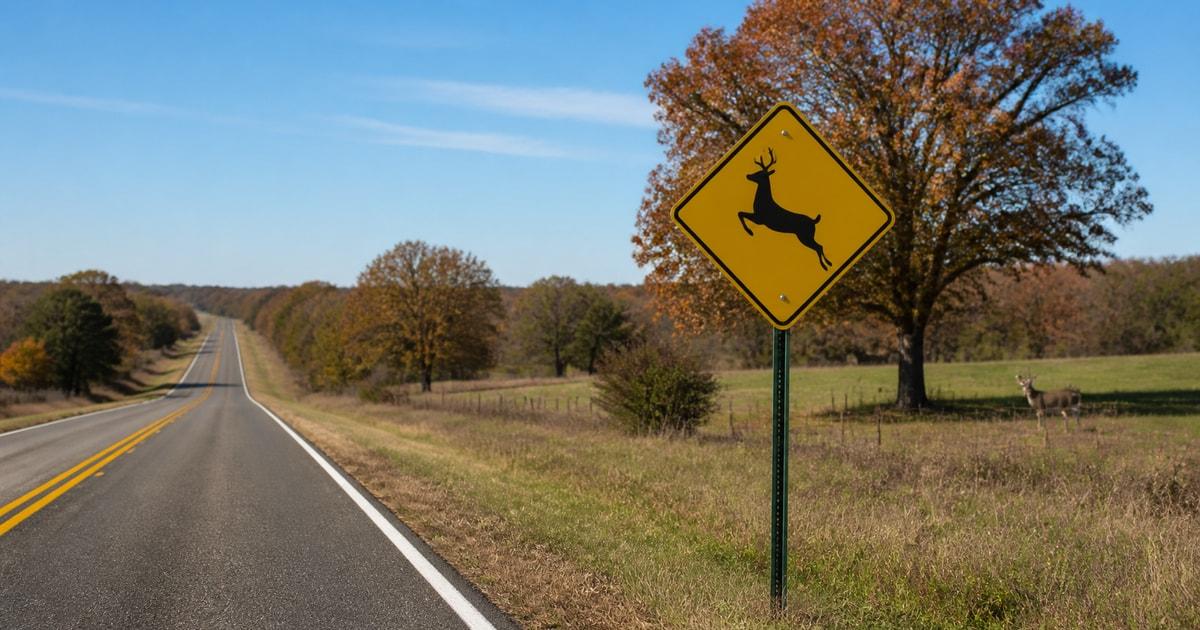
Can You Sue the State Over a Missing Deer-Crossing Sign?
There is an important distinction between a sign that was never installed and an existing sign that was damaged or removed. The Governmental Tort Claims Act's traffic-sign exemption, 51 O.S. § 155(15), addresses both. It expressly does not create liability for failing to place a sign in the first place. Simply pointing to a stretch of road without a deer-crossing sign therefore does not establish a viable claim.
For an existing sign removed or destroyed by third parties, weather, or a traffic collision, the statute includes an exception when the government fails to correct the problem within a reasonable time after actual or constructive notice. That is a possible avenue for investigation, not automatic liability. Other exemptions, including those for discretionary functions and highway maintenance, may matter as well.
A potential government claim needs early review. 51 O.S. § 156 generally requires written notice to the proper recipient within one year of the loss. Separate rules govern when a lawsuit may be filed after denial. Our Governmental Tort Claims Act guide explains the process; do not assume an ordinary two-year negligence deadline protects a government claim.
Deer Season Is Crash Season
The Oklahoma Department of Wildlife Conservation identifies late October through December as the breeding season, when deer movement increases. Dawn and dusk warrant particular attention, but deer can cross at other times. Seeing one deer should prompt a driver to watch for more.
The agency's published tips call for watching deer-crossing signs, slowing and preparing to stop when a deer crosses, and using high beams when no traffic is approaching. Those are practical precautions, not a prediction that every fall collision was avoidable. A claim still requires evidence about the particular road, driver, and crash.
What to Save After the Crash
Get out of danger and seek medical help first. From a safe place, document vehicle damage, lane positions, road signs, lighting, and any visible evidence of the animal. Get witness contact information and preserve available dashcam footage. Do not enter traffic or approach an injured deer to collect proof.
Keep the crash-report number and your account of what happened while it is fresh. If a serious injury claim is possible, ask about preserving the vehicles and any available event data before repairs or disposal. Those records may help distinguish an unavoidable animal strike from a crash caused by a driver's conduct; they are not guaranteed to exist or answer every question.
Frequently Asked Questions
A driver swerved to miss a deer and hit me. Can I recover?
You may have a claim if the driver's failure to use reasonable care caused your injuries. The deer, the driver's reaction, and conduct before the emergency all matter. As Fargo v. Hays-Kuehn explains, disputed negligence and causation questions generally belong to the jury when the evidence supports competing reasonable conclusions. Neither swerving nor mentioning a deer automatically decides the claim.
I braked for a deer and the car behind me hit me. Whose fault is that?
The following driver's distance and attention are central because 47 O.S. § 11-310(a) requires a reasonable and prudent gap for conditions. But the impact alone does not establish negligence. The reason for braking, brake lights, speed, and stopping distance may also matter. Our rear-end crash guide explains how the evidence and comparative fault fit together.
Does my insurance pay if I just hit the deer and nothing else?
Direct animal-strike damage generally falls under optional comprehensive coverage, subject to the policy and deductible. If you miss the deer and hit a fixed object, collision coverage usually applies instead. Neither coverage pays medical bills. Check for medical-payments coverage and investigate driver negligence if someone was injured, including a passenger in a single-vehicle crash.
What if an unidentified driver ran me off the road, not a deer?
An unidentified motorist creates different coverage questions from a deer. Oklahoma uninsured-motorist coverage concerns bodily injury, not damage to your vehicle; a claim still requires proof of a covered motorist's liability. A deer alone does not become an uninsured driver. See our guide to uninsured and hit-and-run crashes and the Oklahoma Insurance Department's coverage guide linked above.
Can I keep the deer I hit?
Do not take it without checking with law enforcement. 29 O.S. § 5-411(B)(1) prohibits possessing meat, a head, a hide, or other carcass parts of wildlife not legally taken. The Oklahoma Department of Wildlife Conservation's published roadkill guidance calls for permission before salvaging a deer. Call a game warden or other law-enforcement officer before removing the animal, its meat, or its antlers, and confirm what authorization is required.
How long do I have to bring a claim after a deer-related crash?
An ordinary negligence claim against a driver generally has a two-year period after accrual under 12 O.S. § 95(A)(3). Government claims generally require written notice within one year of the loss under § 156, followed by separate filing rules. Exceptions can change the analysis, and insurance policies have their own notice requirements. Our limitations guide is a starting point, not a substitute for checking your claim's deadline.
Talk to Someone Who Handles These Cases
If the loss is limited to your car, start by checking the applicable coverage and deductible. If someone was hurt, do not let the description "deer accident" end the inquiry. What each driver did, and what the available evidence shows, can change the answer. If you or a family member was injured in an Oklahoma deer-related crash, contact Addison Law Firm for a free consultation.
Hurt in a Crash That Started With a Deer?
We can review the crash evidence, insurance questions, and possible injury claims.
Talk to a Car Accident Lawyer