Key Takeaways
- A Loose Animal Does Not Make the Owner Automatically Liable: Oklahoma requires owners to restrain livestock, but Shuck v. Cook and Carver v. Ford hold that a motorist still must prove negligence. The animal's presence on the road is the start of the inquiry, not the end.
- Fence Evidence Can Change the Outcome: In Jackson v. Lankford, the owner won because the plaintiff did not counter his fence and maintenance evidence. In Graham v. Crow, the plaintiff produced photographs of a damaged fence and testimony tracing hoofprints to it, and the court sent the claim back for a jury to decide.
- Check Whether the Road Was Formally Designated: A 2024 law creates a narrow class of county-maintained "open pasture roads." On a qualifying designated road, 4 O.S. § 116 says neither the property owner nor the livestock owner is liable for vehicle or occupant damages caused by a livestock collision.
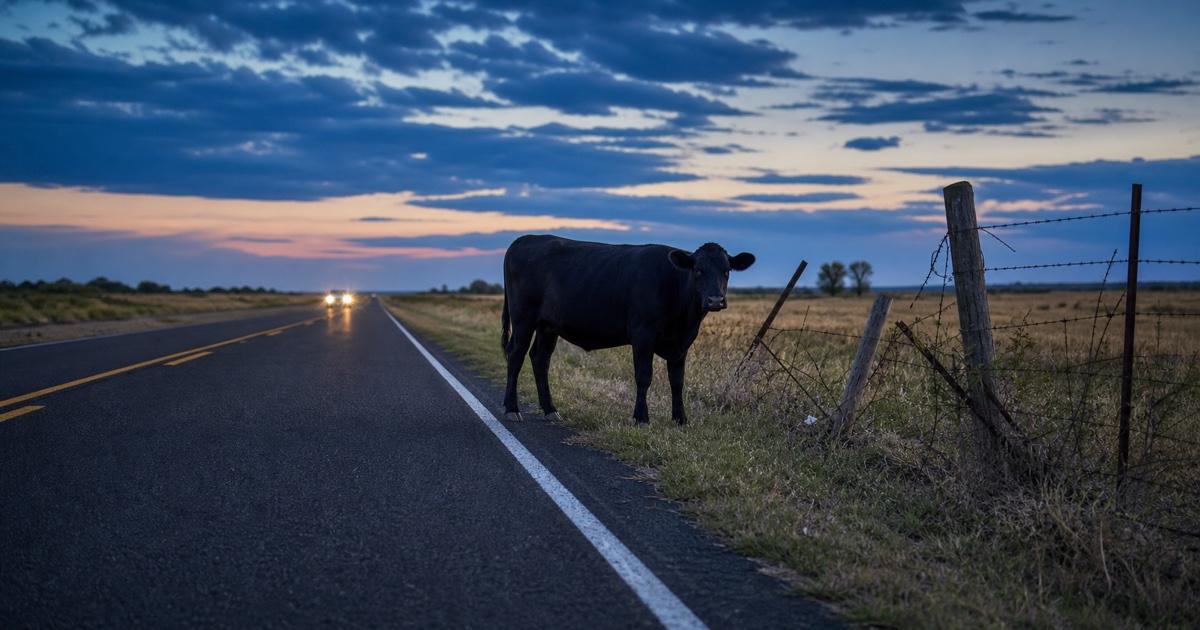
It happens on two-lane highways after dark, and it happens fast. A shape at the edge of the headlights does not resolve into anything until it is too late to brake. A cow, a bull, a horse — a full-grown animal standing in a lane where nothing should be. The people who survive these collisions often assume the legal question answers itself: somebody's animal was loose on a public road, so the owner must be responsible. That conclusion is understandable. Oklahoma law is more complicated.
Most claims turn on negligence, notice, and the condition of the enclosure. A newer statute creates a separate threshold question: was the crash on a county road formally designated as an open pasture road? That answer can change the case before anyone reaches the fence evidence.
The Restraint Statute Is Not Automatic Civil Liability
Oklahoma's herd law, 4 O.S. § 98, says:
"All domestic animals shall be restrained by the owner thereof at all times and seasons of the year from running at large in the State of Oklahoma. Damages caused by the domestic animals trespassing upon lands of another shall be recovered in a manner provided by law."
The definition covers cattle, horses, swine, sheep, goats, exotic livestock, and other animals not considered wild. It excludes domestic house pets.
The neighboring section matters too. 4 O.S. § 99 makes it a misdemeanor to willfully fail to keep a domestic animal in a suitable enclosure, to let it run at large with actual or constructive notice that the enclosure is open, or to knowingly cause it to escape. Section 99 states a criminal penalty. It does not say that a motorist automatically recovers civil damages. Its focus on notice and enclosure, however, tracks the evidence that matters in a negligence claim.
The Oklahoma Supreme Court explained the civil rule in Shuck v. Cook, 1972 OK 25, 494 P.2d 306. Derald Shuck hit a Black Angus bull on U.S. Highway 183 in Dewey County on a dark night in 1966. He relied on § 98, but the trial court struck that theory, the jury found for the defendants on common-law negligence, and the Supreme Court affirmed.
The Court leaned on the history of Oklahoma's herd laws. Champlin Refining Co. v. Cooper, 184 Okla. 153, 86 P.2d 61 (1938), was itself a highway case: a driver rounded a curve on U.S. Highway 75 at night and hit a horse. The Court reversed a verdict for the driver, rejecting the idea that the animal's presence alone established the owner's negligence. Merkle v. Yarbrough, 378 P.2d 333 (Okla. 1963), later held that the herd laws protected grazing land as well as crops and specifically disavowed language in Champlin that suggested otherwise. It did not change Champlin's answer for motorists.
When the Legislature enacted § 98 in 1965, it mentioned damage from animals trespassing on another person's land but did not create a highway remedy. Shuck therefore concluded:
"We agree with the trial court that § 1, c. 117, Session Laws of 1965 (4 O.S. 1961 § 98) [Supp. 1965] was not legislatively intended to protect persons traveling upon the public highways ..."
The current statute is not word-for-word identical to the 1965 version. A 2000 amendment changed the damages phrasing, and a 2007 amendment added exotic livestock. Neither added a civil highway remedy. In 2023, the Oklahoma Court of Civil Appeals still applied Shuck and Carver to a cow-collision claim.
The Open Pasture Road Exception
Oklahoma's general restraint rule now has a narrow statutory exception. 4 O.S. § 116, effective November 1, 2024, allows certain county-maintained roads to be designated as open pasture roads. To qualify, the road had to meet the statutory conditions by November 1, 2025: cattle guards at the access points, the same owner on both sides, and no fencing along the designated land. The county must place cattle-crossing signs at the terminals, and the property owner must provide annual notice showing the road still qualifies and asking that the designation continue.
The liability language is direct. Section 116(D) says neither the property owner nor the livestock owner "shall be liable for damages to any motor vehicle or occupants thereof caused by collision with livestock on a designated open pasture road." Section 99's criminal enclosure rule also expressly excludes animals on those designated roads.
This law is new, and the designation matters more than appearances. A rural road is not exempt merely because cattle are nearby or a warning sign exists. The county designation, the annual continuation notice, the crash location, and the statute's effective conditions all need to be checked.
Negligence Is the Rule on Other Roads
Outside the § 116 exception, a claimant must prove negligence. Carver v. Ford, 1979 OK 26, 591 P.2d 305 was not a highway case; a heifer escaped a stall and injured a man opening a gate. But the Supreme Court used the case to state the livestock rule that later highway cases applied:
"The fact livestock is on the highway does not raise a presumption of negligence. An owner of an escaping animal should not be liable if, without his fault, the animal escapes enclosure such as generally required to restrain livestock."
The Court rejected strict liability where an animal not known to be vicious and not permitted to run at large escapes through no fault of its owner. It ended with the rule that controls: "Any liability of defendant must be predicated upon negligence."
That does not excuse negligent maintenance. It tells the injured person what must be proved. Graham v. Crow, 2023 OK CIV APP 49, 541 P.3d 218 states the affirmative test: an owner is negligently responsible for an animal's escape when the owner "knew, or should have known by conducting routine maintenance, that the animal's enclosure was inadequate to keep the animal contained."
The Fence Evidence Can Decide the Case
The Oklahoma cases repeatedly come back to two questions: what did the owner know, and what condition was the enclosure in?
Prior escapes and notice. In Shuck, witnesses had seen the bull outside the pasture on earlier days. Other testimony suggested the owners had been told the bull was out the day before the crash and again on the day of the crash. The jury still found for the defendants. The point is not that notice is useless. It is that notice creates evidence of negligence, while the jury still decides disputed facts and comparative fault.
A defense win in Jackson. In Jackson v. Lankford, 1998 OK CIV APP 174, 970 P.2d 622, a driver hit a bull on U.S. Highway 62 at night. The owner submitted photographs and evidence of a roughly five-foot, six-strand barbed-wire fence reinforced with cow panels, a customary height of four to five feet, and no prior jumping escape. The fence was undamaged. The Court of Civil Appeals affirmed summary judgment for the owner because the plaintiff produced no evidence that the fence fell below the industry standard or that the owner knew it was inadequate.
Oklahoma also has a statutory fence benchmark. 4 O.S. § 154 defines a "lawful fence" in the part of the code dealing with partition-fence disputes. It generally calls for a 54-inch fence and gives specifications for barbed wire, post spacing, and wire height. No Oklahoma highway-collision decision located for this article treats § 154 as the civil standard of care owed to a motorist. It is a useful yardstick, not an automatic rule.
A plaintiff's win in Graham. In Graham, a car hit a Black Angus cow on Highway 64 near Perry at about 11:00 p.m. The owner submitted an affidavit saying he inspected and maintained the fence, found no escape point, and had no prior reports that his cattle were out. The trial court granted him summary judgment. The plaintiff, however, had photographs showing a fence section weighed down by tree limbs and brush, along with testimony that hoofprints led from the road back to that area. The Court of Civil Appeals reversed and sent the negligence claim back for further proceedings.
Jackson and Graham are both published decisions of the Oklahoma Court of Civil Appeals, an intermediate appellate court. They do not carry the same authority as Oklahoma Supreme Court decisions, but together they show why the evidence changes the outcome. A photograph plus an opinion that a fence looked bad was not enough in Jackson. Photographs tied to a specific escape path and maintenance problem were enough to defeat summary judgment in Graham.
That evidence disappears quickly. Fences get repaired. Gates get moved. Animals get sold. Useful sources include the sheriff's office and Oklahoma Highway Patrol reports, prior calls about loose stock, neighbors, brand and ownership records, county open-pasture-road records, and photographs of the fence line before it changes. The first days after a crash are when that record is easiest to preserve, and the same concerns discussed in our evidence preservation guide apply here.
Comparative Negligence Still Matters
The driver's conduct also comes under scrutiny. Shuck was tried under Oklahoma's old contributory-negligence rule. The Supreme Court observed that the jury could have found the driver negligent for traveling at the maximum permissible speed at night.
Oklahoma now uses modified comparative negligence. Under 23 O.S. § 13, a claimant is barred only when the claimant's negligence is greater than the negligence of the person causing the damage, or greater than the combined negligence of the people causing it. Section 14 reduces the recovery in proportion to the claimant's negligence when recovery is otherwise allowed. Our posts on Oklahoma's 51% bar and comparative negligence explain that framework in more detail.
Expect arguments about speed, headlights, visibility, braking, distraction, and whether the driver had time to react. That makes the owner's notice and maintenance evidence even more important. It supplies the other side of the fault comparison.
Situations That Use Different Rules
- Dogs. Domestic house pets are excluded from § 98, and dog-owner liability follows a different statutory scheme. See our guide to dog bite liability in Oklahoma.
- Deer and other wildlife. Section 98 concerns domestic animals, not wildlife.
- Cattle being hauled. An animal escaping from a livestock trailer raises questions about the carrier, load, and driver, closer to unsecured cargo and road debris.
- Death cases. A fatal collision also implicates Oklahoma's wrongful-death statute. See wrongful death claims in Oklahoma.
- Your own insurance. Coverage for an animal strike depends on the policy language. Our post on recorded statements explains why to read the policy before giving a recorded account.
Frequently Asked Questions
I hit a cow on an Oklahoma highway. Is the owner automatically liable?
No. Shuck held that § 98 does not itself create a highway claim for motorists, and Carver said the animal's presence on the road does not create a presumption of negligence. On an ordinary road, the claimant must prove what the owner knew or should have known and how the animal escaped. On a road formally designated under § 116, the statute may bar vehicle and occupant damages against the property and livestock owners altogether.
Isn't Oklahoma an open-range state?
As a general statewide rule, no. Section 98 requires owners to restrain domestic animals. But § 116 now creates a narrow exception for qualifying county-maintained roads formally designated as open pasture roads. The exact road segment and county records matter.
How do I know whether the road was designated as an open pasture road?
Look for cattle-crossing signs at the road's terminals, but do not stop there. Request the county commissioners' designation records, the property owner's map and notice, and the current annual notice maintaining the designation. Compare those records with the exact crash location. A road that merely looks rural is not enough.
What can make an owner liable on a road that is not covered by § 116?
Negligence, proved with evidence. Graham says an owner can be responsible when the owner knew, or should have known through routine maintenance, that the enclosure was inadequate. Prior escapes, an open gate, unrepaired fence damage, ignored complaints, or a known problem with a particular animal can matter. Jackson and Graham came out differently because the evidence was different.
The fence looked terrible. Is a photograph enough?
It depends on what the photograph proves. In Jackson, the plaintiff's view that the fence looked inadequate did not rebut the owner's evidence about its construction and history. In Graham, photographs were paired with hoofprint testimony tying a damaged fence section to the cow's path, and that was enough to defeat summary judgment. Section 154's 54-inch lawful-fence definition may be a useful benchmark, but it is not an automatic highway standard.
Will my own speed be used against me?
Probably, if there is a factual basis for it. Today that argument is made under comparative negligence. Section 13 measures the driver's fault against the defendant's fault, or the combined fault of multiple defendants, and can reduce or bar recovery depending on the percentages.
How long do I have to bring a claim?
Most Oklahoma personal-injury claims must generally be brought within two years under 12 O.S. § 95(A)(3). That is a residual rule, and other provisions can displace it. Wrongful-death claims, governmental claims, minors' claims, and other circumstances may follow different rules. Our Oklahoma limitations guide gives the broader framework, but the deadline should be confirmed for the particular claim.
Talk to Someone Who Handles These Cases
A loose-livestock collision is not an automatic case, but Graham shows that a claimant with concrete fence and escape-path evidence can get past summary judgment. The first questions are whether § 116 covers the road and what evidence still exists about the enclosure, prior escapes, and the owner's notice. Those records and physical conditions can change quickly. If you or someone in your family was hurt in a livestock collision on an Oklahoma road, contact us for a free, confidential consultation. This article is general information, not legal advice, and does not create an attorney-client relationship.
Hit Loose Livestock on an Oklahoma Road?
Road designation, fence condition, prior escapes, and the animal's path can decide the claim. Preserve that evidence early.
Talk to a Car Accident Lawyer