
Key Takeaways
- Farm Equipment Is Legal on Most Oklahoma Roads: Under 47 O.S. § 11-406, farm tractors and implements of husbandry generally may not travel on interstate highways — trailers and semitrailers within statutory limits are excepted — but they may operate on other Oklahoma roadways if the operator has attached all legally required safety devices and taken the manufacturer's reasonable steps to reduce the equipment's width. Wide equipment must move right for approaching traffic when practicable — and when it cannot, other drivers must yield.
- The Slow-Moving Vehicle Emblem Law Has a Surprising Evidence Rule: 47 O.S. § 12-427 requires the familiar yellow-orange-and-red triangle on the rear of machinery that is both designed to operate and actually operating at no more than 25 miles per hour — but the same statute says evidence of the emblem's use or absence "shall not be admissible in the trial of any case." A missing triangle, standing alone, is not the lawsuit many people assume it is.
- Lighting Violations and Comparative Fault Decide These Cases: 47 O.S. § 12-215 spells out the lamps and reflectors farm equipment must carry, and a nine-state Midwestern study — Oklahoma was not among the states — found that state lighting and marking laws that track national engineering standards track lower farm-equipment crash rates. Under 23 O.S. § 13 and § 14, an Oklahoma jury compares everyone's fault.
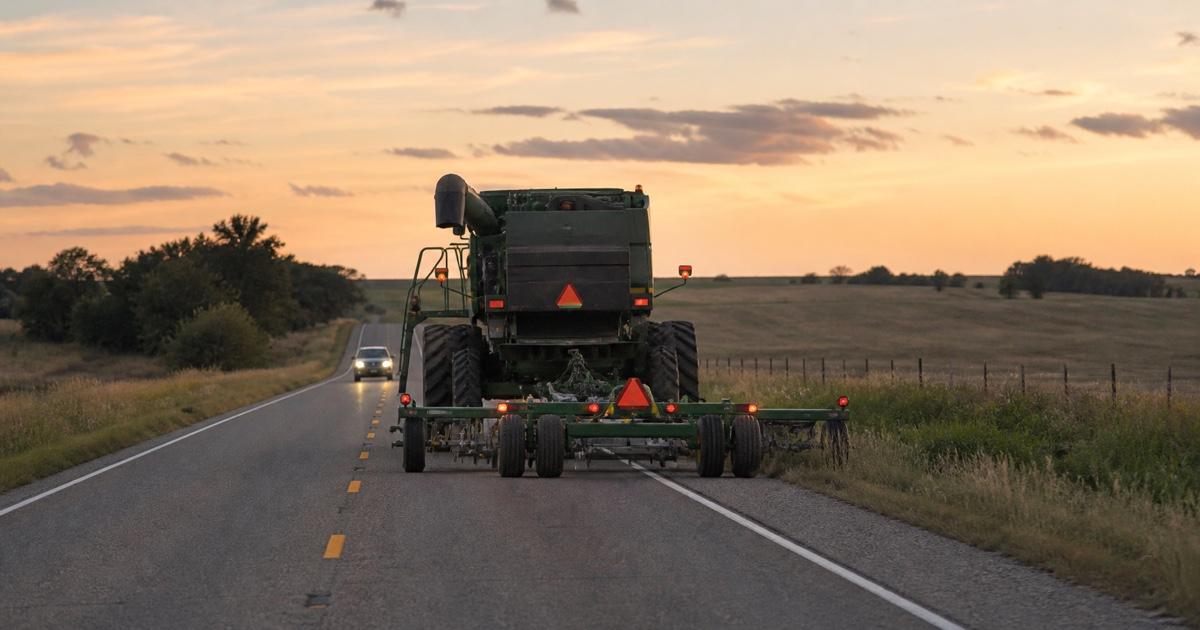
From late summer through the end of the year, Oklahoma's two-lane roads fill up with farm machinery — combines and grain carts moving between fields, tractors pulling implements to the next quarter section, equipment heading home at dusk. Most encounters end with a slow mile and a safe pass. The ones that do not tend to be violent out of proportion to their speed: a car overtakes a combine at 65 miles per hour, a tractor makes a wide left turn into a field entrance, a towed implement with no working lights materializes out of the dark. Who is at fault depends on a set of Oklahoma statutes most drivers — and more than a few farm operators — have never read. This article explains when farm equipment may lawfully be on the road, what its operator owes other drivers, what other drivers owe the equipment, and the unusual evidence rule that shapes how these cases are actually proved.
This article is general legal information, not legal advice about any specific collision. Fault in a farm equipment crash is fact-intensive, and the statutes below interact in ways that require attorney analysis.
What the Research Actually Shows — and Where It Comes From
Oklahoma does not publish a regular statewide count of farm equipment collisions, but the best regional research shows how common — and how dangerous — these crashes are. Researchers at the Great Plains Center for Agricultural Health counted more than 7,000 farm-equipment crashes across nine Midwestern states over six years — an average of more than 1,100 a year — and found that when these collisions happen, the occupants of the passenger vehicle are more than twice as likely to be injured as the farmer, and their injuries tend to be worse.
A study by the Great Plains Center for Agricultural Health at the University of Iowa, published in Occupational and Environmental Medicine, examined nine Midwestern states — Illinois, Iowa, Kansas, Minnesota, Missouri, Nebraska, North Dakota, South Dakota, and Wisconsin. Oklahoma was not among them, so these figures describe the region, not this state. The study found that states whose lighting and marking laws more closely tracked the standards of the American Society of Agricultural and Biological Engineers had measurably lower farm-equipment crash rates: as a state's combined lighting-and-marking score rose by five points, its crash rate fell about 17 percent. The authors modeled what would happen if each state raised that combined score by roughly 25 percent — a measure of how closely a state's statutes track the engineering standard, not of how carefully farmers follow it — and projected a substantial drop in crashes; in their worked example for Wisconsin, from an annual average of 164 down to 65. The study's lead author, Marizen Ramirez, has explained the mechanism plainly: most passenger-vehicle drivers are not familiar with farm equipment, cannot correctly gauge how fast it is moving, and end up closing the gap too quickly and trying to pass in unsafe conditions.
That is the physics of most farm equipment cases: a closing speed problem, a visibility problem, or a passing problem — and often all three.
Yes, the Tractor Is Allowed to Be There
Drivers stuck behind a combine sometimes assume slow farm equipment on a highway is itself illegal. In Oklahoma it generally is not. 47 O.S. § 11-406 draws the lines:
No interstates, with one exception. A farm tractor or implement of husbandry may not travel on any highway that is part of the National System of Interstate and Defense Highways — though the Department of Public Safety may permit such travel in certain geographic areas, and trailers and semitrailers operated within statutory limits or under 47 O.S. § 14-101 are excepted from the prohibition altogether.
Other roads are open — with conditions. On any other Oklahoma roadway, the equipment may operate if the operator "has attached all the safety devices required by law" and has taken reasonable steps to reduce the width of the tractor or implement "as provided for by the manufacturer." Those safety-device and width obligations are not decoration; they are the statutory hook for most negligence theories against an operator, as discussed below.
Wide equipment must give way when it can. When equipment is wider than its marked lane — or wider than half of an unmarked roadway — the operator must move it as far to the right as is practicable and safe, as soon as possible, when any oncoming or following vehicle approaches and when approaching the crest of a hill.
And other drivers must give way when it cannot. Subsection (B) contains a duty that surprises many motorists: when wide farm equipment cannot move right because of a bridge, guardrail, sign, or other physical impediment, the driver of every other vehicle "shall yield the right-of-way," pull to the far right, and stay there until the equipment has passed.
Neither rule excuses carelessness. Subsection (C) provides that nothing in the section relieves the equipment operator of the duty to drive with due regard for the safety of everyone using the roadway.
Two definitions round out the picture. An "implement of husbandry" under 47 O.S. § 1-125 is a device — self-propelled or not — designed and adapted to be used exclusively for agricultural, horticultural, or livestock-raising operations, or for lifting or carrying another implement of husbandry, and not subject to registration when operated on the highways. The definition expressly sweeps in liquid-fertilizer nurse tanks under 1,200 gallons, certain farm trailers and semitrailers, and utility-type all-terrain vehicles with a maximum curb weight of 1,500 pounds fitted with metal front or rear carrying racks when used in agricultural operations. Oklahoma's minimum-speed statute, 47 O.S. § 11-804, prohibits driving a motor vehicle so slowly as to impede the normal and reasonable movement of traffic — but by its own terms the prohibition does not apply "when reduced speed is necessary for safe operation or in compliance with law," which is ordinarily the situation of heavy equipment that simply cannot go faster.
The Orange Triangle — and the Evidence Rule Nobody Expects
The most recognizable farm-safety law in America is the slow-moving vehicle emblem: the yellow-orange triangle with the red reflective border. Oklahoma's version is 47 O.S. § 12-427. It adopts the American Society of Agricultural Engineers standard ASAE S276.3 emblem as the state's official slow-moving vehicle emblem and requires it on the rear of all farm machinery, road construction and maintenance machinery, and other vehicles — including animal-drawn vehicles — that are designed to operate, and are operating, at a maximum speed of no more than 25 miles per hour on a highway, day or night. The emblem goes as near as practicable to the center on the rear, and when a string of farm machinery or implements is towed, one clearly visible emblem on the rearmost vehicle satisfies the statute.
Then the statute does something almost no injured driver expects. Subsection (D) starts conventionally enough: the emblem "shall be in addition to any lighting devices or other equipment required by law," a nonmotor vehicle's failure to display it "shall not relieve the operator of a motor vehicle from negligence in the event of a collision," and nobody may display the emblem on equipment that is not entitled to it. Then subsection (E) goes somewhere else entirely:
"The evidence as to the use of such emblem or the lack of the use of such emblem shall not be admissible in the trial of any case."
Read literally, that means neither side gets to talk about the triangle at trial. An injured driver cannot build a case on the bare fact that the emblem was missing, and an equipment operator cannot defend on the bare fact that it was displayed. The Legislature put the requirement and the evidentiary exclusion in the same statute. The statute does not say what happens next. Subsection (E) excludes evidence of "the use of such emblem or the lack of the use of such emblem" — by its terms, emblem evidence and nothing more. Whether that exclusion also reaches around the edges of a case, into photographs of the rear of the equipment or expert testimony about conspicuity, is unsettled ground, and it is the first thing an attorney should evaluate before building a farm equipment claim around what was or was not on the back of the machine.
The practical lesson cuts in a specific direction, and the statute itself points the way: subsection (D) says the emblem is in addition to the lighting the law requires. Visibility cases against farm equipment operators in Oklahoma get built on the lighting statutes, not the emblem statute.
The Lighting Rules That Actually Decide Cases
47 O.S. § 12-215 is the workhorse. It prescribes, in detail, what farm tractors, self-propelled farm equipment, implements of husbandry, and tractor-plus-towed-implement combinations must carry during the times when Oklahoma law requires lighted lamps (the periods specified in 47 O.S. § 12-201):
Equipment without an electric lighting system must carry at least one lamp showing a white light visible 500 feet to the front and at least one lamp showing a red light visible 500 feet to the rear; self-propelled units must add two red reflectors visible from 100 to 600 feet in headlamp beams.
Tractor-and-towed-implement combinations without electric lighting must mark the extreme left projection of the combination with a white light visible 500 feet to the front, plus either two red lamps to the rear or one red lamp and two red reflectors.
Equipment with an electric lighting system must have two head lamps meeting Oklahoma's headlamp standards under 47 O.S. §§ 12-203.3 or 12-602.1 and at least one red rear lamp visible at 500 feet — and self-propelled units other than tractors need two red rear lamps, or one red lamp plus two red reflectors.
In a lighted combination, the tractor still must meet its own subsection (D) requirements; the towed implement must carry two red rear lamps or two red reflectors; and the combination must show a white-to-amber light visible 500 feet to the front and a red light visible 500 feet to the rear.
The lamps and reflectors required by subsections A through E must be positioned to show, as nearly as practicable, the extreme projection of the equipment on the side of the roadway used in passing it. And when a tractor or unit of equipment carries two or more lamps or reflectors facing the front or the rear — which most configurations under this statute do — they must be positioned to mark the extreme projections both to the left and to the right. The statute is explicitly concerned with telling an approaching driver how wide the thing ahead really is.
Since a 2007 amendment — the only amendment this section has had since 1961 — subsection (G) separately permits any farm tractor or self-propelled unit to carry a flashing strobe-type device visible at 500 feet to the front or to the rear. That permission is optional, specifies no color, and unlike the rest of the section is not limited to the hours when lamps are required.
This level of statutory detail matters in litigation because Oklahoma recognizes negligence per se. In Howard v. Zimmer, Inc., 2013 OK 17, 299 P.3d 463 — answering a question certified by the Tenth Circuit, in a divided decision arising from federal medical-device regulations rather than traffic law — the Oklahoma Supreme Court restated the elements: the claimed injury must have been caused by the violation, must be of the type the standard was intended to prevent, and the injured person must belong to the class the standard was meant to protect. A driver who rear-ends an unlit grain cart at night on a state highway sits close to the center of what § 12-215 exists to prevent. Whether a particular violation supports negligence per se, or is instead evidence of negligence under the ordinary standard, is a legal question for counsel — but the contrast with the emblem statute is stark. One visibility statute comes with its own exclusionary rule; the other reads like a checklist an expert can walk a jury through.
The safety research points the same direction as the statute: the Great Plains Center for Agricultural Health found that increased lighting and marking on farm equipment is associated with reduced roadway crash rates, and its researchers' practical advice — keep the equipment's lights working and turned on, even in daylight; outline the widest points with reflective marking; consider adding red taillights to towed equipment — maps almost one-to-one onto what § 12-215 already requires or permits.
How Fault Actually Gets Decided
Oklahoma compares negligence. Our comparative negligence guide explains the basic framework.
Under 23 O.S. § 13 and § 14 — also discussed in our 51 percent bar article — an injured person recovers only if their share of fault is not greater than the combined fault of everyone else, and any recovery is reduced by their percentage.
In a farm equipment case, the fault arguments run in both directions, and they are predictable.
Against the motorist: speed too fast to react to a vehicle moving 15 miles per hour; following too closely; attempting to pass without a clear view ahead, or passing at the exact moment the equipment began a wide left turn into a field entrance; distraction on a straight rural road where a combine was visible for half a mile; failing to yield to wide equipment pinned by a bridge or guardrail as § 11-406(B) requires.
Against the equipment operator: operating at night or at dusk without the lamps and reflectors § 12-215 requires; failing to attach required safety devices or reduce the equipment's width before taking a road, as § 11-406(A) requires; failing to move right for following traffic when it was practicable and safe; turning left across a lane without signaling or checking for overtaking traffic; and, always, the § 11-406(C) backstop — the duty to operate with due regard for everyone on the road.
Two further theories deserve mention. When the operator was a farmhand or employee of a farming business or custom harvesting operation, the employer may be responsible for the operator's negligence, and the operation's decisions about equipment condition and lighting become part of the case. And when equipment was handed to an inexperienced or unfit operator, Oklahoma's negligent entrustment doctrine — covered in our negligent entrustment article — may reach the person or business that supplied the machine.
What to Do After a Farm Equipment Crash
The evidence in these cases is unusually perishable. The equipment goes back to work — or back into a barn — the same week. Lighting condition, reflector placement, and the actual width of the implement are physical facts that should be photographed before anything is repaired, cleaned, or modified.
Our guide to spoliation and missing evidence explains why early preservation matters when equipment, records, or images may change.
The steps in our guide to the first 72 hours after a car accident apply with extra force: photographs of the equipment from the approaching driver's vantage point, at the same time of day, can decide the visibility question that decides the case. Preserve what the operator and any employer said at the scene, to law enforcement, and to insurers; early descriptions of the equipment's lights, route, speed, and intended turn can matter as much as the photographs.
Oklahoma's general deadline for a personal injury lawsuit is two years under 12 O.S. § 95(A)(3), and related claims carry their own clocks — the details are in our statute of limitations guide.
A fatal collision also raises a separate Oklahoma wrongful-death framework.
One trap is worth naming: if the equipment belonged to a county, a city, or a state agency — a road grader or a mower rather than a combine — the claim runs under the Governmental Tort Claims Act, with its own written-notice requirement and its own much shorter windows. That is one more reason to involve counsel early.
Hurt in a Collision With Farm Equipment?
These cases turn on statutes most lawyers never open — lighting rules, width rules, and an emblem law with its own evidence twist. We know which theories hold up and which evidence disappears first.
Talk to a Personal Injury LawyerFrequently Asked Questions
Is it legal for a tractor or combine to drive on an Oklahoma highway?
Generally yes. Under 47 O.S. § 11-406, farm tractors and implements of husbandry may not travel on interstate highways — subject to limited Department of Public Safety permission in certain areas, and with an express exception for trailers and semitrailers operated within statutory limits. On other roadways the equipment is lawful if the operator has attached the safety devices required by law and taken the manufacturer's reasonable steps to reduce its width. Slow speed alone is not a violation — Oklahoma's minimum-speed statute expressly excepts reduced speed that is necessary for safe operation.
The farm equipment I hit had no orange triangle. Doesn't that make it automatically at fault?
No — and this surprises almost everyone. The emblem statute, 47 O.S. § 12-427, requires the slow-moving vehicle triangle, but it also states that evidence of the emblem's use or absence "shall not be admissible in the trial of any case." Fault in these collisions is usually proved through the lighting and reflector requirements of 47 O.S. § 12-215, the operating duties in § 11-406, and ordinary negligence principles instead. How far the emblem statute's evidence rule reaches is a question you should put to an attorney with the facts of your case in hand.
I rear-ended a tractor at dusk that had no lights. Can I still recover?
Possibly. If the equipment lacked the lamps and reflectors required by 47 O.S. § 12-215 during the hours when lights are required, that violation is a serious fault argument against the operator — and Oklahoma's negligence per se doctrine, restated in Howard v. Zimmer, Inc., 2013 OK 17, may give it added legal force. But a rear-end collision also puts the motorist's lookout, speed, and following distance squarely at issue. Oklahoma compares fault, and under 23 O.S. §§ 13–14 you recover only if your share of fault is not greater than everyone else's combined, with your recovery reduced by your percentage.
The equipment was taking up both lanes. Wasn't that illegal?
Not necessarily. Oklahoma law anticipates that farm equipment may be wider than a lane. When it is, § 11-406 requires the operator to move as far right as practicable and safe when other vehicles approach and at hill crests — but when a bridge, guardrail, or other physical impediment prevents that, the statute flips the duty: every other driver must yield, pull to the far right, and wait until the equipment has passed. Whether the operator or the motorist violated their half of that arrangement is often the central fault question in a head-on or sideswipe case.
Talk to an Oklahoma Personal Injury Lawyer
If you or a family member was seriously hurt in a collision with a tractor, combine, or towed implement anywhere in Oklahoma, the statutes above give the case its shape — but the evidence gives it its outcome, and that evidence tends to disappear quickly. Our Oklahoma car accident lawyers handle rural roadway collisions statewide as part of our personal injury practice. Contact us for a free consultation. This article is general information, not legal advice, and does not create an attorney-client relationship.