
Key Takeaways
- No Break Requirement for Workers 16 and Older: The Oklahoma Department of Labor puts it plainly: neither federal nor state law requires employers to provide breaks to employees who are 16 or older. Breaks and lunch periods for those workers are a benefit the employer chooses — or chooses not — to offer.
- But Breaks That Are Given Follow Federal Pay Rules: Under federal wage regulations, short rest breaks of roughly 5 to 20 minutes count as paid working time, while a bona fide meal period — ordinarily 30 minutes or more — can be unpaid only if you are completely relieved from duty. An employee required to eat at a desk or stay at a machine is working, and must be paid.
- Two Main Wage-Law Exceptions: Covered workers under 16 receive mandatory rest periods under 40 O.S. § 75, and nursing employees are entitled to reasonable pump breaks and a private, non-bathroom space under the federal PUMP Act for a year after a child's birth — though an employer with fewer than 50 employees may claim an undue-hardship exemption.
No — for most Oklahoma workers aged 16 or older, no wage-and-hour law requires your employer to give you a lunch break, a rest break, a smoke break, or any break at all. Oklahoma has no general break statute for adults, and the federal Fair Labor Standards Act does not require breaks either. That surprises a lot of people, because the question that usually matters is hiding one layer down: not whether you get a break, but whether the breaks you do get are paid correctly. Federal law has firm rules on that, and they are where break disputes turn into real wage claims — the 20-minute "unpaid" break, the lunch you work through at your desk, the auto-deducted meal period on a shift that never stopped. This article walks through what Oklahoma wage law actually requires, what federal law adds, and the workers who have specific break protections.
This article is general legal information about Oklahoma and federal law, not legal advice about any specific workplace. Break and pay practices vary, and whether a particular policy violates the law depends on your facts.
The Short Answer: Oklahoma Has No Adult Break Requirement
The Oklahoma Department of Labor's wage-and-hour FAQ answers the question directly: "Neither federal nor state law requires employers to provide breaks to employees that are 16 or older." For workers 16 and up, breaks and lunch periods "are considered benefits and remain at the discretion of the employer."
That means an Oklahoma employer may lawfully schedule an eight-hour, ten-hour, or twelve-hour shift with no meal period at all, may shorten or eliminate a break policy it previously offered, and may set the timing of any breaks it does provide. If your handbook promises breaks, that promise is a matter of company policy — worth reading closely and holding your employer to — but it is not a statutory entitlement for adult workers. No Oklahoma agency will cite an employer for declining to give an adult a lunch. That changes, as the rest of this article explains, the moment the missing break turns into unpaid time.
If that sounds harsh, it is also only half the story. The moment an employer does provide breaks, or lets meal periods blur into working time, federal pay rules take over — and those rules have teeth.
One more category sits outside all of this. Where federal safety rules govern the job, breaks can be mandatory for reasons that have nothing to do with wage law. Drivers of property-carrying commercial motor vehicles, for example, generally may not drive after eight hours of driving time without a consecutive 30-minute interruption in driving status under 49 C.F.R. § 395.3, subject to exceptions including the short-haul rules. Airline crews and railroad employees have their own federal rest requirements. Those are safety mandates enforced by federal regulators, not break rights an employee enforces in a wage case — but they are real, and they mean "Oklahoma requires no breaks" is a statement about wage-and-hour law, not every job.
When Breaks Are Given, Federal Law Decides Which Ones Are Paid
The Fair Labor Standards Act requires pay for all hours worked, and the U.S. Department of Labor's interpretive regulations spell out how break time fits that rule.
Short rest breaks are paid time. Under 29 C.F.R. § 785.18, rest periods of short duration — "running from 5 minutes to about 20 minutes" — are customarily paid for as working time and "must be counted as hours worked." An employer cannot offer a 15-minute break and dock your pay for it, and it cannot offset that compensable rest time against other working time. That is a federal rule, not an Oklahoma one — the Oklahoma Department of Labor's guidance addresses only whether breaks must be offered, not how they must be paid.
Meal periods can be unpaid — if they are real. Under 29 C.F.R. § 785.19, a bona fide meal period is not worktime and need not be paid. But the regulation attaches conditions. The employee "must be completely relieved from duty for the purposes of eating regular meals," and "[o]rdinarily 30 minutes or more is long enough," although a shorter period may qualify under special conditions. The regulation's own examples draw the line vividly: "an office employee who is required to eat at his desk or a factory worker who is required to be at his machine is working while eating." The employer does not have to let you leave the premises — but it does have to actually relieve you of duties.
Put those two rules together and the practical grid looks like this: a short rest break in the regulation's roughly 5-to-20-minute range is paid; a bona fide meal period is unpaid only if you are genuinely free of work during it; and a "lunch" you spend answering phones, watching a register, monitoring patients, or catching up on email is working time that belongs on your paycheck.
Working Through Lunch: Where Break Disputes Become Wage Claims
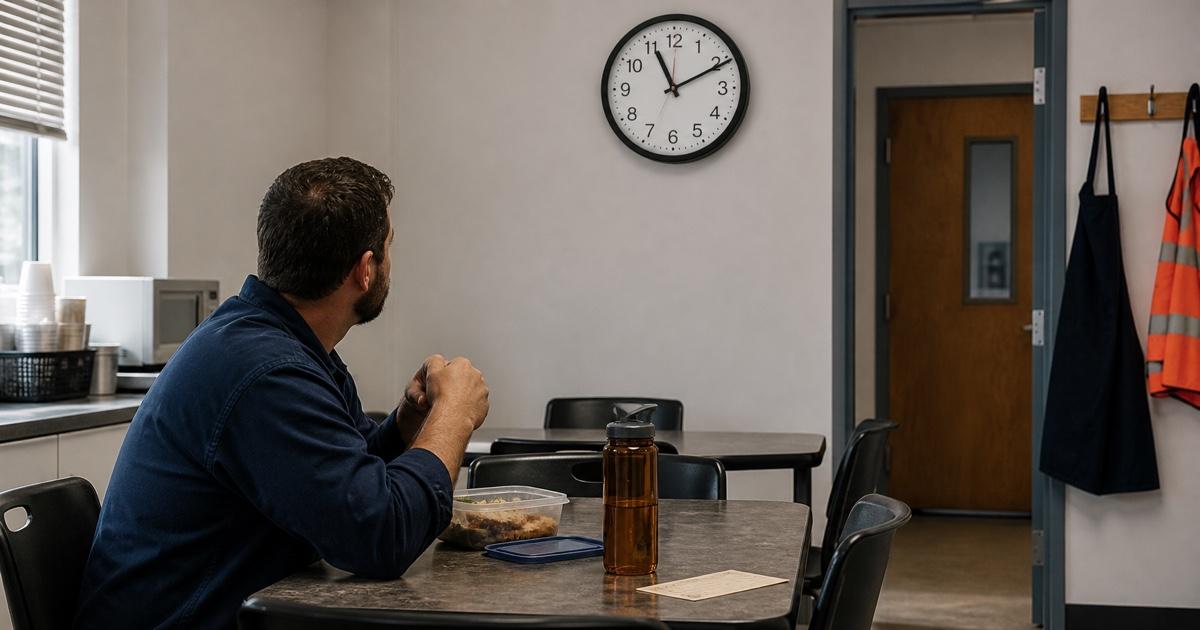
The most common break problem in Oklahoma workplaces is not the absence of breaks — it is the unpaid meal period that never really happens. Payroll systems that automatically deduct 30 or 60 minutes per shift are a recurring source of trouble when the workload does not actually stop; we cover that pattern in depth in our article on auto-deducted meal breaks in healthcare, and the broader landscape of off-the-clock work in our guide to unpaid wages in Oklahoma.
The Tenth Circuit — the federal appeals court covering Oklahoma — has confronted how "relieved from duty" works in practice. In Lamon v. City of Shawnee, Kansas, 972 F.2d 1145 (10th Cir. 1992) — a Kansas case, but binding Tenth Circuit law in Oklahoma — police officers sued their city over unpaid 30-minute meal periods during which they remained on call, had to monitor a radio or leave a phone number, had to respond to emergencies and crimes committed in their presence, and could not run personal errands. A jury found the meal periods compensable. On appeal, however, the Tenth Circuit held that the trial court had instructed the jury under the wrong standard: for law-enforcement employees paid under the FLSA's special public-safety provisions, a meal period is compensable only when the officer's time is spent predominantly for the benefit of the employer — being on call with some limited responsibilities is not automatically work. The court reversed on that issue and sent the case back for a new trial, a ruling that favored the employer on the legal standard even though the officers had won the jury verdict below.
Lamon — again, a Kansas case, though the Tenth Circuit's rule reaches Oklahoma — arose under the FLSA's special public-safety pay rules. But its predominant-benefit analysis is not safely confined to police and firefighters. In Beasley v. Hillcrest Medical Center, 78 F. App'x 67 (10th Cir. 2003), an unpublished Oklahoma case involving nurses and technicians, the Tenth Circuit applied that analysis to § 785.19. The court reasoned that the public-safety regulation incorporates § 785.19 and found no persuasive basis for giving "completely relieved from duty" a different meaning. Because Beasley is unpublished, it is not binding precedent, but it directly addresses non-public-safety employees in Oklahoma. The inquiry is highly fact-specific: a minor interruption does not automatically convert the entire meal period into worktime, while frequent interruptions, patient or equipment monitoring, required phone coverage, or other duties that principally occupy the break may make it compensable. Employers should not assume an unpaid-lunch policy is safe just because it exists on paper; when the workload keeps claiming the meal period, the time may be compensable — and a systematic auto-deduction can multiply a small daily underpayment across every shift and every affected employee. If your employer has also been trimming hours or reclassifying time in other ways, our article on pay and hour cuts in Oklahoma explains where the legal lines sit.
Exception One: Workers Under 16
Oklahoma's child labor law is the state's one true break statute — though note that the same section's hour limits reach only work "other than agriculture or domestic service," so farm and household work sit on different footing. Under 40 O.S. § 75(C), a worker under 16 "must be permitted a one (1) hour cumulative rest period for each eight (8) consecutive hours worked," and may not work "more than five (5) consecutive hours unless permitted a one-half (1/2) hour cumulative rest period." The same statute caps how long younger teens may work at all — three hours on a school day, eight on a non-school day, eighteen hours in a school week and forty in a non-school week, with a narrow exception letting employers not covered by the FLSA schedule a longer shift on a school day that precedes a non-school day. Once a teen turns 16, those Oklahoma break and hour protections end, though federal law still restricts hazardous work until 18 — a subject we cover fully in our guide to Oklahoma teen work laws.
Exception Two: Nursing Employees and the PUMP Act
Federal law carves out a second real entitlement. Under 29 U.S.C. § 218d, enacted as the PUMP for Nursing Mothers Act in December 2022, an employer must provide a nursing employee "a reasonable break time" to express breast milk, "each time such employee has need," for one year after the child's birth — plus a place to do it that is not a bathroom, shielded from view, and free from intrusion. The U.S. Department of Labor's Pump at Work guidance confirms these protections now reach nearly all FLSA-covered employees, including teachers, nurses, drivers, and agricultural workers, subject to narrow exclusions for airline crewmembers and some rail and motorcoach roles.
The statute has edges worth knowing. Pump breaks generally may be unpaid — but the time counts as hours worked "if the employee is not completely relieved from duty during the entirety of such break." An employer with fewer than 50 employees can escape the requirements only if it shows compliance would impose an undue hardship causing significant difficulty or expense. And before suing over a space violation, an employee generally must notify the employer and give it 10 days to comply — a notice step with exceptions where the employer has fired the worker for asking or made clear it will not provide the space.
What to Do If Your Breaks Are Being Taken Out of Your Paycheck
If you suspect your unpaid lunches were not really lunches, the evidence may already be in your hands: schedules, time records, auto-deduction entries on pay stubs, and the texts or emails showing you worked through the break. Keep them. Note the dates and what you were doing during "off" time. If you do not have records, that is not the end of it. Federal law puts the duty to keep accurate time records on the employer, and when those records are missing or wrong, a worker can use a reasonable reconstruction of the hours actually worked; the employer then has the burden to rebut it. A missing paper trail is often the employer's problem, not yours. The Oklahoma Department of Labor accepts wage claims for unpaid wages, and federal law provides its own remedies for unpaid working time — but which path fits, what period of underpayment is recoverable, and what deadlines apply depend on your facts and legal theory. Our Oklahoma wage-claims guide explains the available routes, and our article on Oklahoma statutes of limitations explains why timing still matters. And if you are worried about what happens after you raise it, the FLSA makes it unlawful for an employer to fire you or retaliate against you for filing a wage complaint or taking part in a proceeding under the Act — 29 U.S.C. § 215(a)(3). Retaliation is its own claim, separate from the unpaid time. In lower-wage industries where break abuses cluster, our article on restaurant wage theft shows how these claims tend to look in practice.
Frequently Asked Questions
Is my employer required to give me a 15-minute break in Oklahoma?
No. For workers 16 and older, general Oklahoma and federal wage-and-hour law does not require rest breaks of any length. But if your employer chooses to offer a short rest break in the federal regulation's roughly 5-to-20-minute range, it must be paid and counted as hours worked. Separate federal safety rules can require rest or driving interruptions in certain occupations.
Can my employer make me work through an unpaid lunch?
Your employer can require you to work through lunch — but then the time is not an unpaid meal period anymore. Under 29 C.F.R. § 785.19, a meal period can be unpaid only if you are completely relieved from duty. If you are required to perform duties while eating — at a desk, a register, or a machine — that time is working time and must be paid.
Does Oklahoma require a lunch break on an 8-hour shift?
Not under Oklahoma's general wage-and-hour law for workers 16 or older. Oklahoma imposes no general meal-break requirement on adult shifts of any length, although occupation-specific federal safety rules may require rest or driving interruptions. For covered workers under 16, state law requires a 30-minute cumulative rest period before working more than five consecutive hours and a one-hour cumulative rest period for each eight consecutive hours worked.
Are pump breaks for nursing employees paid?
Generally they may be unpaid, with two important caveats. If you are not completely relieved from duty for the entire break, the time counts as hours worked and must be paid. And no matter how the time is treated, your employer must provide reasonable break time and a private, non-bathroom space for up to a year after your child's birth — unless it has fewer than 50 employees and can prove undue hardship.
A Missing Break Is Rarely the Whole Story
Most break complaints that turn into cases are really pay complaints: time worked that never made it onto a paycheck, multiplied across months of shifts. If your employer deducts meal periods you routinely work through, refuses pump breaks the law requires, or has started squeezing paid break time out of your checks, the records usually tell a clear story — and the sooner they are reviewed, the more of that story is still recoverable. Our employment law team can evaluate your time records and tell you whether what happened to your breaks is legal. Contact us for a confidential consultation. This article is general information, not legal advice, and does not create an attorney-client relationship.
Working Through "Unpaid" Lunches?
Oklahoma wage law generally doesn't require adult breaks — but federal law requires pay for every meal period you actually worked through. If meal periods are being auto-deducted from shifts that never stopped, those minutes add up, and the evidence can prove it.
Talk to an Employment Lawyer