
Key Takeaways
- 79 Detainees Missed Court: On May 11, 2026, the Oklahoma County Sheriff's Office stopped transporting inmates to the courthouse after a staffing agreement with the Jail Trust collapsed. Dozens of hearings were canceled, witnesses were sent home, and at least two defendants with pending plea deals remained in custody.
- A Judge Ordered Transport to Resume: A public defender filed a petition for a writ of habeas corpus, and Presiding Judge Sheila Stinson ordered the sheriff to resume transport the following morning. The order invoked the court's inherent authority to compel the attendance of persons in custody.
- The Legal Fight Is Not Over: Attorney General Gentner Drummond says state law puts transport duty on the sheriff. Sheriff Tommie Johnson III has since filed a lawsuit arguing the Jail Trust should handle transport, and public reporting says that case has been moved to Canadian County.
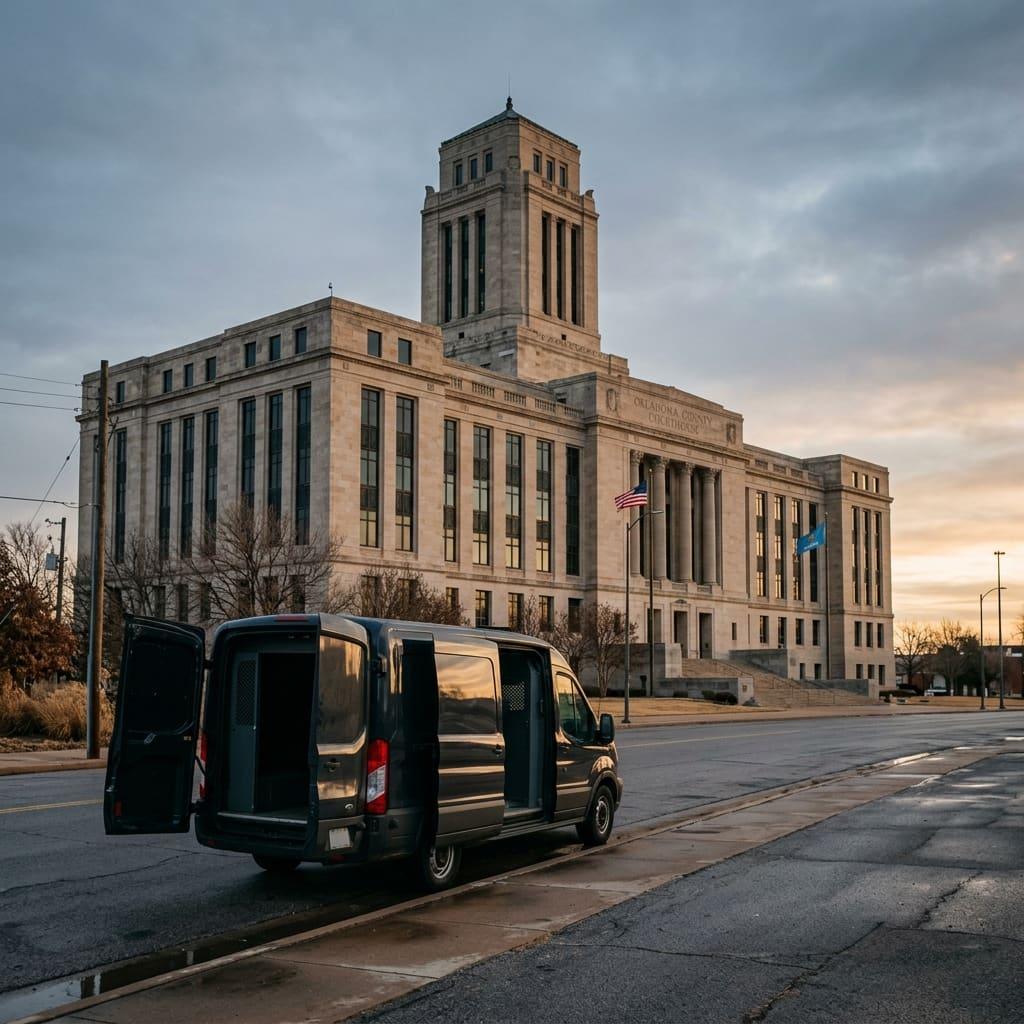
On Monday, May 11, 2026, most scheduled detained defendants at the Oklahoma County Detention Center did not get their day in court. A first group was brought to the courthouse but returned to the jail before ordinary hearings took place. After that, no further transport runs were made. Defendants sat in their cells while judges waited on empty dockets. Witnesses who had been subpoenaed and taken time off work were sent home. Public defenders scrambled to reach clients they could not see. Two people who had negotiated plea agreements that may have freed them that day stayed locked up instead. The reason was not a natural disaster, a security emergency, or a riot. The reason was that two government entities could not agree on who was supposed to drive inmates five blocks to the courthouse.
The standoff between the Oklahoma County Sheriff's Office and the Oklahoma County Criminal Justice Authority, known as the Jail Trust, left 79 detainees without their scheduled court appearances. It prompted a writ of habeas corpus filing from a public defender, an emergency hearing before the presiding district judge, an order directing the sheriff to resume transport, and an opinion from the Oklahoma Attorney General stating that the sheriff is legally obligated to get inmates to court. Transport resumed Tuesday morning. Since then, the sheriff has filed a separate lawsuit asking a court to declare the Jail Trust responsible for transport. The people who missed their hearings on Monday still lost time in court and, for some, time outside custody.
This is a story about a bureaucratic power struggle. But for the people locked inside the Oklahoma County Detention Center, it is something more fundamental. Pretrial detainees have a constitutional right to access the courts. When government infighting blocks that access, it is the detained and their families who pay the price.
How the Transport Breakdown Happened
This dispute has roots going back weeks. On April 8, Sheriff Tommie Johnson III sent a letter to the Board of County Commissioners and the Jail Trust notifying them that his office would stop transporting inmates to court after May 10, 2026. The sheriff's office had been providing transport under a contract with the Jail Trust worth approximately $800,000 per year. Johnson said he wanted to end the arrangement to free up deputies for courtroom security and to save the Trust money on the contract.
The Jail Trust asked for more time. Chairman Jim Holman told The Oklahoman that the Trust "literally begged the sheriff to give us more time," noting that the 30-day notice window began before the Trust even had confirmed funding for the upcoming fiscal year. Hiring and training new transport staff would take at least six months, Holman said. Johnson was unmovable.
On May 8, during a special meeting of the Jail Trust, sheriff's office and jail leaders reached what appeared to be a temporary agreement: three detention officers from the jail would work alongside three sheriff's deputies to handle transport through the end of the fiscal year. Both sides left the meeting believing they had a deal.
On Monday morning, May 11, the detention officers did not show up.
According to the sheriff's office, deputies were sent to begin the transport run as scheduled. When no detention officers appeared to assist, the first group of inmates who had been brought to the courthouse was returned to the jail, and no further transports were made. Jail officials have not publicly explained why the detention officers were absent. The result was immediate and total: every court proceeding involving a detained defendant in Oklahoma County ground to a halt.
What Happened After the Shutdown
Fallout was swift. In the basement of the jail, a courtroom originally built in 1999 for the state trial of Terry Nichols was fitted with folding chairs so that a handful of defendants could appear before a judge without being transported. For most scheduled detainees, that workaround was not enough.
A public defender in the Oklahoma County Public Defender's Office filed a petition for a writ of habeas corpus on behalf of a client who had expected to be released that day through a negotiated plea agreement. The filing put the issue before Presiding Judge Sheila D. Stinson, who held a hearing Monday afternoon. Stinson's resulting order did not resolve the underlying question of who is permanently responsible for transport. But it was direct about the court's authority. The order stated that the court "possesses inherent authority to ensure the operation of the judicial system and to compel the attendance of persons in custody." Stinson ordered the sheriff's office to resume transporting all detainees beginning at 6:30 a.m. Tuesday, while noting that legal challenges could continue through the appellate courts.
Sheriff Johnson complied. But he made clear his disagreement. "Judge Stinson issued the order to resume, but clearly did not weigh into the legality of whose responsibility it is," Johnson said in a statement. "She said it is a question for the appellate court."
District Attorney Vicki Behenna was less diplomatic. "Today's failure to transport resulted in preventable continuances across the docket, increasing costs to taxpayers and placing additional strain on already limited court resources," she said. Behenna noted that her office had multiple witnesses under subpoena who had to be sent home, and police officers who had taken time away from their departments to testify in cases that never went forward.
The Legal Dispute: Indenture Versus Statute
Who must transport inmates is ultimately a question of Oklahoma law, and the answer is less clear-cut than either side suggests.
Oklahoma County's fiscal 2024 annual financial report states that the Jail Trust was established on May 22, 2019, and assumed operation of the detention center on July 1, 2020. The Trust's founding document, called an indenture, defines the scope of the Trust's authority. It also carves out specific exceptions. The indenture states that the following are "specifically excepted and not a part of the Purposes of this Authority": the courthouse holding facilities, courthouse security, and "the implementation, operations and transportation of any inmates or others in custody or in temporary confinement to and from the Oklahoma County Courthouse."
That language was intentional. Commissioner Brian Maughan, who helped draft the indenture, told The Oklahoman that the exception was placed there deliberately to keep law enforcement officers handling transport rather than jail detention officers. "I believed it was law enforcement's responsibility, or it would be best served by doing it with law enforcement," Maughan said. "I still stand by that."
Sheriff Johnson argues from the opposite direction. He points to 19 O.S. § 513.2, which provides that when a county contracts with a public trust to manage a jail, "any duty or responsibility imposed by statute or rule upon the sheriff" regarding the jail's operation is transferred to that trust. Under this reading, the Jail Trust stepped into the sheriff's shoes when it took over the jail, and transport is the Trust's problem now.
Behenna counters that the indenture's explicit exception for transport means the Trust never accepted that duty. The $800,000 annual contract was a payment arrangement, not a delegation of the sheriff's underlying obligation. "In that indenture, it specifically includes four duties that stay with the sheriff, one of which was transport," Behenna said.
The Attorney General sided with Behenna. In a May 11 Attorney General opinion, AG Gentner Drummond wrote that "the Oklahoma County Sheriff holds responsibility for inmates and is obligated to transport them to and from court appearances." Drummond characterized the result as "a straightforward application of Oklahoma law and the clear language of the Trust Indenture."
Attorney General opinions in Oklahoma carry significant legal weight. Public officials are generally expected to follow them unless a court rules otherwise. Johnson says he intends to seek that ruling. "It is an opinion, and I would like to challenge that through the court process," he said.
The Constitutional Right to Court Access
Whatever the outcome of the statutory dispute, the May 11 shutdown raised a more fundamental problem: the constitutional right of pretrial detainees to access the courts.
The right of prisoners and pretrial detainees to meaningful court access has been recognized by the U.S. Supreme Court since at least Bounds v. Smith, 430 U.S. 817 (1977). In Lewis v. Casey, 518 U.S. 343 (1996), the Court clarified that the right requires a showing of "actual injury," meaning a detainee must demonstrate on an individualized basis that the deprivation actually hindered their ability to pursue a specific legal claim. Not every one of the 79 people who missed their hearings on May 11 will be able to make that showing. But for some, the injury is concrete. The Chief Public Defender confirmed that at least two clients had plea agreements ready that would have resulted in their release. Those individuals spent additional days in custody because no one drove them to the courthouse.
Pretrial detainees occupy a distinct constitutional position. Unlike convicted prisoners, whose conditions of confinement are evaluated under the Eighth Amendment's prohibition on cruel and unusual punishment, pretrial detainees are protected by the Due Process Clause of the Fourteenth Amendment. The Supreme Court held in Kingsley v. Hendrickson, 576 U.S. 389 (2015), that a pretrial detainee's excessive-force claim uses an objective standard. That rule should not be generalized to every jail claim. In the published 2026 decision Bond v. Sheriff of Ottawa County, the Tenth Circuit continued to require both objective and subjective components for a pretrial detainee's deliberate-indifference medical-care claim.
In practical terms, the implication is significant. When a pretrial detainee is held in custody past the point at which a court order has authorized release and no further legal basis for confinement exists, that additional detention may constitute an unlawful deprivation of liberty. Oklahoma courts and the Tenth Circuit have recognized over-detention claims in cases where individuals remained jailed after their legal basis for confinement expired. A ready plea agreement does not automatically extinguish the authority to detain; the plea must still be accepted by a judge. But the transport failure on May 11 prevented that judicial act from occurring. For at least two defendants, their cases were ready to resolve, the courtroom was open, and the only thing standing between them and the hearing that could have freed them was a five-block ride that nobody was willing to provide.
The Broader Pattern at Oklahoma County Jail
The transport dispute did not happen in a vacuum. It is the latest episode in a years-long institutional collapse at the Oklahoma County Detention Center.
KOSU reported on June 18, 2026, based on Oklahoma State Department of Health records, that at least 60 people had died in custody since the Jail Trust assumed operations and that the facility had failed a twelfth consecutive inspection since 2020. A 2023 multi-county grand jury reported that conditions constituted a "significant loss of life" and recommended that the Trust self-terminate. The separate 2025 Department of Justice behavioral-health report discussed the jail's role in the larger community system, but it was not a conditions-of-confinement finding against the Oklahoma County Detention Center.
The facility's staffing crisis compounds the problem. As of April 2026, the jail had just 74 detention officers to supervise approximately 1,500 detainees across a 13-story building. The jail recently terminated its contract for dedicated safety checkers to save $180,000 per month, eliminating the only staff whose sole job was to conduct the hourly visual checks required by Oklahoma law. A federal jury awarded $2 million to the family of Gregory Davis after finding that jail staff missed five of six mandatory cell checks before Davis was found dead in his cell in 2021.
This is the institutional context in which the sheriff decided to stop driving inmates to court. The same facility that has struggled to staff its cell blocks and perform required safety checks also failed that day to get scheduled defendants to a courtroom. The transport dispute is a symptom of a deeper problem: a criminal justice infrastructure in which disputed responsibility and limited staffing can disrupt basic functions.
What This Means for Families and Defendants
Families of people detained at the Oklahoma County Detention Center should understand the legal landscape they are navigating.
If your loved one missed a court hearing on May 11 and was held in custody past the point where a court order, bond ruling, or dismissal should have resulted in release, that additional detention may give rise to an over-detention claim. The Fourth and Fourteenth Amendments prohibit confinement without lawful authority. When the government's legal basis to hold someone expires and that person remains locked up, the detention becomes unlawful regardless of the reason. Whether the transport failure on May 11 crossed that line depends on the individual circumstances of each case, but the framework for liability is well established.
Federal civil rights claims under 42 U.S.C. § 1983 are available when government officials violate a detainee's constitutional rights. The transport failure on May 11 is the kind of systemic breakdown that may support municipal liability under the Monell doctrine, which holds government entities accountable when constitutional violations result from official policies, customs, or a deliberate failure to act in the face of known risk. Liability still turns on specific questions of causation, fault, and immunity. But a system in which two government entities publicly refuse to perform a basic function while detainees sit in cells is the type of institutional dysfunction that federal civil rights law can address in the right case.
State claims under the Oklahoma Governmental Tort Claims Act require filing a notice of claim within one year under 51 O.S. § 156. After the government denies the claim or fails to act within 90 days, the family has 180 days to file suit under 51 O.S. § 157. Federal Section 1983 claims carry a two-year statute of limitations in Oklahoma. These deadlines are strict and interlock in ways that require careful management.
Equally important is the preservation of evidence. Transport logs, staffing records, internal communications about the agreement and its collapse, the jail's records of which detainees were scheduled for court, and any video footage from May 11 should all be preserved. In previous Oklahoma County Detention Center litigation, internal documents have surfaced through discovery that would never have come to light without formal litigation holds. Families who believe their loved one was harmed by the May 11 shutdown should consult an attorney promptly to ensure that evidence is secured before it is overwritten or destroyed.
What Happens Next
As of July 2026, transport had resumed under Judge Stinson's order. The sheriff's later lawsuit left the allocation of long-term transport responsibility for a court to decide; this article does not predict that result.
The Jail Trust's budget deficit, the sheriff's staffing shortages, and the county's refusal to fund a dedicated sales tax for jail operations all remain. The Board of County Commissioners voted on May 8 to reject a proposed amendment to the Trust's indenture that would have shifted transport responsibility to the Trust, effectively foreclosing the path the sheriff wanted to take. In June, Sheriff Johnson filed a lawsuit seeking a ruling that the Jail Trust is responsible for transport and challenging portions of the Trust indenture. Public reporting says that lawsuit has been moved to Canadian County.
Meanwhile, the detainees at the Oklahoma County Detention Center remain where they have often been: caught between institutions that cannot agree on who is responsible for them. The May 11 transport failure was not a one-day inconvenience. It was a concrete demonstration of what happens when institutional dysfunction starts affecting court access. For the 79 people who missed their day in court, the consequences were real. Their cases were delayed. Some confinement may have been extended. Their rights were caught in a bureaucratic argument that none of them had any part in creating.
At Addison Law, we represent families affected by the Oklahoma County Jail crisis and have handled claims arising from the facility's systemic failures. If your loved one was held past their release date, missed a critical court hearing, or was harmed while detained at the Oklahoma County Detention Center, contact us for a free, confidential consultation.
Frequently Asked Questions
What happened with Oklahoma County jail transports on May 11, 2026?
On May 11, 2026, the Oklahoma County Sheriff's Office stopped transporting inmates from the Oklahoma County Detention Center to the courthouse after a staffing agreement with the Jail Trust collapsed. Three detention officers who were supposed to assist three sheriff's deputies with transport did not report. The sheriff's office returned the first group of inmates to the jail and made no further transport runs. As a result, 79 detainees missed their scheduled court appearances, dozens of hearings were canceled, and witnesses who had been subpoenaed were sent home.
Why did the sheriff stop transporting inmates?
Sheriff Tommie Johnson III had notified the county in April that his office would stop providing transport after May 10, arguing that the responsibility should fall to the Jail Trust rather than the sheriff's office. Johnson pointed to the approximately $800,000 annual cost of transport and said he needed to reassign deputies to provide security in courtrooms. The sheriff argues that state law transferred transport duties to the Jail Trust when the Trust assumed management of the jail in 2020.
What does the law say about who is responsible for inmate transport in Oklahoma County?
The answer is being litigated. The Jail Trust's indenture explicitly excepts inmate transport from the Trust's responsibilities, keeping that duty with the sheriff. Sheriff Johnson argues that 19 O.S. § 513.2 transfers all of the sheriff's jail-related duties to the entity managing the jail, which would include transport. Attorney General Gentner Drummond issued an opinion on May 11 agreeing with District Attorney Vicki Behenna that the sheriff is legally obligated to transport inmates. AG opinions in Oklahoma carry significant legal weight, but the sheriff has filed suit to challenge the allocation of responsibility.
Can detainees sue if they missed court because of the transport failure?
Potentially. Pretrial detainees have a constitutional right of access to the courts under the Due Process Clause of the Fourteenth Amendment. To establish a federal civil rights claim under 42 U.S.C. § 1983, a detainee would generally need to show "actual injury," meaning the transport failure concretely hindered a specific legal proceeding or extended their confinement. For at least two defendants on May 11, the facts may be stronger than a routine delay: they reportedly had plea agreements ready and remained in custody because they could not reach the courtroom for the hearing that would have resolved their cases.
What is a writ of habeas corpus, and how was one used here?
A writ of habeas corpus is a legal mechanism that requires the government to justify why it is holding someone in custody. On May 11, a public defender filed a writ on behalf of a client who had a plea agreement that would have freed them that day but could not reach the courthouse. The filing prompted Presiding Judge Sheila Stinson to hold an emergency hearing, after which she ordered the sheriff's office to resume all inmate transports the following morning. The writ is one of the oldest protections in American law and is specifically designed to address situations where someone is detained without lawful justification.
How does this transport dispute relate to the broader Oklahoma County Jail crisis?
The transport failure occurred against a documented record of operational problems at the Oklahoma County Detention Center. KOSU's June 18, 2026 review reported at least 60 custody deaths since the Trust assumed operations and a twelfth consecutive failed state health inspection since 2020. A multi-county grand jury recommended that the Trust self-terminate, and the jail ended its dedicated safety-checker contract amid budget pressure. The 2025 Department of Justice behavioral-health matter was separate and did not make a jail-conditions finding against the detention center.
What should I do if my family member is detained at Oklahoma County Jail?
Document everything. Keep records of every communication with the jail, note the dates and times of any missed court hearings, and request copies of any court orders affecting your loved one's case. If your family member was scheduled for a hearing on May 11 or was held in custody past a point when they should have been released, contact a civil rights attorney to discuss whether a claim exists. Evidence in jail cases, including surveillance footage, transport logs, and internal communications, can be overwritten or destroyed quickly. Acting promptly to preserve that evidence is critical.
Was Your Loved One Affected by the Transport Shutdown?
If someone in your family missed a court hearing, was held past their release date, or has been harmed while detained at the Oklahoma County Detention Center, federal civil rights claims may be available depending on the facts. We handle Oklahoma County Jail cases and offer free, confidential consultations.
Schedule a Free Consultation →This article is for general information purposes only and does not constitute legal advice. The facts described are drawn from reporting by News 9, KOCO, The Oklahoman, and publicly available records. Legal proceedings related to the Oklahoma County Detention Center are ongoing.