
Key Takeaways
- Prolonged isolation can cause measurable psychological harm: Psychiatric and correctional-health sources warn that solitary confinement — often 22 to 24 hours per day in a cell with minimal human contact — can produce anxiety, hallucinations, cognitive deterioration, and suicidal ideation. For prisoners with serious mental illness, the risk is especially acute.
- The Eighth Amendment sets constitutional limits: Under Farmer v. Brennan and Hutto v. Finney, prison officials who know that conditions pose a substantial risk of serious harm and fail to act can be held liable under 42 U.S.C. § 1983. Prolonged isolation claims still depend heavily on circuit law, duration, mental-health proof, and notice.
- Oklahoma remains under scrutiny: Oklahoma's use of restrictive housing has drawn sustained attention. In February 2026, the ACLU of Oklahoma announced the end of indefinite solitary confinement for the majority of death row inmates at the Oklahoma State Penitentiary, a significant reform that did not resolve every restrictive-housing issue statewide.
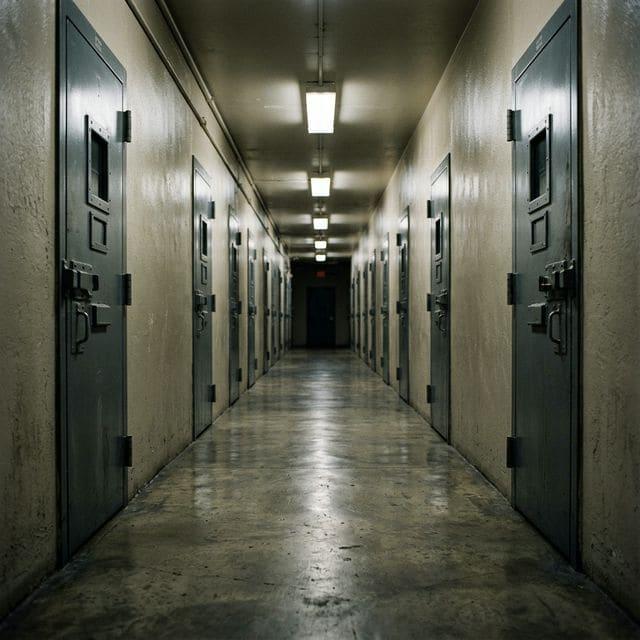
A man sits in a concrete cell roughly the size of a parking space. The lights stay on. There is no window, or if there is, it faces a wall. He eats alone. He exercises alone — if he is allowed to exercise at all — in a concrete pen not much larger than his cell. He speaks to no one except the officers who slide his food tray through a slot in the door. He has been here for months. Some have been here for years. Some for decades. When he is finally released — to general population or to the street — the person who emerges is not the person who went in. He is anxious, paranoid, unable to tolerate noise or proximity to other people, and profoundly changed in ways that clinicians have documented for over a century but that the legal system is only beginning to address with the seriousness the evidence demands.
This is solitary confinement in American prisons, and Oklahoma — which incarcerates more people per capita than nearly any other state in the nation — has used it extensively. The practice goes by many names: administrative segregation, restrictive housing, special management units, protective custody. The labels vary; the experience does not. Twenty-two to twenty-four hours a day in a cell, alone, with almost no meaningful human contact, for weeks, months, or years at a time. The constitutional question at the center of a growing wave of litigation is straightforward: at what point does this practice become cruel and unusual punishment under the Eighth Amendment?
The Documented Toll of Isolation
The psychiatric evidence against prolonged solitary confinement is serious and well developed. Dr. Stuart Grassian's landmark research at Harvard, which studied inmates in Massachusetts's Walpole prison, identified a specific psychiatric syndrome associated with solitary confinement that includes hypersensitivity to stimuli, perceptual distortions and hallucinations, panic attacks, difficulty thinking and concentrating, memory problems, paranoia, and impulse control difficulties. These symptoms appeared in inmates with no prior history of mental illness, often within days of placement in isolation.
Subsequent research has confirmed and expanded these findings. A 2014 study published in the American Journal of Public Health found that inmates in solitary confinement were 6.9 times more likely to commit acts of self-harm than inmates in general population. The National Commission on Correctional Health Care has called for strict limits on solitary confinement, as has the American Psychiatric Association, which has stated that prolonged segregation of inmates with serious mental illness is contraindicated because of the potential for harm. The United Nations Standard Minimum Rules for the Treatment of Prisoners — known as the Nelson Mandela Rules — define prolonged solitary confinement as isolation exceeding 15 consecutive days and prohibit its use, a standard that the UN Special Rapporteur on Torture has characterized as meeting the threshold of cruel, inhuman, or degrading treatment.
For inmates who enter solitary confinement with preexisting mental illness — depression, bipolar disorder, schizophrenia, PTSD — the effects are not merely additive but multiplicative. Isolation strips away every coping mechanism, every social connection, every environmental variation that helps manage symptoms. Psychotic episodes intensify. Self-harm escalates. Suicide attempts increase dramatically. And in facilities where mental health care is stretched thin — a persistent concern across Oklahoma's overcrowded correctional system — inmates in isolation often receive the least mental health support precisely when they need the most.
The Constitutional Framework
The Eighth Amendment prohibits cruel and unusual punishment. The Supreme Court has never ruled squarely on whether solitary confinement per se violates the Eighth Amendment, but it has established the legal framework through which specific conditions and durations of isolation can be challenged.
In Estelle v. Gamble (1976), the Court established that deliberate indifference to serious medical needs violates the Eighth Amendment. In Farmer v. Brennan (1994), it held that prison officials violate the Constitution when they know of and disregard a substantial risk of serious harm to an inmate. In Hutto v. Finney (1978), the Court upheld a lower court's limit on solitary confinement duration — 30 days — as a remedy for unconstitutional prison conditions, implicitly recognizing that the duration of isolation is constitutionally significant.
More recently, Justice Kennedy wrote in his concurrence in Davis v. Ayala (2015) that "[r]esearch still confirms what this Court suggested over a century ago: Years on end of near-total isolation exact a terrible price." He detailed the "human toll wrought by extended terms of isolation" — including "anxiety, panic, withdrawal, hallucinations, and self-mutilation" — and suggested that courts may need to determine whether workable alternative systems for long-term confinement exist. That concurrence, while not binding, signaled growing judicial discomfort with prolonged isolation and invited further litigation.
The practical standard for challenging solitary confinement under the Eighth Amendment requires two showings. First, the objective component: the conditions must be sufficiently serious to deprive the inmate of "the minimal civilized measure of life's necessities." Prolonged isolation that produces documented psychological harm satisfies this element. Second, the subjective component: prison officials must have been aware of a substantial risk of serious harm and failed to take reasonable steps to address it. When the psychiatric evidence against prolonged isolation is as well-established as it is — when national medical organizations have condemned the practice, when the UN has classified it as torture, when facility after facility has produced the same documented harms — the argument that officials didn't know about the risk becomes increasingly difficult to sustain.
How Oklahoma Uses Restrictive Housing
Oklahoma's Department of Corrections operates several forms of restrictive housing under different policies. Special Management Units — governed by ODOC operational procedure OP-040204 — provide a temporary status with less than 22 hours per day of in-cell time for inmates who pose threats to physical safety or facility operations. Extended Restrictive Housing, under OP-040203, confines inmates for 22 or more hours per day and is reserved for situations involving a direct threat to life or facility security. Disciplinary segregation is used as a punishment for rule violations. Each category has its own justification on paper, but for inmates in the most restrictive placements, the lived experience is essentially the same: a small cell, near-total isolation, and minimal meaningful human interaction.
ODOC's own policies state that confinement in a Special Management Unit is "not intended to exceed 30 continuous days" and that continuous confinement beyond 30 days requires the facility head's approval. Reviews are supposed to occur every seven days during the first two months and every 30 days thereafter. But policy and practice are different things. Inmates at Oklahoma facilities have reported spending months or years in restrictive housing with reviews that amount to rubber stamps — brief, formulaic check-ins that do not meaningfully evaluate whether continued isolation is justified or whether the inmate's mental health is deteriorating.
The most visible recent development came in February 2026, when the ACLU of Oklahoma announced that indefinite solitary confinement for the majority of death row inmates at the Oklahoma State Penitentiary in McAlester had ended. For years, death row inmates in OSP's H-Unit had been confined 22 to 24 hours per day with limited access to showers and exercise, no natural light, and no contact visits with family. Mental health visits were conducted through cell door food slots. The ACLU described the conditions as "inhumane and oppressive" and initiated advocacy in 2019 with a demand letter documenting the alleged constitutional violations. Following sustained pressure, ODOC agreed to move death row prisoners to A-Unit, where they can participate in outdoor yard time, jobs, religious services, and contact visits. The reform was significant, but it addressed one population at one facility. Other restrictive-housing practices still require a fact-specific look at current placement records, mental-health care, reviews, and conditions.
The broader context makes this particularly concerning. Oklahoma's prisons are chronically understaffed and overcrowded. The crisis at Allen Gamble Correctional Center in Holdenville, where 22 inmates were killed in four years, illustrates what happens when institutional capacity collapses. In that environment, advocates and litigation have argued that restrictive housing becomes a management tool — a way to control a population that the facility lacks the staff to supervise safely — with inmates placed in isolation based on systemic need rather than individualized risk assessment. That pattern, when documented, is precisely the kind of institutional practice that supports Eighth Amendment claims.
The National Litigation Landscape
Some courts outside the Tenth Circuit have recently allowed serious prolonged-isolation claims to move forward, but the law remains uneven and fact-specific.
In September 2024, a jury in New York found that a prisoner's nine years in solitary confinement violated his Eighth Amendment rights — what is believed to be the first jury verdict in New York state prisons on the constitutional limits of solitary confinement. The case involved Wonder Williams, who was confined in extreme isolation for at least 23 hours a day with constant bright light and limited sensory input. The jury found liability for punitive damages against two corrections officials.
In September 2024, the Third Circuit denied qualified immunity to Pennsylvania corrections officials in a case involving a mentally ill prisoner who endured 26 years of solitary confinement. The court wrote that there was "no room for doubt" that prolonged isolation of a mentally ill individual without penological justification violated a basic constitutional right. That language is powerful persuasive authority, but it is not binding on Oklahoma federal courts.
Class-action litigation is expanding as well. Hammond v. PA DOC, filed in March 2024, challenges the constitutionality of Pennsylvania's solitary confinement practices systemwide. Similar litigation in other states seeks prospective relief addressing prolonged isolation. In prison-conditions cases, however, 18 U.S.C. § 3626 requires court-ordered prospective relief to be narrowly drawn, extend no further than necessary, and use the least intrusive means necessary to correct the proven federal violation.
The Tenth Circuit, which governs Oklahoma, has been more cautious. In Crane v. Utah Department of Corrections, 15 F.4th 1296 (10th Cir. 2021), the court upheld qualified immunity for officials who placed a severely mentally ill prisoner in solitary confinement, finding no "clearly established right" preventing the practice on the facts before it. That does not mean constitutional violations cannot occur in Oklahoma. It means the case must be built carefully around current Tenth Circuit law, documented harm, official notice, duration, available alternatives, and the distinct requirements for individual, local-government, private-entity, or prospective official-capacity claims.
Building a Civil Rights Claim
A person harmed in solitary confinement may have a claim under 42 U.S.C. § 1983 when the elements of the federal right, causation, standing, and a proper defendant are proved. One threshold is the Prison Litigation Reform Act: 42 U.S.C. § 1997e(a) requires a person who is confined when suit is brought to exhaust administrative remedies that are actually available before filing a federal prison-conditions action. The Supreme Court explains in Ross v. Blake that an unavailable remedy need not be exhausted, and Jones v. Bock treats non-exhaustion as an affirmative defense. The facility's operative grievance rules, deadlines, access, interference, and the relief sought all require prompt review.
The evidence starts with the inmate's mental health records and classification history. If the inmate had a diagnosed mental illness before being placed in isolation — or if mental health symptoms developed and were documented during isolation — those records establish the objective severity of the harm. Grievances and sick-call requests in which the inmate reported psychological distress, requested mental health treatment, or complained about the conditions of confinement establish that officials were on notice. Staff log entries documenting the inmate's behavior — self-harm, psychotic episodes, refusal to eat, withdrawal — corroborate the deterioration.
The facility's own policies become powerful evidence when violated. If ODOC procedure requires mental health assessments every 30 days for inmates with identified mental health needs and those assessments didn't occur — or occurred only as perfunctory check-ins without meaningful clinical evaluation — the gap between policy and practice demonstrates deliberate indifference. If the facility's classification procedures required reconsideration of restrictive housing placement at regular intervals and the reviews were rubber stamps, the records speak for themselves.
Entity and prospective-relief theories require separate analysis. Under Monell, a local government is not liable merely because the alleged problem appears systemic; the plaintiff must identify the entity's own actionable policy, custom, or final-policymaker decision and prove the required fault and causation. A state agency presents sovereign-immunity and Section 1983 “person” issues. A claim to stop an ongoing federal violation may proceed against the responsible state official only when standing, the Ex parte Young requirements, and the Prison Litigation Reform Act's prospective-relief limits are satisfied. Qualified immunity is an individual-capacity defense, but its absence does not establish entity liability or entitlement to an injunction.
Expert testimony is critical. Psychiatric experts who can connect the inmate's documented symptoms to the established effects of prolonged isolation provide the causal link between the conditions and the harm. Correctional experts who can testify about professional standards — what responsible facilities do to minimize the use of isolation, how step-down programs work, how mental health screening should function — establish the gap between what the facility did and what it should have done.
What Families Should Know
If your loved one is currently in solitary confinement in an Oklahoma facility and you are concerned about their mental health, the steps you take now can protect both their wellbeing and their legal rights.
Document every communication. Keep a log of every phone call, every visit, every request you make to facility staff about your loved one's condition. Note dates, times, who you spoke with, and what you were told. Send written requests for information about your loved one's housing status, mental health treatment, and classification review schedule — and send them by certified mail so you have proof they were received.
Request your loved one's grievance records and mental health treatment records. Grievances and classification records may be obtainable through Oklahoma's Open Records Act (51 O.S. § 24A.5), though exemptions apply to certain security-related prison records. Medical and mental health records are protected by HIPAA and state privacy law and generally require the inmate's signed authorization or a court order — not just an open-records request. An attorney can help you navigate which records are available and how to compel disclosure through litigation holds or subpoenas.
If your loved one is exhibiting signs of psychological deterioration — reporting hallucinations, expressing suicidal thoughts, engaging in self-harm, withdrawing from communication — escalate immediately. Contact the facility's mental health staff in writing. Contact the ODOC's central office. Document everything. If the facility fails to respond to a documented mental health crisis, that failure becomes evidence of deliberate indifference.
Contact an attorney experienced in Section 1983 civil rights litigation. These cases require specialized knowledge of both constitutional law and correctional practices, and the evidence — particularly mental health records, classification files, and staff logs — must be preserved through formal demands before it can be lost or altered. The statute of limitations for Section 1983 claims in Oklahoma is generally two years from the date of the violation under 12 O.S. § 95. For related state-law tort claims, the Governmental Tort Claims Act (51 O.S. § 156) requires written notice to the state within one year, and suit must be filed within 180 days after the claim is denied. Evidence preservation is time-sensitive regardless of which path applies.
Frequently Asked Questions
Does solitary confinement violate the Constitution?
Not automatically, but it can. The Eighth Amendment prohibits cruel and unusual punishment, and courts have consistently recognized that the conditions and duration of solitary confinement can cross the constitutional line. Prolonged isolation that produces documented psychological harm — particularly for inmates with preexisting mental illness — supports a claim of deliberate indifference under Farmer v. Brennan when officials knew of the risk and failed to act. The longer the isolation and the more severe the mental health consequences, the stronger the constitutional claim.
What is the legal standard for challenging solitary confinement?
Under Section 1983, the plaintiff must satisfy both an objective and a subjective element. Objectively, the conditions must be sufficiently serious to deprive the inmate of the minimal civilized measure of life's necessities — documented psychological harm from prolonged isolation meets this standard. Subjectively, prison officials must have known of a substantial risk of serious harm and consciously disregarded it. Evidence that officials ignored mental health complaints, failed to conduct required reviews, or maintained policies of prolonged isolation despite known psychiatric harm can satisfy this element.
Can families sue on behalf of an inmate in solitary confinement?
If an inmate dies or is incapacitated as a result of conditions in solitary confinement, the estate can bring survival claims and family members may bring wrongful death claims. For living inmates, the inmate themselves is typically the plaintiff, though families play a critical role in documenting conditions, preserving evidence, and engaging counsel. An attorney can advise on the appropriate claims based on the specific circumstances.
How long can Oklahoma keep someone in solitary confinement?
ODOC policies state that confinement in a Special Management Unit is not intended to exceed 30 continuous days and that extensions require the facility head's approval. Reviews are required every seven days during the first two months and every 30 days thereafter. However, these policies do not impose a hard cap, and inmates have been held in various forms of restrictive housing for far longer than written policies contemplate. There is no Oklahoma statute that prohibits prolonged solitary confinement outright, which is why constitutional litigation remains the primary avenue for challenging excessive isolation.
What happened with Oklahoma's death row solitary confinement?
In February 2026, the ACLU of Oklahoma announced the end of indefinite solitary confinement for the majority of death row inmates at the Oklahoma State Penitentiary in McAlester. Death row prisoners had been confined 22 to 24 hours per day in H-Unit with no natural light, no contact visits, and mental health services delivered through cell door slots. Following advocacy that began in 2019, ODOC agreed to move prisoners to A-Unit, where they can access outdoor yard time, jobs, religious services, and contact visits. While significant, this reform applies to death row specifically and does not address the broader use of solitary confinement across the Oklahoma prison system.
Does qualified immunity protect prison officials from solitary confinement claims?
It can protect an individual defendant unless the plaintiff proves a constitutional violation of a right that was clearly established at the time. The Tenth Circuit upheld qualified immunity in Crane v. Utah Department of Corrections, 15 F.4th 1296 (10th Cir. 2021), on the facts before it. A municipality or private corporate entity does not receive qualified immunity, but a federal entity claim still requires proof tied to that entity's own actionable policy or custom. A state agency presents separate sovereign-immunity and Section 1983 “person” barriers.
What damages are available in solitary confinement cases?
The available remedy depends on standing, the defendant, the constitutional injury, causation, proof, and the Prison Litigation Reform Act. 42 U.S.C. § 1997e(e) limits a federal civil action by a confined prisoner for mental or emotional injury without a prior showing of physical injury or the commission of a statutorily defined sexual act; whether a particular injury and requested remedy fall within that provision is claim-specific. Punitive damages may be considered against an otherwise eligible individual only upon the additional showing required by Smith v. Wade, and municipalities are not subject to punitive damages under Section 1983. Section 1988 gives the court discretion over a qualifying prevailing-party fee award; for an action brought by a confined prisoner, § 1997e(d) separately limits a defendant-paid fee award. Filing-fee obligations arise under a different statute, 28 U.S.C. § 1915(b), not § 1997e(d).
Solitary confinement is one of the most consequential civil rights issues in American corrections, and Oklahoma's correctional system has faced sustained scrutiny over staffing, violence, mental-health care, and restrictive housing. If someone you love is suffering in isolation, their rights are not theoretical. Addison Law Firm handles civil rights cases involving conditions of confinement and deaths in custody throughout Oklahoma. Contact us for a free consultation.
Loved One Suffering in Solitary Confinement?
Prolonged isolation can cause devastating psychological harm. When officials ignore documented risk, federal civil rights law may provide a path to accountability.
Get a Free Case Evaluation →This article is for general information only and is not legal advice.
Remedies and Prison Litigation Reform Act sources checked July 14, 2026 against 42 U.S.C. §§ 1983, 1988, and 1997e; 18 U.S.C. § 3626; and the Supreme Court's Monell, punitive-damages, exhaustion, and available-remedies decisions.