Key Takeaways
- The Driver Carries the Affirmative-Defense Burden: Oklahoma treats "unavoidable accident by reason of sudden unconsciousness" as an affirmative defense. In Bowers v. Wimberly, 1997 OK 24, the Oklahoma Supreme Court said the defendant must prove "the sudden unconsciousness that caused the accident and that the attack was not foreseeable." The injured person still has to present a negligence case and identify disputed facts when required, but does not have to prove the driver was faking.
- Foreseeability Is Often the Key Dispute: A blackout only excuses a driver if it was unforeseeable. In Parker, evidence that the driver had fainted twice before at school meant the essential element of unforeseeability was, in the Court's words, "entirely lacking" — and the jury's defense verdict could not stand.
- A Doctor's Affidavit Does Not End the Case: In Bowers v. Wimberly, 1997 OK 24, a trucking defendant won summary judgment on a doctor's affidavit that a stroke caused the crash. The Oklahoma Supreme Court reversed because the record left causation and foreseeability in dispute — not because a physician's affidavit could never support the defense.
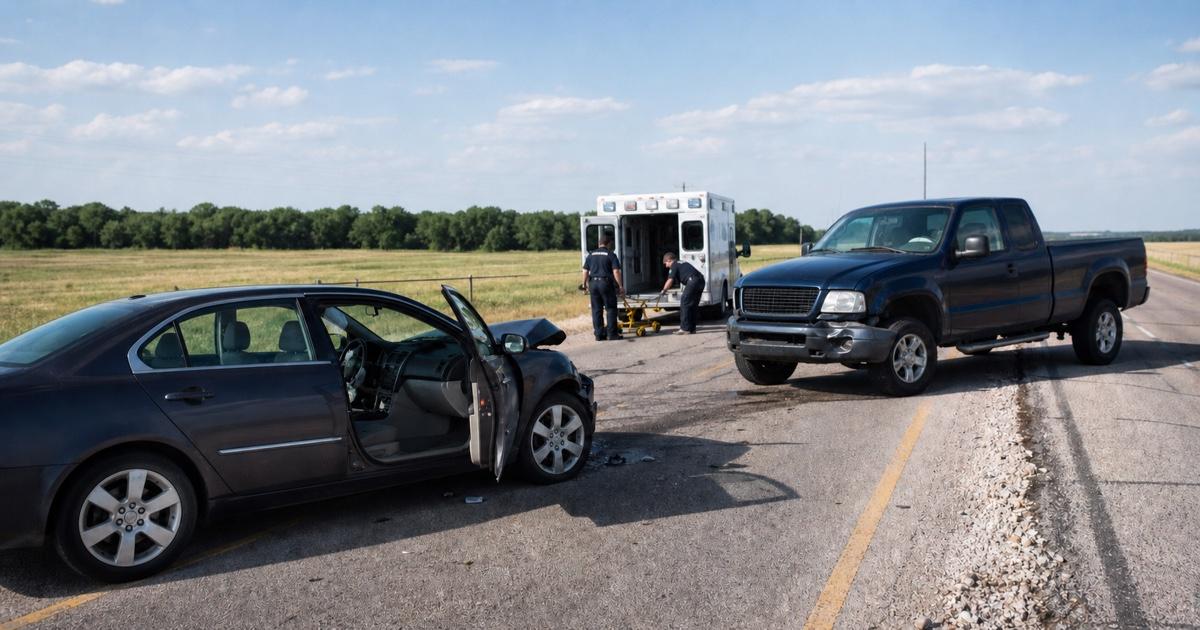
The police leave, the tow truck leaves, and a few weeks later a claims adjuster tells you something that stops the conversation cold: the driver who ran into you had a medical event. A seizure. A fainting spell. A stroke. They were unconscious, the adjuster explains, so nobody was negligent, and there is nothing to pay. It sounds final, and it is meant to. But under Oklahoma law that explanation is not a conclusion — it is an affirmative defense. It has elements. It has a burden of proof. And that burden belongs to the driver who hit you.
Oklahoma courts have addressed this scenario for decades, and the shape of the law is clear enough to describe plainly. A driver who suddenly loses consciousness from a genuinely unforeseeable cause is not chargeable with negligence. But the driver claiming that excuse has to prove it. In one case, the Oklahoma Supreme Court upheld a new trial after a defense verdict lacked evidentiary support; in another, it reversed summary judgment because material facts remained disputed. This post explains what the defense requires and what the evidence may show.
The Rule: Sudden Unconsciousness Can Excuse, But Only If Unforeseeable
The governing Oklahoma authority is Parker v. Washington, 1966 OK 263, 421 P.2d 861, decided by the Oklahoma Supreme Court. Ann Parker had an epileptic seizure while driving and crashed into and partially through the living room wall of Alma Washington's home. Washington sued. Parker's answer pleaded unavoidable accident, the case went to a jury, and the jury returned a verdict for Parker.
That verdict did not survive. The trial court granted Washington a new trial, and on appeal the Oklahoma Supreme Court affirmed the new trial as to Ann Parker. The Court's reasoning is the part worth understanding:
"In this case it is recognized that plaintiff had presented sufficient evidence for the case to be submitted to the jury as to Ann Parker. Since defendant's plea of unavoidable accident is an affirmative defense, the burden of proof was on defendant to introduce affirmative proof of every element thereof. Under the facts in this case, affirmative proof of an essential element of this defense (the 'unforeseeability' of the momentary unconsciousness) was entirely lacking."
The syllabus states the rule directly: an operator who "becomes suddenly stricken by a fainting spell or loses consciousness from an unforeseeable cause, and is unable to control the vehicle, is not chargeable with negligence" — but "for an accident to be unavoidable because the driver lost consciousness driving an automobile, it must appear that the unconsciousness was sudden and that the attack was not foreseeable." Both requirements matter.
The labels matter too. "Unavoidable accident" is the broader plea, while sudden unconsciousness is one factual basis for it. "Sudden emergency" was pleaded separately in Bowers, so it should not be treated as a synonym for unconsciousness. This article focuses on the claim that a driver lost consciousness.
What sank the defense in Parker was ordinary human history. One of Parker's own witnesses testified on cross-examination that Ann "faints," and that the witness had seen her faint twice before at school. Nobody disputed that a seizure happened. It did not matter, because the defense needed the blackout to be unforeseeable, and a person who has fainted before has a harder time proving that it could not have been anticipated.
There is a second, quieter lesson in Parker. Washington had also sued Ann's mother, Marinell Parker, who owned the car, on the theory that she knew her daughter was an unfit driver. The trial court threw that claim out on demurrer because Washington produced no evidence the mother knew anything of the kind. The Oklahoma Supreme Court reversed the new-trial order as to the mother because the record did not show due diligence in developing the alleged newly discovered evidence before trial. The theory failed because the proof had not been developed — a reminder that claims like negligent entrustment rise or fall on what the owner actually knew.
A Doctor's Affidavit Is Not the Last Word
The more modern case is the one that matters most in practice, because it addresses how the defense gets used: as a summary-judgment weapon.
In Bowers v. Wimberly, 1997 OK 24, 933 P.2d 312, a truck driven by Oliver Wimberly and owned by a motor carrier crashed into a toll booth on the H.E. Bailey Turnpike at about 4:00 a.m. George Bowers was working inside the booth and was injured. At the scene, Wimberly told the Oklahoma Highway Patrol trooper that he must have fallen asleep, and the trooper recorded it: "Driver stated he was driving 55 mph and must have fallen asleep." The trooper cited him for careless driving.
Later, a different account emerged. The defendants moved for summary judgment with an affidavit from a physician stating that Wimberly had suffered an acute cerebral infarction that "precipitat[ed]" the crash, that there was no way to anticipate the stroke, and that it was "strictly unforeseeable." The trooper submitted an affidavit too — he had since dismissed the citation, amended his report to find no improper action, and now believed the accident was unavoidable. The trial court granted summary judgment for the defendants. The Court of Civil Appeals affirmed, reasoning that Bowers had failed to controvert the medical evidence.
The Oklahoma Supreme Court granted certiorari, vacated the Court of Civil Appeals opinion, reversed the summary judgment, and remanded for further proceedings. Two holdings from that opinion are worth carrying around:
First, the burden never shifted the way the lower courts thought. The Court restated Parker: "the burden of proof is on the defendant to introduce affirmative proof of every element of his affirmative defense of unavoidable accident." Requiring the plaintiff to come forward with medical evidence disproving the stroke was, in the Court's word, "an incorrect standard."
That does not mean an injured person can sit still. Parker recognized that Washington had first presented enough negligence evidence to send the case to the jury. And when a defendant supports a summary-judgment motion, the plaintiff must identify materials showing a genuine dispute of material fact. Bowers rejected the heavier requirement that the plaintiff supply medical evidence disproving the doctor's account; it did not erase the plaintiff's ordinary burden to present a negligence case and identify disputed facts.
Second, a physician cannot decide the case by affidavit. The Court held that the doctor's statements about causation and foreseeability "are not 'uncontroverted facts,'" because the affidavit "goes beyond medical diagnosis and offers legal conclusions on foreseeability and causation. These are issues to be determined by the trier of fact." The Court added that even if there were no controversy about whether a stroke occurred, there remained "a fact question as to when the stroke occurred and whether the stroke caused the accident."
That last point is the one adjusters rarely volunteer. A medical event may follow a collision rather than cause it, so chronology matters. In Bowers, the driver's statement at the scene, together with the trooper's later affidavit saying the driver appeared to have suffered a head injury, put the cause of the crash in controversy. As the Court put it: "The result in the case at bar is trial by affidavit."
What This Means If You Are the One Who Was Hit
Read together, Parker and Bowers describe a defense that is real but demanding. Some practical consequences follow.
The first account of the crash matters enormously. In Bowers, what preserved the case was a contemporaneous statement in a trooper's report that conflicted with the later medical narrative. Crash reports, dispatch recordings, witness accounts, and the driver's own words at the scene are exactly the material that later affidavits have to be measured against. That is one reason the first days after a crash are worth taking seriously, and why evidence preservation is not an abstraction.
The driver's medical history can be central to foreseeability. Parker turned on evidence of two prior fainting spells. A diagnosed seizure disorder, prior syncope, prescribed medication, a physician's warning, or a treatment history may bear on whether a loss of consciousness could have been anticipated. That history generally comes out through the discovery process and medical records — not from the adjuster's phone call.
Be careful about what you say early. A recorded statement taken before anyone knows the sequence of events can be used to freeze your account while the other side's story is still developing. Our discussion of recorded statements and insurance traps covers why that asymmetry matters.
Falling asleep and a sudden medical event are different factual theories. In Bowers, the driver's first statement was that he fell asleep, while the later medical evidence pointed to a stroke. The Oklahoma Supreme Court did not decide which account was true. It held that the conflicting evidence created a fact question that could not be resolved on affidavits.
When a Commercial Driver Is Involved
If the vehicle that hit you was a commercial truck, medical qualification records may add another evidence trail.
The federal driver-qualification rules in Part 391 generally apply to covered commercial motor vehicle drivers in interstate commerce, subject to exceptions in 49 CFR 391.2 for specified farm, custom-harvesting, beekeeping, and pipeline-welding operations. Under 49 CFR 391.41(b)(8), the physical-qualification standard states that a driver "has no established medical history or clinical diagnosis of epilepsy or any other condition which is likely to cause loss of consciousness or any loss of ability to control a commercial motor vehicle." Related provisions address certain cardiovascular and respiratory conditions. Section 391.41 also permits qualification through a Federal Motor Carrier Safety Administration medical variance, so the existence and terms of any variance must be checked rather than assumed.
Oklahoma has a separate intrastate-only waiver rule for a narrow group of applicants. Under OAC 670:15-23-6, the applicant must operate solely in Oklahoma and must also satisfy one of the rule's threshold categories, such as its grandfather provision or a specified federal exception. The covered conditions include neurological disorders. An application is made jointly by the driver and the motor carrier employer, and a waiver may carry driving restrictions.
The relevance is practical. A carrier's qualification file, the driver's medical certification status, and any variance or waiver paperwork may matter when a commercial driver claims a blackout. A joint waiver application may also bear on what the carrier knew. Whether the federal rule applied, whether the driver was qualified, what the carrier knew, and what its records show are case-specific questions. Bowers itself involved a truck driver and a motor carrier, although the opinion turned on Oklahoma evidence and summary-judgment law rather than a qualification rule.
The Bigger Picture: What the Evidence Must Show
Nothing in this post promises an outcome. A driver who genuinely suffers a sudden, unforeseeable stroke at the wheel may prevail on this defense. The point is narrower and, for someone facing a denial letter, more useful: a claim of medical emergency is not self-proving. The driver must prove the sudden unconsciousness, that it caused the crash, and that the attack was not foreseeable. In Parker, the Court upheld a new trial because the defense verdict lacked support on foreseeability. In Bowers, it reversed summary judgment because causation and foreseeability remained disputed.
Other issues may still bear on the case — whether fault is shared, under Oklahoma's comparative negligence framework, and whether coverage is adequate at all, which is where uninsured and underinsured motorist coverage can matter. Those are separate questions from whether the blackout excuse holds up.
Frequently Asked Questions
The other driver's insurer says he had a seizure, so there is no claim. Is that right?
Not necessarily, and not automatically. Under Parker v. Washington and Bowers v. Wimberly, sudden unconsciousness is an affirmative defense. The driver must prove that the unconsciousness caused the crash and that the attack was not foreseeable. An insurer asserting the defense is stating a position, not establishing a fact. Whether the defense succeeds depends on evidence that usually has not been developed when the denial is issued.
Do I have to hire a doctor to prove the other driver did not have a medical emergency?
That was precisely the standard the Oklahoma Supreme Court rejected in Bowers v. Wimberly. The Court held it was "an incorrect standard" to require the plaintiff to controvert the defendant's medical evidence with competing medical proof. The plaintiff still has to identify material facts in dispute. In Bowers, the accident report and the trooper's later affidavit put causation in controversy.
What if the driver knew about their condition?
Foreseeability is a central element of the defense. Parker is the illustration: testimony that the driver had fainted before meant that affirmative proof of unforeseeability was, as the Court described it, entirely lacking, and the defense verdict was not sustained by the evidence. What a specific driver knew, was told, or had experienced before is a factual matter that has to be developed in that case.
Does it matter whether the driver had the medical event before or after the crash?
It can matter a great deal. Bowers held that even assuming a stroke occurred, "there is a fact question as to when the stroke occurred and whether the stroke caused the accident." A medical event that follows a collision is not a defense to causing it.
How long do I have to file a claim in Oklahoma?
Most Oklahoma personal-injury claims must generally be brought within two years under 12 O.S. § 95(A)(3), which sets a two-year period for an action "for injury to the rights of another, not arising on contract, and not hereinafter enumerated." That is a residual provision, and other rules can displace it. A wrongful-death claim runs under a separate statute, 12 O.S. § 1053. Claims against governmental entities carry different and much shorter notice deadlines. Our overview of Oklahoma statutes of limitations covers the landscape, but the deadline that applies to a particular claim should be confirmed for that claim.
Talk to Someone Who Handles These Cases
A medical-emergency defense arrives sounding like the end of the discussion. Under Oklahoma law it is closer to the beginning of one — a defense with elements, a burden, and two Oklahoma Supreme Court decisions requiring the evidence to be tested rather than accepting the defense at face value. If you have been told there is no claim because the driver who hit you blacked out, contact us for a free, confidential consultation. This article is general information, not legal advice, and does not create an attorney-client relationship.
Told the Crash Was "Unavoidable"? Get a Second Look.
A claim of sudden illness is an affirmative defense the other driver has to prove — including that it caused the crash and was unforeseeable. Crash reports, statements, and medical history may tell a different story.
Talk to a Car Accident Lawyer