
Key Takeaways
- The Claim Usually Runs Through Insurance, Not Your Friend's Wallet: A standard homeowners policy includes personal liability coverage for the homeowner's "legal responsibility (or liability) for injuries to others or their property while they're on your property," in the words of the National Association of Insurance Commissioners' consumer guide. Many policies also carry a separate medical payments coverage that, as the same guide puts it, "[p]ays medical bills for people hurt on your property or hurt by your pets." The policy's own terms and limits control what either coverage pays in a given case.
- A Social Guest Is a "Licensee" Under Oklahoma Law: Oklahoma sorts the people on someone's land into trespassers, licensees, and invitees, and the owner's duty depends on the category. In Pickens v. Tulsa Metropolitan Ministry, the Oklahoma Supreme Court described a licensee as one who "enters onto property of another for his own benefit or pleasure by express or implied permission of the landowner" — which is what a dinner guest, a visiting neighbor, or a friend watching the game is doing.
- Hidden Dangers Are the Heart of a Guest's Case: In Brown v. Nicholson, the Oklahoma Supreme Court held that whether the injured visitor was a licensee or an invitee, the owners "owed her a duty to exercise care to keep the premises reasonably safe from hidden dangers, traps, snares, and the like" — and reversed a summary judgment that had thrown the case out. Known-but-concealed hazards, like a rotted porch board or a step that gives way, are what this duty is about.
- Two Years Is the General Deadline: Oklahoma's limitations statute, 12 O.S. § 95(A)(3), gives two years to file "an action for injury to the rights of another, not arising on contract." Insurance claims move on their own practical clock, but the lawsuit deadline is the one that forfeits the claim if it passes.
If you were hurt at a friend's house in Oklahoma, homeowners insurance may cover the claim, depending on the policy and the facts: its personal liability coverage responds when the homeowner is legally responsible for a guest's injury, and many policies include a separate medical payments coverage for the medical bills of people hurt on the property. Whether the homeowner is legally responsible turns on Oklahoma premises-liability law, which asks what kind of visitor you were and what the homeowner knew about the hazard that hurt you. This article walks through the duty a host owes a guest, how the insurance actually works, the defenses you should expect, and the deadline that governs all of it.
This article is general legal information, not legal advice. Whether a particular homeowner is liable for a particular injury — and what a particular policy covers — are fact-specific questions that depend on the property, the hazard, the policy language, and the evidence.
What an Oklahoma Homeowner Owes a Guest
Oklahoma premises-liability law starts by classifying the injured person. As the Oklahoma Supreme Court explained in Pickens v. Tulsa Metropolitan Ministry, 1997 OK 152, 951 P.2d 1079, entrants fall into three categories — trespasser, licensee, and invitee — that form a graduated ranking based on the owner's interest in the visitor's presence, with the owner's duty rising as the ranking does. The full framework, including how it applies to businesses, is covered in our guide to premises liability in Oklahoma.
A social guest — the friend invited for dinner, the neighbor who stops by, the family visiting for the weekend — is ordinarily a licensee: someone on the property with the owner's permission, for the guest's own benefit or pleasure rather than the owner's business. That classification matters because the duty owed to a licensee is narrower than the duty a store owes a customer. A homeowner is not required to inspect the house for unknown hazards before company arrives. What the law requires is care about the dangers the homeowner actually knows about and a guest is unlikely to discover.
The Oklahoma Supreme Court put teeth in that duty in Brown v. Nicholson, 1997 OK 32, 935 P.2d 319. The plaintiff, who parked with permission at the building where she worked, broke her leg on a steep parking ramp whose weather stripping had partially worn away; the owners knew several women had reported falling on the ramp. The trial court granted the owners summary judgment on the theory that she was a mere licensee owed no warning. The Supreme Court reversed. Whichever category she fell into, the owners "owed her a duty to exercise care to keep the premises reasonably safe from hidden dangers, traps, snares, and the like," and whether the ramp's defect was hidden or instead open and obvious was a question for a jury, not a judge on paper. The court also held that when the facts are disputed, the visitor's status itself can be a jury question.
For a guest hurt at a private home, Brown frames the practical inquiry. What did the homeowner know? Was the hazard something a guest could reasonably be expected to see and avoid, or was it concealed — a soft spot in the deck, a missing step in a dark stairwell, a loose handrail that looked solid? A homeowner who knew about a danger like that and said nothing is exactly who the licensee duty reaches.
The Open-and-Obvious Defense
The flip side of the hidden-danger duty is the open-and-obvious defense, and homeowners' insurers use it. In Pickens itself, the court affirmed judgment for the property owner because the hazard — a retaining wall the plaintiff fell from — was open, obvious, and known to him; Oklahoma law generally does not require an owner to warn anyone of perils that are plain to see. If you tripped over the garden hose lying in plain view across a sunlit walkway, expect the defense to lead with that.
But "obvious" is argued more often than it is true. Brown holds that whether a defect was open and obvious or instead had a "deceptively innocent appearance" can be a question for the jury, and it measures obviousness by whether, under similar circumstances, "an ordinary prudent person would have been able to see the defect in time to avoid being injured" — not by hindsight. Oklahoma courts have also recognized limits on the defense in other settings, which we cover in our guide to the open-and-obvious doctrine in slip-and-fall cases.
Why a Claim Against a Friend Is Usually an Insurance Claim
An injury claim can raise concerns about a friendship as well as the available coverage. The NAIC's consumer guide to homeowners insurance describes the two coverages that matter. Personal liability coverage protects the homeowner against "financial loss if you are sued and found legally responsible for injuries or damages to someone else," and homeowners insurance generally covers the homeowner's legal responsibility for injuries to others on the property. Medical payments coverage is a separate coverage: in the guide's words, it "[p]ays medical bills for people hurt on your property or hurt by your pets," and the policyholder chooses its limit just as with liability coverage. Every policy's terms, exclusions, and limits are its own, so what a specific claim is worth under a specific policy is a document question an attorney should review.
In practice, when the policy covers the injury, a guest's claim is usually presented to, negotiated with, and paid by the insurance company. A lawsuit, when one is filed, names the homeowner, because the negligence claim is against the person responsible for the property, not against the insurer. Whether the insurer defends the homeowner, and how much it will pay, depends on the policy's language, its exclusions, and its limits — which is why the policy itself is one of the first documents a lawyer asks to see. Understanding this changes the conversation many injured guests dread: when coverage applies, pursuing the claim is a claim on coverage the homeowner has been paying premiums for, not a raid on the homeowner's bank account. Where the injury is serious and the policy is small, or where the policy excludes the claim, questions about other coverage and the homeowner's personal exposure get harder, and that is a conversation to have with a lawyer before anything is signed.
Common At-Home Injury Scenarios
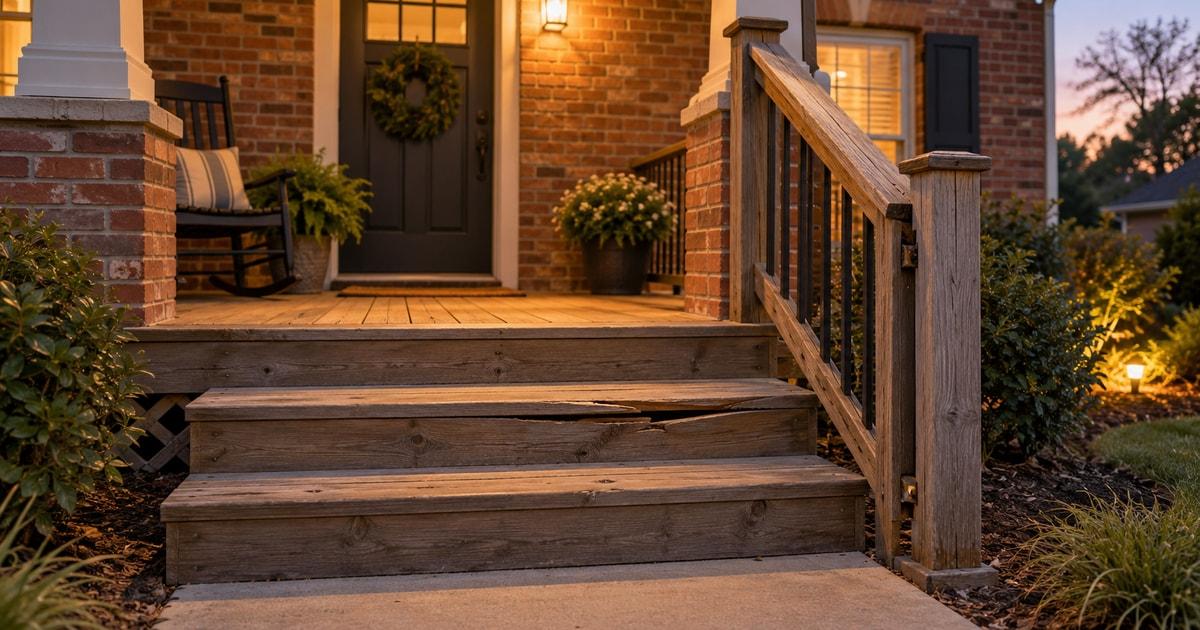
The same duty framework applies across the hazards that actually put guests in the emergency room. Stairs, decks, porches, and balconies produce the classic hidden-danger cases — rot, missing fasteners, and failed railings are often known to the owner and invisible to the guest. Dog bites are their own category: Oklahoma has a specific statute for dog-bite liability, covered in our dog bite liability guide. Backyard pools raise both supervision and premises questions, which we address in our guide to swimming pool and drowning accidents. Whatever the mechanism, the early evidence looks the same: photographs of the condition before it is repaired, the names of people who heard the homeowner mention the problem before the injury, and medical records that tie the injury to the event.
What If You Were Partly Careless?
Oklahoma applies comparative negligence, codified at 23 O.S. § 13: an injured person's own negligence does not bar recovery unless it is greater than the combined negligence of the defendants, and under 23 O.S. § 14 any recovery is "diminished in proportion to" the injured person's own negligence. A guest who had been drinking, was looking at a phone on the stairs, or ignored a warning will hear about it in negotiations. That is an argument to be answered with facts, not a reason to abandon a claim — the framework is explained in our guide to comparative negligence in Oklahoma.
What About Someone Who Wasn't Invited?
The classification system has a floor, and the Legislature wrote it down. Under 76 O.S. § 80, enacted in 2011, a possessor of land generally "has no duty to make its premises safe for a trespasser," with two main exceptions: an owner who knows or reasonably should know a trespasser is present may not injure that person through a wanton or intentional act, and a child trespasser injured by a highly dangerous artificial condition may have a claim if the statute's specific elements are met — including proof that the owner knew or had reason to know children were likely to trespass and that the condition was unusually attractive to children. The statute sets age-based presumptions about a child's capacity to appreciate danger. For the ordinary adult guest, none of this applies; an invited visitor is not a trespasser.
The Deadline
Oklahoma's statute of limitations for injury claims not arising on contract is two years under 12 O.S. § 95(A)(3). Insurance negotiations do not pause that clock. How the limitations rules work across different claim types — and the exceptions that can apply — are covered in our statutes of limitations guide.
Frequently Asked Questions
Will my friend have to pay me out of their own pocket?
Usually not, if the homeowner carries a homeowners policy that covers what happened. Personal liability coverage responds to the homeowner's legal responsibility for injuries to others on the property, up to the policy's limit, and many policies also include medical payments coverage for guests' medical bills. Whether the insurer defends the claim and what it pays depend on the policy's terms, exclusions, and limits. The homeowner's personal exposure generally becomes a live issue when there is no policy, when the policy excludes the claim, or when the injury's value exceeds the available coverage, which are questions an attorney evaluates early.
What do I have to prove to hold a homeowner responsible in Oklahoma?
For a social guest, the core questions are what the homeowner knew and what you could reasonably have seen. Oklahoma law requires an owner to use care to keep the premises reasonably safe from hidden dangers, traps, and snares — the duty the Oklahoma Supreme Court enforced in Brown v. Nicholson — but it does not make a homeowner the insurer of a guest's safety, and it generally does not require warnings about open and obvious conditions. Evidence that the owner knew about the hazard before you were hurt is often the center of the case.
What if the hazard seems obvious in hindsight?
Expect the insurer to argue it was open and obvious, because that defense defeated the claim in Pickens v. Tulsa Metropolitan Ministry. But the question is judged by the actual circumstances — lighting, appearance, and what a reasonable person in your position would have perceived — and Brown v. Nicholson holds that a deceptively innocent-looking defect can put the question to a jury. Photographs taken before the condition is repaired matter enormously.
How long do I have to bring a claim?
Two years from the injury for most Oklahoma personal-injury claims, under 12 O.S. § 95(A)(3). Exceptions exist in both directions, and claims involving minors or government property follow different rules, so treat two years as the general rule, not a guarantee, and get specific advice early rather than late.
Talk to an Oklahoma Premises Liability Lawyer
Being hurt at a friend's home puts an injury and a relationship in the same case, and when the homeowner's policy covers the injury, the claim is a claim on that coverage rather than on the friendship. Relevant questions include what the homeowner knew, what you could reasonably have seen, and what the policy covers. Read more about premises liability. This article is general information, not legal advice, and does not create an attorney-client relationship.
Contact Addison Law Firm