
Key Takeaways
- Drivers Owe the Same Duty of Care in Parking Lots: Oklahoma's general negligence principles and comparative fault rules apply in parking lots just as they do on public roads. Drivers owe each other a duty of reasonable care regardless of whether the accident occurs on a highway or in a commercial parking lot — and the comparative fault system under 23 O.S. § 13 determines how damages are divided.
- The Property Owner May Share Liability: If a confusing lot design, missing signage, poor lighting, or a known hazard contributed to the crash, the property owner or manager may be liable under Oklahoma premises liability law. This opens a second avenue of recovery beyond just the other driver.
- Evidence Disappears Fast: Parking lot surveillance footage is often recorded on a loop and may be overwritten quickly — sometimes within days. The steps you take immediately after the accident — photographing the scene, requesting footage, and documenting witness information — can make or break your claim.
It happens in an instant. You are backing out of a space at the grocery store and another car clips your bumper. Someone cuts through a row of parked cars and T-bones you at the end of an aisle. A driver barreling through the lot hits you while you are walking to your car with bags in your hands. These collisions rarely make the news — they happen at low speeds, they do not usually involve fatalities, and they are so common that most people treat them as minor inconveniences. But for the person dealing with vehicle damage, a neck injury that does not show up for days, or a pedestrian who was knocked to the ground, parking lot accidents raise legal questions that are surprisingly complex.
The core question — who is at fault? — seems like it should have a simple answer. But parking lots create a unique environment where the normal rules of the road collide with private property law, confusing layouts, and ambiguous right-of-way. Oklahoma's comparative fault system means that both drivers may share responsibility, and the percentage assigned to each party directly reduces what they can recover. Add in the possibility that the property owner itself may bear some liability for a dangerous condition, and what looked like a fender-bender becomes a multi-party dispute with real financial consequences.
Why Parking Lot Accidents Are So Common
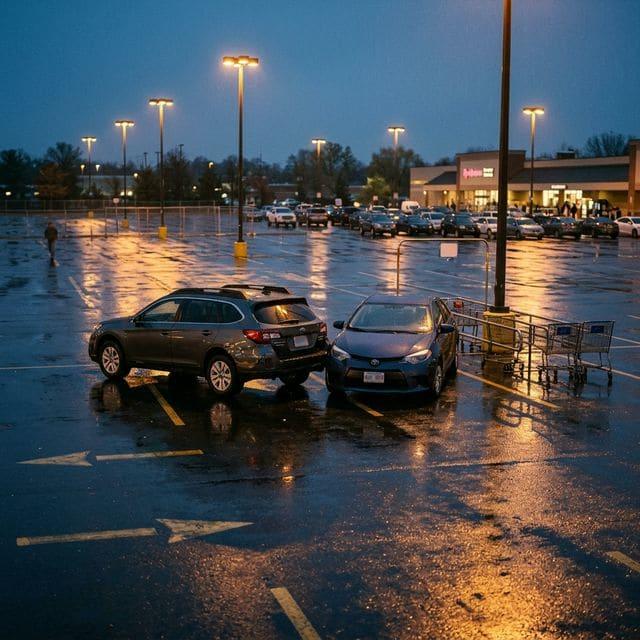
Parking lots are, by design, environments where vehicles and pedestrians mix at close quarters. Cars are backing up with limited visibility. Drivers are distracted — looking for spaces, checking their phones, managing children in the backseat. Pedestrians walk between cars with shopping carts, often not watching for traffic. Sight lines are obstructed by SUVs, trucks, and delivery vehicles. And unlike public roads, parking lots often lack the traffic control devices — signals, stop signs, lane markings — that impose order on vehicle movement.
The National Safety Council has warned that parking lots and parking structures produce tens of thousands of crashes nationally each year, with serious injuries and deaths. Oklahoma's vehicle-dependent population and abundance of large retail parking lots make these collisions a frequent reality across the state. The injuries may seem minor compared to a highway crash, but soft tissue injuries, concussions, and back injuries from low-speed parking lot collisions can produce long-lasting symptoms that require ongoing treatment and impose real costs.
How Fault Works in Oklahoma Parking Lots
Oklahoma is a comparative fault state under 23 O.S. § 13. This means that when multiple parties are at fault for an accident, each party's damages are reduced by their percentage of fault. Critically, under Oklahoma's modified comparative fault rule, a plaintiff who is 51 percent or more at fault cannot recover at all. This threshold makes fault allocation in parking lot cases a high-stakes determination.
The standard negligence framework applies: every driver owes a duty of reasonable care to other drivers and pedestrians. In a parking lot, that duty includes maintaining a safe speed, keeping a proper lookout, yielding to traffic in the main travel lanes, checking mirrors and blind spots before backing up, and obeying any posted signs or pavement markings. A driver who breaches that duty — by backing up without looking, cutting through empty spaces diagonally, or speeding down a lane — is negligent.
What makes parking lot accidents tricky is that both drivers may have done something that contributed to the collision. One driver is backing out of a space while the other is driving too fast through the aisle. One driver has the practical right-of-way in the travel lane but is distracted by a phone. These are the cases where comparative fault becomes decisive, and where insurance companies often fight hardest to shift blame onto the injured party. If the insurer can push a claimant's fault share to 51 percent, they owe nothing. That is why documenting the scene and understanding the rules is so important.
Right-of-Way Rules That Most Drivers Get Wrong
One of the biggest misconceptions about parking lot accidents is that no traffic laws apply because the lot is private property. This is not accurate. Oklahoma courts have consistently held that drivers owe each other the same duty of reasonable care on privately owned lots open to the public as they do on public roads. General negligence principles — not specific traffic statutes — govern the analysis, and the duty to drive safely, maintain a lookout, and yield when appropriate applies in every parking lot that is open to customers, visitors, and the general public.
While Oklahoma does not have a specific statutory framework for parking lot right-of-way, adjusters and attorneys apply practical fault principles based on general negligence standards. Pedestrians are generally given priority over vehicles, particularly near store entrances and in marked crosswalks. A driver backing out of a parking space is typically expected to yield to vehicles already moving through the aisle, because the backing driver is changing position and has a duty to ensure it is safe to do so. At unmarked intersections within a lot, the general negligence duty to keep a proper lookout governs — neither driver has an automatic statutory right-of-way, and fault depends on the specific circumstances of the collision.
These principles are not posted on a sign at the entrance to the lot, and most drivers have never consciously thought about them. But they are the principles that adjusters and attorneys apply when determining fault. A driver who pulls out of a parking space into the path of an oncoming vehicle traveling through the aisle bears a heavier share of fault, because the maneuvering driver has a duty to yield to through traffic. Conversely, a driver traveling through the aisle at excessive speed or while texting may bear comparative fault even when the other driver technically failed to yield.
When the Property Owner Is Liable
The other driver is not always the only liable party. Under Oklahoma premises liability law, property owners and property managers owe a duty to invitees — which includes customers and their guests — to maintain reasonably safe conditions and to warn of known hazards.
In the parking lot context, property owner liability can arise from several conditions. Poor lot design is one of the most common. Lots with confusing traffic flow — missing directional arrows, blind corners created by landscaping or structural pillars, intersections without stop signs, or lanes that are too narrow for two-way traffic — create conditions that foreseeably lead to collisions. When the owner controls the design and layout of the lot and fails to address a known hazard, the owner can be liable for accidents that result.
Inadequate lighting is another significant factor. Parking lot accidents that occur at night or in covered structures are more likely when the lighting is insufficient for drivers and pedestrians to see each other. Oklahoma courts have recognized that property owners have a duty to provide adequate lighting in areas where they invite public traffic. A burned-out light fixture or a dark section of the lot that the owner failed to maintain can be a contributing cause of the accident — and a basis for premises liability.
Failure to maintain the surface is relevant too. Potholes, uneven pavement, faded lane markings, and accumulated water or ice create hazards for both vehicles and pedestrians. If a driver swerves to avoid a pothole and strikes another car, or a pedestrian trips on broken pavement and is then struck by a vehicle, the property owner's failure to maintain the lot is part of the causal chain. Seasonal conditions matter in Oklahoma — water accumulation after spring storms, ice in winter, and heat-buckled asphalt in summer are all foreseeable conditions that property owners must address.
Missing or obscured signage is another basis for claims. Stop signs, speed limit signs, directional arrows, and pedestrian crossing markings are the lot owner's responsibility to install and maintain. When their absence contributes to an accident, the property owner's negligence is a factor in the fault analysis.
Pedestrian Injuries in Parking Lots
Pedestrian accidents in parking lots deserve special attention because the injuries can be severe. Fault depends on the driver's lookout, vehicle movement, visibility, lot markings, and the pedestrian's own care. Oklahoma drivers must exercise due care to avoid colliding with pedestrians, and parking lots create frequent pedestrian traffic and close visibility.
The most common scenario involves a driver backing out of a space who fails to see a pedestrian walking behind the vehicle. Backup cameras have reduced but not eliminated these accidents. Distracted drivers, obstructed mirrors, large vehicles with significant blind spots, and pedestrians who are themselves distracted — looking at a phone, managing children, loading groceries — all contribute. The backing driver's lookout often becomes central, though the pedestrian's own comparative negligence may reduce recovery if the evidence shows a lack of reasonable care.
Children are particularly vulnerable. They are smaller, harder to see, less predictable in their movements, and may dart out from between parked cars without warning. Oklahoma law imposes a reduced standard of care on children — they are held to the standard of care of a reasonable child of similar age, experience, and intelligence, not the standard of an adult. This means a child's comparative fault share is typically lower than what an adult would receive in the same circumstances, and a driver's duty to anticipate the presence of children in parking lots near stores, restaurants, and family-oriented businesses is correspondingly heightened.
Evidence Preservation Is Critical
Parking lot accident cases are won or lost on evidence, and the most important evidence has a very short shelf life. Surveillance footage from the property's cameras is the single most valuable piece of evidence in a parking lot accident — and many commercial systems record on a loop that overwrites older footage on a rolling basis. Retention periods vary by property and system, but footage can be lost within days if no steps are taken to preserve it.
Within the first 72 hours of the accident, you should take several critical steps. Request surveillance footage from the property owner or manager in writing — identifying the date, time, and location of the accident and specifically requesting that all footage from the relevant cameras be preserved. If the property owner refuses or fails to preserve the footage after your request, that failure may give rise to a spoliation inference — an evidence rule that allows the jury to assume the destroyed footage would have been unfavorable to the party who failed to preserve it. An attorney can send a formal preservation demand letter that creates legal consequences for destruction of evidence.
Photograph the scene thoroughly. Capture the positions of the vehicles, the damage to each vehicle, skid marks or debris on the pavement, the condition of the lot surface, any relevant signage (or its absence), sight-line obstructions, and the lighting conditions. Take wide-angle shots to establish context and close-up shots to document detail. Photograph any contributing conditions — a pothole, a blind corner, a burned-out light. If you have injuries, photograph those as well.
Get witness contact information. Parking lot accidents often have witnesses — other shoppers, store employees, cart-return attendants. Their accounts of what happened can be decisive, especially when the two drivers give conflicting versions. Witnesses who leave the scene without being identified are almost impossible to locate later. Do not give a recorded statement to the other driver's insurer without consulting an attorney first — those statements are designed to establish admissions that reduce your recovery.
Insurance Complications in Parking Lot Cases
Parking lot accident insurance claims present several complications that highway accident claims typically do not. Because fault is often disputed and comparative fault percentages are hard to establish without clear evidence, insurers frequently deny claims or offer lowball settlements.
When the other driver is at fault but disputes it, you may need to file a claim through your own collision coverage and pursue the other driver's insurer separately. If the other driver leaves the scene — a hit-and-run — your uninsured motorist coverage may apply. Oklahoma requires insurers to offer uninsured motorist coverage on auto policies unless it is rejected in writing under 36 O.S. § 3636, and that coverage can be crucial in parking lot hit-and-runs where the other driver is never identified.
If the property owner is a potentially liable party, the claim may involve both the other driver's auto insurance and the property owner's commercial general liability policy. These are separate claims with separate insurers, and each insurer will try to shift blame to the other party. Navigating this multi-party dynamic requires understanding how comparative fault allocations affect each insurer's exposure. An experienced personal injury attorney can manage these overlapping claims simultaneously and ensure that the total recovery reflects the full extent of your damages.
Delayed injury symptoms are particularly common in parking lot accidents because the speeds are low and the immediate impact seems minor. Drivers often decline medical attention at the scene, only to develop neck pain, headaches, back pain, or cognitive symptoms in the days that follow. These soft tissue and whiplash injuries are real, they require treatment, and they are compensable — but the gap between the accident and the first medical visit is something the insurer will use against you. Seek medical evaluation promptly, even if you feel fine at the scene.
Frequently Asked Questions
Do the same negligence rules apply in parking lots as on public roads?
Yes. While Oklahoma's Chapter 11 traffic statutes apply primarily to highways and public rights-of-way, the general duty of reasonable care applies wherever drivers operate vehicles — including commercial parking lots open to the public. Drivers owe each other the same duty of care in a parking lot as on a public road, and Oklahoma's comparative fault rules under 23 O.S. § 13 govern how damages are allocated when both parties share fault.
Who is at fault when two cars back into each other in a parking lot?
When two vehicles are backing out of opposite spaces and collide, fault is typically shared. Both drivers had a duty to check their surroundings before reversing, and both failed to see the other vehicle. In Oklahoma, comparative fault percentages would likely be split evenly or close to it, with each driver's recovery reduced by their share of fault. The specific facts — who started backing first, whose view was more obstructed, whether either driver was distracted — can shift the allocation.
Can I sue the property owner if a parking lot accident was caused by bad design?
Yes. If a confusing lot layout, missing signage, blind corners, inadequate lighting, or poor surface conditions contributed to the accident, the property owner may be liable under Oklahoma premises liability law. Property owners owe invitees a duty to maintain reasonably safe conditions. You would need to show that the condition was known or should have been known to the owner, that it created a foreseeable risk of harm, and that the owner failed to address it.
How long do I have to file a parking lot accident claim in Oklahoma?
The statute of limitations for personal injury claims in Oklahoma is two years from the date of the accident under 12 O.S. § 95. For property damage only claims, the limitations period is also two years. However, evidence — particularly surveillance footage — disappears within days, so acting quickly is essential even if the filing deadline is years away.
What if the other driver left the scene?
If the other driver fled without exchanging information, you may have a claim under your own uninsured motorist coverage. Oklahoma law requires insurers to offer uninsured motorist coverage unless it is rejected in writing. Filing a police report is important even for a parking lot hit-and-run, as some policies require a report as a condition of coverage. Surveillance footage and witness statements become even more critical in hit-and-run cases to establish what happened.
Should I call the police after a parking lot accident?
You should. Although police response to parking lot accidents varies — some departments will not dispatch officers for low-impact collisions on private property — having a police report creates an official record of the accident, the drivers involved, witness statements, and the officer's observations about conditions. If a report is not available, document everything yourself: take photographs, exchange insurance information, note the date and time, and get witness contact information.
What damages can I recover in a parking lot accident case?
You can recover the personal injury damages available under Oklahoma law, including medical expenses, lost wages and diminished earning capacity, vehicle repair or replacement costs, pain and suffering, and loss of enjoyment of life. For injuries occurring on or after September 1, 2025, Oklahoma's 23 O.S. § 61.3 can cap noneconomic damages unless an exception applies. If the at-fault party's conduct was particularly egregious — such as extreme speed, intoxication, or fleeing the scene — punitive damages may also be available. The value of your claim depends on the specific factors of your case, including the severity of your injuries and the strength of the evidence establishing fault.
Parking lot accidents happen every day in Oklahoma, and they are often more consequential than people expect. Whether you are dealing with a disputed-fault fender-bender, a pedestrian injury, or a hit-and-run in a commercial lot, the legal issues — comparative fault, premises liability, evidence preservation, and insurance coverage — require careful handling from the start. Addison Law Firm helps Oklahoma families navigate these claims and identify the insurance coverage available. Contact us for a free consultation.
Injured in a Parking Lot Accident?
Whether it is a fender-bender, a pedestrian injury, or a hit-and-run, parking lot accidents raise fault, liability, and evidence questions that need early attention.
Get a Free Case Evaluation →This article is for general information only and is not legal advice.