Key Takeaways
- The Stop-Arm Law Works in Both Directions: Under 47 O.S. § 11-705, a driver meeting or overtaking a school bus with its red loading signals on must stop before reaching the bus and stay stopped until the signals shut off. The main exception is a highway with "separate roadways" — and a painted center line or turn lane does not, by itself, qualify.
- School Zones Carry Their Own Rules: Speeding in a properly marked school zone doubles the fine under 47 O.S. § 11-806.1, and since November 1, 2025, 47 O.S. § 11-901e makes it unlawful to hold or use a hand-held phone while driving through one during the hours its posted reduced speed limit is in effect.
- A Violation Can Power a Civil Claim: These statutes exist to protect children near schools and buses. When a violation causes injury, Oklahoma's negligence per se doctrine — restated by the Oklahoma Supreme Court in Howard v. Zimmer, Inc., 2013 OK 17 — may let the statute itself supply the standard of care. The family still has to prove the violation caused the harm.
A driver who hits a child at a bus stop or in a school zone may have broken a specific Oklahoma traffic law written for that setting — the stop-arm law, the school-zone speed limit, or the new school-zone phone ban. Whether one of those rules applies depends on the facts, including the bus signals, the posted zone hours, the driver's speed, and any phone use. That matters for an injury claim, because Oklahoma law can treat the violation of a safety statute as negligence in itself, and because the evidence these laws generate — stop-arm camera video, citations, witness reports — often decides what the insurance company will and will not dispute. As Oklahoma students head back to class in August, this article walks through the three traffic laws that change the rules around schools and buses, and how each one shapes a civil case when a child is hurt.
This article is general legal information about Oklahoma law, not legal advice about any specific crash. How these rules apply depends on the facts — where the bus was, what the signs said, and what the driver did.
The Stop-Arm Law: 47 O.S. § 11-705
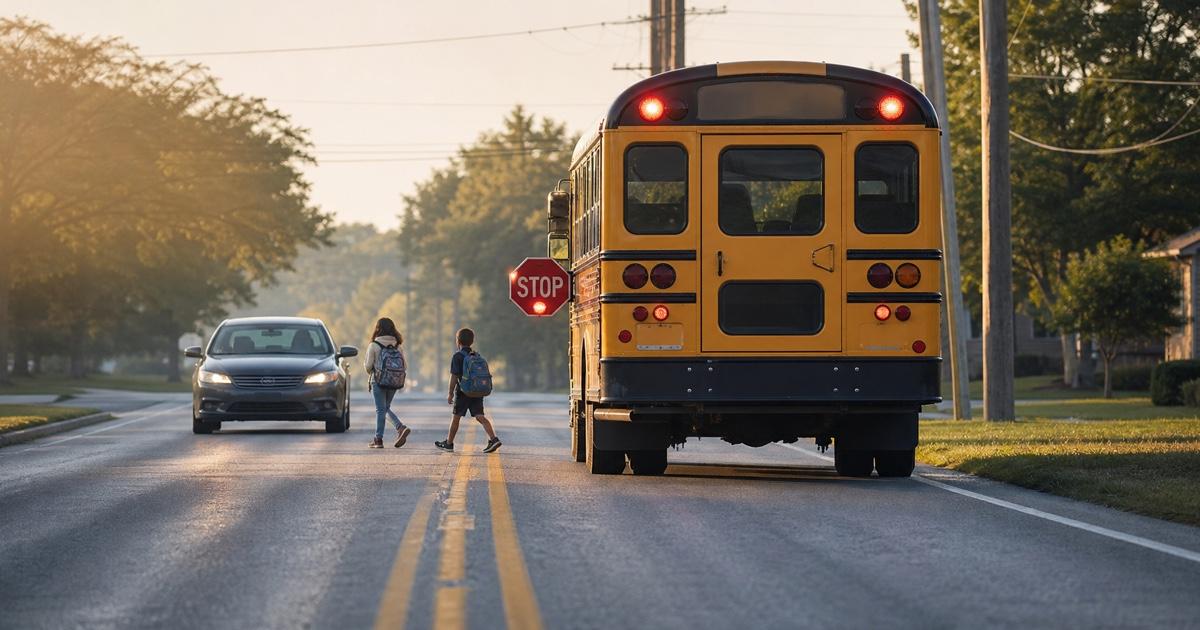
Oklahoma's school bus statute is blunt. Under 47 O.S. § 11-705(A), the driver of a vehicle meeting or overtaking a school bus that is stopped to take on or discharge children, with its red loading signals in operation, must stop before reaching the bus and may not proceed until the signals are deactivated — and even then must pass "at a speed which is reasonable and with due caution for the safety of such school children."
Two details in that sentence do real work:
"Meeting or overtaking" means both directions. Traffic behind the bus and traffic coming toward it must stop. Many drivers believe oncoming traffic is exempt on any road with a center line. That is wrong. The statute's main exception, in subsection (C), applies on a highway with separate roadways — or on a controlled-access highway where the bus is stopped in a loading zone and pedestrians are not permitted to cross. A painted median, a center turn lane, or an ordinary two-lane road does not by itself create separate roadways. Title 47 treats a highway as divided into separate roadways where an intervening space, a physical barrier, or a dividing section is "so constructed as to impede vehicular traffic" — and paint impedes nothing. When in doubt, the law expects drivers to stop.
The statute polices the moment children are crossing. The duty attaches exactly when a child is most exposed — walking to or from the bus door, often across a traffic lane. A driver who blows past a stop-arm is not merely committing a ticket-level offense (the statute sets a fine of not less than $100, plus a $100 special assessment). The driver is violating a rule that exists for one reason: children near a stopped bus are hard to see, unpredictable, and legally entitled to the road.
The statute also builds its own evidence system, which becomes important in a civil case. Under § 11-705(D), a bus driver who witnesses a stop-arm violation reports the vehicle to local law enforcement, which issues a warning letter to the registered owner. And under § 11-705(E), school districts may install video-monitoring systems on buses and stop-arms; the recording must capture the license plate, an identifiable image of the driver's face, the signal status, and the time, date, and location. If your child was hurt by a driver passing a stopped bus, that video system — where the district has one — may have recorded the crash itself. Asking the district and law enforcement to preserve it should happen immediately, for the reasons we explain in our guide to the first 72 hours after a car accident.
School Zones: Doubled Fines and a New Phone Ban
School zones carry two statutory rules of their own.
First, speed. Under 47 O.S. § 11-806.1, where a properly marked school zone has a posted reduced speed limit in effect, no one may drive faster than that limit — and a violation "shall result in the doubling of the appropriate fine." The Legislature does not double fines for ordinary speeding. It does for school zones, which tells you how it weighs the risk.
Second, phones. Effective November 1, 2025, 47 O.S. § 11-901e makes it unlawful to operate a moving vehicle while manually texting or simply holding or using a hand-held cell phone in a road construction zone, or in a properly marked school zone during the times its posted reduced speed limit is in effect. That last condition matters: the school-zone half of the ban tracks the school-zone speed limit rather than running around the clock. Hands-free and voice-operated use is excepted, as are genuine emergency calls. The fine is modest — not more than $100, with no license points — but for injury cases the statute's significance is not the fine. It is that Oklahoma now has an on-the-books rule that a driver holding a phone during an active school-zone period is doing something unlawful, in the very place where a child was hurt. Our article on distracted driving in Oklahoma covers how phone records and this new statute fit into proving what a driver was actually doing.
How a Traffic Violation Becomes a Civil Case
A ticket is not a verdict. But Oklahoma law gives statutory violations real weight in injury litigation through the doctrine of negligence per se, which can substitute the statute's command for the ordinary reasonable-person standard of care. In Howard v. Zimmer, Inc., 2013 OK 17, the Oklahoma Supreme Court — answering a certified question from the Tenth Circuit, in a decision favorable to the injured plaintiff — restated the elements: the injury must have been caused by the violation, the injury must be of the type the statute was intended to prevent, and the injured person must be a member of the class the statute was meant to protect. Oklahoma applies that framework to its own rules of the road. The Supreme Court has treated a violation of Title 47's railroad-crossing statute as negligence per se. Hamilton v. Allen, 1993 OK 46; Nye v. BNSF Railway Co., 2018 OK 51.
A child struck by a driver who passed a stopped school bus sits at the center of that framework. The stop-arm law exists to prevent precisely that injury, to precisely that class of person. The same logic reaches school-zone speeding and, potentially, the new phone ban — though whether any particular statute supports negligence per se in a particular case is a legal question the court decides, and negligence per se is not liability per se. No Oklahoma appellate court has yet applied the doctrine to the stop-arm statute itself, so this is the framework a court would work from, not a settled result. The family still must prove the violation actually caused the injury, and the defense will still be heard on causation and damages.
Two more Oklahoma doctrines matter in these cases:
Children are not judged as adults. When the defense argues that a child "darted out" or crossed carelessly, Oklahoma law does not measure that child against an adult standard of care. The Oklahoma Supreme Court has held that the care required of a child is judged by that child's maturity, capacity, intelligence, alertness, experience, and previous training, in light of the danger encountered. Bready v. Tipton, 1965 OK 158. Oklahoma also puts a driver's obligation toward children directly into the rules of the road: under 47 O.S. § 11-504, every driver must exercise due care to avoid colliding with a pedestrian and "shall exercise proper precaution upon observing any child" on a roadway. That does not create a separate, elevated duty for the jury to apply. Oklahoma instructs juries on ordinary care, with the presence and predictable behavior of children among the circumstances that define what ordinary care required. Thomas v. Gilliam, 1989 OK 59. How that interacts with Oklahoma comparative negligence rules is often the central fight in a child-pedestrian case — which is one reason these claims should not be evaluated by adjuster's instinct. Our overview of pedestrian accidents in Oklahoma explains the framework in more depth.
A child's settlement usually needs court approval. Resolving a minor's injury claim in Oklahoma ordinarily involves a court-approval process designed to protect the child, a subject we cover in our guide to minor settlements and court approval.
When the Bus or the School District Is the Defendant
Everything above assumes the at-fault party is a private driver. When the school bus itself caused the harm — a bus that struck a child, or a crash involving district transportation — the defendant is likely a public school district, and the case changes character entirely. Claims against Oklahoma school districts run through the Governmental Tort Claims Act, with a strict one-year written notice requirement, a second and far shorter set of deadlines once that notice is filed — the claim is deemed denied if the district does not approve it within ninety days, and suit generally must be filed within one hundred eighty days of denial — and immunity exemptions that can bar some claims outright. 51 O.S. § 157. The Oklahoma Supreme Court has held that an adjuster's request for more information and a claimant's unilateral request to negotiate did not extend those deadlines. I.T.K. v. Mounds Public Schools, 2019 OK 59. We walk through that framework, including the notice trap for families of injured children, in our article on children injured at school and the GTCA, and more generally in our guide to GTCA sovereign immunity. If a commercial truck or private vehicle hit a school bus, the private defendants are analyzed separately — our post on the Elgin school bus crash on I-44 walks through that mix.
And if the at-fault driver carried no insurance or too little, the family's own uninsured/underinsured motorist coverage may be the most important policy in the case — see our guide to Oklahoma UM/UIM coverage and rejection rules.
Frequently Asked Questions
Do drivers coming toward a school bus have to stop, or only the cars behind it?
Both. Section 11-705(A) applies to a driver "meeting or overtaking" a stopped school bus with its red loading signals on. The exception is narrow: on a highway with separate roadways, oncoming traffic on the other roadway need not stop. An ordinary two-lane road, a painted median, or a center turn lane does not by itself qualify as separate roadways — oncoming traffic must stop.
The driver who passed the bus only got a warning letter. Does that hurt my child's case?
No. The warning-letter procedure in § 11-705(D) is a screening mechanism for reported tag numbers, and the statute says the letter is not even recorded on the driver's record. A civil injury claim does not depend on whether the driver was convicted, ticketed, or warned. The civil case turns on what actually happened — which is why preserving stop-arm video, witness accounts, and the bus driver's report matters far more than the traffic outcome.
What if my child ran into the street without looking?
Expect the insurance company to raise it — and do not accept the framing at face value. Oklahoma evaluates a child's conduct by a child's standard, not an adult's, judged by that child's maturity, intelligence, alertness, experience, and training in light of the danger. A driver's obligation runs the other way at the same time: under 47 O.S. § 11-504, a driver must exercise proper precaution upon seeing a child on a roadway. Whether and how much any carelessness by the child reduces recovery is a comparative negligence question that depends heavily on age and facts. It is a question for a lawyer, not an adjuster.
Who pays when the school bus itself caused the crash?
If the bus was operated by a public school district, the claim runs through the Governmental Tort Claims Act — a written-notice regime with a one-year notice deadline, a ninety-day period in which the district's silence generally counts as a denial, a one-hundred-eighty-day deadline to file suit after denial, and its own damage caps and exemptions. An adjuster's request for more information or ongoing settlement discussions do not necessarily stop those clocks. If a genuine independent contractor operated the bus, the contractor may fall outside the GTCA because the Act generally excludes independent contractors from its definition of "employee." That can change the deadlines, defenses, and damages rules. Contractor status turns on the facts, not just the contract label, so families should preserve a timely GTCA notice to the district while counsel identifies every responsible entity.
The Season When This Law Matters Most
Every August, Oklahoma streets refill with buses, crosswalks, and children who are not thinking about traffic. The statutes above exist because drivers cannot be trusted to slow down on their own — and when a driver ignores them and a child is hurt, those same statutes become the backbone of the civil case. If your child was injured in a school zone, at a bus stop, or in a crash involving a school bus, our personal injury team can evaluate who is liable and which deadlines apply. Contact us for a free consultation. This article is general information, not legal advice, and does not create an attorney-client relationship.
A Child Hurt on the Way to School?
Bus and stop-arm video survives only as long as a district's retention policy says it does, witnesses scatter, and the GTCA clock does not wait for anyone — including children. If a driver, a bus, or a school district is responsible for your child's injuries, the evidence that proves it needs to be preserved now.
Talk to an Injury Lawyer