
Key Takeaways
- Distraction can trigger a multi-vehicle pileup: A driver glancing at a phone for five seconds at 55 miles per hour travels about the length of a football field without watching the road, enough to miss stopped traffic and start a chain-reaction crash.
- Oklahoma's comparative fault system can split liability among multiple drivers: In a multi-car pileup, fault is apportioned to each negligent party, and you can recover damages as long as your share of fault is not greater than 50%.
- Evidence disappears fast after a pileup: Dashcam footage, cell phone records, and electronic data from vehicles must be preserved quickly — once lost, the strongest proof of another driver's distraction may be gone permanently.
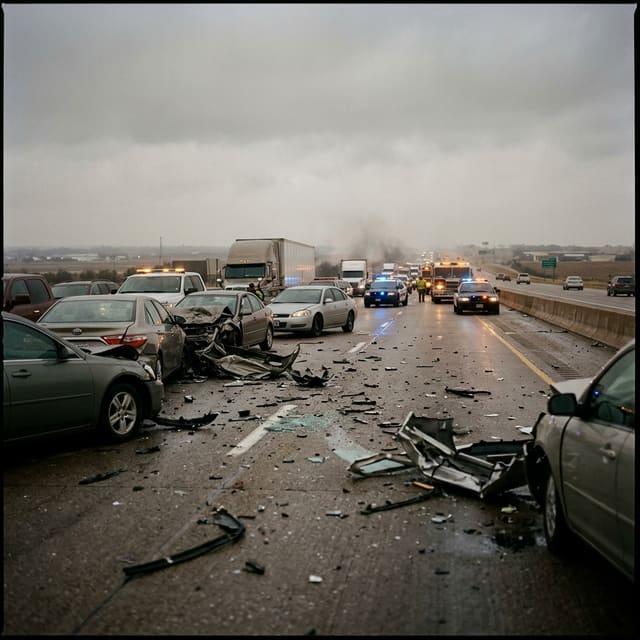
A five-second glance at a phone at 55 miles per hour covers about the length of a football field. On an Oklahoma interstate, that blind distance can be all it takes to miss the brake lights ahead, slam into slowing traffic, and set off the kind of chain-reaction pileup that sends vehicles to the shoulder and people to the hospital.
Multi-vehicle pileups are among the most destructive — and legally complicated — crashes on Oklahoma roads. When one distracted driver triggers a chain reaction, sorting out who caused what becomes an exercise in accident reconstruction, insurance battles, and overlapping negligence. Understanding how Oklahoma law handles these cases is the first step toward protecting your right to full compensation.
The Scope of the Problem in Oklahoma
Oklahoma's highway system — long stretches of I-35, I-40, I-44, and the Turner Turnpike — creates the conditions for catastrophic multi-vehicle crashes. High-speed traffic, sudden weather changes, and the ever-present glow of a cell phone in a driver's hand are a dangerous combination. The National Highway Traffic Safety Administration reports that distracted driving claimed 3,208 lives nationally in 2024 and injured more than 315,000 people. Those numbers may still undercount the problem because distraction can be hard to prove after a serious crash.
These aren't just fender-benders. Multi-vehicle pileups on Oklahoma interstates regularly involve semi-trucks, passenger vehicles, and motorcycles colliding at highway speeds. The injuries are severe: traumatic brain injuries, spinal cord damage, crush injuries, and burns from post-collision fires.
What Oklahoma Law Says About Distracted Driving
Oklahoma's primary distracted driving statute is 47 O.S. § 11-901d, officially titled "The Trooper Nicholas Dees and Trooper Keith Burch Act of 2015." The law makes it unlawful to operate a motor vehicle while using a hand-held electronic communication device to manually compose, send, or read a text message while the vehicle is in motion. The statute carries a maximum fine of $100. In a civil lawsuit, evidence that a driver was texting at the time of a crash is powerful proof of negligence.
For commercial motor vehicle operators and public transit drivers, 47 O.S. § 11-901c imposes stricter rules and a $500 fine for texting or using a hand-held mobile telephone while operating. Federal motor-carrier rules also prohibit texting and hand-held mobile phone use by drivers of commercial motor vehicles under 49 C.F.R. §§ 392.80 and 392.82. These rules are particularly relevant in pileup cases involving semi-trucks, where a distracted commercial driver can cause catastrophic damage.
Oklahoma also now restricts hand-held phone use in properly marked school zones and road construction zones under 47 O.S. § 11-901e. That rule matters in injury cases because a crash in a school zone or work zone may involve more than ordinary inattention; it may involve a specific safety rule written for the place where the crash happened.
It's also worth noting that Oklahoma's distracted driving statutes do not cover every form of distraction. Eating, adjusting a navigation system, disciplining children in the backseat, or rubbernecking at another crash can still support a negligence claim even when no specific phone statute was violated. The National Highway Traffic Safety Administration categorizes distraction into three types: visual (taking your eyes off the road), manual (taking your hands off the wheel), and cognitive (taking your mind off driving). Texting while driving is especially dangerous because it involves all three simultaneously, but any one type can be enough to trigger a pileup at the wrong moment.
How Fault Works in a Multi-Vehicle Pileup
Multi-vehicle pileups present unique liability challenges. When five, ten, or twenty vehicles are involved in a chain reaction, the question "who caused this?" rarely has a simple answer. Oklahoma's comparative negligence framework provides the legal machinery for sorting it out.
Under Oklahoma's modified comparative fault system, fault is apportioned among all negligent parties. If you were injured in a pileup, you can recover damages as long as your share of fault is not greater than 50%. Your recovery is reduced by your percentage of responsibility. Consider a typical pileup scenario: Driver A is texting and rear-ends Driver B at highway speed, bearing 55% of the total fault. Driver C was following too closely behind Driver A and couldn't stop in time, contributing 25%. Driver D failed to activate hazard lights after the initial impact, contributing to a secondary collision and bearing 20%. If you're Driver B — hit from behind by a texting driver — you bear no fault and can recover 100% of your damages. But if you're Driver D, your recovery is reduced by your 20% share of responsibility.
Oklahoma follows a several liability model, meaning each at-fault party is responsible only for their proportionate share of the damages. This matters in pileup cases because it means you may need to pursue claims against multiple drivers — and their respective insurance policies — to recover full compensation. If one at-fault driver carries minimum liability coverage and another carries substantial coverage, strategic decisions about which claims to pursue and how to allocate damages become critical. This is one reason pileup cases are rarely suitable for self-representation.
Evidence That Proves Distraction in a Pileup
Proving that a specific driver was distracted at the moment of impact requires concrete evidence, and the strongest proof must be preserved quickly before it disappears.
Cell phone records obtained through subpoena can reveal whether a driver was sending or receiving texts, using apps, or making calls at the time of the crash. Metadata timestamps often align precisely with the recorded time of impact. Most modern vehicles also contain event data recorders — essentially "black boxes" — that capture pre-crash data including speed, throttle position, braking inputs, and steering angle. An absence of braking before impact, combined with maintained highway speed, strongly suggests the driver wasn't watching the road. This is the same kind of electronic evidence that proves critical in trucking accident cases.
Dashcams in the injured party's vehicle or in other vehicles involved in the pileup can capture the at-fault driver's behavior in the seconds before impact. Nearby business surveillance cameras and highway traffic cameras may also provide crucial footage— but this evidence must be preserved immediately, as many systems overwrite footage within days. Witness testimony from other drivers and passengers who saw a driver looking down at their phone, weaving within their lane, or failing to react to slowing traffic can also provide powerful corroboration. In complex pileup cases, accident reconstruction experts analyze physical evidence — skid marks, impact patterns, crush damage, debris fields, and final vehicle positions — to determine the sequence of events and identify which driver's negligence initiated the chain reaction.
The urgency of evidence preservation cannot be overstated. Dashcam footage is overwritten. Cell phone data can be deleted. Vehicle black box data may be lost if the vehicle is repaired, scrapped, or towed. The failure to preserve relevant evidence can constitute spoliation, but prevention is far better than litigation over destroyed evidence. Sending a formal preservation letter to all parties and their insurers within hours of a crash protects your right to evidence that may be decisive.
What to Do After a Multi-Vehicle Pileup
If you're involved in a chain-reaction crash on an Oklahoma highway, the steps you take in the first 72 hours can determine the outcome of your claim. Get to safety and call 911 first — multi-vehicle pileups often involve secondary collisions as approaching vehicles encounter the crash scene. Seek medical attention immediately, even if you feel fine; injuries from pileups are frequently severe but may not be immediately apparent due to adrenaline, and delayed symptoms including signs of traumatic brain injury, internal bleeding, or spinal damage can emerge hours or days later.
Document everything you can: photograph vehicle positions, damage, road conditions, weather, traffic signals, and any visible phone use by other drivers. Collect contact information from as many witnesses as possible before they leave the scene — in a pileup, there are often many eyewitnesses. Do not give recorded statements to any of the insurance companies that will contact you quickly; they are designed to lock you into positions that reduce your claim. And contact a personal injury attorney as soon as possible — multi-vehicle pileup claims involving distracted driving are among the most complex cases an injury lawyer handles, requiring immediate preservation letters, multi-party investigations, and coordination across overlapping insurance claims.
Insurance Complications in Pileup Cases
Multi-vehicle crashes create a tangle of insurance issues that distinguish them from simple two-vehicle accidents. Each driver involved may carry different levels of liability coverage, and if the primary at-fault driver has only minimum coverage ($25,000 in Oklahoma), pursuing additional claims against other at-fault parties or tapping your own uninsured/underinsured motorist coverage may be necessary to recover full compensation.
Each insurance company will also attempt to shift blame to other drivers in the pileup. This mutual finger-pointing can delay resolution and reduce offers across the board, while your own carrier may assert subrogation rights, claiming a portion of any recovery you obtain from at-fault parties. If at-fault drivers are uninsured or underinsured, your own uninsured/underinsured motorist coverage becomes a critical safety net — and Oklahoma law allows UM/UIM stacking in certain circumstances, potentially multiplying your available coverage. The bottom line: multi-vehicle, multi-insurer claims require strategic coordination. Accepting a quick settlement from one insurer can compromise your ability to recover from others.
Frequently Asked Questions
Can I recover damages if I was partially at fault for a multi-vehicle pileup in Oklahoma?
Yes, as long as your share of fault is not greater than 50%. Under Oklahoma's modified comparative negligence system, your compensation is reduced by your percentage of fault. If you are found more than 50% at fault, you are barred from recovering any damages. In a pileup involving multiple at-fault drivers, each party's negligence is evaluated separately.
How do I prove the other driver was texting when they caused the crash?
Cell phone records obtained through subpoena can show whether a driver was sending or receiving texts, using apps, or browsing the internet at the time of impact. Event data recorders in the vehicle may confirm that no braking occurred before the collision. Witness testimony from other drivers or passengers, dashcam footage, and accident reconstruction analysis all contribute to building a distraction case.
Who pays for my injuries in a multi-vehicle pileup with multiple at-fault drivers?
Under Oklahoma's several liability rules, each at-fault driver is responsible for their proportionate share of your damages. You may need to pursue claims against multiple drivers and their insurance policies. If at-fault drivers carry insufficient coverage, your own UM/UIM policy can help fill the gap. An experienced attorney can coordinate these overlapping claims.
What is the statute of limitations for a distracted driving pileup claim in Oklahoma?
Oklahoma's statute of limitations for personal injury claims is two years from the date of the accident. However, critical evidence — cell phone records, dashcam footage, and vehicle data — can be lost well before that deadline. Beginning an investigation immediately protects your ability to prove fault.
Are commercial drivers subject to stricter distracted driving rules in Oklahoma?
Yes. Under 47 O.S. § 11-901c, commercial motor vehicle operators and public transit drivers face a $500 fine for texting or using a hand-held mobile telephone while operating. Federal motor-carrier regulations also prohibit texting and hand-held mobile phone use by drivers of commercial motor vehicles. Violations can support negligence claims and may affect the motor carrier's safety case.
Should I accept a quick settlement offer after a pileup crash?
Usually not without legal advice. Quick settlement offers from insurance companies are often made before injuries, fault allocation, and available coverage are fully understood. Accepting a settlement from one insurer can also affect your ability to recover from other at-fault parties. Consult an attorney before accepting any offer.
What if the at-fault driver has no insurance or minimal coverage?
If the distracted driver who caused the pileup carries only minimum liability coverage ($25,000 in Oklahoma) or no insurance at all, your own uninsured/underinsured motorist coverage is a critical backstop. Oklahoma law allows UM/UIM stacking in certain circumstances, potentially multiplying your available coverage. An attorney can evaluate all available insurance sources to maximize your recovery.
Hurt in a Multi-Vehicle Crash?
Chain-reaction pileups involve multiple at-fault drivers, overlapping insurance claims, and evidence that disappears fast. We move quickly to preserve the proof, identify each responsible party, and position the claim for full evaluation.
Free Consultation — No Fee Unless We Win →If you've been involved in a multi-vehicle pileup on an Oklahoma highway, an experienced personal injury attorney can help you navigate the complex liability and insurance issues.
This article is for general information only and is not legal advice.