
Key Takeaways
- Spring break can raise highway crash risk: Oklahoma's I-35 and I-40 corridors may see heavier travel during March and early April as students and families move through the region. More vehicles, fatigue, distraction, alcohol, weather, and unfamiliar roads can combine into serious wrecks.
- Out-of-state injuries create jurisdictional complexity: If an Oklahoma resident is injured in Texas during spring break travel, or a Texas resident is injured on I-35 in Oklahoma, forum and choice-of-law questions can affect the claim. Those questions should be evaluated early.
- The first 72 hours matter: Evidence on interstate highways disappears fast. Dashcam footage can be overwritten, skid marks fade, and witnesses continue driving. Early preservation often determines how strong the case can become.
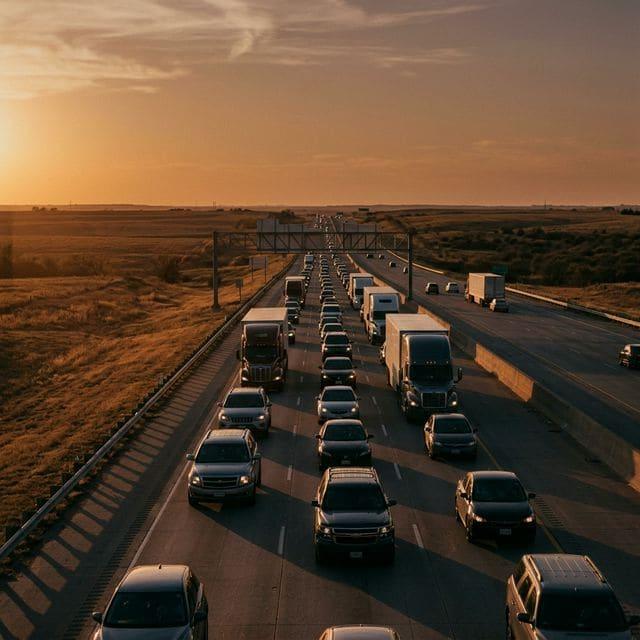
Every March, Oklahoma's interstate highways fill with travelers. College students from OU, OSU, UCO, and universities across the region head south on I-35 toward Dallas and the Texas coast. Families load up for trips to Branson, the Gulf, or the mountains. Spring breakers from Kansas, Missouri, and Nebraska pass through Oklahoma on I-44 and I-40 on their way to warmer destinations. The legal problem is not just traffic volume. It is traffic volume mixed with fatigue, distraction, alcohol, weather, construction, and drivers who do not know the road. If you or a family member is planning to travel, or has already been injured, early decisions about evidence and insurance can make a real difference.
Oklahoma's Interstate Danger Zones
I-35 and I-40 intersect in Oklahoma City, creating one of the busiest interchange systems in the region. During normal conditions, these corridors already carry heavy traffic. During spring break, the risk factors can stack up quickly.
I-35 runs 236 miles through Oklahoma from the Kansas border to Texas, passing through Oklahoma City, Norman, and the Arbuckle Mountains south of Davis. The stretch between Oklahoma City and the Red River is a primary route for spring break travel to Texas. Construction zones, lane reductions, curves, weather, and the transition from urban to rural driving can all matter. Speed limits increase to 75 mph south of the metro, and excess speed can make an avoidable mistake catastrophic.
I-40 spans the entire state east to west, connecting Amarillo to Memphis and passing through Oklahoma City, El Reno, Weatherford, and Henryetta. The western stretch between Oklahoma City and Amarillo is notorious for wind-related accidents, particularly involving high-profile vehicles and trucks. Spring weather in western Oklahoma is unpredictable — clear skies can give way to dust storms, crosswinds, and sudden severe weather that catches travelers off guard. The eastern stretch sees increased traffic from families heading toward the Ozarks, and the I-44 corridor through Tulsa carries travelers northeast toward Branson in southwest Missouri — one of the most popular spring break family destinations in the region.
The I-35/I-40 interchange in downtown Oklahoma City concentrates traffic from both corridors into a complex web of merging lanes, elevated ramps, and construction zones. During spring break travel peaks, this interchange becomes a bottleneck where slow-moving traffic and high-speed merging create rear-end collision chains and sideswipe accidents.
Why Spring Break Crashes Are So Dangerous
The factors that make spring break travel uniquely dangerous go beyond simple volume increases. Fatigue is the silent killer on these trips. Students leaving Norman or Stillwater after Friday classes routinely drive straight through to South Padre Island or Destin — eight to twelve hours behind the wheel, often at night, often after a week of midterms and sleep deprivation. The National Highway Traffic Safety Administration has reported that drowsy driving was a factor in over 91,000 police-reported crashes in a single year. Long interstate drives during spring break concentrate this risk on specific corridors at specific times.
Distracted driving compounds the problem. Passengers managing music, navigation apps, and social media in a car full of friends create an environment where the driver's attention is constantly divided. Oklahoma's texting-while-driving ban under 47 O.S. § 11-901d prohibits sending or reading text messages while driving, but enforcement on interstate highways is difficult and the law does not cover all forms of distraction.
Alcohol is a serious spring break risk. Travelers may drive home still impaired, hungover, or exhausted from several days of drinking. Oklahoma's dram shop liability law can extend liability to bars and restaurants in some over-service cases, and punitive damages may be available when the evidence shows reckless disregard by an impaired driver.
Unfamiliarity with the road adds another layer of risk. Out-of-state drivers passing through Oklahoma may not know about the Arbuckle Mountain curves on I-35, the crosswind zones on I-40 west of El Reno, or the construction zones that reshape lane configurations between visits. Local drivers who know these hazards instinctively take precautions; out-of-state travelers encounter them at highway speed with no warning beyond a road sign they may not process in time.
What Oklahoma Crash Data Shows
Oklahoma's crash statistics show why interstate evidence matters. According to the Oklahoma Highway Safety Office's federal fiscal year 2024 annual report, Oklahoma recorded 706 traffic fatalities in 2023, just below the 710 fatalities recorded in 2022. Statewide crash totals do not prove that any particular spring break wreck was foreseeable, but they confirm the stakes: high-speed Oklahoma crashes cause serious and fatal injuries every year, and the investigation has to be built from evidence, not assumptions.
The Oklahoma crash statistics reveal patterns that repeat year after year. Rear-end collisions occur in construction zones where traffic slows suddenly. Single-vehicle rollovers happen on rural stretches where drivers fall asleep or overcorrect after drifting onto the shoulder. Multi-vehicle pileups occur when weather changes rapidly and drivers fail to adjust speed. These are the patterns investigators should test against the facts of a spring break wreck.
Comparative Fault in Oklahoma
Oklahoma follows a modified comparative negligence system under 23 O.S. §§ 13–14. Section 13 bars recovery entirely if your fault exceeds that of the defendant, and Section 14 provides that any recovery is reduced in proportion to your degree of fault. The practical effect: if you're 51% or more at fault, you recover nothing — and every percentage point below that reduces your award dollar for dollar. This rule matters enormously in spring break crash cases because defense attorneys and insurance adjusters will aggressively argue contributory fault.
If you were speeding when a truck merged into your lane without signaling, they'll argue your speed contributed to the severity of the crash. If you were driving while fatigued and failed to brake in time for stopped traffic, they'll argue you should have pulled over to rest. If you were following too closely in heavy traffic, they'll attribute a percentage of fault to you even if the lead vehicle stopped without warning. Every percentage point of fault they can assign to you reduces your recovery dollar for dollar — and if they push it past 50%, you get nothing.
This is why evidence preservation in the first 72 hours after a crash is critical. Dashcam footage, highway camera recordings, GPS data, phone records proving you weren't texting, and witness statements all help establish that the other driver — not you — caused the crash. On an interstate where the physical evidence disappears under passing traffic within hours, the digital evidence and witness identification you preserve immediately after the crash may be all you have.
Out-of-State Injuries: Which Law Applies?
Spring break travel creates a jurisdictional puzzle that catches many victims off guard. If you're an Oklahoma resident injured on I-35 in Texas, your case will generally be governed by Texas law — including Texas's statute of limitations (two years for personal injury), Texas's comparative fault rules (which use a 51% bar similar to Oklahoma's), and Texas's damage caps for certain claims. You may be able to file in Oklahoma if the at-fault driver is an Oklahoma resident or if the vehicle was insured through an Oklahoma policy, but the substantive law that governs your claim often depends on where the crash occurred.
Conversely, if a Texas student driving north on I-35 crashes into your vehicle in Canadian County, Oklahoma law applies — including Oklahoma's statutes of limitations, Oklahoma's comparative fault rules, and Oklahoma's rules on uninsured and underinsured motorist coverage. The at-fault driver's Texas insurance policy will still be the primary source of recovery, but Oklahoma law governs how much you can recover and under what conditions.
These jurisdictional questions get even more complex in crashes involving commercial vehicles. A trucking company headquartered in Missouri, with a driver licensed in Arkansas, hauling a load from Texas through Oklahoma on I-40 when it jackknifes into your car near Henryetta — that scenario involves potential claims under federal motor carrier safety regulations, the laws of multiple states, and the chain of liability that connects the driver, the carrier, the broker, and potentially the shipper. An attorney experienced in trucking accident litigation can navigate these multi-jurisdictional claims; a general practitioner may miss critical theories of recovery.
What to Do After a Spring Break Highway Crash
The steps you take immediately after a crash on I-35 or I-40 determine whether your case can be successfully pursued. Call 911 and request that the Oklahoma Highway Patrol or local law enforcement respond. On interstate highways, OHP is typically the investigating agency, and their crash report will be a foundational document in your case. Do not leave the scene until law enforcement arrives unless your safety requires it.
Document everything you can. Photograph the vehicles from multiple angles, the road conditions, the weather, any skid marks or debris, road signs, and the positions of all vehicles before they're moved. Get the names, phone numbers, and insurance information of all drivers involved. If there are witnesses — including passengers in other vehicles who stopped — get their information before they leave. On a busy interstate, witnesses drive away and are never found again.
Seek medical attention immediately, even if you feel fine. Delayed injury symptoms are common after high-speed crashes — adrenaline masks pain, and injuries like traumatic brain injuries, internal bleeding, and spinal injuries may not present symptoms for hours or days. A medical evaluation within 24 hours of the crash creates a documented link between the accident and your injuries that becomes much harder to establish if you wait.
Be careful before giving a recorded statement to the other driver's insurance company. The adjuster who calls you within hours of the crash is protecting the claim file. Do not guess, minimize injuries, or speculate about fault before you understand what happened.
Notify your own insurance company as your policy requires, especially if uninsured or underinsured motorist coverage may apply. Avoid speculative statements about fault or the full extent of injuries. An attorney can also send prompt preservation letters to the other driver's insurance company, a trucking company if commercial vehicles were involved, and the Oklahoma Department of Transportation if road conditions or construction-zone evidence may matter.
Frequently Asked Questions
Are spring break crashes more severe than normal highway accidents?
They can be. The combination of interstate speeds, heavier traffic, fatigued drivers on long trips, alcohol impairment, weather, and commercial trucks can produce more serious injuries than a low-speed local collision. The severity depends on the facts: speed, impact angle, vehicle size, medical proof, and available insurance.
I was injured on spring break in Texas. Can I file my case in Oklahoma?
Potentially. If the at-fault driver is an Oklahoma resident, or if your uninsured/underinsured motorist policy was issued in Oklahoma, you may have options to file in Oklahoma courts. However, the substantive law governing your claim typically depends on where the crash occurred. An attorney experienced in multi-state personal injury cases can evaluate jurisdiction and determine the best forum for your claim.
The other driver was a student with minimal insurance. What are my options?
Your own uninsured/underinsured motorist (UM/UIM) policy covers the gap between what the at-fault driver's insurance pays and your actual damages. Under 36 O.S. § 3636, policies issued, renewed, or reinstated after November 1, 2014 are generally not stackable unless the policy expressly provides for stacking — so the availability of additional layers of UM/UIM coverage depends on the specific terms of your policy. If the student was driving a parent's vehicle, the parent's insurance policy may also provide coverage. An attorney can review your policies to identify all available sources of recovery.
How long do I have to file a car accident claim in Oklahoma?
Oklahoma's statute of limitations for personal injury claims is two years from the date of the accident under 12 O.S. § 95. However, if a government entity is involved — for example, if a road construction defect or highway design contributed to the crash — the Governmental Tort Claims Act requires a notice of claim within one year. Acting quickly is critical to preserving evidence on interstate highways, where physical evidence disappears rapidly.
What if a construction zone contributed to my crash?
If highway construction, lane closures, poor signage, or road defects contributed to your crash, you may have claims against the construction contractor, the Oklahoma Department of Transportation, or both. Government entities have sovereign immunity protections under the Governmental Tort Claims Act, and the GTCA's exceptions are narrow — discretionary decisions about highway design and planning are typically protected. However, claims based on negligent maintenance of existing roadways, failure to address known hazards, or construction zone safety failures can survive immunity defenses in certain circumstances. A notice of claim must be filed within one year.
Can I recover damages if I was partially at fault?
Yes, as long as your fault does not exceed 50%. Under Oklahoma's modified comparative negligence system, your recovery is reduced by your percentage of fault. If you were 20% at fault for following too closely and the other driver was 80% at fault for an unsafe lane change, your damages are reduced by 20%. But if a jury finds you 51% or more at fault, you recover nothing.
Should I accept the insurance company's first settlement offer?
Be cautious. Early offers after highway crashes are often made before you understand the full extent of your injuries, before treatment is complete, and before lost wages and future damages are calculated. Once you accept a settlement and sign a release, you generally cannot go back for more money, even if your injuries turn out to be worse than initially thought.
Spring break should be about rest, not recovery from a highway crash. But if you or a family member is injured on I-35, I-40, or any Oklahoma highway this spring, the decisions you make in the first days matter. Addison Law Firm handles car accident and trucking accident cases across Oklahoma and works with attorneys in neighboring states when multi-jurisdictional claims arise. Contact us for a free consultation.
Injured on a Spring Break Trip?
Highway crashes during spring break travel can involve higher speeds, complicated insurance questions, and time-sensitive evidence. Talk to a lawyer before key proof disappears.
Get a Free Case Evaluation →This article is for general information only and is not legal advice.