
Key Takeaways
- Testing is mandatory when the rule applies: Federal rules require commercial drivers to be drug- and alcohol-tested before hiring, at random, and after qualifying crashes (49 CFR Part 382).
- Crashes trigger their own testing rules: Under 49 CFR 382.303, a fatality requires a post-accident drug and alcohol test, and other serious crashes require one when the driver is cited — with tight testing cutoffs (alcohol within 8 hours, drugs within 32 hours).
- The Clearinghouse leaves a paper trail: Since January 6, 2020, carriers must query the federal Drug & Alcohol Clearinghouse before letting a driver work and at least once a year after (49 CFR 382.701).
- A carrier can be directly liable: In Fox v. Mize (2018), the Oklahoma Supreme Court held that a company admitting its driver was on the job does not, by itself, bar a negligent-entrustment claim against the company.
In the hours after a serious truck crash, one question can quietly decide the strength of an entire case: was the driver tested for drugs and alcohol, and did the trucking company ever check whether this driver should have been behind the wheel at all? Federal law creates records for both questions — and when a carrier ignores those rules, the gap in its file can be as revealing as a failed test itself. If you were hurt or lost a family member in an Oklahoma truck wreck, understanding how driver testing works helps you see why moving quickly to preserve those records matters so much.
This guide explains the federal drug- and alcohol-testing rules that apply to commercial truck drivers, the special testing required after a crash, the Drug & Alcohol Clearinghouse, and how testing failures fit into an Oklahoma injury or wrongful-death case. It is general information, not legal advice about any specific crash.
Quick Answer: What the Rules Require
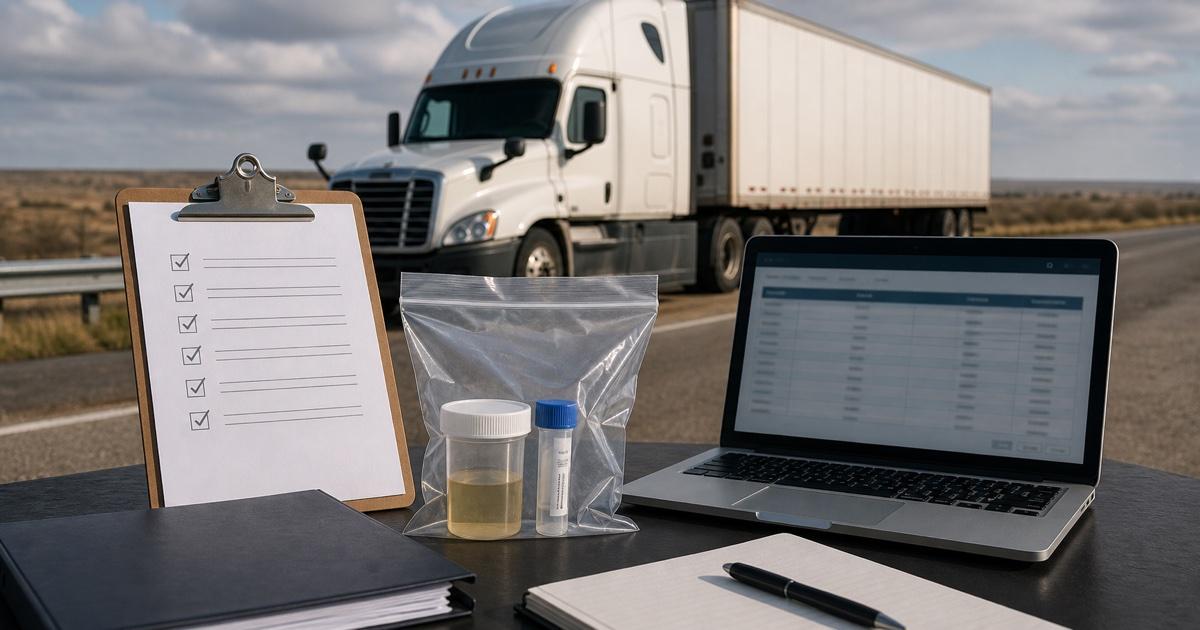
Commercial drivers who operate vehicles requiring a commercial driver's license are subject to a federal drug- and alcohol-testing program under 49 CFR Part 382. In broad terms, that program requires testing at several points: before a driver is hired for safety-sensitive work (pre-employment testing under 49 CFR 382.301), on a random basis throughout employment (49 CFR 382.305), when there is reasonable suspicion of use, after certain crashes, and before a driver returns to duty following a violation. These are not industry suggestions — they are federal regulations, and a carrier's compliance (or failure to comply) is documented in records the company is required to keep.
Post-Accident Testing: A Clock That Runs Fast
The crash itself can trigger a testing duty. Under 49 CFR 382.303, an employer must test a surviving driver for alcohol and for controlled substances "as soon as practicable" after a crash involving a commercial vehicle on a public road when either of two things is true: the crash involved a human fatality, or the driver received a citation for a moving violation arising from the crash and the crash involved bodily injury requiring immediate medical treatment away from the scene, or disabling damage requiring a vehicle to be towed away.
The timing rules are strict because alcohol and drugs leave the body. The regulation says that if an alcohol test is not given within two hours, the employer must document why, and if it is not given within eight hours, the employer must stop trying and keep a record explaining the delay. For controlled-substances testing, the cutoff is 32 hours. A test that a trucking company should have arranged but did not — or arranged too late — is itself a documented fact that can matter later.
Note that under the regulation, results of a breath, blood, or urine test conducted by law enforcement with independent authority can satisfy the federal requirement if the employer obtains them. That is one reason the police investigation and any criminal charges connected to a crash can become important threads in a civil case.
The Drug & Alcohol Clearinghouse
The Federal Motor Carrier Safety Administration also runs a national database called the Drug & Alcohol Clearinghouse. Since carriers became required to use it on January 6, 2020, an employer generally must run a query of the Clearinghouse before allowing a driver to perform safety-sensitive functions, and at least once a year for current drivers, under 49 CFR 382.701. The database flags drivers who have a verified positive test, a refusal to test, or certain other violations.
The same regulation prohibits an employer from using a driver to perform safety-sensitive functions when a query shows an unresolved testing violation, unless the driver has completed the return-to-duty process. Employers must also keep records of each query for three years. Because the Clearinghouse generates dated, auditable records, the absence of a required query — or a query that turned up a problem the carrier ignored — can be a concrete, provable failure rather than a matter of opinion.
How Testing Failures Fit Into an Oklahoma Case
A truck crash case usually involves more than the driver. Oklahoma law has long recognized that a motor carrier can be liable not only for its driver's conduct (vicarious liability, or respondeat superior) but also for its own independent negligence — for example, entrusting a commercial vehicle to a driver it knew or should have known was unfit. Testing and Clearinghouse records go directly to what the company knew or should have known.
This distinction was the centerpiece of Fox v. Mize, 2018 OK 75. There, a motorcyclist was killed in a 2015 collision in Norman with a tractor-trailer whose driver, a blood test later showed, was under the influence of a prescription narcotic banned by the federal motor-carrier rules. The employer admitted the driver was acting within the course and scope of his employment and argued that admission should wipe out the family's separate negligent-entrustment claim against the company. On certiorari from a certified interlocutory order out of Cleveland County, the Oklahoma Supreme Court disagreed and affirmed the trial court's decision to let the negligent-entrustment claim proceed. The court held that negligent entrustment "is a separate and distinct theory of liability" from respondeat superior, and that an employer's stipulation that the crash occurred in the course and scope of employment "does not, as a matter of law, bar a negligent entrustment claim." The court also explained that its earlier decision in Jordan v. Cates, 1997 OK 9 — which had limited some direct claims after a course-and-scope admission — is, "for now," limited to its facts.
The practical lesson is that a carrier generally cannot make its own conduct disappear simply by admitting the driver was on the job. Whether the company tested, queried the Clearinghouse, and acted on what it found can remain a live question. Whether a particular regulatory violation supports a claim of negligence, negligence per se, or punitive damages depends on the specific facts and is a judgment for counsel and the court — this article does not resolve that for any case.
Evidence That Disappears Fast
Testing-related evidence is time-sensitive and largely controlled by the trucking company. Post-accident test results and the chain-of-custody paperwork, the driver's qualification and testing file, Clearinghouse query records, and the carrier's drug-and-alcohol policy all sit inside the company's systems and can be overwritten, archived, or lost on routine cycles. So can the truck's electronic data showing speed and braking, which we discuss in our piece on truck black box evidence.
Because of that, a prompt written preservation (spoliation) letter demanding that testing records, the Clearinghouse query history, and the driver qualification file be retained is one of the most important early steps. Our overviews of evidence that disappears fast after a truck crash, the trucking liability chain, and who can be sued after an Oklahoma truck wreck explain how these records connect to the larger case. Testing rules also overlap with a carrier's hiring duties, which we cover separately in negligent hiring of truck drivers in Oklahoma.
What Families and Injured People Should Do Now
Focus first on health and on protecting evidence. Get complete medical care and keep every record. Write down the trucking company's name and the truck and trailer numbers. Be cautious about giving a recorded statement to the trucking company's insurer before you understand your rights. And move quickly to involve counsel who can send a preservation demand, because testing files and Clearinghouse records may not stay easy to recover and the carrier has no obligation to volunteer them.
Timing also matters for filing. A wrongful-death claim from a fatal crash is governed by 12 O.S. § 1053, and many personal-injury claims must be brought within two years under 12 O.S. § 95(A)(3). Oklahoma also follows a modified comparative-negligence rule that can reduce or bar recovery depending on the share of fault assigned to each person, as we explain in Oklahoma's 51% bar. Deadlines and defenses vary with the facts and the parties, so confirm how they apply to your situation rather than assuming.
Frequently Asked Questions
When is a truck driver required to be drug tested after a crash?
Under 49 CFR 382.303, post-accident drug and alcohol testing is required when a commercial-vehicle crash on a public road involves a human fatality. It is also required when the driver is cited for a moving violation arising from the crash and the crash caused bodily injury needing immediate off-scene medical treatment, or disabling damage requiring a tow. The regulation sets tight testing cutoffs — alcohol testing within eight hours and controlled-substances testing within 32 hours.
What is the FMCSA Drug & Alcohol Clearinghouse?
It is a federal database of commercial-driver drug and alcohol program violations. Since January 6, 2020, employers generally must query it before putting a driver in a safety-sensitive role and at least once a year afterward, and they cannot use a driver with an unresolved violation. These query records are kept and can show whether a carrier checked a driver's history before a crash. See 49 CFR 382.701.
Does a positive drug test automatically mean the trucking company is liable?
No. A positive test or a missed test is evidence, not an automatic verdict. Liability depends on causation, the parties involved, and the specific facts, and the legal effect of a regulatory violation is something a court decides case by case. An attorney can evaluate how testing evidence fits a particular claim.
Can I sue the trucking company directly, or only the driver?
Oklahoma recognizes both vicarious liability for the driver's conduct and direct claims against the carrier for its own negligence. In Fox v. Mize (2018), the Oklahoma Supreme Court held that a company's admission that its driver was acting within the scope of employment does not, by itself, bar a negligent-entrustment claim against the company. Which claims fit your situation depends on the facts.
How long do I have to file a claim in Oklahoma?
Many personal-injury claims must be filed within two years under 12 O.S. § 95(A)(3), and wrongful-death claims are governed by 12 O.S. § 1053. Because deadlines can change depending on the parties and circumstances, confirm the specific deadline that applies to your case rather than relying on a general rule.
What records prove whether testing rules were followed?
Post-accident test results and chain-of-custody documents, the driver qualification and testing file, the carrier's Clearinghouse query history, and the company's written drug-and-alcohol policy are the core records. Because the trucking company controls them, a prompt preservation demand helps keep them from being lost.
At Addison Law, we handle Oklahoma trucking accident cases, including crashes on the I-35, I-40, and I-44 corridors where driver fitness and federal compliance are at issue. If you or your family was harmed in a truck crash, contact us to discuss your situation.
Hurt in an Oklahoma Truck Crash?
Drug-testing and Clearinghouse records are controlled by the trucking company and can disappear fast. Acting quickly to preserve them can shape the whole case.
Learn How We Can Help →This article is for general information only and is not legal advice.