
Key Takeaways
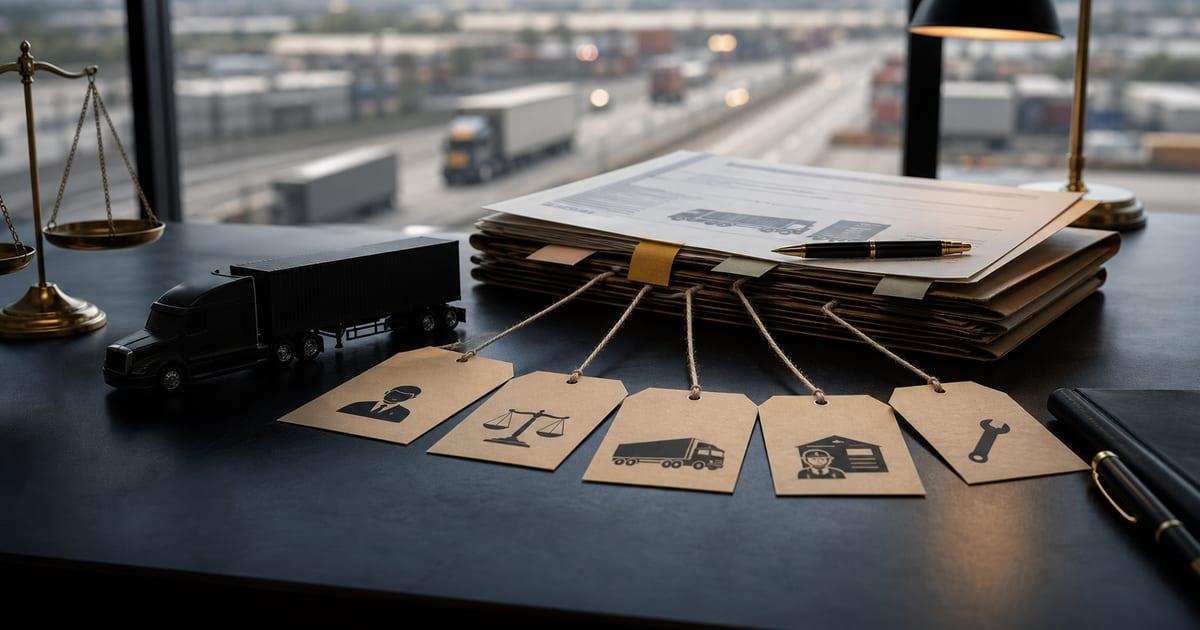
- The driver is only the beginning: A truck wreck can involve the motor carrier, broker, shipper, trailer owner, maintenance vendor, loading company, and separate insurance layers.
- Federal rules define duties: Driver qualification, hours of service, inspection, repair, maintenance, and insurance rules create a paper trail.
- Contracts matter: Bills of lading, broker-carrier agreements, dispatch messages, and lease documents often show who controlled the shipment.
When an 18-wheeler hits a family vehicle, the obvious question is whether the driver made a mistake. That question matters. But in a serious Oklahoma truck wreck, it is rarely the only question. Commercial freight moves through layers of contracts, companies, equipment, schedules, and insurance. A case that stops at the driver may miss the companies that put the risk on the road.
Our broader trucking accident liability guide explains the full chain. This article focuses on the practical defendant map: who may be sued, what proof connects each party to the crash, and why early investigation matters.
The Truck Driver
The driver may be liable for speeding, distraction, unsafe lane changes, following too closely, fatigue, impaired driving, failure to keep a proper lookout, or violations of hours-of-service rules. Driver conduct is usually the first layer of proof because it explains how the crash happened.
But driver-only cases can be incomplete. The driver may have been pressured by dispatch, sent out without proper rest, assigned unsafe equipment, or placed on a route that could not be completed safely. Driver conduct often points upward to corporate decisions.
The Motor Carrier
The motor carrier is usually central. The carrier may be responsible for the driver's negligence under the governing facts and law, and it may also be directly liable for its own choices: negligent hiring, inadequate training, poor supervision, unsafe dispatch, ignored log violations, or poor maintenance.
Federal Motor Carrier Safety Regulations impose duties throughout the operation. Driver qualification rules appear in 49 C.F.R. Part 391. Hours-of-service rules appear in 49 C.F.R. Part 395. Inspection, repair, and maintenance duties appear in 49 C.F.R. Part 396. A carrier that treats those rules as paperwork rather than safety rules can create direct liability.
The Broker
A freight broker arranges transportation. Broker liability is fact-sensitive and heavily litigated, but a broker may matter when it chose an unsafe carrier, ignored available safety information, controlled details of the shipment, or created delivery pressure that encouraged unsafe driving. Our Oklahoma trucking broker liability guide explains that issue in more detail.
The key documents are the broker-carrier agreement, rate confirmations, email or text instructions, load board records, safety checks, and communications about pickup and delivery. If the broker simply connected parties, the defense will say it had no operational control. If the broker dictated timing, routing, equipment, or carrier choice despite warning signs, the analysis changes.
The Shipper or Loader
The shipper may be responsible when cargo caused or contributed to the wreck. Overweight freight, shifted cargo, poor securement, missing placards, and dangerous loading practices can cause rollovers, jackknifes, brake problems, and loss of control.
Load documents matter: bills of lading, weight tickets, seal records, loading diagrams, photographs, and warehouse communications. If a truck left a warehouse overloaded or improperly secured, the case may include the shipper, loading contractor, or warehouse operator.
The Maintenance Vendor or Equipment Owner
Brakes, tires, lights, reflective tape, steering components, underride guards, and coupling systems can all become evidence. If a maintenance shop inspected the truck but missed a dangerous condition, or if a leasing company provided unsafe equipment, those parties may share fault.
Maintenance claims depend on work orders, inspection records, driver vehicle inspection reports, repair invoices, out-of-service history, and the physical condition of the tractor and trailer. That is why a preservation demand should cover the equipment itself, not just documents.
Venue and Local Investigation
The defendant map also depends on where the crash happened. A collision near Norman and Moore on I-35 may involve Cleveland County venue issues and local witnesses. A Tulsa-area wreck may involve the Broken Arrow Expressway, Creek Turnpike, or Tulsa County. Our pages for Norman car accidents, Moore car accidents, and Broken Arrow car accidents explain the local evidence context for those areas.
For statewide trucking analysis, the Oklahoma trucking accidents hub is the starting point.
How Discovery Reveals Hidden Parties
The first police report may list only the truck driver, tractor owner, and insurance information available at the scene. That is useful, but it rarely tells the whole story. The rest usually appears through document requests, subpoenas, preservation demands, and corporate testimony.
Bills of lading identify the freight and shipment path. Rate confirmations identify the broker and motor carrier terms. Lease documents may show whether the tractor or trailer was controlled by another company. Maintenance records may show a third-party shop. Dispatch records may show who controlled timing. Load photos, scale tickets, and seal records may identify warehouse or shipper conduct. Insurance filings may reveal policies that were not obvious from the crash exchange sheet.
This is why early letters should be broad enough to preserve contracts and communications, not just driver logs. A carrier that is willing to produce the police report and insurance card may still resist producing broker communications, safety audits, or maintenance records until litigation forces the issue.
Insurance Layers and Practical Recovery
Identifying defendants is partly about accountability and partly about practical recovery. A catastrophic injury or death can exceed a single policy. Federal financial-responsibility rules require many motor carriers to maintain minimum coverage, with requirements addressed in 49 C.F.R. Part 387, but minimum coverage may still be inadequate in a life-changing case.
Additional at-fault entities may have separate coverage: broker errors-and-omissions coverage, shipper liability coverage, trailer-owner coverage, maintenance-shop coverage, or umbrella policies. Those policies are not automatic. They must be identified and tied to actual fault.
The defense often tries to narrow the case to the driver. A careful plaintiff investigation asks a broader question: who created, controlled, ignored, or profited from the risk that caused this wreck?
Red Flags That More Parties May Be Involved
Some facts should immediately widen the investigation. A rollover after a curve may point to cargo shift, speed, tire failure, or route pressure. A rear-end crash in stopped traffic may point to fatigue, distraction, following distance, or disabled collision-warning systems. A brake-failure claim may point to inspection and maintenance records. A crash shortly after leaving a warehouse may point to loading, securement, and weight issues.
Ownership clues matter too. If the tractor, trailer, and cargo all display different names, the case probably involves multiple companies. If the driver is an owner-operator, the lease and operating authority become important. If the load moved through a broker, broker-carrier communications should be preserved. If the vehicle had recent repair work, the maintenance shop may need to be included in the evidence hold.
The earlier these red flags are identified, the easier it is to preserve the records before each company starts blaming the others.
Frequently Asked Questions
Can I sue the trucking company as well as the driver?
Often, yes. The carrier may be responsible for the driver's negligence and may also face direct claims for hiring, supervision, maintenance, dispatch, or regulatory violations.
Can a broker be liable for a truck crash?
Sometimes. Broker liability depends on carrier selection, safety checks, control over the shipment, communications, and applicable law. The broker documents should be preserved early.
Why sue more than one company?
Because multiple companies may have caused different parts of the risk, and each may have separate insurance. A full defendant map can be essential when injuries are catastrophic or a death occurred.
What records show who controlled the shipment?
Bills of lading, rate confirmations, broker-carrier agreements, dispatch messages, driver logs, lease documents, load board records, and insurance filings can all matter.
Does Oklahoma comparative fault apply to truck cases?
Yes. Oklahoma comparative fault rules under 23 O.S. §§ 13-14 can allocate fault among the injured person and all responsible defendants. Identifying every at-fault party can change the recovery picture.
Need the Full Trucking Defendant Map?
We trace the driver, carrier, broker, shipper, equipment, and maintenance records to identify every responsible party.
Map My Truck CaseLearn more about truck accident evidence preservation.
This article is for general information only and is not legal advice.