
Key Takeaways
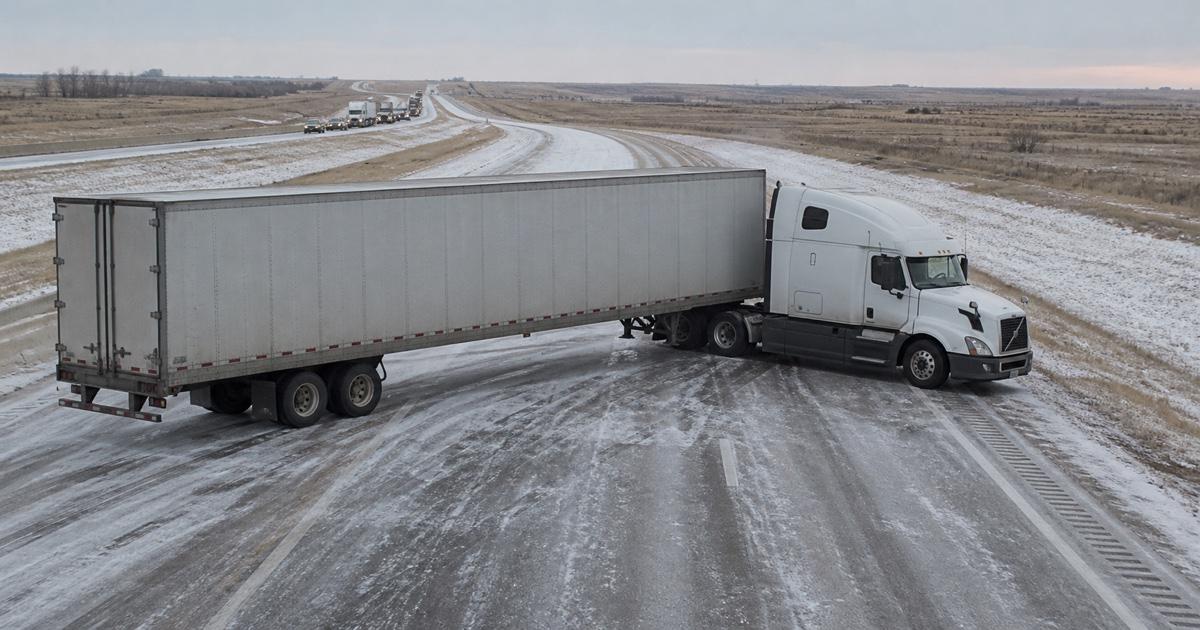
- Bad Weather Is Not a Free Pass: Under 49 C.F.R. § 392.14, a commercial driver must use "extreme caution" when snow, ice, sleet, fog, mist, rain, dust, or smoke affects visibility or traction, must reduce speed, and must stop driving entirely "if conditions become sufficiently dangerous." A trucker who jackknifed on an icy Oklahoma highway was governed by that rule the whole time.
- Jackknife Prevention Is Tested — and, Since 2022, Taught: Federal licensing rules treat skid recovery as core professional knowledge. 49 C.F.R. § 383.111(a)(15) puts skid causes and recovery procedures on the required-knowledge list. For drivers who earned a Class A CDL on or after February 7, 2022, the federal entry-level curriculum also requires instruction in avoiding and recovering from jackknifes. The public-road unit must be discussed, but it need not be performed, and trainees do not have to demonstrate proficiency.
- Oklahoma Fault Law Decides Who Pays: Oklahoma compares everyone's negligence. Under 23 O.S. § 13, an injured person can recover as long as their own share of fault is not greater than the combined fault of everyone who caused the wreck. Under 23 O.S. § 14, the recovery is then reduced by that person's percentage of fault.
When a semi jackknifes across an Oklahoma highway, fault usually comes down to how the truck was being driven in the seconds — and the miles — before the trailer swung out of line. A jackknife is a loss-of-control event: the trailer stops following the tractor and slides toward it, folding the rig like a pocketknife. Ice, rain, or fog may set the stage, but federal safety rules assume hazardous weather will happen and tell commercial drivers exactly what to do about it: slow down, use extreme caution, and get off the road if conditions become dangerous enough. That is why "the roads were bad" is the beginning of the fault analysis, not the end of it. This article explains the federal rules that govern a jackknifing tractor-trailer, how Oklahoma's comparative fault statute sorts out responsibility, and what evidence answers the question in a real case.
This article is general legal information, not legal advice about any specific crash. Fault in a jackknife wreck is fact-intensive, and the analysis below is the framework, not a prediction.
What a Jackknife Is — and Why It Matters Legally
A jackknife happens when the trailer's momentum overcomes the grip of its tires and it rotates around the coupling, sweeping across adjacent lanes until the rig folds. Our jackknife accident practice page covers the physics and the injury patterns in more depth. What matters for the legal analysis is the mechanism: a jackknife is the end result of a chain — speed, braking technique, following distance, load, equipment condition, and road surface — and nearly every link in that chain is regulated.
That regulatory chain is what separates a truck jackknife from an ordinary car skid. A passenger-car driver who slides on black ice is judged by the general standard of reasonable care. A commercial driver is judged against a written rulebook that anticipated the ice.
The "Ice Storm Defense" Meets 49 C.F.R. § 392.14
A familiar defense in a weather-related jackknife case is some version of: the driver did nothing wrong; the road was icy; it was an accident. Federal law has a direct answer. Under 49 C.F.R. § 392.14, "[e]xtreme caution in the operation of a commercial motor vehicle shall be exercised when hazardous conditions, such as those caused by snow, ice, sleet, fog, mist, rain, dust, or smoke, adversely affect visibility or traction." The rule then adds two commands: "Speed shall be reduced when such conditions exist," and "[i]f conditions become sufficiently dangerous, the operation of the commercial motor vehicle shall be discontinued and shall not be resumed until the commercial motor vehicle can be safely operated."
The regulation did not merely permit the driver to slow down; it required extreme caution the moment traction was affected, and it required the driver to stop driving entirely if conditions became sufficiently dangerous. The rule's only continuation proviso is passenger-specific: when compliance would increase the hazard to passengers, the vehicle may be operated only to the nearest point where passenger safety is assured. It is not a general exception whenever the driver believes stopping would endanger other road users.
Oklahoma law layers a parallel duty on top. Under 47 O.S. § 11-801(A), every driver must travel at a "careful and prudent speed" that accounts for "the traffic, surface, and width of the highway and any other conditions then existing," and no driver may go faster than allows a stop "within the assured clear distance ahead." Subsection (E) separately requires an "appropriate reduced speed" when a special hazard exists "by reason of weather, or other hazardous highway conditions." When a rig loses the trailer on a wet or icy road, the posted number on the sign does not answer whether the driver was going too fast. The statute asks what was careful and prudent for the surface, traffic, and weather that existed. A speed that is lawful in July can be a violation of § 11-801 in February.
The practical consequence: in a jackknife case, the weather is rarely the end of the discussion. It directs attention to what the driver did in response — speed reduction, following distance, braking, and the decision whether conditions required stopping altogether.
Jackknife Prevention Is Tested — and, Since 2022, Taught
Federal licensing rules treat jackknife avoidance as core professional knowledge. 49 C.F.R. § 383.111 lists required knowledge that maps directly onto a jackknife investigation: skid control and recovery, including "the causes and major types of skids" and "the procedures for recovering from skids" (subsection (a)(15)); speed management, including speed and stopping distance and speed and surface conditions (subsection (a)(9)); extreme driving conditions such as snow and ice (subsection (a)(12)); and the emergency use of vehicle safety systems in "skids and loss of brakes" (subsection (a)(3)(ii)). Drivers of combination vehicles — the tractor-trailers that jackknife — must also know the operating practices unique to those rigs (subsection (c)).
For entry-level drivers covered by the federal training rules — generally drivers first obtaining a Class A CDL on or after February 7, 2022 — that knowledge is also part of a mandated curriculum. 49 C.F.R. § 380.603 preserves an exemption for drivers who received the credential before that date. Appendix A to Part 380 includes "Skid Control/Recovery, Jackknifing, and Other Emergencies" in its theory unit (A1.3.2) and public-road unit (A3.12). But the rule is precise about the limit: A3.12 must be discussed during public-road training, need not be performed, and does not require the trainee to demonstrate proficiency.
In litigation, those provisions provide a regulatory yardstick. In Howard v. Zimmer, Inc., 2013 OK 17, ¶¶ 11, 13, 15, the Oklahoma Supreme Court held that federal regulations may support a negligence per se claim and described valid regulations as "highly material and relevant" to the applicable standard of care and its alleged breach. Whether a particular trucking regulation supplies negligence per se still depends on causation, whether the injury is the kind the rule was designed to prevent, and whether the injured person belongs to the class it protects. The regulations also open the training file as a line of investigation: what this driver was required to know, what training actually occurred, and what the carrier's written winter-driving policies said.
The Other Links in the Chain: Speed, Brakes, and the Load
Weather cases get the headlines, but jackknifes happen on dry pavement too, and the investigation looks at every input the driver and carrier controlled. Hard braking at highway speed — especially braking that locks or drags unevenly — is a classic trigger, which is why the condition and adjustment of the braking system matters; our article on brake failure and negligent maintenance explains how maintenance records are obtained and read. How the trailer was loaded matters as well, because cargo weight and distribution affect how the rig behaves under braking — the subject of specific federal securement rules discussed in our unsecured cargo article. Fatigue, distraction, and following too closely each show up in jackknife sequences, and each has its own regulatory framework covered elsewhere on this site, including hours-of-service violations and the CMV cell phone rules.
The point is not that every jackknife proves negligence. It is that a jackknife is rarely unexplained once the data comes out — and the data usually belongs to the trucking company.
How Oklahoma Comparative Fault Applies
Oklahoma is a comparative negligence state. Under 23 O.S. § 13, contributory negligence does not bar recovery unless the injured person's negligence is greater than the combined negligence of everyone who caused the harm. Under 23 O.S. § 14, the recovery is then diminished in proportion to that person's share. Our article on the Oklahoma 51 percent bar walks through how those percentages play out.
If a jackknifing trailer swept into your lane, the investigation focuses on the truck side of the equation — speed for conditions, braking, maintenance, training, and load. If instead you came upon a rig already blocking the roadway, visibility, time, roadway geometry, and warning devices become central. Our article on stopped trucks and warning devices covers that second fact pattern in detail. Neither scenario is automatic for either side; Oklahoma's statutes require the factfinder to assign percentages from the evidence.
A serious jackknife wreck can also put more than the driver on the hook. Depending on the facts, the carrier, the maintenance provider, or a shipper who loaded the trailer may share responsibility — the roster of potential defendants and the theories against each are covered in who can be sued after an Oklahoma truck wreck.
The Evidence That Answers the Fault Question
Because a jackknife leaves physical evidence, its cause can often be reconstructed — if the evidence survives. Depending on the tractor and the event, the engine control module may preserve speed, throttle, brake application, or other hard-stop data. Capture is not guaranteed; it depends on the module, its configuration, the event trigger, available power, and whether later operation overwrites the record. Our ECM black box guide explains those limits. Dashcam video, electronic logging device data, dispatch communications, maintenance records, weather records, and loading documents may fill other gaps. Federal retention periods vary, some are measured in months, and some electronic data may be overwritten or may never exist. That is why the first 72 hours after a semi-truck crash matter and why a preservation demand goes out promptly in a serious case.
Where the wreck happened matters too. Our truck crash corridor guide profiles the I-35, I-40, and I-44 routes that carry much of Oklahoma's commercial traffic. In winter weather, an investigation also has to account for bridges, overpasses, curves, grades, and other places where traction may change quickly.
Hurt in a Jackknife Truck Wreck?
The carrier's investigators are often working while the road is still closed. Logs and other company records may be kept for months, not years, while electronic data can disappear sooner. We move quickly to identify and preserve the available sources.
Talk to a Trucking Accident LawyerFrequently Asked Questions
Does a jackknife by itself prove the trucking company was negligent?
No. A jackknife establishes that the tractor and trailer lost alignment and control; it does not establish why. The injured person still has to prove negligence and causation with evidence such as speed, braking, road conditions, maintenance, load information, and the driver's choices before the wreck. There is no automatic presumption that the carrier was negligent merely because the rig folded.
The truck driver says the ice caused the jackknife. Does bad weather excuse the wreck?
Bad weather is the starting point of the analysis, not the end of it. 49 C.F.R. § 392.14 anticipates hazardous conditions and prescribes the response: extreme caution, reduced speed, and stopping entirely if conditions become sufficiently dangerous. Oklahoma law adds its own requirement of careful and prudent speed for the conditions then existing under 47 O.S. § 11-801. The legal question is not simply whether the road was icy; it is whether the driver's response complied with those duties. That question is answered with evidence, not with the weather report alone.
Nobody got a ticket at the scene. Does that hurt my case?
Not by itself. Troopers working a multi-vehicle wreck in an ice storm often cite no one, and a citation decision is not the civil fault determination. The civil case is built on the reconstruction — ECM data, physical evidence, witness accounts, weather records, and the carrier's own files — and it applies a different standard than a roadside citation decision: the comparative negligence framework of 23 O.S. § 13.
Was every commercial driver trained to recover from a jackknife?
Not necessarily. Federal licensing rules list skid causes and recovery procedures as required commercial-driver knowledge under 49 C.F.R. § 383.111. But the federal entry-level training requirements apply prospectively: under 49 C.F.R. § 380.603, drivers who received the relevant CDL before February 7, 2022, generally are exempt. Even for covered new Class A drivers, Appendix A requires the public-road jackknife unit to be discussed but not necessarily performed, and it requires no demonstration of proficiency. That makes the driver's actual training history a case-specific question.
Talk to an Oklahoma Truck Accident Lawyer
If a jackknifing tractor-trailer injured you or a family member anywhere in Oklahoma, the records that may explain why the trailer came around — speed, braking, training, maintenance, and loading — can begin disappearing quickly. Our Oklahoma jackknife accident lawyers handle these cases across the state, including crashes along the I-44 corridor. Contact us for a free consultation. This article is general information, not legal advice, and does not create an attorney-client relationship.