
Key Takeaways
- A Blowout Is Usually a Clue, Not Bad Luck: Federal law sets minimum tire standards for commercial trucks. Under 49 CFR 393.75, no truck may be operated on a tire that has tread or sidewall separation or exposed body-ply material, steering-axle tires must have at least 4/32 of an inch of tread, and other tires at least 2/32. A tread separation or blowout frequently traces back to a violation of one of these rules — not to an unavoidable accident.
- The Carrier's Paperwork Tells the Story: Federal rules require motor carriers to systematically inspect and maintain their trucks (49 CFR 396.3). Before driving, a driver must be satisfied that the vehicle is safe and review the prior inspection report when one is required (49 CFR 396.13). A written defect report is required when a safety defect is discovered or reported, but property-carrying drivers do not have to create a no-defect report. Maintenance files, defect reports, and repair records can show whether a tire failure was preventable.
- More Than One Party May Be Responsible: A blowout case can involve the motor carrier for poor maintenance and, in some cases, the tire or retread manufacturer under Oklahoma's manufacturers'-products-liability doctrine. Recovering against the tire maker depends on preserving the failed tire itself — the single most important piece of physical evidence.
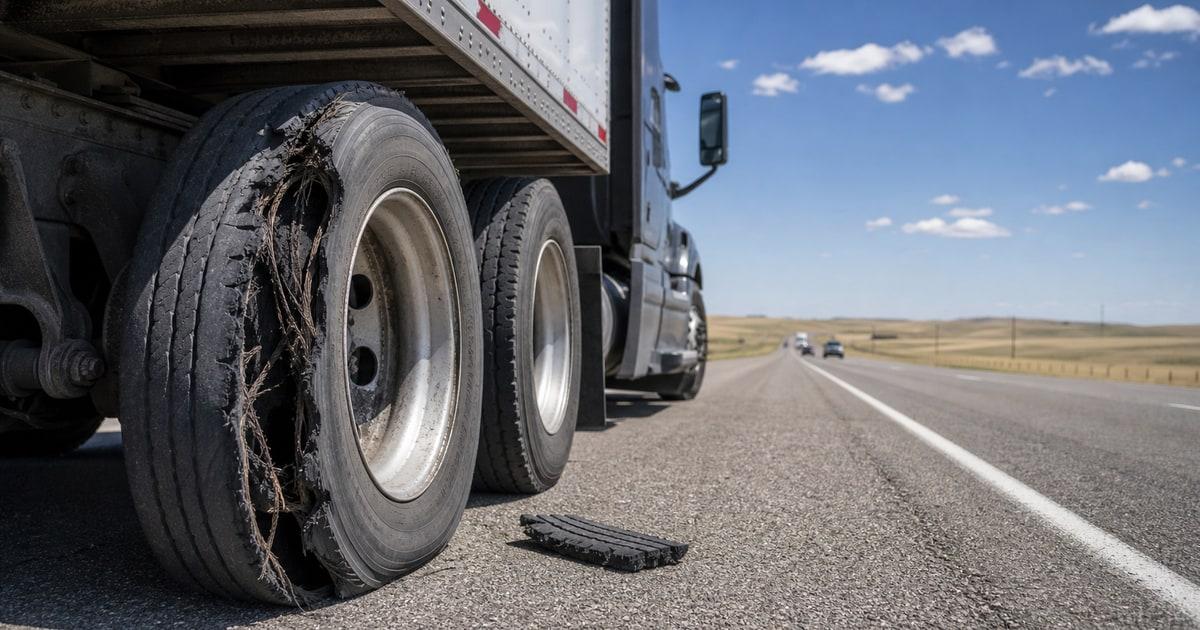
On a July afternoon in Oklahoma, the pavement on Interstate 40 can become punishingly hot. That heat is exactly what a worn or underinflated truck tire cannot handle: the casing overheats, the tread lets go, and a fully loaded tractor-trailer suddenly loses stability on one corner. The strip of rubber left in the road — what drivers call a "road gator" — may be the only visible trace of a failure that had been building for thousands of miles. When a commercial truck tire blows out and injures someone, the question is almost never simply "the tire failed." It is why the tire failed, who was supposed to catch the problem first, and who is now responsible.
Commercial-truck tire defects show up regularly in roadside enforcement. During the Commercial Vehicle Safety Alliance's 2025 International Roadcheck, inspectors recorded 2,899 tire-related out-of-service violations. Tires accounted for 21.4% of all vehicle out-of-service violations, second only to brakes, according to the alliance's 2025 inspection results. Those are inspection violations, not crash statistics, but they show how often tire conditions can be serious enough to take a commercial vehicle off the road. On Oklahoma's freight corridors — the I-35, I-40, and I-44 routes that carry heavy interstate traffic through the state — a blowout at highway speed can send a rig across lanes or into oncoming traffic. This post explains the rules that govern truck tires, how a blowout becomes a liability case, and what has to be preserved before the proof disappears.
A Blowout Is Usually a Clue, Not an Accident
Tires do not typically explode without a reason. The most common mechanical catalyst is underinflation: an underinflated tire flexes more, builds excess heat, and wears unevenly, and in hot weather that heat is what finally causes the tread to separate or the casing to fail. Age, prior road damage, overloading, and worn tread all compound the risk. None of that is a mystery to the trucking industry — it is the reason the federal government regulates commercial tires and requires carriers to inspect them.
That is what makes a truck tire case different from a simple "unavoidable accident" defense. When a passenger tire fails, there may be no maintenance program behind it. When a commercial tire fails, there is supposed to be a documented inspection and maintenance system — and the records either show the carrier was watching the tire or show that it was not.
The Federal Tire Standard: 49 CFR 393.75
The core federal rule for truck tires is 49 CFR 393.75. It prohibits operating a commercial motor vehicle on a tire that has any of the following conditions: body ply or belt material exposed through the tread or sidewall; any tread or sidewall separation; a flat tire or an audible air leak; or a cut deep enough to expose the ply or belt material. In plain terms, a tire that is coming apart is not supposed to be on the road at all.
The same regulation sets minimum tread depths. Tires on the front (steering) wheels of a truck or truck tractor must have a tread groove depth of at least 4/32 of an inch, measured on a major tread groove. Every other tire must have at least 2/32 of an inch. The steering-axle standard is higher because those tires control the truck's handling. The rule also restricts retreaded and regrooved tires: no bus may run recapped or retreaded tires on its front wheels, and a regrooved tire rated to carry 4,920 pounds or more may not be used on the front wheels of a truck or truck tractor. Section 393.75 additionally requires that tires not be operated below the cold inflation pressure specified for the load being carried.
A blowout case often starts by asking a simple question against this standard: what did the failed tire actually look like, and would it have passed 49 CFR 393.75 the morning of the crash?
Inspection and Maintenance: Where These Cases Are Won
A tire standard only matters if someone is checking. Two more federal rules put that duty on the carrier and the driver.
Under 49 CFR 396.3, every motor carrier must "systematically inspect, repair, and maintain" all of the vehicles under its control, and the parts and accessories — expressly including wheels and rims — must be "in safe and proper operating condition at all times." Carriers must keep maintenance records for each vehicle. Those records are frequently the heart of a tire case: they show whether the carrier had a real inspection program or was running tires until they failed. The same maintenance framework often matters in truck brake-failure cases.
On top of that, 49 CFR 396.11 requires a written driver-vehicle inspection report covering tires, wheels, and rims when a driver discovers or reports a safety defect. For property-carrying trucks, however, the rule does not require a no-defect report when the driver found nothing wrong. 49 CFR 396.13 separately requires a driver, before driving, to be satisfied that the truck is in safe operating condition and to review the prior inspection report when one is required. That distinction matters: the absence of a report does not prove that a clean inspection occurred. A driver who noticed a low or damaged tire and drove anyway, or a carrier that ignored repeated defect reports, is a very different case than a genuinely sudden failure.
Oklahoma Intrastate Carriers Are Covered, Too
Carriers sometimes argue that because a truck was operating only within Oklahoma, the federal rules do not apply. Oklahoma has adopted much of the federal safety framework for many intrastate commercial vehicles. OAC 165:30-3-34(g) incorporates the Oklahoma Department of Public Safety's motor-carrier rules, and OAC 595:35-1-5 applies federal Parts 390 through 397, with state amendments and exceptions, to covered intrastate carriers. That includes many commercial vehicles weighing more than 10,001 pounds. The carrier, vehicle, cargo, and any statutory exception still have to be checked in a specific case, but "we only drive in Oklahoma" is not, by itself, an escape from tire and inspection standards.
Negligence Per Se: Turning a Safety Rule Into a Claim
When a safety regulation is violated and the violation causes the kind of harm the rule was meant to prevent, Oklahoma law can treat the violation itself as negligence — "negligence per se." The Oklahoma Supreme Court set out the test in Hampton v. Hammons, 1987 OK 77, 743 P.2d 1053. The Court reversed in part after the trial court sustained a demurrer to the evidence and held that the negligence-per-se theory presented a jury question. Under that test, the plaintiff must show that the violation caused the injury, that the injury was of the type the law was intended to prevent, and that the injured person belongs to the class the law was designed to protect.
Applied to a tire blowout, the argument is straightforward in structure: the federal tire and inspection rules exist to prevent exactly the kind of loss-of-control crash a tread separation causes, and other people on the highway are exactly the class those rules protect. Whether the elements are met is a fact question for a specific case — but the framework is how a regulatory violation becomes something a jury can act on.
When the Tire Itself Was Defective: Product Liability
Sometimes the problem is not maintenance but the tire. A tire that was defectively manufactured, or a retread that was negligently produced, can support a claim against the manufacturer separate from any claim against the carrier. Oklahoma recognizes manufacturers' products liability — strict liability for a product sold in a defective condition unreasonably dangerous to the user — which the Oklahoma Supreme Court adopted in Kirkland v. General Motors Corp., 1974 OK 52, 521 P.2d 1353. That doctrine does not depend on proving the manufacturer was careless; it focuses on whether the product was defective and unreasonably dangerous. The Court in Kirkland also held that the limitation period for such a claim is two years.
A product claim lives or dies on the physical evidence. If the failed tire is thrown away, retreaded over, or lost in salvage, the ability to prove a manufacturing or retread defect can disappear with it.
Preserve the Evidence — Before It Is Gone
Truck tire cases are perishable in a way most people do not expect. The evidence that decides them starts vanishing within days:
- The failed tire and its casing. This is the most important item. The tire, the valve stem, and any recovered tread fragments should be located and preserved before the vehicle is repaired or the tire is discarded.
- The truck itself, before repair or salvage, so the wheel position, condition of the other tires, and inflation setup can be documented.
- The carrier's maintenance and tire-purchase records, driver-vehicle inspection reports, and annual inspection certificates.
- Electronic control module (ECM) data, which can show speed and braking around the failure — see our guide to what the truck's black box records.
The tool that keeps this evidence intact is a prompt preservation (spoliation) letter to the carrier and its insurer. Our overview of evidence spoliation in Oklahoma explains why that step cannot wait, and the first 72 hours after a semi-truck crash are usually when a tire case is won or lost.
Frequently Asked Questions
Isn't a tire blowout just an unavoidable accident?
Sometimes, but far less often than carriers suggest. Federal law requires commercial tires to be free of tread and sidewall separation, sets minimum tread depth, and requires carriers to inspect and maintain their vehicles. Drivers must be satisfied that the truck is safe before driving and must report safety defects they discover. When a tire fails, maintenance files, defect reports, purchase records, and the tire itself can show whether the failure was truly sudden or the predictable result of a tire that should have been replaced.
The truck was only operating inside Oklahoma. Do the federal rules still apply?
Generally, yes. The Oklahoma Corporation Commission's rules for intrastate carriers require compliance with the federal safety standards and require vehicles to be in safe operating condition. Purely local operation does not excuse a bald or separated tire. The exact provision that applies should be confirmed for the specific carrier.
Who can be held responsible for a truck tire blowout?
It depends on the facts. The motor carrier may be liable for failing to inspect or maintain the tire; a repair or tire shop may be liable for negligent service; and the tire or retread manufacturer may be liable if the tire was defective. Identifying every responsible party is part of why these cases require early investigation — see our guide to who can be sued after an Oklahoma truck wreck.
How long do I have to bring a claim?
Most Oklahoma personal-injury claims, including truck-crash and product claims, must generally be filed within two years under 12 O.S. § 95. But the evidence-preservation clock is far shorter than the legal one: the tire and the truck can be gone within weeks. Do not wait on the two-year deadline to protect the proof.
Talk to Someone Who Handles These Cases
A truck tire blowout looks like a random catastrophe, but the answer to why it happened is usually sitting in a maintenance file, an inspection report, and the failed tire itself. Those things only help if someone moves to preserve them before repairs and salvage erase the record. Learn more about our Oklahoma trucking-accident practice, or contact us for a free, confidential consultation. This article is general information, not legal advice, and does not create an attorney-client relationship.
A Tire-Failure Truck Crash Needs Fast Evidence Work
The failed tire, the maintenance records, and the truck itself can answer what went wrong — but only if they are preserved before they are repaired, retreaded, or scrapped.
Talk to a Truck Accident Lawyer