
Key Takeaways
- Two rulebooks apply: Oklahoma's load-securement statute, 47 O.S. § 14-105, and the federal cargo-securement standards in 49 CFR § 393.100 both require loads to be secured so nothing drops, spills, or falls onto the highway.
- The driver has a separate duty: Under 49 CFR § 392.9, a commercial driver may not operate unless cargo is properly distributed and secured, and must re-inspect the load at set intervals on longer trips.
- More than the driver may be responsible: A fallen-load crash can involve the driver, the motor carrier, and whoever loaded or packaged the freight — which is why preserving evidence early matters.
- Debris cases move fast: The truck, its load records, and any dash or roadside camera footage can disappear quickly. Identifying the truck and the carrier is often the first battle.
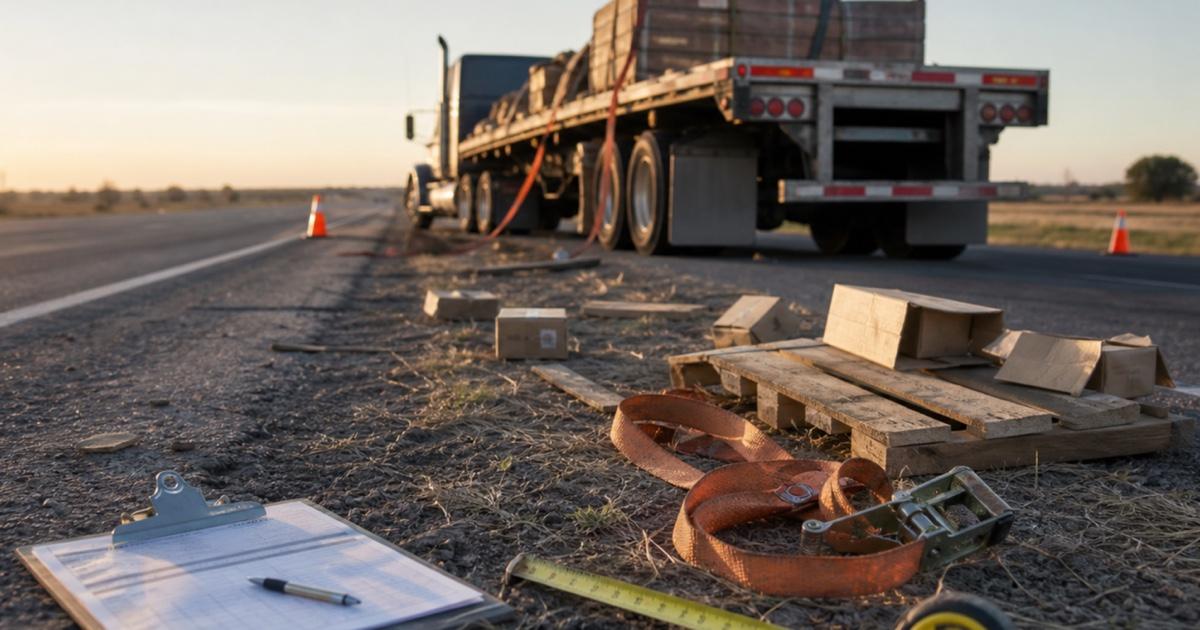
A ladder, a length of pipe, a mattress, a strap that lets go, a load that shifts and spills across two lanes of I-40 — debris that falls from a commercial truck turns an ordinary drive into a sudden emergency. Sometimes the object strikes a windshield directly. Sometimes a driver swerves to miss it and hits something else. Either way, the people hurt are left asking the same questions: whose load was that, and were they allowed to haul it that way? In Oklahoma, the answer starts with two sets of rules about how cargo has to be secured before a truck ever reaches the highway.
The state rule: Oklahoma requires loads that cannot escape
Oklahoma has a specific statute governing how anything hauled on a public road must be contained. Under 47 O.S. § 14-105, "No vehicle shall be driven or moved on any highway unless such vehicle is so constructed or loaded as to prevent any of its load from dropping, sifting, leaking, blowing or otherwise escaping therefrom," with narrow exceptions for sand dropped for traction and water or substances used to clean or maintain the roadway.
The statute goes further than just construction. Subsection B requires that the load "and any covering thereon is securely fastened so as to prevent said covering or load from becoming loose, detached or in any manner a hazard to other users of the highway," and it requires loose material such as sand or cinders to be covered. Subsection C carves out trucks loaded with livestock, poultry, hay, or agricultural products, but only if the truck is still "so constructed or loaded as to prevent" those items from escaping (47 O.S. § 14-105).
In plain terms, Oklahoma law puts the burden on the person hauling the load to make sure it stays on the truck. A mattress that blows off, a chain that drags, gravel that sprays a following car — each can implicate this statute.
The federal rule: cargo securement standards for commercial trucks
Most large trucks on Oklahoma's interstates are commercial motor vehicles operating in interstate commerce, which means they are also subject to the Federal Motor Carrier Safety Regulations. The federal cargo-securement standards sit in a subpart pointedly titled "Protection Against Shifting and Falling Cargo." Its general rule, 49 CFR § 393.100, says each commercial motor vehicle "must, when transporting cargo on public roads, be loaded and equipped, and the cargo secured ... to prevent the cargo from leaking, spilling, blowing or falling from the motor vehicle," and must be secured to prevent shifting that affects the vehicle's stability or maneuverability.
The driver carries an independent obligation. Under 49 CFR § 392.9, a driver may not operate, and a carrier may not permit a driver to operate, a commercial motor vehicle unless the cargo is "properly distributed and adequately secured" under the federal standards. That regulation also requires the driver of a truck or truck tractor to inspect the load within the first 50 miles, and to re-examine it whenever the driver's duty status changes or after the truck has been driven for three hours or 150 miles, whichever comes first (49 CFR § 392.9). A sealed trailer the driver was ordered not to open, or a load packed in a way that makes inspection impracticable, is treated differently.
These standards run alongside the state statute rather than replacing it. A single fallen-load crash on an Oklahoma highway can therefore raise both an Oklahoma securement question and a federal one.
Who oversees the trucks on Oklahoma's roads
Carriers that cross state lines answer to the federal rules directly. Carriers that operate entirely within Oklahoma are licensed and regulated by the Oklahoma Corporation Commission's Transportation Division, which requires intrastate for-hire carriers to follow safety regulations and to operate in a way that prevents "unsafe loading or overloading of vehicles on roadways." The precise way Oklahoma incorporates the federal cargo-securement standards for intrastate carriers is set by Corporation Commission rule, and the exact provision should be confirmed for any specific case before it is relied on in court.
When a fallen load becomes a liability case
A securement violation does not, by itself, decide a civil case. But it can be powerful evidence. When a load was not secured the way state and federal rules require and that failure caused a crash, the violation goes to the heart of whether the trucking operation acted reasonably. How an Oklahoma court allows a jury to use a statutory or regulatory violation — as negligence per se, as evidence of negligence, or otherwise — depends on the facts and the specific rule at issue, and is a question for counsel to evaluate in each case.
Fallen-cargo cases also tend to have more than one possible defendant. Responsibility can extend beyond the driver to the motor carrier that dispatched the trip and, in some situations, to a separate company that loaded or packaged the freight. Sorting out who controlled the load and who is answerable is its own analysis — one this firm walks through in detail in our look at who can be at fault in a trucking accident and who can be sued after an Oklahoma truck wreck. This is distinct from an overweight-truck problem; for that issue, see our discussion of overloaded trucks and cargo violations.
The "phantom" debris problem
Some of the hardest fallen-object cases involve debris from a truck that never stops — the load is gone and the truck is over the horizon before anyone gets a plate. When the at-fault vehicle cannot be identified, the injured driver's own uninsured/underinsured motorist coverage can become the focus, and Oklahoma has specific rules about how that coverage applies. We cover those mechanics separately in our guides to uninsured and underinsured motorist claims and what to do when you are hit by an uninsured driver. Whether and how uninsured motorist coverage responds to a no-contact debris event is fact-specific, so the details of the policy and the encounter matter. Police reports, witnesses, dashcam video, vehicle damage, and scene photos can all matter when the truck is never identified.
Evidence disappears quickly
Cargo cases reward speed. The truck can be repaired or returned to service, the remaining load can be re-secured and delivered, and bills of lading, securement logs, and any onboard or roadside video can be overwritten on a schedule. Identifying the carrier early and sending a preservation demand can keep that proof from being lost. Our overview of preserving evidence in trucking cases explains what to ask for and why timing is critical, and our guide to the first hours after a semi-truck crash in Oklahoma walks through the immediate steps.
Frequently asked questions
Is it illegal in Oklahoma for cargo to fall off a truck?
Oklahoma law requires that a vehicle be constructed or loaded to prevent its load from dropping, sifting, leaking, blowing, or escaping, and that the load and any covering be securely fastened so they do not become a hazard to other road users (47 O.S. § 14-105). Commercial trucks are also subject to federal cargo-securement standards (49 CFR § 393.100). Whether a particular incident violated those rules depends on the facts.
Who is responsible if debris from a truck hits my car?
Responsibility can fall on the driver, the motor carrier, or a company that loaded or packaged the freight, depending on who controlled how the load was secured. Federal rules place duties on both the carrier and the driver (49 CFR § 392.9). Identifying every responsible party is part of the investigation.
What if I swerved to avoid the debris instead of hitting it?
A crash caused by avoiding fallen cargo can still trace back to the securement failure. These "near-miss" collisions turn on proof connecting the debris and the truck to your crash, which is one reason preserving evidence and identifying the carrier early is important.
Does it matter that I never made contact with the truck?
It can matter a great deal, especially if the truck is never identified. In no-contact and "phantom vehicle" situations, your own uninsured/underinsured motorist coverage may come into play, and Oklahoma has specific rules about how that coverage works. The outcome depends on your policy and the facts of the encounter.
How quickly should I act after a fallen-cargo crash?
As soon as possible. The truck, the load, the paperwork, and any video evidence can change or disappear within days. Early identification of the carrier and a preservation demand help protect the proof a claim depends on.
Hit by Debris or a Fallen Load on an Oklahoma Highway?
Identifying the truck and the company behind the load is often the hardest part — and the clock is already running on the evidence. We can help you sort out who is responsible.
Talk to a Trucking Accident LawyerLearn more about Oklahoma trucking accident cases and how the chain of liability in a trucking crash is built.
This article is for general information only and is not legal advice.