
Key Takeaways
- Underride is uniquely lethal: When a car slides under a trailer, the trailer — not the car's crumple zones and airbags — strikes the passengers, often at head height.
- Federal rules govern rear guards: Most trailers built on or after January 26, 1998 must carry a rear impact guard under 49 CFR 393.86, and NHTSA strengthened the guard standard in a 2022 rule.
- Side underride is still largely unregulated: There is no federal requirement for side underride guards as of July 2026 — NHTSA remains in a prerule/comment-analysis posture, while a July 2026 notice addressed underride crash data rather than a guard mandate — which shapes how these cases are built.
- Liability can reach beyond the driver: The carrier, trailer owner, maintenance provider, or manufacturer may share fault depending on the guard's condition and design.
The crash looked survivable on paper — a rear-end collision at highway speed, the kind people walk away from every day. But this time the front of the car kept going, sliding under the back of a tractor-trailer until the trailer's steel frame met the windshield. That is underride, and it is one of the few crash types where modern safety engineering — crumple zones, airbags, seat belts — is bypassed entirely. If you lost someone this way, or survived a crash where your vehicle went beneath a truck, you are not imagining how different it felt. The physics really are different, and so is the legal case.
This guide explains what underride crashes are, the federal guard rules that are supposed to prevent them, why side underride remains a regulatory gap, and how fault is sorted out under Oklahoma law.
Quick Answer: What Makes Underride Different
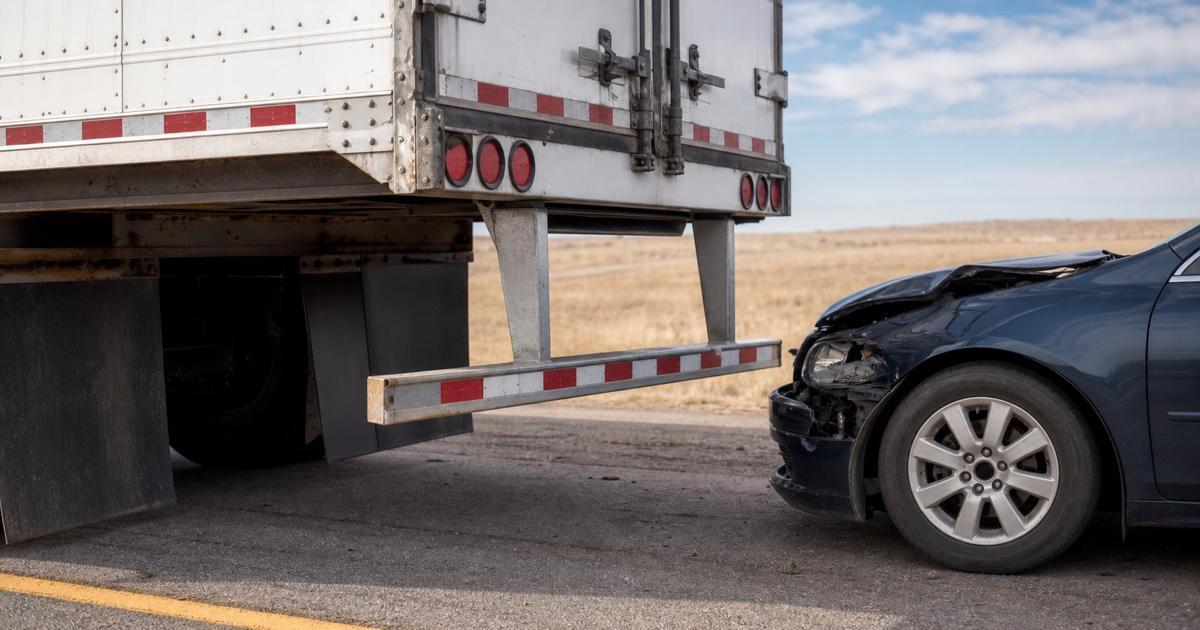
In a typical car-to-car crash, the vehicles' bumpers and crumple zones absorb energy at roughly the same height, and the occupant compartment stays intact. In an underride crash, the passenger vehicle is lower than the truck's body, so the car slides underneath instead of crashing into a structure designed to absorb the hit. The trailer's frame can intrude directly into the passenger compartment, frequently at the level of the occupants' heads and chests. That is why underride collisions produce catastrophic and fatal injuries even at speeds people associate with minor wrecks.
There are two main types. Rear underride happens when a car strikes the back of a trailer and slides beneath it. Side underride happens when a car strikes the side of a trailer — often a trailer crossing or turning across a roadway — and goes under the side, where there is usually no guard at all.
The Federal Rear Guard Rule
Rear impact guards — the horizontal steel bars hanging below the back of most trailers, sometimes called "ICC bumpers" or "Mansfield bars" — are federally required equipment. Under the Federal Motor Carrier Safety Regulations, 49 CFR 393.86, each trailer and semitrailer with a gross vehicle weight rating of 10,000 pounds or more and manufactured on or after January 26, 1998 must be equipped with a rear impact guard meeting Federal Motor Vehicle Safety Standard No. 223, and the vehicle must meet FMVSS No. 224 when the guard is installed. The regulation lists narrow exceptions — including pole trailers, pulpwood trailers, low-chassis vehicles, special-purpose vehicles, and wheels-back vehicles — so not every piece of equipment on the road is covered.
In 2022, the National Highway Traffic Safety Administration upgraded the underlying performance standards. The final rule published July 15, 2022 amended FMVSS Nos. 223 and 224 to require rear guards to withstand and absorb energy from a compact or subcompact passenger car striking the rear of a new trailer at about 35 mph (56 km/h), a step up from the prior, less stringent standard. NHTSA has described the change as one that most existing U.S. trailers already meet, and it has paired the rulemaking with broader federal actions on underride protection.
A guard only protects if it is present, properly rated, and maintained. Guards corrode, get bent in dock contact, or are removed and not replaced. When a covered trailer lacks a compliant guard, or the guard fails because it was damaged or poorly maintained, that condition can become central to a crash case.
The Side Underride Gap
Side underride is the harder problem. As of July 2026 there is no federal regulation requiring side underride guards on trailers and semitrailers. NHTSA's 2023 advance notice of proposed rulemaking said there were no federal requirements for side underride guards and requested comments on whether to require them. NHTSA's June 2024 report to Congress said the agency would defer deciding whether to develop performance requirements until after advisory-committee recommendations and comment analysis. The federal Unified Agenda entry for Spring 2025 still listed the item in the prerule stage, with comment analysis targeted for January 2026. A July 8, 2026 Federal Register notice discussed underride crash-data collection and reporting issues, but it did not create a federal side-guard mandate. Legislation to require side guards has been introduced in Congress but, as of this writing, has not become a federal requirement.
Because the rulemaking is active, any case-specific analysis should confirm the federal posture as of the date the claim is evaluated.
The practical consequence is that a side underride case usually cannot be built around a violated federal equipment mandate the way a rear-guard case sometimes can. Instead, it tends to turn on conventional negligence — how and where the truck was positioned, conspicuity (reflective tape and lighting that help a driver see a trailer blocking the road at night), speed, and the sequence of events — rather than on a missing guard the law required.
Who May Be Liable in an Oklahoma Underride Case
Underride cases often involve more than the truck driver. Depending on the facts, responsibility may be shared among several parties, and identifying all of them early matters because each may carry separate insurance. The motor carrier may be liable for its driver's conduct and for its own decisions about equipment, maintenance, and inspection. The company that owns or leases the trailer — frequently a different entity than the one operating the tractor — may be responsible for the guard's condition. A maintenance or repair provider may share fault if a guard was damaged and never fixed. And in some cases a trailer or guard manufacturer may face a product-liability claim if a guard failed to perform as a reasonably safe design should. Our overview of the trucking liability chain and who can be sued after an Oklahoma truck wreck explains how these layers fit together.
Because the at-fault truck may be only one defendant, an honest assessment of comparative fault matters from the start. Oklahoma follows a modified comparative negligence rule: under 23 O.S. §§ 13–14, an injured person who is found more than 50% at fault is barred from recovering, and a recovery is otherwise reduced by the percentage of fault assigned to them. Trucking defendants frequently argue the car was speeding or following too closely; in underride litigation, the response is often that a compliant, maintained guard is designed precisely to prevent catastrophic intrusion in exactly those rear-impact scenarios.
Evidence That Disappears Fast
Underride cases rise or fall on physical and electronic evidence, much of which is controlled by the trucking company and can be altered, repaired, or routinely overwritten within days. The trailer itself is evidence: the presence, height, rating, corrosion, and prior damage of the rear guard should be documented and preserved before the trailer is repaired or returned to service. The truck's electronic data — engine control module and telematics records that can show speed, braking, and movement — should be preserved early, as we explain in our piece on truck black box evidence. Maintenance and inspection files, driver logs, and dispatch records round out the picture.
Because so much of this evidence sits inside the carrier's control, a prompt written preservation (spoliation) letter demanding that the trailer, guard, and electronic data be retained is one of the most important early steps. See our guidance on evidence that disappears fast after a truck crash and the first 72 hours after an Oklahoma truck crash.
What Families and Survivors Should Do Now
If you are dealing with the aftermath of an underride crash, focus first on health and on protecting evidence. Get complete medical evaluation and keep records, even if injuries seemed to "settle" — head, neck, and internal injuries from this crash type are often severe. Photograph the vehicles and the scene if you safely can, and write down the trucking company and trailer information. Avoid giving a recorded statement to the trucking company's insurer before you understand your rights. And move quickly to involve counsel who can send a preservation demand, because the trailer and its data may not stay available for long.
Two Oklahoma deadlines bear on timing. A wrongful-death claim arising from a fatal crash is governed by 12 O.S. § 1053, and most personal-injury claims must be brought within two years under 12 O.S. § 95(A)(3). Specific deadlines can vary with the facts and the parties involved, so confirm how they apply to your situation rather than assuming.
Frequently Asked Questions
What is the difference between rear underride and side underride?
Rear underride happens when a vehicle strikes the back of a trailer and slides beneath it; rear impact guards are federally required on most trailers to limit this. Side underride happens when a vehicle goes under the side of a trailer — for example, a trailer crossing or turning across a road — where there is generally no guard, because side guards are not federally mandated as of June 2026.
Are underride guards required by law?
Rear impact guards are required on most trailers and semitrailers with a gross vehicle weight rating of 10,000 pounds or more that were manufactured on or after January 26, 1998, under 49 CFR 393.86. Side underride guards are not currently required by federal regulation.
Can I still recover if the car was partly at fault?
Possibly. Oklahoma uses a modified comparative negligence system under 23 O.S. §§ 13–14: you can recover if you are found 50% or less at fault, with your award reduced by your share of fault, but you are barred if you are found more than 50% at fault. How fault is apportioned is often heavily contested in underride cases.
Who can be sued after an underride crash?
Depending on the facts, potential defendants include the truck driver, the motor carrier, the company that owned or leased the trailer, a maintenance provider, and — in some cases — a trailer or guard manufacturer. Identifying every responsible party early helps reach all available insurance.
How long do I have to file a claim in Oklahoma?
Many personal-injury claims must be filed within two years under 12 O.S. § 95(A)(3), and wrongful-death claims are governed by 12 O.S. § 1053. Deadlines can shift depending on the parties and circumstances, so it is important to confirm the specific deadline that applies to your case rather than rely on a general rule.
Why does evidence preservation matter so much in these cases?
The trailer, its rear guard, and the truck's electronic data are often the most important evidence, and they are controlled by the trucking company. Trailers get repaired or returned to service and electronic records are overwritten on routine cycles, so a prompt preservation demand can be critical to keeping that evidence intact.
At Addison Law, we handle Oklahoma trucking accident cases, including truck underride accident claims involving tractor-trailers on the I-35, I-40, and I-44 corridors. If you or your family was harmed in an underride crash, contact us to discuss your situation.
Hurt in a Truck Underride Crash?
These cases turn on evidence the trucking company controls. Acting quickly to preserve the trailer and its data can make the difference.
Learn How We Can Help →This article is for general information only and is not legal advice.