
Key Takeaways
- Oversize Movement Is Tightly Regulated: Oklahoma caps ordinary vehicles at 102 inches wide and 13 1/2 to 14 feet tall under 47 O.S. § 14-103. Outside the chapter's express exemptions, movement beyond the ordinary limits generally requires a permit — and moving a load for which a permit is required without one is a misdemeanor under 47 O.S. § 14-116a.
- Wide Loads Generally Must Be Escorted: Under 47 O.S. § 14-120.1, a vehicle or load wider than 12 feet generally must be accompanied by the escort vehicle or vehicles prescribed by the Oklahoma Department of Transportation, and for-hire escort drivers must be ODOT-certified. The statute exempts qualifying retail implement dealers moving farm implements within 150 air miles of the retail distribution point.
- Violations Can Strengthen a Civil Claim: Oklahoma's negligence per se doctrine may let a safety rule supply the standard of care when the rule protects this person from this kind of harm and the violation caused the injury. In Howard v. Zimmer, Inc., 2013 OK 17, the Oklahoma Supreme Court confirmed that federal law did not bar such an Oklahoma claim based on a federal regulation — while cautioning that negligence per se is not liability per se. Causation still has to be proved.
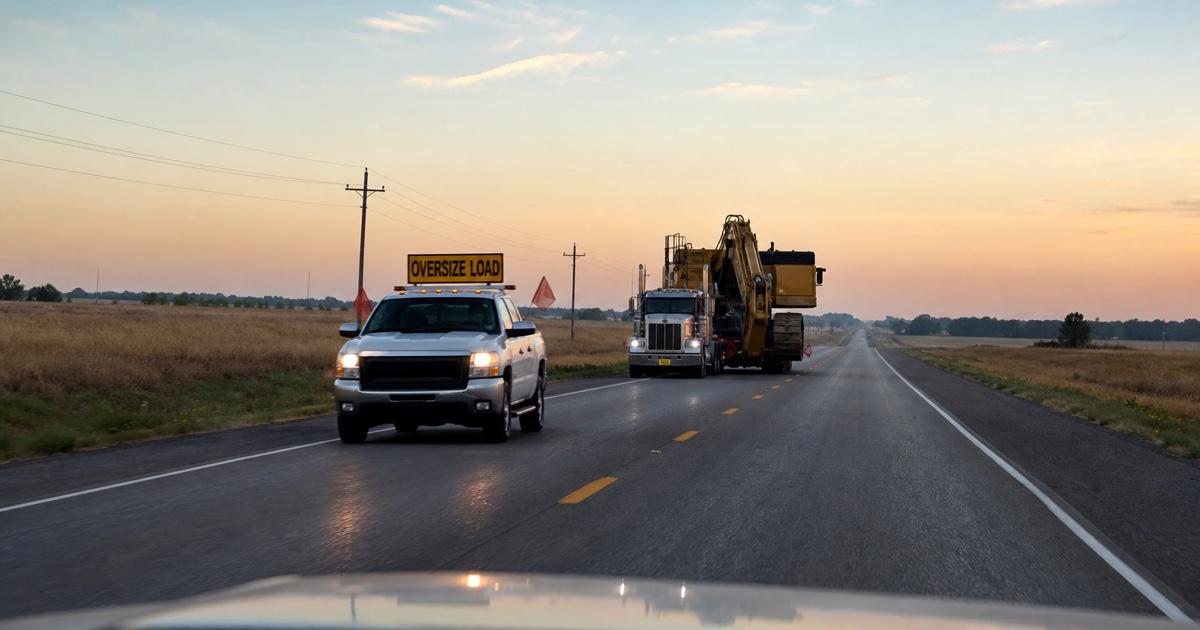
Most drivers have squeezed past one on a two-lane highway: a lowboy trailer hauling a bulldozer, a half of a manufactured home leaning into the wind, a wind-turbine blade that seems to go on forever. Oklahoma moves an enormous amount of oversize freight — energy equipment, agricultural machinery, structural steel — and the law treats those moves as exactly what they are: an elevated hazard that is tolerated only under strict conditions. When a wide, tall, or overlong load hits another vehicle, clips a bridge, or forces a car off the road, the first questions are whether the load was permitted, whether the required escorts were in place, and whether every condition of the move was honored.
If you were hurt in a crash involving an oversize or wide load in Oklahoma, liability often turns on the rules the hauler agreed to follow before the wheels ever turned. Oklahoma statutes set baseline limits on vehicle width, height, and length. Outside specific statutory exceptions, loads exceeding those limits generally require an Oklahoma Department of Transportation permit, and loads wider than 12 feet generally must travel with prescribed escort vehicles. A hauler or escort company that ignored an applicable requirement — no required permit, missing escorts, an uncertified escort driver, or a load that simply should not have been on that road — has handed an injured person some of the strongest liability evidence Oklahoma law offers. This article explains the size limits, the permit and escort system, and how violations translate into a civil case. It is general information, not legal advice about any specific crash.
What Counts as an Oversize Load in Oklahoma
Oklahoma's baseline dimension limits live in 47 O.S. § 14-103. With limited exceptions, no vehicle may have a total outside width over 102 inches — eight and a half feet. Height is capped at 13 1/2 feet on county roads and 14 feet on turnpikes, interstates, and U.S. or state highways unless a special permit issued through the Department of Transportation authorizes more. Length limits are more intricate — 45 feet for a single truck, 53 feet for a semitrailer in a tractor-semitrailer combination, and 70 feet overall for most other combinations on any road or highway — with additional caps and carve-outs for doubles, utility-pole hauls, unitized equipment, and contractors hauling to public project sites.
Two details in the statute matter for injury cases. First, the height rule is backed by an explicit liability provision in § 14-103(B)(3): operators and owners of vehicles exceeding 13 1/2 feet are, in the statute's words, held liable for all damages to structures spanning the highway or damages suffered by other affected parties caused by the vehicle or load exceeding the posted height. Second, subject to the chapter's specific exceptions, the statute channels loads beyond the baseline limits into the permit system — oversize movement in Oklahoma is not forbidden, but it is never casual. A load that exceeds these limits is "oversize," and its lawful movement generally must be planned, papered, and supervised before it enters traffic.
The Permit System — and Why Moving Without One Is a Crime
Oversize and overweight moves run through the Department of Transportation's Size and Weight Permit Division, under fee and application procedures set out in 47 O.S. § 14-116 and ODOT's size and weight permit rules in Title 730, Chapter 50 of the Oklahoma Administrative Code. Permits are issued for specific loads and routes, and Oklahoma law distinguishes single-trip permits from annual and annual-fleet permits for qualifying vehicles. The Oklahoma Highway Patrol's Troop S — the Size and Weight enforcement division — enforces these laws statewide and coordinates law-enforcement escorts for the largest "super load" moves.
The teeth are in 47 O.S. § 14-116a: any person, firm, or corporation who moves any load or manufactured home without a required Department of Transportation permit is guilty of a misdemeanor, with escalating fines for repeat violations. The permit must be carried in the vehicle and shown to any law enforcement officer, and if the operator has no permit, the statute says the load "shall not continue to be moved." An unpermitted oversize load on an Oklahoma highway is not merely a paperwork lapse; it is a criminal offense.
Permits also come with conditions — the route, timing, and manner of the move are regulated through ODOT's permit rules rather than left to the hauler's judgment. After a crash, the permit file becomes a roadmap for a liability investigation: Was there a permit at all? Did it cover this route on this day? Was the load actually the size and configuration the application described? Each mismatch is a fact a jury gets to hear.
Escort Vehicles: The Safety System Around the Load
Width is the dimension that puts oversize loads into other people's lanes, and Oklahoma addresses it directly. Under 47 O.S. § 14-120.1, any vehicle or combination with an outside width over 12 feet must be accompanied by an escort vehicle or vehicles, as prescribed by the Department of Transportation — on every highway in the state, including the interstates. The statute carves out one narrow exemption: escort requirements do not apply to retail implement dealers moving farm implements from a retail distribution point to a farm or other location within a 150-air-mile radius of that distribution point. "Retail implement dealer" is a defined term limited to a business engaged primarily in selling farm tractors or implements of husbandry, which is one reason a lawyer has to look closely at exactly who was hauling what, and from where.
ODOT's rules flesh out what an escort actually is. Under OAC 730:50-5-16, escort vehicles must carry specific equipment — mounted "Oversize Load" signage, red flags, a 360-degree amber warning beacon visible from 500 feet, two-way radios compatible with the hauler's, stop/slow paddles, fire extinguishers, flares or reflectors, and a height-measuring pole for loads 15 feet 9 inches or taller. Escort operators are authorized — and expected — to control traffic when the load stops or creates a hazard, and the rule requires the escorted load to pull off the roadway when it presents a safety risk to other traffic. Escort operators must be trained to flagger standards under the Manual on Uniform Traffic Control Devices.
Two more requirements matter enormously after a crash. Under 47 O.S. § 14-120.1(B) and OAC 730:50-5-17, no one may operate an escort vehicle for hire, when required by § 14-120.1, without being certified by ODOT — a process that requires a training course and examination. Under OAC 730:50-5-16(f), each certified escort operator must also carry commercial liability coverage of no less than $1,000,000 combined single limit or $1,000,000 per occurrence, protecting the public against loss of life, bodily injury, and property damage. That means an escort company may be a potential defendant with coverage separate from the trucking company's policy.
How Violations Become Evidence in a Civil Case
A statute or rule violation does not automatically decide a civil case, but Oklahoma law gives it real weight. Under the state's negligence per se doctrine, a violation may substitute a statutory or regulatory standard of care for the ordinary reasonable-person standard where three things hold: the violation caused the injury, the injury is of the type the enactment was meant to prevent, and the injured person is within the class it was meant to protect. The Oklahoma Supreme Court set out that test in Hampton v. Hammons, 1987 OK 77, 743 P.2d 1053. In Howard v. Zimmer, Inc., 2013 OK 17, the court answered a question certified by the Tenth Circuit and held that federal law did not bar an Oklahoma negligence per se claim built on a federal regulation. But the court cautioned that "negligence per se does not equate to liability per se." The plaintiff still has to prove that the violation caused the harm. Whether this doctrine fits a particular oversize-load statute or rule is a question for the court; no Oklahoma appellate decision located for this article has decided that issue.
Even where a court stops short of negligence per se, a proven violation is powerful ordinary-negligence evidence. A jury that hears the load was 13 feet wide with no escort, or moving without a permit in violation of a criminal statute, does not need a Latin phrase to understand what reasonable care required. And because Oklahoma bars recovery only when the injured person's own fault exceeds 50 percent, violation evidence can be decisive in the comparative-fault fight described in our guide to Oklahoma's 51 percent bar.
The flip side deserves honesty: a permit is not a shield for the hauler, and a violation is not an automatic win for the plaintiff. The defense will argue the violation played no causal role — that the crash would have happened with a permit in the glovebox and escorts in place. Causation is where these cases are won and lost, which is why the investigation has to tie the specific failure — the missing front escort that would have warned oncoming traffic, the over-height load that never should have taken that route — to the specific mechanism of the crash.
Who Can Be Liable After an Oversize Load Crash
Oversize moves involve more parties than an ordinary truck wreck, and several of them may share responsibility. The motor carrier and its driver are the starting point, on the same respondeat superior and direct-negligence theories that apply in any trucking case. The company that hired an unqualified or uninsured hauler for a heavy move may face negligent hiring claims. The shipper or rigging contractor that configured, loaded, or secured the equipment may be responsible for dimension or securement failures. The escort company — whose certified operators must carry at least $1,000,000 in commercial liability coverage — may be liable if escorts were absent, unqualified, out of position, or failed in their traffic-control duties. And for the largest permitted moves, the permit file itself will show who planned the route and who was supposed to be watching. Our guide to who can be sued after an Oklahoma truck wreck walks through the broader liability chain, and our trucking accident practice page explains how we approach these cases.
Weight-based violations are a related but distinct problem — overweight axles, crushed brakes, and pavement damage have their own statutes and their own proof issues, covered in our article on overloaded trucks and cargo violations. An oversize case is about geometry and process: a load too wide, too tall, or too long for its surroundings, and the planning and supervision the law required before it moved.
What to Do — and What to Preserve
The evidence that proves an oversize-load case has a short shelf life. The permit application and approved route survey, the escort company's dispatch records and certifications, the driver's logs, dashcam and ECM data, and the load's actual measured dimensions all need to be demanded early — ideally through a preservation letter before anything is repaired, released, or overwritten. Our guides to trucking evidence preservation and the first 72 hours after a semi-truck crash explain the mechanics. Photographs of the load, the roadway, and any escort vehicles (or their absence) taken at the scene can matter as much as anything a subpoena later produces.
Frequently Asked Questions
How wide can a truck load legally be in Oklahoma without a permit?
The general limit is 102 inches — eight and a half feet — of total outside width under 47 O.S. § 14-103, excluding things like tire bulge and approved safety devices. Beyond that, a move generally requires authorization through the ODOT permit system, and once a load exceeds 12 feet in width, 47 O.S. § 14-120.1 generally requires escort vehicles as prescribed by ODOT. The statutes contain limited exceptions — for example, a person hauling their own round-baled hay up to 11 feet wide for non-resale purposes, and the retail-implement-dealer escort exception discussed above — so the exact facts of the haul matter.
The truck that hit me had a permit. Does that end the case?
No. A permit authorizes a specific move under specific conditions; it does not immunize the hauler from negligence. If the load was off its permitted route, moving outside permitted conditions, larger than described, or traveling without required escorts, the permit may actually strengthen the case by showing the hauler knew exactly what safety measures were required and skipped them. Even a fully compliant move can involve ordinary negligence — following too closely, unsafe speed, improper lane position — like any other crash.
Can the escort or pilot car company be sued too?
Potentially, yes. Escort operators have defined duties under ODOT rules, including warning approaching traffic, controlling traffic when the load stops, and requiring the load to leave the roadway when it creates a hazard. For-hire escort operators must be ODOT-certified when § 14-120.1 requires the escort, and each certified operator must carry commercial liability coverage of no less than $1,000,000 combined single limit or $1,000,000 per occurrence. If an escort was missing, unqualified, out of position, or failed to warn, the escort company may be a potential defendant with its own insurance coverage.
What if the oversize load hit a bridge or overpass and debris hit my car?
Oklahoma law speaks to this directly: 47 O.S. § 14-103(B)(3) provides that operators and owners of vehicles that exceed — or carry loads that exceed — 13 1/2 feet are held liable for all damages to any part of structures spanning the highway, or damages suffered by other affected parties, caused by the vehicle or load exceeding the posted height. Over-height strikes can present strong liability evidence, but they still require prompt preservation of the load's measurements, the route plan, and any warnings the driver ignored.
Is it illegal to pass an oversize load and its escorts?
Oklahoma has no special statute that categorically bans passing an oversize load and its escorts. Ordinary passing rules still apply. ODOT rules authorize escort operators to direct traffic to stop, slow down, or proceed when needed for safe movement, but those rules do not themselves create a separate no-passing offense for other motorists. The same rules require the escorted load to move as far off the roadway as practicable and stop when necessary to let other traffic pass safely. After a crash, the actions of the driver, the hauler, and each escort are evaluated under the ordinary rules of negligence and Oklahoma's comparative-fault system.
Talk to Someone Who Handles Truck Crash Cases
An oversize-load crash is rarely just a driving error. It is usually the last link in a chain of decisions — how the load was measured, which route was approved, which escorts were hired, and whether anyone said no when the move stopped being safe. Those decisions leave a paper trail, and that trail disappears quickly once the load is delivered and the file is closed. If you or a family member was hurt in a crash involving an oversize or wide load anywhere in Oklahoma, contact us for a free, confidential consultation. This article is general information, not legal advice, and does not create an attorney-client relationship.
Hit by an Oversize or Wide Load?
Permit files, route surveys, and escort records can prove what went wrong — but they vanish fast once the move is over. We know what to demand and how quickly to demand it.
Talk to a Truck Accident Lawyer