
Key Takeaways
- Texting Behind the Wheel of a Truck Is a Federal Violation: 49 C.F.R. § 392.80 flatly prohibits commercial drivers from texting while driving — and "driving" includes sitting at a red light or stopped in traffic. A separate rule, 49 C.F.R. § 392.82, prohibits even holding a phone to make a call.
- The Trucking Company Has Its Own Duty: Both federal rules say no motor carrier may "allow or require" its drivers to text or use a hand-held phone while driving. A company that tolerates phone use — or builds dispatch practices that demand it — is not just vicariously liable for its driver. It may have violated the regulation itself.
- Oklahoma Has Its Own Statute: 47 O.S. § 11-901c makes it a misdemeanor, punishable by a $500 fine, for a commercial motor vehicle driver to text or use a hand-held phone on any Oklahoma street or highway.
- A Violation Can Do Real Work in a Civil Case: Oklahoma recognizes negligence per se claims based on violations of federal regulations. In Howard v. Zimmer, Inc., 2013 OK 17, the Oklahoma Supreme Court answered a certified question from the Tenth Circuit and held that a federal regulation's violation can substitute for the common-law standard of care.
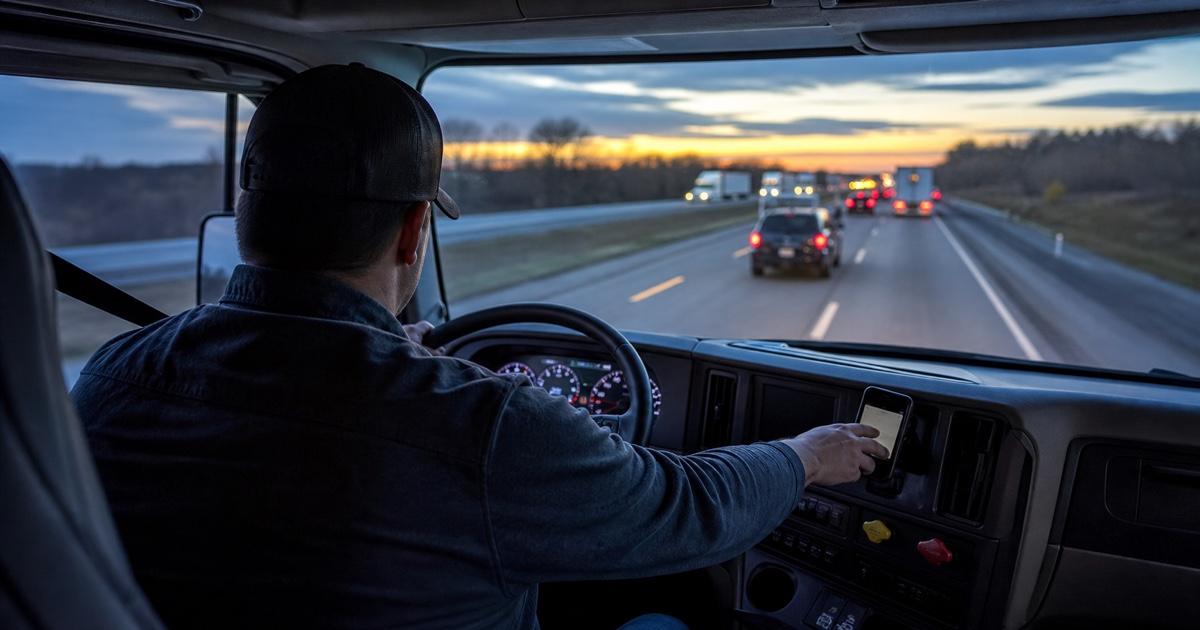
Can a truck driver legally use a cell phone while driving? Under federal law, the answer is essentially no. A commercial driver may not text, may not hold a phone to make a call, and may not even reach for a phone in a way that takes the driver out of a belted, seated driving position. The only lawful way for a trucker to talk on the phone in motion is hands-free, with the phone mounted or within easy reach, operated with a single button. Those rules — 49 C.F.R. §§ 392.80 and 392.82 — apply on every mile of I-35, I-40, and I-44, and Oklahoma layers its own criminal statute on top. When a distracted trucker causes a wreck, the phone records rarely lie, and the rules the driver broke can become the backbone of the injured person's civil case.
This article is general information about federal and Oklahoma law, not legal advice. How any of these rules apply to a specific crash depends on the facts, the vehicle, and the evidence that can still be recovered.
What Federal Law Actually Prohibits
The Federal Motor Carrier Safety Regulations address distracted driving in two separate rules, and the distinction between them matters.
The texting ban. Under 49 C.F.R. § 392.80, no driver of a commercial motor vehicle may engage in texting while driving. "Driving" is defined broadly: it means operating the vehicle with the motor running, including while temporarily stationary because of traffic, a traffic control device, or other momentary delays. A trucker thumbing through messages at a stoplight is violating the rule. The only way out of the definition is to pull the vehicle to the side of, or off, the highway and stop somewhere it can safely remain.
The hand-held phone ban. 49 C.F.R. § 392.82 prohibits using a hand-held mobile telephone while driving a commercial motor vehicle. According to the FMCSA's guidance on the rule, "using" a hand-held phone means any of three things: holding the phone with at least one hand to make a call, dialing by pressing more than a single button, or reaching for the phone in a way that takes the driver out of a seated, belted driving position. A driver who leans over to grab a phone off the passenger seat can violate the rule before saying a word.
The emergency exception. Both rules allow phone use when necessary to communicate with law enforcement or other emergency services. That exception is narrow, and it is the carrier's or driver's burden to bring themselves within it.
Why the rule exists. The FMCSA's research findings are stark: the odds of a safety-critical event — a crash, near-crash, or unintentional lane deviation — are six times greater for commercial drivers who dial a phone while driving. Drivers who dialed took their eyes off the road for an average of 3.8 seconds. At 55 mph, that is roughly 306 feet traveled blind — about the length of a football field.
The Carrier Is Regulated Too
Each rule contains a second prohibition that injured people and their lawyers should never overlook: no motor carrier shall allow or require its drivers to text or use a hand-held phone while driving.
That language matters because it creates a company-level duty independent of the driver's. A carrier whose dispatch system pushes messages to drivers in motion and expects prompt replies, whose managers call drivers who are known to be on the road, or whose safety program exists on paper but is never enforced, has its own regulatory problem — not merely a respondeat superior one. That distinction can shape discovery and can support direct negligence theories against the company alongside claims based on the driver's conduct, similar to the corporate-conduct theories discussed in our guides to negligent hiring in trucking and the trucking liability chain.
Oklahoma's Own Statutes
Oklahoma criminalizes the same conduct at the state level. Under 47 O.S. § 11-901c, it is unlawful for any person to operate a commercial motor vehicle on any Oklahoma street or highway while texting or while using a hand-held mobile telephone. A violation is a misdemeanor punishable by a $500 fine. The statute's definition of "operate" mirrors the federal one — it includes sitting in traffic or at a light — and its texting definition sweeps in SMS, email, instant messaging, and even commands to pull up a web page. It contains its own carve-outs, including emergency communications and certain uses of dispatch and fleet-management devices, so whether particular conduct fits the statute is a fact question worth careful attention.
For every other driver on the road, Oklahoma's general texting ban, 47 O.S. § 11-901d — the Trooper Nicholas Dees and Trooper Keith Burch Act of 2015 — prohibits composing, sending, or reading text messages while a vehicle is in motion. The commercial statute is stricter and carries a fine five times higher, which reflects the legislature's judgment about how much more dangerous an 80,000-pound distracted vehicle is.
What a Violation Costs the Driver and the Company
On the regulatory side, the consequences are significant. FMCSA's published fact sheet describes substantial federal civil penalties against drivers and penalties several times higher against employers who allow or require hand-held phone use. Those maximums are adjusted for inflation each year. A violation also carries the maximum severity weight in the agency's Safety Measurement System, the scoring system that shapes a carrier's safety profile.
Repeat violations also threaten the driver's license. Under 49 C.F.R. § 383.51, violating a state or local law on texting or hand-held phone use while driving a commercial motor vehicle is a "serious traffic violation": a second conviction within three years disqualifies the driver from operating a commercial motor vehicle for 60 days, and a third within three years brings a 120-day disqualification.
For the injured person, these consequences matter less for their own sake than for what they reveal. A driver facing disqualification has an incentive to minimize phone use in a post-crash statement. A carrier with a poor Safety Measurement System profile has a paper trail. Both are reasons the underlying records — not the after-the-fact explanations — are what count.
How a Phone Violation Strengthens a Civil Case
A regulatory violation does not automatically win a lawsuit, but in Oklahoma it can do something close to it on the duty and breach elements.
Oklahoma's negligence per se doctrine substitutes a statutory or regulatory standard of care for the ordinary reasonable-person standard. As the Oklahoma Supreme Court explained in Howard v. Zimmer, Inc., 2013 OK 17, the plaintiff must show that the injury was caused by the violation, that the injury was of the type the regulation was meant to prevent, and that the injured person is among the class the regulation was meant to protect. Howard arose in a different context — a certified question from the Tenth Circuit about a medical-device regulation — but its holding was general and deliberate: the court expressly overruled prior Oklahoma Court of Civil Appeals decisions to the contrary and answered that a federal regulation's violation can supply the standard of care under Oklahoma law. Whether a court applies that doctrine to a particular FMCSR violation in a particular case is a legal question the court decides, but the argument is straightforward: the cell phone rules exist precisely to prevent distracted-driving crashes, and a motorist struck by a texting trucker is squarely within the protected class.
Even where negligence per se is not given, the violation is powerful ordinary-negligence evidence, and it can matter to the comparative-fault calculus described in our guide to Oklahoma's 51 percent bar. In cases involving reckless indifference, a carrier's known tolerance of phone use may also become relevant to punitive damages theories — an issue that deserves attorney analysis on specific facts rather than a general statement here.
Proving the Driver Was on the Phone
Phone-use cases are won with records, and the records disappear on a schedule.
Cell phone records. Call and data logs from the driver's personal phone and any company-issued device can be obtained in discovery and, when timestamps are matched against the crash time, can show a call or data session in progress. Precision matters: the crash time must come from a reliable source, which is one reason the truck's own electronics are so important.
The truck's electronic systems. Modern trucks record speed, braking, and fault events in the engine control module, and electronic logging devices place the truck in time and space. Synchronizing phone logs with ECM and ELD data is how a "he glanced at his phone" case becomes a timeline.
Dashcams and witness observations. Many fleets run driver-facing cameras. Footage showing a phone in hand is close to unanswerable — which is also why it must be preserved quickly.
Preservation is urgent. Carriers are not obligated to keep every record forever, and some data cycles off systems in days or weeks. A spoliation letter demanding preservation of phone records, ELD data, ECM downloads, and camera footage should go out immediately — the same discipline described in our guides to trucking evidence preservation and the first 72 hours after a semi-truck crash.
Frequently Asked Questions
Is hands-free phone use legal for truck drivers?
Generally yes. The federal rules permit hands-free use where the phone is close enough to operate while the driver is belted and seated, and can be started or answered with a single button — voice-activated dialing, an earpiece, or speakerphone. But a driver who unsafely reaches for a phone is out of compliance even if the plan was to use it hands-free, according to FMCSA's guidance.
Does the ban apply if the truck was stopped at a red light?
Yes. Both federal rules and the Oklahoma statute define driving or operating to include being temporarily stationary because of traffic, a traffic control device, or other momentary delays. The rules stop applying only when the driver has pulled the vehicle to the side of, or off, the highway and stopped where it can safely remain.
Does a texting ticket automatically win my injury case?
No. A citation or conviction is one piece of evidence, and Oklahoma's negligence per se doctrine still requires proof that the violation caused the crash and your injuries. Causation and damages remain contested issues, and whether the doctrine applies at all in a given case is decided by the court. What a documented violation does is make the breach-of-duty fight much harder for the defense.
Can I get the truck driver's phone records?
Not on your own — but a lawyer can. Phone carriers respond to subpoenas and court orders issued in litigation, and the trucking company's own records, dispatch messages, and device policies are discoverable. Because some of this material is retained for limited periods, early preservation demands matter more in these cases than in almost any other.
Do these rules apply to every truck on the road?
The federal rules apply to drivers of commercial motor vehicles as defined in the safety regulations, which cover most semi-trucks and other large commercial vehicles in interstate commerce, and Oklahoma's statute reaches commercial motor vehicles operated on any street or highway in the state. Whether a particular vehicle and trip are covered — and by which rule — is one of the first questions a lawyer will answer, because it determines which standards of care apply. Who else may share liability is covered in our guide to who can be sued after an Oklahoma truck wreck.
Talk to Someone Who Handles Truck Crash Cases
A distracted-trucking case usually looks ordinary at the scene — a rear-end impact, a drift across the centerline, a truck that never braked. What makes it a phone case is the evidence assembled afterward: call logs matched to ECM timestamps, dispatch messages sent to a moving truck, camera footage the carrier hoped no one would ask for. That evidence has a short shelf life. If you or a family member was hurt in a crash with a commercial truck anywhere in Oklahoma, contact us for a free, confidential consultation. This article is general information, not legal advice, and does not create an attorney-client relationship.
Hit by a Truck Driver Who Was on the Phone?
Federal law banned that call. Phone records, ELD data, and dashcam footage can prove it — but only if they are preserved before they cycle off the carrier's systems.
Talk to a Truck Accident Lawyer