
Key Takeaways
- Oklahoma's Designated Season Covers the Full Year: Federal hours-of-service rules do not apply to agricultural hauling within a 150 air-mile radius "during planting and harvesting periods, as determined by each State" — and under 49 C.F.R. § 395.1(k), Oklahoma has designated that period as January 1 through December 31, every year.
- Livestock Gets an Exemption at Both Ends of the Trip: The regulation exempts agricultural commodities within 150 air miles of the source — and, for livestock specifically, adds a second exempt zone within 150 air miles of the final destination. A cattle run can begin and end outside the hours-of-service system entirely.
- Exempt Does Not Mean Unaccountable: A separate rule, 49 C.F.R. § 392.3, forbids driving — and forbids a carrier from requiring or permitting driving — when fatigue impairs safety. That rule sits outside the exempted part and still applies. So does ordinary Oklahoma negligence law.
If you were hit by a cattle truck in Oklahoma, there is a real chance the driver was not subject to any federal limit on driving hours, was not keeping an electronic log, and was not required to take a single rest break — lawfully. Federal law exempts agricultural hauling, including livestock, from the hours-of-service rules within a 150 air-mile radius during each state's designated planting and harvesting season, and Oklahoma has designated its season as the entire calendar year. The exemption changes how a serious livestock-hauler crash is investigated: the route and cargo determine which records were required. This article explains what the agricultural exemption actually covers, what it does not excuse, and how fatigue and driving hours get proven when there is no logbook to subpoena.
This article is general legal information, not legal advice. Which rules governed a particular truck on a particular run depends on the cargo, the route, the vehicle, and the crash date, and those details need case-specific review.
Cattle Country, Cattle Trucks
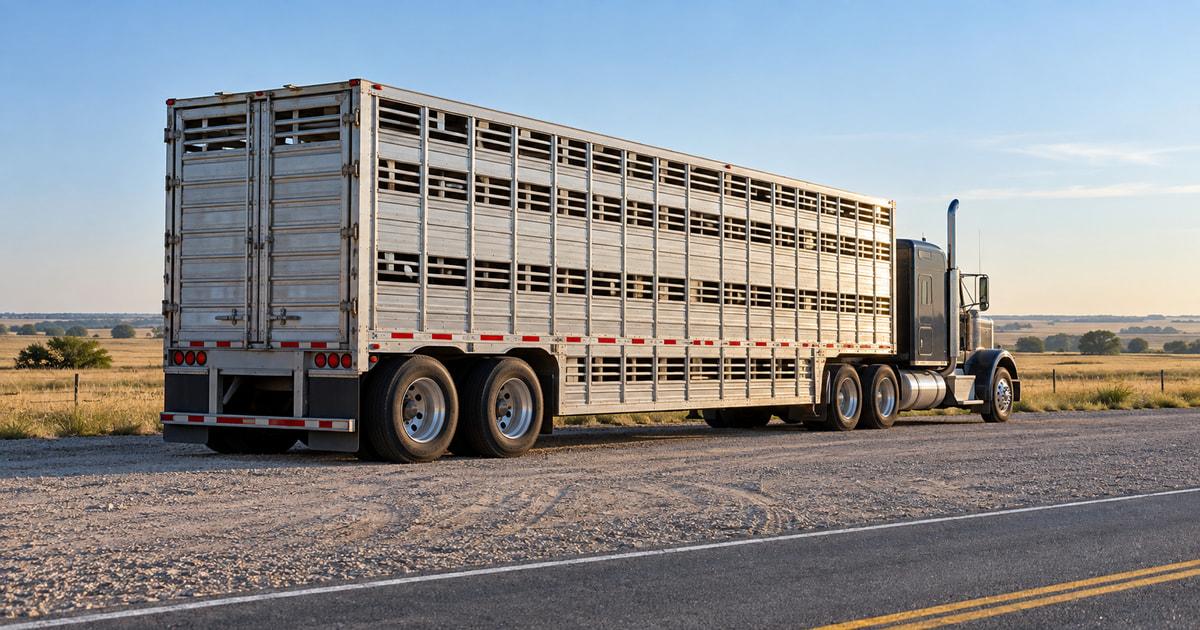
Livestock hauling is not a niche in this state. According to the U.S. Department of Agriculture's January 2026 Cattle inventory report, Oklahoma had 4.65 million cattle and calves on January 1, 2026, and 1.97 million beef cows — more than any state except Texas. Cattle move by truck from ranch to sale barn, from sale barn to wheat pasture or feedlot, and from feedlot to processor. Loaded cattle pots are heavy, tall, and top-sensitive — live cargo shifts its own weight — and they share two-lane highways with passenger cars in every corner of the state.
After a livestock-truck wreck, the driver's logs and electronic logging device data are important records to request in a semi-truck crash case. In a livestock case, that demand often comes back with an answer that sounds like an evasion but may be legally accurate: there are no logs, because none were required.
The Agricultural Exemption, Piece by Piece
The general federal driving limits are strict, and we cover them in detail in our guide to hours-of-service violations. The agricultural exception to those limits lives in 49 C.F.R. § 395.1(k), and its opening line does most of the work: the hours-of-service part "shall not apply during planting and harvesting periods, as determined by each State," to drivers in the categories that follow.
Those categories are broader than most people expect:
Agricultural commodities from the source. Drivers hauling agricultural commodities are exempt from the source of the commodities to any point within a 150 air-mile radius of that source. Under the definitions in 49 C.F.R. § 395.2, "agricultural commodity" reaches non-processed food, feed, fiber, livestock, and perishable horticultural products — and "livestock" itself is defined to include essentially all living animals raised for commercial purposes, down to insects and aquatic animals. An air mile is longer than a highway mile; the same section's short-haul provision equates a 150 air-mile radius to 172.6 statute miles.
Farm supplies to the farm. Drivers hauling farm supplies for agricultural purposes are exempt from a wholesale or retail distribution point to the farm within a 150 air-mile radius, and from wholesale to retail distribution points within the same radius. The definition of "farm supplies" covers products related to planting and harvesting during the state's designated season — and livestock feed at any time of year.
Livestock near the destination. For livestock specifically, the regulation adds a category the older guidance documents do not mention: transportation of livestock within a 150 air-mile radius of the final destination is also exempt. Read together with the source-side exemption, a cattle run of moderate length can be exempt at both ends, with only the middle portion — if any — governed by the ordinary rules.
What "Exempt" Means in Practice
The Federal Motor Carrier Safety Administration’s guidance on the source-side agricultural exemption explains that work and driving hours within the qualifying 150 air-mile source radius are not limited by Part 395, and an electronic logging device is not required there. It also states that time worked within that source radius does not count toward the driver’s daily and weekly limits. That source-side guidance does not address the separate destination-side livestock exception in § 395.1(k)(4). Each zone must be established from the trip’s actual source, final destination, cargo, and route before deciding where Part 395 applies.
And in Oklahoma, there is no seasonal window to check. The exemption applies only "during planting and harvesting periods, as determined by each State" — but the Oklahoma Department of Public Safety has designated that period as January 1 to December 31. In this state, for this purpose, the designated season runs the full calendar year.
The Rancher's Own Truck: Covered Farm Vehicles
A separate and even broader exemption can apply when the truck belongs to the operation itself. Under § 395.1(s), drivers of "covered farm vehicles" are outside the hours-of-service rules entirely. As the Oklahoma DPS summary explains, a covered farm vehicle is one registered with a farm designation, operated by a farm or ranch owner, family member, or employee, used to move the operation's own commodities, livestock, machinery, or supplies, and not used for hire. Qualifying vehicles are also exempt from commercial driver's license requirements, drug-and-alcohol testing, medical certification, and the federal inspection-and-maintenance rules — though weight and distance conditions apply, and Oklahoma's own Title 47 traffic laws continue to govern regardless.
One more wrinkle: even when a livestock hauler is subject to the ordinary rules — say, on the long middle leg of an interstate run — § 395.1(v) excuses the 30-minute rest break whenever livestock are on the trailer. When FMCSA renewed an exemption from the break rule for livestock haulers in 2015, it cited the well-being of the animals and noted that the temperature inside a stopped livestock trailer can rise rapidly; the exception is now written into the regulation. But the net effect is that a loaded cattle truck may lawfully run leg after leg that an ordinary freight truck could not.
Hit by a Cattle Truck or Livestock Hauler?
Sale barn records, livestock paperwork, dispatch messages, and fuel and toll records can help reconstruct a driver's day when no logbook was required. Our truck driver fatigue guide explains why those records should be preserved early.
The Exemption Is Not a License to Drive Exhausted
Here is what § 395.1(k) does not do: it does not repeal the rest of federal safety law, and it does not touch Oklahoma negligence law.
The hours-of-service exemption removes Part 395 — the hours rules. It leaves Part 392 fully in force. Under 49 C.F.R. § 392.3, no driver may operate a commercial motor vehicle, and no carrier may require or permit a driver to operate one, "while the driver's ability or alertness is so impaired, or so likely to become impaired, through fatigue, illness, or any other cause, as to make it unsafe" to drive. That prohibition applies to an exempt agricultural run just as it applies to a regulated freight run. Notably, even the covered-farm-vehicle exemption — the broadest of them all — does not extend to Part 392.
Ordinary negligence principles do the same work. A jury deciding whether a livestock hauler used reasonable care does not grade the driver against the exemption; it asks whether a reasonably careful driver would have kept driving in that condition, at that hour, after that day. A lawful exemption does not excuse driving while dangerously fatigued. The evidence must still connect the unsafe driving to the crash and injury. The exemption defeats one specific argument — that the driver broke the federal hours rules — not the case. And the exemption questions themselves are often litigable: whether the cargo qualified, where the "source" actually was, whether the truck had left the 150 air-mile radius, and whether a for-hire hauler could claim covered-farm-vehicle status at all are fact questions a defense cannot simply assert.
Proving Fatigue Without a Logbook
The practical consequence of the exemption is an evidence problem, not a liability shield. When there is no electronic logging device file and no record-of-duty status, the driver's day has to be rebuilt from everything else — which is why early evidence preservation matters even more in these cases than in ordinary truck wrecks:
- Sale barn and market records. Livestock auctions document consignments, buyers, load-outs, and times. A load-out ticket is a timestamp on the start of a run.
- Bills of lading and livestock paperwork. Livestock movement often generates health certificates and shipping documents with dates, origins, and destinations.
- Fuel, toll, and weigh records. Fuel card transactions, turnpike toll data, and scale tickets place the truck at points along the route with times attached.
- Phone and dispatch records. Texts and calls between driver, dispatcher, buyer, and receiver often map the whole day — including the 4 a.m. start no log ever recorded.
- The truck itself. Many modern trucks record speed and fault data independently of any logging device, and GPS or telematics may exist even where no ELD does.
That reconstruction also answers the exemption question itself. The 150 air-mile radius, the location of the source, and the route are geographic facts; the records above establish them. Sometimes the reconstruction shows the "exempt" run was nothing of the kind — a for-hire carrier hauling processed product, or a driver far outside the radius with no log. Then the analysis in our hours-of-service violations guide applies with full force, and the missing records become their own problem for the carrier.
Because cattle hauling involves ranchers, order buyers, sale barns, carriers, and feedyards in shifting combinations, identifying every company that may share responsibility is as important as reconstructing the hours. And these cases overlap with a related body of Oklahoma law: when the animals themselves end up on the road, different rules govern, which we cover in our guide to loose livestock collisions.
Frequently Asked Questions
Do cattle trucks have to follow the same hours-of-service rules as other semis?
Often, no. Under 49 C.F.R. § 395.1(k), the federal hours-of-service rules do not apply to drivers hauling agricultural commodities — including livestock — within a 150 air-mile radius of the source during the state-designated planting and harvesting season, and livestock haulers get an additional exempt zone within 150 air miles of the final destination. Oklahoma has designated its season as the full calendar year, so the exemption is available here year-round. Outside those zones, the ordinary rules apply, though the 30-minute break requirement is excused while livestock are aboard.
If the driver was exempt, can I still bring a fatigue case?
Yes. The exemption removes the hours-and-logging rules; it does not remove 49 C.F.R. § 392.3, which prohibits driving — and prohibits a carrier from requiring or permitting driving — when fatigue impairs safety. It also does not change Oklahoma negligence law, which asks whether the driver and the companies behind the truck used reasonable care. Fatigued driving can be negligent regardless of whether any hours rule was broken. The exemption changes what evidence proves the case, not whether the case exists.
How do you prove how long the driver had been on the road without a logbook?
By rebuilding the day from records that exist for other reasons: sale barn load-out tickets, bills of lading and livestock paperwork, fuel card and toll transactions, scale tickets, phone and dispatch records, and any GPS, telematics, or engine data on the truck. Those same records establish the geographic facts — source, route, and radius — that determine whether the exemption applied at all. This evidence is time-sensitive, and a preservation demand should go out immediately.
Does the exemption cover a rancher hauling his own cattle?
Frequently, yes, and then some. A qualifying "covered farm vehicle" — registered with a farm designation, driven by the operation's owner, family, or employees, hauling the operation's own livestock or supplies, and not operating for hire — is exempt not only from the hours rules but also from CDL, drug-testing, medical certification, and federal maintenance requirements, subject to weight and distance conditions. Whether a particular truck actually met every condition is a fact question worth close scrutiny, and none of it exempts the driver from Oklahoma's traffic laws or from the duty to drive unimpaired.
Do these federal exemptions apply to a truck that never leaves Oklahoma?
Oklahoma applies the federal safety framework to covered intrastate carriers through Department of Public Safety rules adopted under 47 O.S. § 230.15, with its own intrastate variances, and DPS publishes its own guidance on these agricultural exemptions. But intrastate coverage thresholds and variances differ from the interstate rules, so which limits governed a purely in-state run depends on the vehicle, cargo, and crash date — one of the first things a lawyer should pin down.
Preserve the Records That Test the Exemption
Oklahoma's year-round season makes the agricultural exemption especially important in cattle-truck cases. After a serious crash, preserve the records needed to test whether the exemption applied and whether fatigue contributed to the wreck. Contact Addison Law Firm for a free consultation — there is no fee to find out where you stand.