
Key Takeaways
- Length and Weight Trigger Different Rules: Federal rules protect ordinary twin-trailer combinations on the National Network and bar trailer-length limits below 28 feet. Oklahoma allows 29-foot trailers in those rigs. An LCV is a tractor with two or more trailers operating on the Interstate System above 80,000 pounds; length restrictions are a separate question.
- Oklahoma Allows Triples Under Permit: The federal table lists Oklahoma doubles up to 110 feet of cargo-carrying length and triples up to 95 feet, with an Interstate ceiling of 90,000 pounds subject to axle and bridge limits. Triples need an annual state permit; Interstate operation above 80,000 pounds needs additional weight authorization.
- Check the Driver's Actual Qualifications: Review the commercial license, endorsement, and any LCV training or grandfather certificate. Certificates are specific to doubles or triples. Federal LCV training rules apply to interstate commerce; their application to a purely intrastate operation requires separate analysis.
- Multi-Trailer Handling Matters: LCV training covers rearward amplification, jackknifing, and rollover. Those topics point an investigation toward speed, steering, and loading; they do not prove how a particular crash happened.
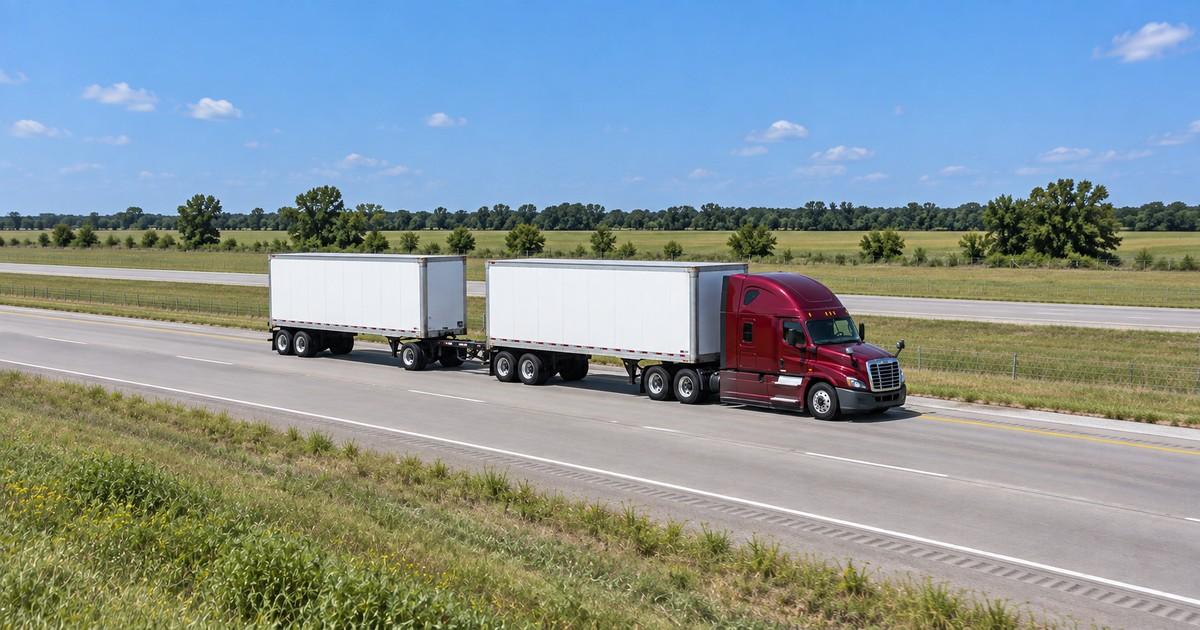
Double and triple trailer trucks are legal in Oklahoma, but their routes, weight, and operating conditions matter. Triples need a state permit, and both longer and heavier combinations face restrictions that a single-trailer rig may not. When a multi-trailer truck is involved in a wreck, the investigation should establish which rules applied to that configuration and trip before drawing conclusions about fault.
This article is general legal information, not legal advice. Multi-trailer crash cases turn on route, permit, training, and loading records that have to be obtained and read for the specific rig involved, and nothing here substitutes for case-specific review.
Two Different Kinds of "Doubles" Under the Law
A tractor pulling two short trailers is not automatically an LCV. 23 CFR § 658.13(b) protects tractor-semitrailer-trailer combinations on the National Network and bars states from imposing trailer-length limits below 28 feet. It also protects certain 28.5-foot trailers lawfully in use on December 1, 1982, in combinations no longer than 65 feet. Separately, § 658.23(b)(1) exempts doubles with trailers no longer than 28.5 feet from the cargo-carrying-unit freeze. Oklahoma permits 29-foot trailers in ordinary doubles.
Two overlapping federal restrictions need to be kept separate. 23 CFR § 658.23 addresses both heavier LCV operations on the Interstate System and longer cargo-carrying combinations on the National Network. Its grandfathered limits generally preserve operations allowed on June 1, 1991; they do not give a carrier permission to take any multi-trailer truck anywhere.
For the federal training rules, 49 CFR § 380.105 defines an LCV by configuration, road system, and actual gross weight: a tractor with two or more trailers operating on the Interstate System at more than 80,000 pounds. Trailer length alone does not answer that question. Even short doubles can meet that definition if they meet the weight and operating conditions.
Under 47 O.S. § 14-103(C)(3), trailers in a tractor-semitrailer-trailer combination may reach 53 feet on the Interstate System and four-lane divided federal-aid primary highways, but no more than 29 feet on other roads. The statute's two-unit limit has an exception allowing a tractor-semitrailer to tow one additional trailer. Triples require an annual special combination vehicle permit from the Oklahoma Department of Transportation under 47 O.S. § 14-121. That statute sets a $240 annual fee and a 29-foot maximum for each trailer.
Where Longer Doubles and Triples Can Legally Run in Oklahoma
The table in Appendix C to 23 CFR part 658 preserves Oklahoma's grandfathered limits: 110 feet of cargo-carrying length for doubles and 95 feet for triples, with a 90,000-pound Interstate gross-weight ceiling. Axle-group and bridge-formula restrictions still apply. These are limits, not a blanket authorization for every combination within them. State permits and route conditions must also be satisfied.
The federal Oklahoma listing distinguishes doubles whose trailers do not exceed 29 feet from those with at least one longer trailer. The longer combinations use a listed network. State access rules in OAC 730:50-5-6 measure the five-mile terminal or service access limit along the most direct route, not as a radius. For those longer doubles, two-lane connections of up to 15 miles must be designated by the department for direct travel between divided-highway segments. A two-lane road is therefore neither automatic permission nor automatic proof of a violation.
Appendix C works as a freeze: it preserves the conditions Oklahoma had in place in 1991 and limits what the state may allow. The permit itself comes from Oklahoma's current rules, which add their own conditions. OAC 730:50-5-9 bars triples in decreased visibility, lateral winds over 45 miles per hour, and slick, icing, icy, or snow-packed pavement. The same section addresses trailer placement: the heaviest belongs in front and the lightest at the rear, and an empty trailer must not precede a loaded one.
For triples, OAC 730:50-7-5 requires at least 500 feet between the triple and other vehicles except when overtaking and passing, and use of the right-hand outside lane except to pass or in an emergency. Those spacing and lane rules are written for triples, not doubles. For an LCV on the Interstate above 80,000 pounds and no more than 90,000 pounds, OAC 730:50-5-4 separately requires a special annual divisible load permit. The triples permit alone should not be treated as proof of overweight authorization. Obtain the actual permits and route approval.
The Driver Behind a Multi-Trailer Rig Needs More Than a CDL
For a U.S. commercial driver's license (CDL) holder operating these highway combinations, the Class A license and doubles/triples endorsement are basic checks. 49 CFR § 383.93 requires the endorsement's knowledge test. The investigator should confirm the applicable licensing rules, including any recognized foreign license, before calling a driver unqualified. Our guide to negligent hiring in trucking cases addresses the broader hiring inquiry.
LCV training is a separate inquiry under 49 CFR part 380, subpart B. The federal rules apply to LCV operators in interstate commerce under § 380.103. Oklahoma adopts part 380 by reference, but its separate intrastate applicability rule does not list that part. Read OAC 595:35-1-4 and 595:35-1-5 together in the official Oklahoma code; do not assume the training requirement applies identically to a purely intrastate operation. Double and triple certificates are type-specific, with different experience prerequisites.
Oklahoma's Appendix C entry also lists at least two years of tractor-trailer experience for triple drivers and requires the permit holder to certify the driver as qualified. The current state permit rules do not repeat that experience condition; they require the permit holder to supervise the driver and follow the federal motor carrier safety rules. Check the carrier's certifications and the driver's actual experience rather than assuming either way.
A valid § 380.111 Certificate of Grandfathering can substitute for training. Eligibility depended on recent experience in vehicles representative of the type of LCV the driver would keep operating. Applications were limited to the year following June 1, 2004, so this is not an exemption a carrier can create today. The carrier must confirm the grandfathering conditions were met. Section 380.113 separately bars operation beyond what the driver's training certificate, license, and endorsements authorize.
Appendix F to part 380 requires instruction on emergency maneuvers, rearward amplification, jackknifing, rollover, and load distribution. Research prepared for the Federal Highway Administration explains rearward amplification as the relationship between the lateral acceleration of the last unit and the first during a maneuver. The crack-the-whip effect is principally a concern in sudden obstacle avoidance, not a description of every turn or ordinary driving situation. That makes speed, steering, loading, and configuration worth investigating. Neither the research nor the curriculum proves causation in a particular crash. See the related guides to jackknife crashes and truck rollovers.
What This Means After a Crash
A multi-trailer wreck expands the ordinary truck-crash investigation in specific ways.
Route and permit records. Was the rig on an authorized route or access connection, and did the carrier hold the required permit? Compare the configuration, weight, and trip with the actual authorization. A proven violation may matter to negligence, but it does not establish causation or damages by itself. An injury claim still needs evidence connecting unsafe conduct to the crash.
Driver qualification and training records. Request the license history, applicable LCV training or grandfathering certificate, and supporting experience records. Not every document necessarily sits in one file or still exists, and access depends on the case and discovery rules. Our guide to the first 72 hours after a semi-truck crash explains why early preservation matters.
Loading and coupling evidence. Stability depends partly on decisions made before dispatch: trailer order, weight distribution, converter-dolly condition, and secure connections. Oklahoma's permit rules address heaviest-to-lightest trailer placement. Scale tickets, loading records, photographs, and maintenance records can help establish whether those conditions were met.
Every defendant in the chain. The driver, carrier, loader, and equipment owners may have different roles; a multi-trailer rig can mix ownership unit by unit. Responsibility depends on conduct and legal duties, not ownership alone. Our guides explain who may be sued after a truck wreck and the insurance issues.
Oklahoma's comparative-fault rules still apply — a claimant who is found more than half at fault recovers nothing, as we explain in our guide to Oklahoma's 51 percent bar — and most injury claims face a two-year filing deadline, with shorter notice periods for some defendants, so early review matters; see our statutes of limitations guide for the framework and its exceptions.
Frequently Asked Questions
Are triple trailer trucks legal in Oklahoma?
Yes, with limits. 47 O.S. § 14-121 requires an annual Oklahoma Department of Transportation special combination vehicle permit. Each trailer is limited to 29 feet, with a 95-foot cargo-carrying limit and weight restrictions. Interstate operation above 80,000 pounds requires separate weight authorization. Routes, limited access, and the state's weather restrictions also matter; a permit is not permission to operate in every condition.
Can a double-trailer truck drive on any Oklahoma highway?
Not every double on every road. 23 CFR § 658.13(b) protects ordinary twin-trailer combinations on the National Network and bars trailer-length limits below 28 feet. 47 O.S. § 14-103 allows trailers up to 29 feet in those combinations on other Oklahoma roads too, subject to weight limits. A double with a trailer longer than 29 feet is confined to the Interstate System and four-lane divided highways, with limited access provisions. Whether the truck also meets the federal LCV definition is a separate question involving weight and Interstate operation.
What extra qualifications does the driver of a double or triple need?
For a U.S. CDL holder, start with the Class A license and doubles/triples endorsement. If the rig was running on the Interstate System above 80,000 pounds, check for an LCV training or grandfather certificate covering that double or triple combination. The federal training rules apply to interstate commerce, so the operation matters. Check the weight, route, and actual certification records; trailer count or a missing document in one file does not resolve qualification.
Does it matter that the truck that hit me was pulling two or three trailers?
It can. Longer or heavier combinations may carry additional route, permit, and training requirements, and multi-trailer handling matters in an emergency. The investigation should identify the rules that applied to the actual truck and trip. Neither trailer count nor a rule violation alone proves fault: unsafe conduct must be connected to the crash.
Talk to a Lawyer About the Records
Permits, qualification records, scale tickets, and coupling maintenance records can help explain how a multi-trailer combination was dispatched and operated. Early preservation can protect that evidence while responsibility is investigated. If a double or triple trailer truck injured you or a family member on an Oklahoma highway or turnpike, contact us about your case through our trucking accident practice. This article is general information, not legal advice, and does not create an attorney-client relationship.
Hit by a Double or Triple Trailer Truck?
The truck's configuration, route, qualifications, and loading records deserve a closer look. Talk with us about preserving evidence and investigating what happened.
Talk to a Trucking Accident Lawyer