
Key Takeaways
- Reconstruction Combines Physical Evidence With Electronic Data: A reconstructionist works from what the crash left behind — tire marks, gouges, debris, crush damage, final rest positions — and cross-checks it against electronic sources such as engine control module (ECM) data and electronic logging device (ELD) records to build a physics-based account of speeds, positions, and timing.
- The Opinion Must Survive Oklahoma's Reliability Gate: In Christian v. Gray, 2003 OK 10, the Oklahoma Supreme Court adopted the federal Daubert and Kumho Tire standards for expert testimony in civil cases, and 12 O.S. § 2702 — amended effective September 1, 2025 — now expressly requires the party offering the expert to show it is more likely than not that the opinion rests on sufficient data and reliable, reliably applied methods.
- Preservation Should Not Wait: Covered hours-of-service records have a six-month minimum retention period (49 C.F.R. § 395.8(k)), and required driver vehicle inspection reports have a three-month period (49 C.F.R. § 396.11). Maintenance-record rules include one year where the vehicle is housed or maintained and six months after it leaves the carrier's control (49 C.F.R. § 396.3(c)). Separate litigation-preservation duties may require longer retention.
Truck crash reconstruction works backward from tire marks, vehicle damage, scene measurements, and available electronic records to explain how a collision happened. It can help test competing accounts of speed, position, braking, and timing. It does not give an expert the jury's job of deciding legal fault. This article explains the evidence a reconstructionist uses, why preservation matters, and Oklahoma's rules for admitting and challenging expert testimony.
This article is general legal information, not legal advice about any specific crash. How these methods and rules apply to a particular collision depends on facts and records that need individual review.
What a Reconstructionist Actually Works From
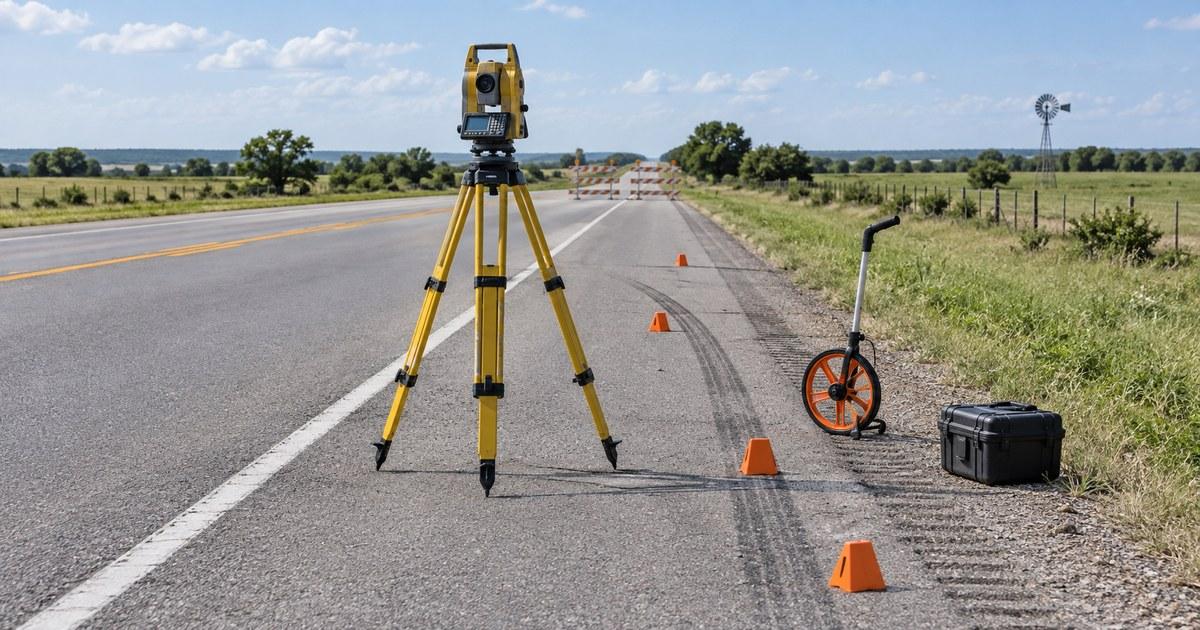
Crash reconstruction is applied physics and engineering, and it starts at the scene. The marks a heavy truck leaves in a collision are evidence with a short shelf life: braking and yaw marks on the pavement, gouges and scrapes where metal met asphalt, fluid trails, and the scatter pattern of debris. Combined with the vehicles' points of rest, this scene evidence anchors the geometry of the crash — where the impact happened within the roadway and how the vehicles moved afterward.
The second layer is the vehicles themselves. Depending on the vehicle and available measurements, crush damage can help an expert estimate impact direction and severity; it does not supply those answers by itself. On the tractor and trailer, an inspection can document the condition of the brake system, tires, lights, and coupling — the same components a carrier is required to keep in safe operating condition under the federal maintenance rules discussed in our article on brake failure and negligent maintenance claims. Scene and vehicle documentation tools include total-station survey equipment, drone photography, and three-dimensional scanning.
From that record, the reconstructionist applies methods such as momentum and energy analysis, time-and-distance calculations, and visibility and perception-response analysis to develop opinions about speed, positioning, and avoidability. Their strength depends on both the underlying data and whether the method fits the question being asked.
The Electronic Layer: ECM, ELD, and Camera Data
Heavy trucks may store electronic data that corroborates or contradicts the physical evidence. The engine control module — often called the truck's black box — may retain speed, brake, and throttle-related information associated with a hard-braking or fault event. Whether an event is captured, and whether later events overwrite it, depends on the equipment and settings. Fleet telematics and dash cameras may provide additional records. Our guide to ECM black box evidence and the firm's ECM and black box practice page cover these sources in depth.
Two regulatory distinctions matter. Under 49 C.F.R. § 395.8, drivers subject to the duty-status recording requirement generally must use an ELD, but exceptions apply. Some short-haul operations are exempt from duty-status logs; other exceptions permit alternative recording methods. The rule prohibits false duty-status reports and tampering with an ELD or required electronic records. It is not a blanket rule governing every computer record on every truck.
Separately, 49 C.F.R. § 563.3 covers specified passenger cars and other light vehicles manufactured on or after September 1, 2012, with a gross vehicle weight rating of 8,500 pounds or less and an unloaded vehicle weight of 5,500 pounds or less, if equipped with an event data recorder. It also excludes certain vehicles. Part 563 does not impose standardized heavy-truck crash recording or retention. What a tractor recorded, and what survives, must be checked against its actual equipment and records.
Reconstruction is strongest when the electronic and physical evidence are read together. An ECM speed figure means more when it matches the yaw marks and crush analysis; a driver's log entry means more — or less — when compared against GPS pings and fuel receipts. That cross-checking is the reconstructionist's day-to-day work.
Why the Clock Matters: Retention Windows and Preservation
Federal retention rules set minimum periods, not permission to destroy relevant evidence once a separate preservation duty applies. A covered motor carrier must retain a driver's records of duty status and supporting documents for at least six months (49 C.F.R. § 395.8(k)(1)). Required driver vehicle inspection reports must be kept for three months (49 C.F.R. § 396.11(a)(4)); the rule generally does not require a report when no defect or deficiency was discovered or reported, and it has coverage exceptions. Records required by 49 C.F.R. § 396.3 must be retained for one year where the vehicle is housed or maintained, and for six months after it leaves the carrier's control. Repairs, module replacement, continued operation, or salvage may alter or destroy vehicle evidence. A preserved download or separate fleet record may still exist; losing the truck does not establish that every electronic record is gone.
Counsel can send a preservation demand identifying the vehicle, crash, and relevant evidence to the carrier and other record holders. A letter helps document notice; it is not necessarily what first creates a preservation duty. Relevant evidence may need to be preserved when litigation is reasonably anticipated. Our articles on spoliation of evidence in Oklahoma, preserving trucking evidence, and the first 72 hours after a semi-truck crash explain the practical steps.
Police work can be an important source, not something a civil expert must discard and recreate. In Covel v. Rodriguez, 2012 OK 5, the plaintiff's reconstruction expert used highway patrol photographs and survey data along with other records. The task is to evaluate those materials, identify gaps, and decide whether additional measurements or expert work are needed.
The Courtroom Gate: Christian v. Gray and Section 2702
A reconstruction opinion is only useful if a court will admit it, and Oklahoma has a defined test. In Christian v. Gray, 2003 OK 10, the Oklahoma Supreme Court — acting on a writ in an original-jurisdiction proceeding after a trial court excluded a plaintiff's causation expert — adopted the United States Supreme Court's Daubert and Kumho Tire decisions as the standard for admitting expert testimony in Oklahoma civil cases. The court granted the writ and sent the case back for the parties to litigate admissibility under the newly adopted standard; it did not hold the expert's testimony admissible or inadmissible. Under that framework, the trial judge acts as a gatekeeper, weighing non-exhaustive factors that include whether the expert's method can be and has been tested, whether it has been peer reviewed and published, its known or potential error rate and controlling standards, and its acceptance in the relevant expert community. Kumho Tire matters here because it extended that gatekeeping to technical and engineering testimony — exactly the category crash reconstruction occupies.
Section 2702 already contained reliability requirements before 2025. The amendment effective September 1, 2025 expressly added a more-likely-than-not showing by the proponent and a separate helpfulness condition, and revised the reliable-application language. Current 12 O.S. § 2702 addresses helpfulness, sufficient facts or data, reliable methodology, and reliable application to the case. The changes appear in section 9 of enrolled Senate Bill 453. Federal courts apply Federal Rule of Evidence 702 instead.
Admissibility standards do not mean every expert automatically gets a separate pretrial hearing. Christian described an inquiry when reliability is sufficiently challenged and cannot be taken for granted. In Covel, the Oklahoma Supreme Court held that an untimely reliability objection was waived absent fundamental error and affirmed the trial court's judgment for the plaintiffs. Those decisions predate the 2025 amendment; they should not be read to erase its express requirements. Cases proceeding under Oklahoma's expedited civil-action process also require attention to 12 O.S. § 1782, which restricts when expert-admissibility challenges may be made. Counsel must address both the current evidence standard and the procedure governing the particular case.
For an injured family, this cuts both ways. Your reconstructionist's opinions must be built to survive a challenge — which rewards early scene documentation, verified data downloads, and disciplined methodology. And the carrier's expert is subject to the same gate: an opinion that leans on assumptions rather than sufficient facts and data can be tested, and sometimes excluded, before trial. Fault fights in Oklahoma ultimately run through the state's comparative negligence system, where percentages control recovery — our article on Oklahoma's 51% bar explains those stakes.
Technical Opinions Are Not a Verdict on Fault
In Gabus v. Harvey, 1984 OK 4, 678 P.2d 253, the Oklahoma Supreme Court reversed for a new trial after an investigating officer attributed a pedestrian collision to the pedestrian's failure to yield. The opinion did not help the jury evaluate matters requiring specialized knowledge; the jury could draw the relevant conclusion itself.
The Court of Civil Appeals applied that distinction in Moore v. Blackwell, 2014 OK CIV APP 37, 325 P.3d 4, reversing a defense judgment over fault testimony by an officer and a reconstructionist. The majority distinguished permissible testimony about speed, impact location, braking, and evasive action from conclusions that a party was not negligent or was responsible for the collision. A judge dissented from that part of the decision.
These decisions do not make every opinion touching causation inadmissible. The question is whether the particular testimony supplies useful specialized knowledge or merely tells jurors what result to reach. An expert can explain the physical evidence without taking over the jury's decision on legal fault.
How Reconstruction Fits the Rest of a Truck Case
Reconstruction helps answer how the collision happened; a claim must also identify who owed a duty and whether a breach caused the injury. The possible defendants may include the driver, carrier, or another party whose conduct contributed to the wreck. Our guide to who can be sued after an Oklahoma truck wreck explains those distinctions. See our trucking accident practice page and I-40 truck accident page for the broader claim context.
Frequently Asked Questions
How soon after a truck crash should reconstruction work begin?
As early as practical. Tire marks fade, road conditions change, and vehicles may be repaired or moved. Some required inspection reports have a three-month regulatory retention minimum, but that minimum does not authorize destruction when a separate preservation duty applies. Counsel can identify the evidence holders and seek preservation promptly; scene documentation is most useful before the evidence changes.
The police already investigated. Do we still need our own reconstruction?
A law enforcement investigation may provide important measurements, photographs, and witness accounts. Whether a separate reconstruction expert is needed depends on the disputed issues and available evidence. If expert testimony is offered in Oklahoma state court, it must satisfy 12 O.S. § 2702; the existence of a police report neither eliminates that requirement nor means every claim needs another expert.
Can a reconstruction expert tell the jury who was at fault?
Technical testimony about speed, impact location, or braking is different from a conclusion that someone was legally at fault. Gabus and Moore rejected fault opinions that did not help jurors understand matters requiring specialized knowledge. That is not a blanket ban on opinions touching causation; the particular testimony must be useful and otherwise admissible. The jury decides legal fault.
Can a reconstruction expert's opinion be thrown out of court?
Yes. Oklahoma's current 12 O.S. § 2702 requires the proponent to establish helpfulness, sufficient facts or data, reliable methods, and reliable application by a more-likely-than-not showing. An opinion that does not satisfy the governing standard may be excluded. Timely objections matter, and expedited civil actions have additional procedural rules. An expert's credentials alone do not resolve those questions.
Injured in an Oklahoma Truck Crash?
Scene conditions and electronic records can change quickly. Talk with us about what evidence may be available, who holds it, and whether a reconstruction expert could help resolve the disputed facts.
Talk to an Oklahoma Truck Accident LawyerIf you or a family member were seriously injured in a collision with a commercial truck, contact Addison Law Firm to discuss the claim and available evidence. This article is general information, not legal advice, and does not create an attorney-client relationship.