
Key Takeaways
- 10,001 Pounds Is the Line, Not 18 Wheels: Under 49 C.F.R. § 390.5T, a vehicle used on a highway in interstate commerce is a "commercial motor vehicle" when its weight or weight rating — alone or in combination with a trailer — reaches 10,001 pounds. A pickup hitched to a gooseneck trailer can clear that threshold, which means the federal motor carrier safety regulations can apply to a rig that looks nothing like a semi.
- No CDL Does Not Mean No Rules: For ordinary freight, the Group A weight test includes ratings and actual weights: a combination at least 26,001 pounds with a towed unit over 10,000 pounds, using the greater applicable figures. Read 49 C.F.R. § 383.91 together with § 383.5. A rig advertised as "non-CDL" still needs to be checked against those figures. Staying under the CDL threshold does not take the rig out of the safety regulations that attach at 10,001 pounds.
- Check the Federal Minimum: A for-hire carrier hauling ordinary freight across state lines in vehicles rated 10,001 pounds or more must maintain at least $750,000 in public liability financial responsibility under 49 C.F.R. § 387.9. Whether the hotshot operator actually had that coverage, and whose policy responds, is often the first fight in these cases.
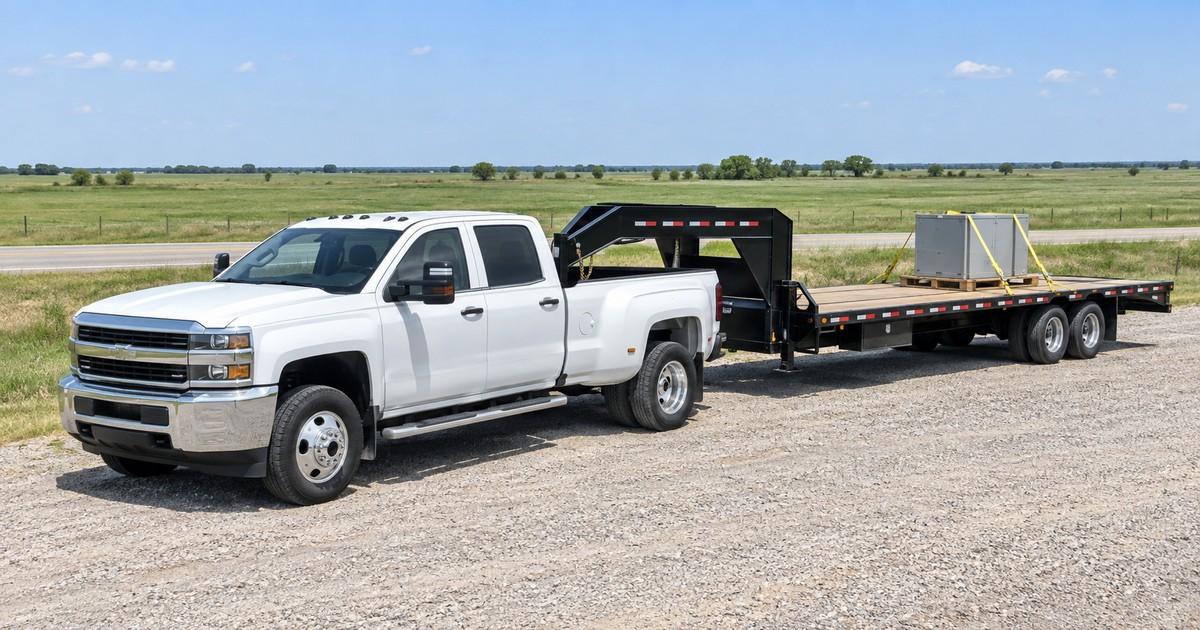
A pickup pulling a gooseneck trailer can be a commercial truck under federal law. After a hotshot freight crash, the truck and trailer weights, the shipment, and the carrier behind the trip matter more than whether the vehicle looks like an 18-wheeler. Those facts help identify the safety rules, licensing requirements, and financial responsibility obligations that applied. They do not, by themselves, prove who caused the crash.
This article is general legal information, not legal advice. Which rules applied to a particular rig depends on its weight ratings, cargo, route, and the crash date, and requires case-specific review.
What Hotshot Trucking Is — and Why the Label Does Not Matter
"Hotshot" is an industry nickname, not a legal category. It usually describes an owner-operator or very small carrier using a one-ton or medium-duty pickup and a 30- to 40-foot trailer to move time-sensitive loads: oilfield parts, farm and construction equipment, vehicles, building materials. Nothing in the federal rules turns on the nickname. The questions that decide which rules applied are concrete: what did the combination weigh and what was it rated to weigh, was the freight moving for hire, and was the trip in interstate or purely intrastate commerce?
Federal law answers the first question with numbers. Under 49 C.F.R. § 390.5T, a "commercial motor vehicle" includes any self-propelled or towed vehicle used on a highway in interstate commerce to transport property when the vehicle has a gross vehicle weight rating, gross combination weight rating, gross vehicle weight, or gross combination weight of 10,001 pounds or more — whichever of those is greater. A pickup rated at 10,000 pounds pulling a trailer rated at 14,000 pounds has a combination rating of at least 24,000 pounds. A higher applicable manufacturer label or actual weight can raise that figure, not lower it. For a property haul in interstate commerce, that combination clears the 10,001-pound weight threshold. Check the truck label, trailer rating plate, and available scale records; the pickup's rating alone does not answer the question.
For rigs that meet the definition, the Federal Motor Carrier Safety Regulations generally apply, including rules addressing driver qualification, inspection, maintenance, and hours of service. Exceptions and part-specific applicability provisions still matter; commercial-vehicle status does not mean every rule applies to every trip. Our overview of who can be sued after an Oklahoma truck wreck explains how those duties translate into liability theories; the point here is simpler. The defense cannot shrink the case to "two pickups collided" if the numbers put the rig inside the commercial system.
The CDL Line — and the Rigs Built to Sit Just Under It
The license question runs on a different threshold. For an ordinary property-hauling combination, read 49 C.F.R. § 383.5 with § 383.91. Ratings alone are not the whole test. Actual weights can also bring the combination into Group A. Passenger and hazardous-material operations have additional licensing triggers, and applicable exemptions must be checked.
A rig advertised as "non-CDL hotshot" still needs a weight and use review. Door-jamb labels, trailer labels, manufacturer data, and available scale records matter. A licensing violation does not automatically establish crash liability; the claim must connect the relevant conduct to the injury. Conversely, a driver who lawfully operates without a CDL may still have federal safety duties under the lower commercial-vehicle threshold.
Authority and Insurance: Where Hotshot Cases Are Won or Lost
A for-hire interstate property carrier generally needs federal operating authority, but there are exceptions. FMCSA identifies exempt-commodity carriers and certain commercial-zone operations among them. Under 49 C.F.R. § 392.9a, a carrier subject to the registration requirement cannot operate without or beyond its authority and is subject to an out-of-service order for violating that rule. An authority exemption is not a blanket exemption from safety or financial responsibility requirements.
For qualifying for-hire interstate carriers of nonhazardous property using vehicles rated at least 10,001 pounds, § 387.9 sets a $750,000 public-liability minimum. The July 21, 2026 technical amendment changed wording in the hazardous-materials row, not that amount. Financial responsibility can be satisfied through the authorized methods in § 387.7, including insurance, a surety bond, or approved self-insurance. Our trucking insurance and MCS-90 guide explains the distinction between those obligations and coverage for a particular crash.
After a crash, identify the carrier responsible for the trip and obtain the relevant policies and agreements. A driver may own the truck while hauling under another carrier's lease. Federal filings, the load documents, and the lease can help identify those relationships; a company name on the truck is only a starting point. Our first 72 hours after a truck crash guide explains early evidence preservation.
Open-deck loads also call for a securement investigation. Photographs of chains, straps, attachment points, and the load's position may help explain what happened. Our unsecured cargo and road debris guide covers that issue.
Oklahoma Wrinkles: Intrastate Hauls and the Companies Behind the Truck
A trip entirely within Oklahoma can still be part of an interstate shipment. The definition of interstate commerce in § 390.5T includes certain in-state legs of transportation originating or terminating outside the state. For genuinely intrastate operations, Oklahoma's adoption of federal rules and its variances need separate review. Our oilfield trucking guide discusses that state framework; an oilfield destination alone does not establish an exemption.
Oklahoma law also reaches the people and companies behind the driver. In Fox v. Mize, 2018 OK 75, the Oklahoma Supreme Court reviewed a certified interlocutory order in a fatal collision case involving a company tractor-trailer and held that negligent entrustment is a separate and distinct theory from respondeat superior — so an employer that admits its driver was on the job does not, by that stipulation, wipe out a claim that it entrusted its vehicle to an unfit driver. The court affirmed the trial court's refusal to dismiss the entrustment claim; the plaintiff's separately dismissed negligent hiring claim was not before the court, and the decision resolved the entrustment question only. In a hotshot case, that principle matters when the rig's owner handed the keys and the load to a driver with a record, a suspension, or a known substance problem — a theory explained more fully in our article on negligent entrustment in Oklahoma.
What This Means for Your Claim
If a hotshot rig hurt you or a family member, three things need attention early:
- Treat it as a trucking case from day one. The weight ratings, the operating authority status, the insurance filings, and the load paperwork all need to be identified and preserved before they scatter. A crash between a sedan and a pickup-and-gooseneck is presumptively worth a commercial-carrier investigation.
- Check coverage rather than assuming it. Obtain the policies and relevant endorsements before accepting either a personal-auto limit or a commercial limit as the answer.
- Preserve the evidence promptly. Trucks may be repaired or sold, and records may be overwritten. Request the relevant evidence without assuming it will remain available.
Our trucking accident practice page describes how we investigate commercial vehicle cases, including the small-carrier and owner-operator wrecks that never involve an 18-wheeler.
Frequently Asked Questions
Is a pickup pulling a gooseneck trailer legally a commercial truck?
It can be. Under 49 C.F.R. § 390.5T, the combination is a commercial motor vehicle if it is used on a highway in interstate commerce to haul property and its weight or weight rating — truck and trailer combined, whichever figure is greater — is 10,001 pounds or more. The truck and trailer labels and available weight records are the starting point, not the "hotshot" label. Purely intrastate hauls are judged under Oklahoma's parallel rules instead.
Do hotshot drivers need a CDL?
Not every hotshot driver needs one, but ratings alone do not answer the question. The ordinary-freight Group A test includes actual weights as well as ratings under § 383.5. Hazardous-material loads can trigger separate requirements. Check the vehicle, load, use, and any applicable exemption rather than relying on a "non-CDL" advertisement.
How much insurance does a hotshot operator have to carry?
A for-hire carrier hauling ordinary freight in interstate commerce in vehicles rated 10,001 pounds or more must maintain at least $750,000 in public liability financial responsibility under 49 C.F.R. § 387.9. Depending on the material, quantity, and type of operation, the schedule requires $1 million or $5 million for specified oil and hazardous-material loads. Whether the operator actually carried compliant coverage — and which policy responds for a leased-on or unauthorized trip — has to be verified through federal filings and the policies themselves.
What if the hotshot driver had no operating authority or no commercial insurance?
First determine whether authority and financial responsibility were required for that operation. If they were, noncompliance is a regulatory issue, not automatic proof of crash causation. Recovery still requires identifying a liable party and available coverage, which may include the driver, carrier, a legally responsible owner, or applicable uninsured or underinsured motorist coverage.
Can I sue the company that owned the truck if the driver was at fault?
Potentially. An employer may be liable for its driver's negligence within the scope of employment. A separate negligent entrustment claim requires proof that the person who supplied the vehicle knew or should have known the driver was likely to use it dangerously, and that negligent operation caused the injury. Under Fox v. Mize, 2018 OK 75, an employer's admission that the driver was acting within the scope of employment does not, by itself, bar that claim. The plaintiff still must prove its elements. Ownership alone does not establish liability; the vehicle's control, the driver's fitness, and the parties' relationships matter.
Talk to Someone Who Treats Small Rigs as Big Cases
Hotshot wrecks sit in a gap: too commercial for a car-accident playbook, too small for the defense to concede they are trucking cases. If a pickup-and-trailer rig hauling freight injured you or a family member in Oklahoma, contact us for a free, confidential consultation. This article is general information, not legal advice, and does not create an attorney-client relationship.
Hit by a Hotshot Rig?
A pickup-and-trailer crash may involve commercial safety duties and coverage that are not obvious at the scene. We can review the available facts and identify what needs to be investigated.
Talk to a Trucking Accident Lawyer